HOT NEWS !
Stay informed on the old and most recent significant or spectacular
nautical news and shipwreck discoveries

-
The mystery of Durban harbour
- On 19/10/2009
- In Wreck Diving
By Barbara Cole - IOL
Shipwreck sleuth Vanessa Maitland likes nothing better than a mystery, and getting to the bottom of something for her means real deep research.
Maitland is a maritime archaeologist and when the ocean finally looks like giving up some of its secrets, she is called in to don her diving suit and investigate.
The Agatha Christie of the deep might not have uncovered the stuff of boys' adventure novels like pirated gold coins, but what she finds is much more important, she said.
"The treasure is the information you get," she said.
Fathoming a mystery might take her years, but as she put it, "it is not the destination, but the voyage that counts".
Maitland was called in recently after a mystery shipwreck was detected during dredging operations to widen and deepen the entrance to Durban harbour, which will enable the bigger ships of the future to get into the port.
Read more... -
Treasures from a watery grave
- On 16/10/2009
- In Underwater Archeology
By Li Li - Beijing Review
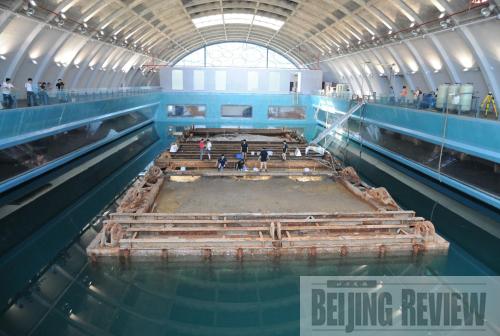
Archaeologists exploring a well-preserved shipwreck prove a forgotten marine trade route.The first probing of the ancient merchant vessel Nanhai No.1 after the wreck was put into a museum pool of simulated seawater successfully recovered porcelain and stone artifacts from its cabin on September 27.
Archaeologists said the more than 200 precious porcelain artifacts found on the 800-year-old ship were produced by some of China's best kilns operating at that time.
First discovered at the sea bottom 18 nautical miles off the coast in the South China Sea, known as Nanhai, in 1987, the 30-meter-long wrecked ship is believed by Chinese archaeologists to be one of the largest and best-preserved ancient vessels in the world.Archaeologists salvaged the wreck and its surrounding silt with an iron container and hoisted it from its watery grave in December 2007.
The container was dragged ashore to a museum that was built specifically to exhibit the ship in the coastal city of Yangjiang.The find was put into a pool that allows scientists to control the water temperature, pressure and other conditions to replicate the sea floor upon which the ship rested for centuries.
The creative salvage operation attracted enormous media coverage and was praised as a significant archaeological expedition for China.
-
World's oldest submerged town dates back 5,000 years
- On 16/10/2009
- In Underwater Archeology

From Science Daily
Archaeologists surveying the world's oldest submerged town have found ceramics dating back to the Final Neolithic. Their discovery suggests that Pavlopetri, off the southern Laconia coast of Greece, was occupied some 5,000 years ago — at least 1,200 years earlier than originally thought.These remarkable findings have been made public by the Greek government after the start of a five year collaborative project involving the Ephorate of Underwater Antiquities of the Hellenic Ministry of Culture and The University of Nottingham.
As a Mycenaean town the site offers potential new insights into the workings of Mycenaean society. Pavlopetri has added importance as it was a maritime settlement from which the inhabitants coordinated local and long distance trade.
The Pavlopetri Underwater Archaeology Project aims to establish exactly when the site was occupied, what it was used for and through a systematic study of the geomorphology of the area, how the town became submerged. -
Murky waters and a creaky law
- On 13/10/2009
- In Treasure Hunting / Recoveries
By Beverley Ware - The Chronicle Herald
A large rock juts out of the dark, choppy waters off Prospect.
Inscribed on it is the date Nov. 24, 1814, and the name Fantome, the British warship that hit a rocky reef and sank there.
This spot, about 30 kilometres southwest of Halifax, has become the flash point for a turf war that reaches to the depths of the ocean floor.
The crew of the 18-gun naval brig survived, and for nearly 200 years, so has the mystique about what the sloop may have been carrying.
Because of that, archaeologists and the treasure hunters who hire them to document Nova Scotia’s marine heritage are at loggerheads over how wrecks like the Fantome should be treated.
Nova Scotia is the only province to allow treasure hunting. Critics say the Treasure Trove Act should be abolished. -
Bad weather hampers billion dollar recovery
- On 13/10/2009
- In World War Wrecks
From PR Web
Sub Sea Research has been over the shipwreck several times only to be driven off by heavy seas. Captain Greg Brooks stated "This has been the worst offshore weather in decades, but we will keep at it until we recover all the treasure aboard."The German U-Boat U.87 fired 2 torpedoes at the freighter "Port Nicholson". Both torpedoes hit the ship and several hours later she sank. What is remarkable about this ship is that she carried a secret cargo of bullion headed from Europe to the U.S.
That cargo is 71 tons of platinum. At the time of sinking, it was un-salvageable because of depth restrictions, and the fact officials placed her sinking in the wrong spot.
She was not to be found until Sub Sea Research began the hunt in 2007. The company filed a federal claim on the site as soon as the wreck was located.
Utilizing their 220' salvage ship "M/V Sea Hunter", operations for recovery began in July. The companies two ships left Portland Maine and headed to the wreck site offshore Cape Cod Ma.
-
The Mary Rose's artefacts give us a unique insight into Tudor life
- On 12/10/2009
- In Museum News

By Dr Eric Kentley - Times Online
Launched as the flagship of a young and ambitious king, the Mary Rose was not only a reflection of Henry VIII’s ambitions, she was also a new breed of warship.She was one of England’s first ships to be built with gunports: part of the first generation of broadside-firing warships that heralded the beginnings of a 300-year period of warship design.
But the Mary Rose is important not only to maritime historians. It is also what she took with her to the bottom of the Solent in 1545 that gives her a special significance.These were the possessions and tools of 500 men from all levels of society. The 19,000 artefacts that have been recovered range from gunners’ linstocks to gambling dice, from a bosun’s call to a rosary.
There is no comparable collection of Tudor artifacts anywhere: no other archaeological site has given us so many insights into Tudor life.No other shipwreck, no other structure and no other collection gives such a clear window into the 16th century. It is no exaggeration to describe the Mary Rose as England’s Pompeii.
Her loss at a precise moment gives us a chronological reference point for all the artefacts that went down with her. This is almost unique for a museum collection.Specialists from many fields consistently remark how the Mary Rose artifacts they have studied represent the earliest known examples of their type or provide unique information for the study of human society.
-
Shipwrecked army plaque returned
- On 10/10/2009
- In World War Wrecks

From BBC News
A plaque commemorating the deaths of Nottinghamshire soldiers has been returned to their regiment after it was recovered from a 97-year-old shipwreck.
The brass memorial was aboard the SS Oceana bound for Bombay when it sank off the Sussex coast in 1912.
It was found by diver Jamie Smith, who handed it back to the 2nd Battalion the Mercian Regiment at a special ceremony.
The plaque names soldiers who died serving in India from 1819 to 1838. It will be displayed at Nottingham castle. Most of the regiment of 800 men, as well as many of their family members, died during the posting due to illness.
Major Oliver Hackett said: "It's a very strong link to the past, which reminds us of the hardships our predecessors and their families had to undergo in an overseas posting."
Mr Smith, of Tunbridge Wells in Kent, who uncovered the plaque in August, said: "When you go diving you go into history and when you find something as significant as this you realize it has to be done." -
Saving the wrecks of the Channel
- On 09/10/2009
- In Underwater Archeology

By Dalya Alberge - Wall Street Journal
Marine archaeologists have discovered a 17th-century shipwreck in recent months with a cargo that includes the world's earliest pocket calculator -- a wooden carpenter's rule -- while exploring the seabed of the English Channel.It offers a tantalizing taster of treasures that may lie within nearly 270 wrecks that have been identified, but whose survival is under serious threat from 21st-century trawlers working the busy channel between the Continent and Britain.
Some historic vessels that fell victim to the sea or cannon fire centuries ago could disappear within five years, according to a leading British marine archaeologist, Sean Kingsley, who is an adviser on the most extensive archaeological deep-sea survey of the Channel ever undertaken."Incalculable wreck destruction has already occurred," says Dr. Kingsley, who heads Wreck Watch International, a specialist consultancy. "Sites of major archaeological significance have been or are being completely destroyed.
Without a swift resolution, future generations may judge us as having signed the death warrant for some of the world's most important archaeological sites."