HOT NEWS !
Stay informed on the old and most recent significant or spectacular
nautical news and shipwreck discoveries

-
Wreck of the Atocha in the Caribbean
- On 23/10/2009
- In Treasure Hunting / Recoveries

By Scott Jones - Scuba Diving Examiner
A very rare, delicate, gold amethyst ring was recovered on the famed shipwreck site of the Nuestra Senora de Atocha by scuba divers in the Caribbean it was announced yesterday.
In the year 1622, 35 miles off the coast of Key West, Florida the Spanish Galleon Nuestra Senora de Atocha sank in a violent hurricane en route from Havana, Cuba back to Spain.Famed underwater treasure hunter Mel Fisher first began searching for this wreck years ago. Today, Fisher’s family and crew continue the search he began for the rear section of the ship, which has been dubbed the Sterncastle. This portion of the ship is known to have held the wealthiest of passengers and thus some of the most precious artifacts and jewelry.
The Fisher’s most recent find, announced yesterday, is a rare gold ring bearing a deep purple amethyst stone. It was found by the seasoned crew of the salvage vessel J.B. Magruder, Captained by Andy Matroci.
It is a rare one-of-a-kind artifact that Kim Fisher describes: "It is a plain gold band with a large box-shaped gold setting on the top with an amethyst inside. The amethyst is so dark it is almost black. It probably would have come from a large crystal in order to be that dark. We have found several other rings with similar characteristics without stones in them, or with emeralds, but this is the first ring with an amethyst found on the Atocha site." -
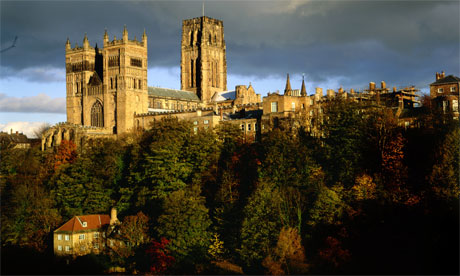
Durham cathedral divers discover gold and silver treasure trove in riverbed
- On 23/10/2009
- In Treasure Hunting / Recoveries
By Maev Kennedy - Guardian
After almost 30 years, the riverbed below Durham Cathedral has given up a bewildering secret: a hoard of ecclesiastical gold and silver, including medals, goblets, and crucifixes once owned by the Queen, the pope and other state and church leaders.
A total of 32 objects given as gifts to the late Michael Ramsey – a former archbishop of Canterbury who was bishop of Durham for four years in the 1950s and spent some of his retirement in the city – have been recovered from deep in the bed of the river Wear by two amateur divers, brothers Gary and Trevor Bankhead.
Their finds include gold, silver and bronze medals struck to commemorate the second Vatican council, which must have been presented when Ramsey – archbishop of Canterbury from 1961 to 1974 – met Pope Paul VI at the Vatican in 1966.
The Bankhead brothers, who made some 200 dives over two years under license from the cathedral, also discovered a solid gold Japanese medal probably presented when Ramsey met Nikkyo Niwano, president of the Japanese Buddhist movement, in 1973. -
Rare piece of history displayed
- On 23/10/2009
- In Expeditions
By Josh Humphries - The Daily Reflector
An anchor believed to be from Blackbeard's flagship, the Queen Anne's Revenge, was taken from the water by researchers with the QAR Project, a state-funded research expedition that will eventually bring up 700,000 individual artifacts.
The anchor was displayed at the QAR Conservation Lab on the East Carolina University West Research Campus on Thursday afternoon.
Historians say that the infamous pirate and his ship ran aground in 1718 in Beaufort Inlet. The wreckage, which was first found in 1996, is located about a mile from Fort Macon in 25 feet of water.
As more artifacts are recovered researchers are more and more confident that the wreckage is what remains of Blackbeard's ship.
“This is the oldest shipwreck we have worked on in North Carolina,” Mark Wilde-Ramsing, QAR project manager, said. “It is associated with Blackbeard and every artifact is important for understanding what was going on at the time.” -
Underwater archaeology exhibition opens at Shihsanhang museum
- On 23/10/2009
- In Museum News
From Taiwan News
An exhibition that promises to offer a fascinating insight into the world of underwater archaeology and the history of ancient maritime links between Taiwan and China is being held at the Shihsanhang Museum of Archaeology in Bali, Taipei County until Dec. 13.
Under the theme Diving into History, the exhibition is composed of six divisions that feature a wide range of biological fossils from the Taiwan Strait that date back 40,000 years, an array of underwater cultural and historic assets, and a virtual underwater archaeological site, according to Lee Li-fang, a Council for Cultural Affairs (CCA) official who is one of the organizers of the exhibition.
Other highlights include 20 artifacts retrieved from a sunken Chinese Qianlong period (1736-1796) vessel that was named General No.
1 after Penghu's General Islet where it was discovered by fishermen in 1994, Lee said.
According to unofficial statistics based on sunken ship records, there are an estimated 500 sunken vessels in the Taiwan Strait, said Ho Chuan-kun, director of the Department of Anthropology at the National Museum of Natural Science in Taichung City, who is another exhibition organizer. -
A sense of injustice lasting 130 years
- On 22/10/2009
- In General Maritime History
By Les Leyne - Times Colonist
George Abbott made his legislature debut as minister of aboriginal relations and reconciliation this week, and one of the first orders of business is a request for an apology.
There's lots to be sorry about in his new job, given how the last two centuries of history have left the original inhabitants of B.C.
And there's one specific incident that has slowly become an issue.Some native people on the west coast of Vancouver Island want the present-day government to atone in some fashion for what now appears to have been an atrocity 130 years ago.
The story, very briefly, is that after a shipwreck, word made its way to Victoria that survivors had been massacred by the Indians.
A gunboat was sent up the coast to investigate.
It shelled a native village and nabbed two suspects, Katkinna and John Anietsachist.They were tried and found guilty in Victoria, then taken back home, baptized en route, and hanged.
-
Expert to unfurl the majestic tale of the Titanic
- On 22/10/2009
- In Famous Wrecks
By Helen Jardine - BDA Sun
More than two decades ago he was collecting jewellery from the deck of the RMS Titanic, two and a half miles beneath the ocean's surface.
Last week he was discussing climate change and space travel with Buzz Aldrin - the second man ever to walk on the moon.
This week ocean explorer, doctor and author Joe MacInnis is in Bermuda to give a talk on the exploration and salvage of one of the world's most famous shipwrecks.
"Titanic is one of those wonderful, extraordinary, majestic stories that everybody can project themselves into," Dr. MacInnis said. "People wonder where they could be on that ship and ask themselves, 'what would I have done on that night?'"
Dr. MacInnis went on his first dive of the Titanic in 1987, when he says he had an "extraordinary experience".
He explained: "I was with the French team and we were at the bottom of the ocean looking into the sediment and the pilot stopped the submarine and said, 'What's that?'
"It was a small bronze statue of a woman with an uplifted arm, about three feet long. And we recognized it right away because it was such an iconic image - it was the statue that stood at the bottom of the grand staircase. -
Mary Celeste discovery hints to a shady past
- On 22/10/2009
- In Famous Wrecks

By James Whittaker - BDA Sun
A bottle of wine, discovered by scuba divers in the wake of Hurricane Bill, could help piece together an untold subplot of one of Bermuda's most storied shipwrecks.
The corked bottle, dated 1853, was found amid the wreckage of the Mary Celeste - a steam-powered blockade runner used to transport guns to British forces during the American Civil War. And experts believe it could hint at the ship's role in a trans-Atlantic black market wine trade.
The ship went down off the South Shore in 1864 claiming the life of the cook, who is rumored to have scrambled below decks in a futile bid to retrieve his wages.
The latest discovery, made by curator of wrecks Phillipe Rouja, hints at another role for the fated paddle wheel steamer.
"It's not worth that much in itself, but what it tells us about the story is more pleasing," said Mr Rouja.
"The wine had to have come from France, so while they were running guns it seems as though they were also running bottles of wine.
"Somewhere there was probably a buyer for this. It speaks to a black market trade."
The discovery was made in the immediate aftermath of Hurricane Bill. The storm churned up the seabed around the wreck, exposing parts of the ship that had been buried under sand for years.
"You usually cannot see the stern at all but this time it was completely exposed, right down to the keel."
After making the find Mr Rouja immediately closed off the wreck to recreational divers. It is relatively unusual to discover new artifacts on Bermuda's shipwrecks, which have been heavily salvaged over the years, and he was keen to preserve the site.
He had planned further archaeological dives in a bid to retrieve pieces of the crate and confirm his theory that the wine bottle was part of a larger order destined for sale in the South. -
In-depth exploration of Titanic at next historical society talk
- On 21/10/2009
- In Museum News
By Jackie Hanusey - Shore News Today
Tom Maddox of Estell Manor, the owner of East Coast Diving in Northfield, will share his experience of being one of the last divers to see the Titanic during a Greate Egg Harbour Historical Society presentation 6:30 p.m. Thursday, Oct. 22 at the Egg Harbor Township Community Center.
In was in 2005 that Maddox went with a crew filming the special “Titanic's Final Moments: Missing Pieces” for The History Channel.
The opportunity of a lifetime to see the legendary shipwreck on the bottom of the ocean came by way of a diving student from 20 years ago, David Concannon, who went on to become a lawyer for James Cameron, producer and director for the film “Titanic.”
Fewer than 120 people have seen Titanic since it was found in 1985 about 2½ miles down on the Atlantic Ocean floor.
“It’s kind of like outer space,” he said. ‘Very few people can say they have gone there.” After they arrived on the wreck site, it took some time to get to their ultimate destination.
It takes 2½ hours to descend to the bottom where they can explore for seven hours before another two-hour journey back to the surface. Only three submersibles can stand the pressure at the depths of Titanic, and its close quarters. “Three people are in a 6-foot sphere for over 12 hours,” Maddox said about the experience.
He said a lot goes through your mind on such a trip. “You think about how you pass the point of no return,” he said, noting that after a certain point if one thing goes wrong with the sub, you would be crushed to death in moments.
There are also emotions one feels. “Even on the ship over top of her, there is also an eerie feeling that some type of hell happened there one night,” he said. “You can feel the screams and the panic.”
Maddox’s role during the expedition was to videotape the bow of the ship. “When you are down there you see first hand life jackets, ones that people either didn’t get on or someone was in it,” he said.
You also see the divides of the various classes still down there in the ruins. “The biggest remainders in the debris field are toilets, cups and saucers,” he said, noting that porcelain does not wither away in the water.
You also see the remainders of third class, as he saw chamber pots or bedpans, which passengers would have used on the bottom of the ocean.
While a man in scuba gear can only safely dive about 130 feet, Maddox said he still felt the urge to “crawl out the window” at times, wishing he could touch and feel what was going on outside. Beyond knowing the ship was the reason for going to sea, Titanic’s influences are everywhere when on the expedition, right down to the emergency drill you have to do first.
Read more...