HOT NEWS !
Stay informed on the old and most recent significant or spectacular
nautical news and shipwreck discoveries

-
Galle: A treasure trove of wrecked ships
- On 18/01/2010
- In People or Company of Interest
By Gamini Mahadura - The Sunday Times
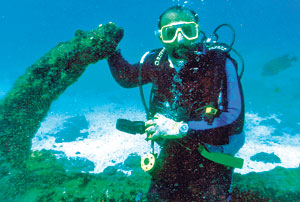
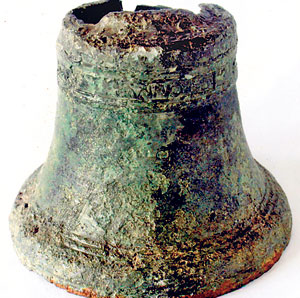
Galle port with its splendid natural harbour was an important port in days of yore being reputed as a trade centre due to its location just 12 miles away from international sea routes.Many sunken ships have been found here according to the UNESCO Pacific Zone’s marine archaeological centre in Galle Fort.
There are as many as 26 places that need to be surveyed here which have a history dating back a hundred years.Along the coast in the Galle and Ambalangoda areas more than 100 wrecks of ships are reported have been found already. According to divers it is a new world which is the happy breeding grounds for fish.
R K Somadasa de Silva of Hikkaduwa, a diver of repute had this to say on these findings.“I have over 30 years experience as a diver having dived in seas off Germany and England. I have more than 5000 hours of diving experience and I run an international diving school at the Coral Sands Hotel in Hikkaduwa.
Some shipwrecks in the Galle area are over 500 years old and full of archaeological value.
Some organized groups use dynamite to get at treasures in ships sunk between Galle and Ambalangoda.” Some steps have to be taken by marine archaeologists to save these treasures from vandals, he said.
-
Treasure found off La Manga
- On 16/01/2010
- In Underwater Archeology

By Sally Bengtsson - Le@der
Buried beneath shells, rocks and sand, for 2,600 years, while the construction boom has been completely changing the surrounding landscape, a treasure of incalculable value has lain just off La Manga.
Now, 26 centuries later, archaeologists from eleven countries are bringing these antique objects to the light of day once again.The find appears to be the cargo of a commercial ship carrying ivory from African elephants, amber and lots of ceramic objects.
The find has been kept secret for the past three years by the team of divers led by the Spaniard Juan Pinedo Reyes and the American Mark Edward Polzer.The recovery project is being financed by National Geographic, who have reached an agreement with the Spanish Minister of Culture, the Institute of Nautical Archaeology and the University A&M of Texas.
The recovery is taking place around Grosa Island and El Farallon Island, just off La Manga. Over the last three years 1,400 objects have been collected.Even some of the wood from the bottom of the ship has survived since the 7th Century before Christ (620 BC), and has been recovered. It is believed the vessel measured approximately 15 meters long.
-
Bugatti car that spent 70 years under water could fetch # 80k at auction!
- On 14/01/2010
- In Miscellaneous
From Sify News
A rare Bugatti that lay at the bottom of a lake for 73 years is set to fetch over 80,000 pounds at auction-the price of a brand new luxury motor.
The legendary car was dumped in the water in 1936 by a frustrated Swiss official because the owner had abandoned it without paying the import tax. The value of the car was less than the money owed and the customs officer was compelled to destroy it.
Thus, he drove it over the Italian border to nearby Lake Maggiore - and pushed it into the deep waters. The story became part of folklore in the nearby town of Ascona as locals debated whether the car actually existed.
After 30 years, the truth emerged after a keen diver rediscovered the Bugatti lying on its side 160 feet down at the bottom of the lake. Since then, members of the local diving club regularly visited it and last year decided to raise it and sell it for a local charity.
Surprisingly, there was still air in the tyres and traces of the original Bugatti blue paint on the bodywork. It is believed that 20 per cent of the vehicle is salvageable and collectors and museums are likely to be keen to buy it. -
Courts curb bounty hunters seeking torpedoed liner's £15m bullion
- On 13/01/2010
- In Treasure Hunting / Recoveries
By John Hooper - Guardian
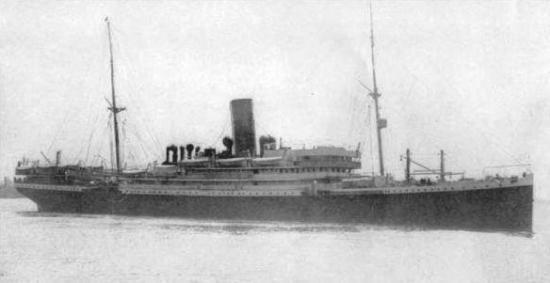
The Italian government has stepped in to the hunt for €17m (£15m) worth of sunken treasure, spilled from the Italian liner Ancona, which a US firm is hoping to recover from the bed of the Mediterranean between Sicily and Sardinia.
The Ancona was carrying gold and silver when it sank on 7 November 1915 after being torpedoed by a German U-boat flying an Austro-Hungarian flag. Of 760 people on board, more than 200 perished when the giant transatlantic vessel went down.
A foreign ministry spokesman said tonight that lawyers in America had taken action in the US courts that meant neither the salvagers nor the government could take any initiative without first giving 45 days' notice to the other party.
A spokeswoman for Odyssey Marine Exploration, the Florida-based firm searching for the treasure, said it had filed a joint motion with the Italian government "preserving the administratively closed status of the case". She added: "There is no dispute between Odyssey and the Italian government."
The manifest of the first world war ship recorded its 12 trunks of gold, and shipment of silver bars. The bullion, entrusted to a civil servant, was thought to be intended for purchasing arms for Italy.Some Italian officials regard the vessel as now untouchable. Sebastiano Tusa, head of the government's marine heritage department on Sicily, told La Stampa: "It is a war cemetery that cannot be defiled by a company looking to make money.
The only acceptable project might be a non-profit-making one for scientific and historical research, with the agreement of all the nations involved in the disaster."
-
US$30 million treasure buried under sand off Chile's coast
- On 13/01/2010
- In Treasure Hunting / Recoveries
By Laura Burgoine - The Santiago Times
A shipwrecked vessel containing an estimated US$30 million of treasure may soon be resurfaced in Chile after more than two centuries in Davy Jones’ locker.
The National Monuments Council (NMC) is currently negotiating with private company Oriflama SA over the ownership rights of Spanish galleon “Our Lady of the good council and San Leopoldo,” which has been located under the sands of Playa La Trinchera in Curepto (Region VII).
Oriflama SA and local museums have been working towards recovering the ship and its treasure since 2001. But under the National Monuments Act No. 17,288, the remains of the Galleon are state property.
NMC executive secretary Oscar Acuna said the NMC is willing to award Oriflama SA 25 percent of the value of the treasure for their work, but that ultimately the galleon belongs to the state.
The ship’s treasure, which is believed to include gold coins, fine glassware, guns of war, furniture, and clothing decorated with gold and various jewels, cannot be officially valued until the ship’s remains are recovered from under the sand.
The project has already cost Oriflama SA US$1million, and by the time the resurfacing of the vessel is complete, costs are estimated at another US$15 million.
Oriflama SA CEO Hernan Couyoudijan said the company’s goal is to create a museum after completing the project. “We want to make a museum out of it.This would not only preserve some of history but potentially boost tourism in Curepto” he said.
-
Ship sails to tell of ancient trade
- On 12/01/2010
- In Maritime News
By Nadim Kawach - Emirates Business
More than 15 Omani sailors will set sail from the port of Muscat next month, heading for Singapore aboard a wooden vessel modelled on the famous Tang Treasure ship that sank in the Indian Ocean while laden with gold and other precious items belonging to the old Chinese Tang dynasty.
The 18-metre long Jewel of Muscat, a reconstructed ninth century sewn-plank ship, has started sailing in the Sea of Oman on the first sea trial ahead of its formal voyage to Singapore towards the end of February.
The wind-powered vessel is scheduled to start its journey across the Indian Ocean with transit stops along the western coast of India and other south Asian countries.It will keep to ancient trade routes and stop in India, Sri Lanka and Malaysia before arriving in Singapore five months later, where it will be given as a gift from Oman to the people of Singapore.
"Singapore is one of Oman's oldest trading partners. Jewel of Muscat will be displayed in Singapore to highlight the awareness of the old trade routes between the two countries," Badr bin Hamoud Al Busaeedi, Director-General of the Omani Foreign Ministry, said at a launch ceremony this week.
-
Shipworm threatens archaeological treasures
- On 12/01/2010
- In Marine Sciences

From Physorg
The dreaded shipworm is moving into the Baltic Sea, threatening artefacts of the area's cultural heritage.Researchers at the University of Gothenburg, Sweden, suspect that the unfortunate spread is due to climate change, and are currently involved in an EU project to determine which archaeological remains are at risk.
The shipworm is capable of completely destroying large maritime archaeological finds in only 10 years, and while it has avoided the Baltic Sea in the past, since it does not do well in low salinity water, it can now be spotted along both the Danish and German Baltic Sea coasts.
The shipworm has for example attacked shipwrecks from the 1300s off the coast of Germany, and we are also starting to see its presence along the Swedish coast, for example at the Ribersborg cold bath house in Malmö,' says Christin Appelqvist, doctoral student at the Department of Marine Ecology, University of Gothenburg.
Appelqvist and her colleagues believe that the development may be due to climate change. In short, the increased water temperature may help the shipworms to become adapted to lower salinity.The group is part of the EU project WreckProtect, a cooperative effort to assess which archaeological treasures are at risk. The project includes researchers from Sweden, Denmark and the Netherlands, as well as experts from France and Germany.
-
Memorial plaque placed on Centaur
- On 11/01/2010
- In World War Wrecks
By Andrew fraser From -The Australian
A brass memorial plate was placed on the AHS Centaur early today, despite the ship being classified as a war grave, after a special permit was granted in record time to override the Historic Shipwrecks Act.
The state of the ocean floor has led to some problems with laying a memorial to the hospital ship, which has been two kilometres beneath the waves for more than 66 years after being torpedoed by a Japanese submarine during World War II.
The brass plate was blessed at a service in Sydney three weeks ago attended by members of the Centaur Association, and originally the intent was to place the plate on the ocean floor beside the wreck.
But when ship hunter David Mearns, who located the Centaur earlier this month, lowered an identical plate to the ocean floor it promptly sank into the mud.
On Sunday night the Queensland government urgently contacted its federal counterpart to see if the plate could be placed on the ship itself.