HOT NEWS !
Stay informed on the old and most recent significant or spectacular
nautical news and shipwreck discoveries

-
Artefacts from wreck sold off
- On 24/02/2012
- In Auction News
From This Is Cornwall
The original lifebelt from the shipwreck of the Flying Enterprise and the captain's life jacket have been sold at auction.The Second World War American Liberty ship was wrecked in late December, 1951, 42 miles off Falmouth.
It remained afloat, although listing heavily, until January 10, 1952.
It made headlines at the time when skipper Kurt Carlsen remained on board in a dramatic attempt to save the ship and tow it to safety.
It was 500 miles off Fastnet Rock when a 30ft wave cracked the hull and knocked out the engines.
A total of 40 crew and ten passengers jumped to safety and were picked up by SS Southland.
Ken Darcy, mate of the tugboat Turmoil, jumped to the deck to attach a tow line and both men remained with the vessel for the 15 days of towing until it sunk, less than 50 miles from the safety of Falmouth. -
Peru: Spain stole it first
- On 24/02/2012
- In Illegal Recoveries
By Lloyd Sowers - My Fox Houston
There is yet another twist in the international battle over a treasure trove of gold coins and other artifacts found by a Tampa company.
The country of Peru is asking the U.S. Supreme Court to stop the imminent transfer of the half-billion dollar treasure from the U.S. to Spain.
The gold and silver coins were discovered by Tampa-based Odyssey Marine Explorations in 2007.
At the time, the find was estimated to be worth around $500 million to collectors, which would have made it the richest shipwreck in history.
Since then, Odyssey has been in a legal battle with Spain over who gets to keep the coins.
The U.S. Supreme Court denied a motion by Tampa's Odyssey Marine Exploration to stop the transfer, so Odyssey officials agreed to give the Spanish government access, and said the company would not oppose the efforts.
Now, Peru is saying that silver and gold was essentially stolen by the Spanish from the people of Peru centuries ago.
Peru is asking the U.S. Supreme Court not to allow Spain to take possession of the treasure. -
What's the total value of the world's sunken treasure ?
- On 23/02/2012
- In General Maritime History

By Rob Goodier - Popular Mechanics
Three historic shipwrecks have been in the spotlight recently, with cargoes of platinum ingots, gold, and silver estimated at $4.5 billion in total. These huge hauls made us wonder: Just how much money is buried at sea ?When the last responders leave the sunken cruise liner Costa Concordia, the wreck's status may shift from grave site to treasure trove.
Its passengers and interior decorators reportedly left behind a wealth of cash, jewels, antiques, and thousands of pieces of art. Souvenir hunters, looters, and even the mafia may have plans to dive the wreck for a piece of that fortune.
It's been a busy month for shipwreck headlines and shipwreck hunters. The team that announced the discovery of the Port Nicholson, a World War II–era British merchant ship found 50 miles off the coast of Maine, says it bore 71 tons of platinum ingots worth about $3 billion.
Other shipwreck hunters turned up the HMS Victory, which sank in the English Channel in 1744 with a "secret" cargo of gold valued at $1 billion.
And, in an episode that shows the high stakes of shipwreck salvaging, Spain is currently recovering the estimated $500 million haul of gold and silver from the Spanish galleon Nuestra Señora de las Mercedes that sank in 1804; an American company found the ship but lost court cases to Spain over the rights to the treasure.
All this undersea treasure hunting got us wondering: Just how much money is out there buried at sea? We put the question to marine archeologists, a historian, and a shipwreck hunter. Their answers ranged from "Who knows ?" to "$60 billion"—and each was instructive.
An estimate of the value of sunken treasure in the world begins with a guess at the number of sunken ships. James Delgado, director of the Maritime Heritage Program at the National Oceanic and Atmospheric Administration (NOAA), estimates that there are a million shipwrecks underwater now."Given everything that's charted and all the rest, I would say that the majority of them remain undiscovered," Delgado says. After all, 70 percent of the planet's surface is water, and humans have only begun to be able to reach the depths. "[Considering] this, 95 percent of the ocean still remains unknown to us.
It's the last frontier," Delgado says. "We know more about the surface of the moon than what's at the bottom of the sea."
Maritime historian Amy Mitchell-Cook at the University of West Florida says she doesn't think it's possible to make an estimate. "Even in Pensacola Bay, where I am, I don't think we have an accurate number of shipwrecks," she says.
"There were Spanish, French, English, and Americans all in the area, as well as international trade. We know a lot of ships sank, but we don't have a complete set of records." -
España comienza la revisión del inventario del tesoro de "La Mercedes"
- On 22/02/2012
- In Illegal Recoveries
KBNT News
Los técnicos españoles comenzaron hoy en Sarasota, costa oeste de Florida, las labores de revisión y preparación de las cerca de 595.000 monedas que forman el tesoro de la fragata "Nuestra Señora de las Mercedes", antes de su envío a España hacia finales de semana.
"Se trata de un trabajo complejo y muy minucioso que tenemos que intentar acabar en tres días", explicó hoy a Efe una portavoz del ministerio español de Educación, Cultura y Deportes desplazada a Sarasota junto al equipo de técnicos españoles.
Por ello, a primera hora de la mañana una delegación española acudió a la sede de Numismatic Guaranty Corporation (NGC), la empresa encargada de custodiar el tesoro rescatado de las profundidades del mar en 2007 por la empresa estadounidense de exploraciones submarinas Odyssey frente a las costas de Portugal.
Esa delegación estaba integrada, entre otros, por el abogado que ha llevado todo el caso judicial frente a Odyssey, James Goold, y por el agregado cultural de la embajada de España ante Estados Unidos, Guillermo Corral.
En esa reunión se estudiaron los detalles de cómo enfocar el trabajo de inventario, según explicó a Efe la citada portavoz, que insistió en que por el momento no se puede hacer público el lugar en que está almacenado el tesoro, aunque todo apunta a que podría ser la propia sede de NGC.
El inmueble, en las afueras de Sarasota, cuenta con amplias medidas de seguridad y allí fue donde acudió la delegación este martes por la mañana.
Unas horas después, los seis técnicos desplazados desde España, especialistas del Museo Nacional de Arqueología y del de Arqueología Subacuática de Cartagena, y representantes de la Subdirección General de Protección del Patrimonio Histórico, se dirigieron hacia el lugar donde está el tesoro para iniciar sus trabajos.
-
Odyssey expolió 16 cañones de bronce en 2006
- On 22/02/2012
- In Illegal Recoveries
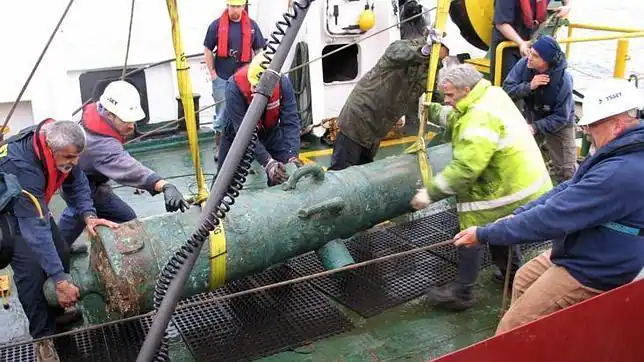
Jesús García Calerocaleroje - ABC.es
Los interrogatorios de la Guardia Civil abren la puerta a nuevos expolios que se investigan en el Juzgado número 3 de La Línea.
La posibilidad siempre estuvo ahí: la hipótesis de que los cazatesoros hayan expoliado más pecios durante sus largas estancias en Gibraltar.
Los barcos de Odyssey Marine Exploration estuvieron durante al menos seis años operando en aguas del Estrecho.
Patrocinados por el Gobierno británico, que presionaba diplomáticamente para conseguir permisos, aseguraron una y otra vez a nuestras autoridades que buscaban el buque inglés «HMS Sussex». Pero después del expolio en secreto de 590.000 monedas en mayo de 2007 saltaron todas las alarmas. ¿Qué habían estado haciendo tanto tiempo en nuestras costas, si en un mes reventaron un pecio y trasladaron a Tampa 17 toneladas de monedas ?
Mientras acaba de ejecutarse la sentencia de la justicia de EE.UU. que ordena el retorno de las monedas a España, ABC ha tenido acceso a un informe de la Guardia Civil que demostraría que todas las sospechas dieron en el blanco.
Según varios testimonios de personas con contactos en Odyssey, antes de la "Mercedes" expoliaron varios pecios y tal vez en aguas españolas. Son testimonios, pero, como mínimo, la justicia española deberá seguir investigando.
En uno de ellos, mantenido ante miembros de la Brigada de Patrimonio de la Unidad Central Operativa de la Guardia Civil, el declarante relató que pudo observar en diversas ocasiones pruebas e indicios de daños al patrimonio por parte de las naves de Odyssey en aguas españolas.
En concreto, da testimonio de que varios meses antes del ya célebre expolio que tuvo lugar en mayo de 2007, extrajeron algunos objetos preciosos (metálicos) a unos 25 kilómetros del Peñón de Gibraltar, en dirección a Estepona. No son, desde luego, aguas internacionales.
Las declaraciones ante la Guardia Civil son pródigas en detalles pero, lo intresante es la información que aporta en su quinto punto de una de ellas, donde relata algo que hasta ahora no sabíamos: que «han extraído de la zona del Mediterráneo, siempre en aguas españolas, cerámica de dos pecios, uno fenicio y otro púnico». -
Four unknown shipwrecks found
- On 22/02/2012
- In Underwater Archeology
From Athens News
Four previously unknown shipwrecks have been discovered some 30 kilometers off the Bay of Irakleio, Crete, in recent underwater exploration conducted by the ephorate of underwater antiquities.
The new finds comprise two Roman era shipwrecks, one containing 1st and 2nd-century Cretan amphorae and the other containing 5th-7th century post-Roman era amphorae, and two shipwrecks containing Byzantine amphorae, dated from the 8th-9th century and later.
The finds, which were made south and east of the Dia islet, which lies 7 nautical miles north of Irakleio, were documented and taken ashore for further analysis.
Three more recent shipwrecks were also discovered, as well as four other areas with archaeological material of various eras and origin which, due to their immense research interest, will be further explored in 2012 by the ephorate.
The exploration was conducted to locate and record underwater antiquities in the wider area of the bay of Irakleio, as well as the Gulf of Yera of Lesvos island and the island of Tilos.
-
Spain sending military planes to retrieve treasure
- On 21/02/2012
- In Illegal Recoveries
From US News
Spain said Monday it will soon send hulking military transport planes to Florida to retrieve 17 tons of treasure that U.S. undersea explorers found but ultimately lost in American courts, a find experts have speculated could be the richest shipwreck treasure in history.
The Civil Guard said agents would leave within hours to take possession of the booty, worth an estimated euro380 million ($504 million), and two Spanish Hercules transport planes will bring it back. But it was not exactly clear when — Monday or Tuesday — the planes and the agents would leave Spain.
Last week, a federal judge ordered Tampa-based Odyssey Marine Exploration to give Spanish officials access to the silver coins and other artifacts beginning Tuesday.
Odyssey found them in a Spanish galleon, the Nuestra Senora de las Mercedes, in 2007 off Portugal. Spain argued successfully in court that it never relinquished ownership of the ship or its contents.
The Spanish Culture Ministry said Monday the coins are classified as national heritage and as such must stay inside the country and will be displayed in one or more Spanish museums.
It ruled out the idea of the treasure being sold to ease Spain's national debt. -
Local shipwreck divers react to court ruling for Tampa Treasure Hunting Co.
- On 21/02/2012
- In Underwater Archeology
By Jessica Clarck - First Coast News
From old cannons to pewter spoons, Starr Cox gets to see a lot of shipwreck discoveries.
"My primary job is to take care of the artifacts we bring up, catalogue them, and document and conserve them if we're going to keep them," Coxx is the Archaeological Conservator with the St. Augustine Lighthouse Archaeological Maritime Program - or LAMP.
She and the rest of the staff come into contact with rare finds from shipwrecks while diving wrecks off the First Coast.
"Everybody's interested in the stuff. Everybody," Cox said. "It's just cool !"
It's so cool that some people have made a business out of it such as Odyssey Marine Exploration in Tampa. It dives shipwrecks around the world and works with robotic devices in deep waters.
In 2007, Odyssey found literally tons of coins on a Spanish shipwreck off the Portuguese coast and brought the discovery back to Florida. It's reportedly worth more than $500 million. A federal judge's ruling now orders Odyssey to send it all back to Spain this week.
Sam Turner, Director of Archaeology with LAMP, agrees with the ruling.
"I think it's pretty clear it's property of the Spanish government," Turner stated Monday.
He said it goes back to the concept many countries agreed to keep: sovereign immunity.
"That a Spanish vessel would remain a Spanish vessel," Turner explained. "An American vessel would remain an American vessel... property of the sovereign governments."
That's true even if another country discovers the shipwreck hundreds of years later.
Because there are literally hundreds of shipwrecks off the First Coast and because St. Augustine was a Spanish port, there's a possibility Turner and the rest of the LAMP crew could discover a shipwreck from Spain.
Turner said if they ever do, they'll notify Spain and work together on the project.