HOT NEWS !
Stay informed on the old and most recent significant or spectacular
nautical news and shipwreck discoveries

1956 shipwreck claims life of Houston diver
By Neil Stratton
To get a true picture of what Houston diver Terry DeWolf was trying to do when he lost his life exploring the wreck of the Andrea Doria this week, think of touring a museum at least 230 feet from the nearest breathable oxygen and at least 50 miles by water from the nearest hospital.
The site, deep in the Atlantic Ocean south of Nantucket, Mass., is the grave of 51 people who lost their lives when the luxury liner collided with another ship and went down more than 50 years ago.
It is also considered the Mount Everest of diving, a perilous plunge of more than 200 feet to the seabed that now, with DeWolf's death, has claimed the lives of 15 divers.
"It's a pretty dangerous dive," said Capt. Ed Ecker of the East Hampton Town Police Department. "I don't want to speculate, but what generally happens is that they either get the bends or something goes wrong with the equipment."
On Monday, the dive boat John Jack sailed out of Sportsman's Dock in Montauk, N.Y., ferrying DeWolf and nine other divers to the site of the wreck as part of the 2008 Andrea Doria Expedition, a charter led by Richard Kohler, a famous diver and television personality who gained fame on The History Channel's Deep Sea Detectives program.
From The Gazette
Archaeologists hope tests will determine age of Amerindian dugout canoe found at bottom of Quebec lake in 1986.
Since its discovery on the bottom of a lake north of Montreal more than 20 years ago, an amazingly well-preserved and possibly prehistoric dugout canoe has sparked debate among archaeologists.
The debate has focused on whether the vessel was hollowed out of a massive white pine by Amerindians using stone tools and fire in the 1400s, making it a rare example of dugout technology in the St. Lawrence River valley before the European conquest.
Or whether the five-metre-long vessel was made later, in the 1500s to 1600s by Amerindians, perhaps using technology and metal tools belonging to French colonists who had a history with dugouts in Europe.
Read more...
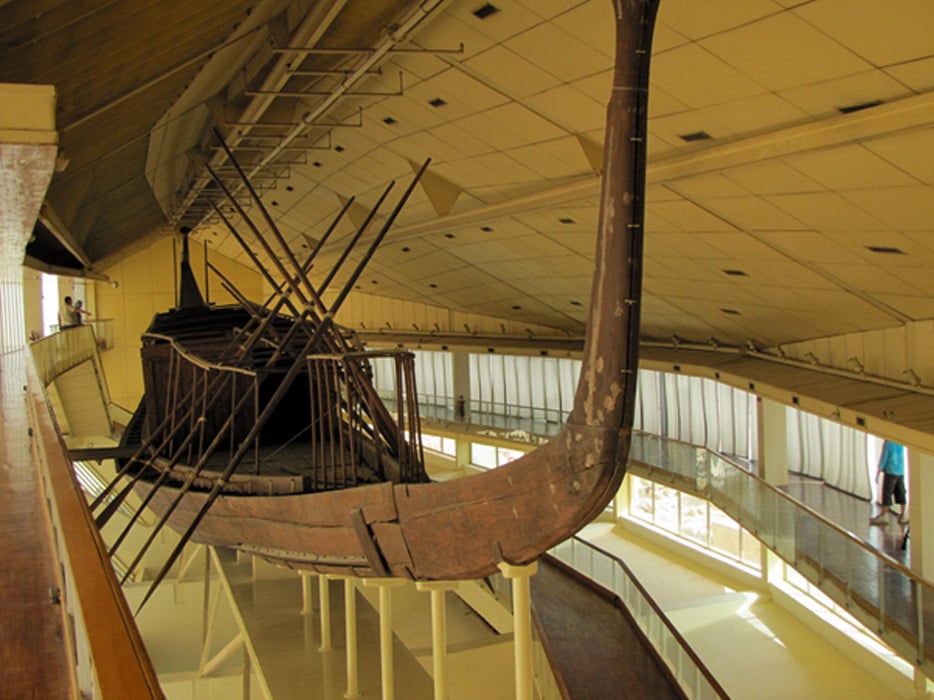
By Nevine El-Aref
Visitors to the Giza Plateau will be able to view Khufu's second solar boat through a tiny camera 4,500 years after it was buried to ferry the king to eternity.
On the southern side of Khufu's Great Pyramid, a hundred journalists, photographers, cameramen and television presenters gathered inside a five-metre-long metal hanger padded with black fabric.
Inside the hanger were 10 leather chairs and an LCD screen showing scenes of Khufu's solar boat in situ.
From last Saturday, Khufu's second solar boat is on show to the public for the first time since its discovery by Egyptian architect and archaeologist Kamal El-Mallakh with Zaki Nour in 1954.
At that time El-Mallakh and Nour found two boat pits during routine cleaning at the southern side of the Great Pyramid.
The first pit was found under a roof of 41 limestone slabs, each weighing almost 20 tonnes, with the three westernmost of the slabs being much smaller than the others leading them to be interpreted as keystones.
On removing one of the slabs El-Mallakh and Nour saw a cedar boat, completely dismantled but arranged in the semblance of its finished form.
Also inside the pit were layers of mats, ropes, instruments made of flint and some small pieces of white plaster along with 12 oars, 58 poles, three cylindrical columns and five doors.
Lake Baikal exploration revives memories of sunken treasure

From RIA - Novosti
As Russian scientists descend in mini-submarines to previously un-explored parts of Baikal, the world's deepest lake, national media have pointed to possible treasure finds including Imperial Russian gold and silver.
The expedition in the vast Siberian lake, which started on Tuesday and will run for two years, is focused on studies of the lake's unique ecosystem, but researchers have also said they will be looking for 'archeological artifacts'.
Among the many 'artifacts' rumored to have disappeared into Baikal's depths are several sacks of gold, taken from the Imperial Russian reserves and carried across the ice by Admiral Alexander Kolchak's White forces fleeing the Bolsheviks in the winter of 1919-1920.
Some of the officers reportedly froze on the ice in 60 degrees of frost, and the treasure sunk when the thaws came.
Although the Kolchak story is unproven, several other cases of lost treasure have been documented.
Que ? Spanish crew's lack of English sank the Mary Rose
From the Times Online
Researchers believe the vessel's fate was sealed when its mainly Spanish crew could not understand the orders of their officers.
For generations, the reason why the Mary Rose sank during a battle with a French invasion force has divided historians.
Now a new theory can be added to the list of suggestions about why the pride of Henry VIII's navy was lost: two thirds of its crew were foreigners who failed to understand orders.
Forensic science examinations of the 16th-century crew's skulls have revealed that the majority were not British but southern European, most probably Spanish.
Researchers believe that the vessel's fate was sealed because of their inability to understand their officers' orders when it began taking on water in the Solent, off Portsmouth, in 1545.
Ancient Greek computer from 100 B.C.: Archimedes strikes again ?

By Paul Wallis
A device for computing the calendar called the Antikythera Mechanism was found on an ancient shipwreck over 100 years ago.
Reexamined using modern technology, an advanced mechanism has been deciphered and its functions reconstructed. One look at this mechanism is impressive.
It becomes more so, as you discover it uses gears and dials, a whole new class of technology, and complexity, in the world of 100 B.C.
Archimedes, who lived in Syracuse and died in 212 B.C., invented a planetarium calculating motions of the Moon and the known planets and wrote a lost manuscript on astronomical mechanisms.
Some evidence had previously linked the complex device of gears and dials to the island of Rhodes and the astronomer Hipparchos, who had made a study of irregularities in the Moon’s orbital course.
Read more...
Marine burglar alarm squawks at the sound of bubbles

By Colin Barras
An estimated 1 million ancient shipwrecks litter the seafloor around the globe, proving a tempting target for looters and a nightmare for archaeologists and governments to protect.
But that could be set to change with the advent of a submarine alarm that can identify the telltale sounds of approaching treasure hunters in the hubbub of the oceans.
Recent technological advances have been a boon for underwater research – improvements in GPS navigation, sonar and diving gear mean ancient shipwrecks are more accessible than ever.
But archaeologists worry that the same advances will also benefit looters seeking to make a quick profit.
Tuncay Akal of the TÜBİTAK - Marmara Research Center in Kocaeli, Turkey, is a member of an international research team designing an early warning system that can identify plunderers by their acoustic signature and alert officials of their presence.
Read more...
Divers to search for shipwrecks

From The Herald
Divers are to launch a mission to find two ships which have lain undisturbed at the bottom of Plymouth Sound for centuries.
University of Plymouth staff and students are to hunt for the remains of the Paulsgrove, which sank in 1637, and the Dutton, which was lost in 1796.
The Dutton's sinking became part of maritime folklore when a passer-by helped save nearly 500 people on board in a dramatic rescue which became the subject of a couple of celebrated paintings.
The English East Indiamen Paulsgrove sunk with its cargo of spices and silks from Indonesia.
The team of seven students and four staff will spend a week from Monday exploring an area off Plymouth Hoe and to the east of Drake's Island in an attempt to locate the remains of two wrecks.
Project leader Martin Read, who lectures in the university's School of Earth, Ocean and Environmental Sciences, said: “Previous work by students from the university using acoustic survey equipment has located several potential targets which might be parts of shipwrecks.
The Dutton was carrying troops to the West Indies and was seeking shelter from a storm in the Cattewater when she hit Mount Batten reef and crashed into Plymouth Hoe.
Read more...