HOT NEWS !
Stay informed on the old and most recent significant or spectacular
nautical news and shipwreck discoveries

2008 science hunts lost Franklin ships
By James P. Delgado
Can modern science find an explorer and his two ships 160 years since they went missing in the Canadian Arctic ?
Many Canadians are asking that question since last week's announcement that Parks Canada, working in tandem with the Canadian Coast Guard and the Canada Hydrographic Service, was launching a new, and hopefully final, search for Captain Sir John Franklin's ships Erebus and Terror.
In 1848, the British Admiralty launched the first of 32 separate expeditions to search for Franklin. Those searches spanned the vastness of the Canadian Arctic archipelago and more than a decade.
What they found were traces of the two ships -- personal belongings, scattered equipment, a trail of skeletons, one face-down on the tundra with the scraps of his notebook in a frozen pocket revealing his last plaintive entry, "Oh death, where is thy sting?"
However, no ships. Encounters with the Inuit revealed heartbreaking stories of abandoned ships, of men struggling to head south, of starvation, madness, and cannibalism.
Read more...
Cussler ends lawsuit over finding Hunley
By Schuyler Kropf
Clive Cussler says he doesn't need another court victory to prove he found the Hunley submarine, so on Friday he dropped his seven-year legal battle with a South Carolina man over the claim.
Lawyers for the author and shipwreck hunter filed a motion to dismiss Cussler's lawsuit against rival Edward Lee Spence, a man who claims he found the Confederate submarine several years earlier.
Cussler filed the suit in 2001 to stop Spence from telling people the adventure writer had jumped his claim. Spence filed a countersuit, which was thrown out of court last year.
Discovery of historic wreck is a significant find
From The Whig
What a glorious discovery has been made of the remains of HMS Montreal ("New shipwreck discoveries hearken back to War of 1812," Aug. 19).
This 22-gun sloop was launched from the Kingston naval dockyard (now home to Royal Military College) in April 1813.
Initially named after the captain general and governor-in-chief of British North America, Sir George Prevost, it was quickly renamed HMS Wolfe and became post ship for the newly arrived commander of the Lake Ontario naval squadron, Commodore Sir James Lucas Yeo. It was crewed by some 130 ratings.
The Wolfe played a key role on Lake Ontario throughout 1813. It was Yeo's flagship during the raid on Sacket's Harbor in May 1813 and fought in the four actions between the British and American squadrons during August and September 1814.
Perhaps the most famous of these encounters was the "Burlington Races" of Sept. 28, 1813, in which the Wolfe lost its mizen topmast to American fire and was only saved from destruction through a bold move by Commander William Mulcaster on the Royal George, who placed his ship between the Wolfe and the American flagship, allowing Yeo to race away from the danger.
For the next three hours, the American squadron chased the British, who found refuge in Burlington Bay. Within a day, the Wolfe was restored to fighting trim and Yeo was back on the lake.
Read more...
Peru wants to know origin of shipwrecked treasure
By Christine Armario
Peru's government wants to know if 17 tons of silver coins recovered from a shipwreck in the Atlantic Ocean last year were made there, complicating the legal quest to determine who rightfully owns the multimillion-dollar treasure.
Peru filed a claim Tuesday in U.S. District Court in Tampa to determine where the coins originated, entering the fray over the $500 million loot found on a sunken ship by Tampa-based Odyssey Marine Exploration. Odyssey has been fighting the Spanish government for ownership of the ship and its contents.
Peruvian consumer rights advocates contend the coins were made with Peruvian metals and minted in Lima. When Nuestra Senora de las Mercedes y las Animas sank west of Portugal with more than 200 people on board in 1804, Peru was still a Spanish colony.
"Probably every colonial Spanish shipwreck that has ever been discovered has had coins that originated in Peru," Greg Stemm, Odyssey Marine Exploration's chief executive officer, wrote in an e-mail. "So it will be interesting to see how successful they are in getting other governments and shipwreck explorers to recognize their interest."
Peru's claim states that it is entitled to any property that originated there and was produced by its people. An official at the Peruvian embassy in Washington, D.C., declined to comment.>
Sunken ship Redux: wreckage may do morehrm than good

From Discover
Yesterday we wondered whether the U.S. Navy’s plan to intentionally sink some of its old warships, so that they’d become new homes for fish and attractions for recreational divers, would be such a great idea in the long run.
Today, a new study looking at a different shipwreck suggests that not only might intentionally sinking old ships be a bad idea, but officials might have to remove shipwrecks from sensitive ecosystems before they cause too much harm.
Back in 1991, a 100-foot-long ship sank in Palmyra Atoll National Wildlife Refuge near Hawaii. Now, 17 years later, scientists studying the area say the coral reef is under attack by an organism called Rhodactis howesii.
It is a corallimorph, a relative to anemones and corals that clears out competitors with it stinging tentacles. Rhodactis is an invasive species to the Palmyra Atoll, and it doubled its presence between 2006 and 2007, pushing out the diverse mix of corals that is native there.
Read more...
Warship ablaze, but none injured
From The Jakarta Post
A Navy anti-submarine warship caught fire during a routine patrol in the waters off Lampung with all personnel on board surviving the accident.
Navy spokesperson First Adm. Iskandar Sitompul said Tuesday the warship KRI Memet Sastrawiria, commanded by Maj. Gema Eka Putra, was heading to Labuhan Siging port when fire gutted the port side of its stern.
"We are still investigating the cause of the fire. More importantly, everybody is safe," Iskandar said.
The warship is a Parchim class corvette once operated by East Germany. Indonesia bought the corvette as part of the 1985 purchase of 39 East German warships.
Measuring 75.2 meters in length and 9.8 in width, the corvette is armed with an anti-submarine rocket launcher, torpedoes and sea mines. It can cruise at a maximum of 24.7 knots.
Full story...
New shipwreck discoveries hearken back to War of 1812
From Jordan Press Whig
Kenn Feigelman and his team of underwater filmmakers planned to spend the summer documenting on film all the known wrecks in the waters around Kingston. They also hoped to find a new wreck.
They didn't expect to find four old ships, including one that likely hasn't been seen for nearly 200 years, along with a debris field of other ships near the city.
One wreck was previously found then lost. The wreck, a large hulk sitting on the bottom of the lake, is believed to be HMS Montreal, a Kingstonbuilt ship that was scuttled after the War of 1812, said Feigelman, who runs DeepQuest2 Expeditions.
"This isn't just Kingston history, this is North American history," Feigelman said, referring to the warships his crew stumbled upon.
"We're not saying we found them for the first time, but it's a discovery for sure."
USS Shark opens portal to the past
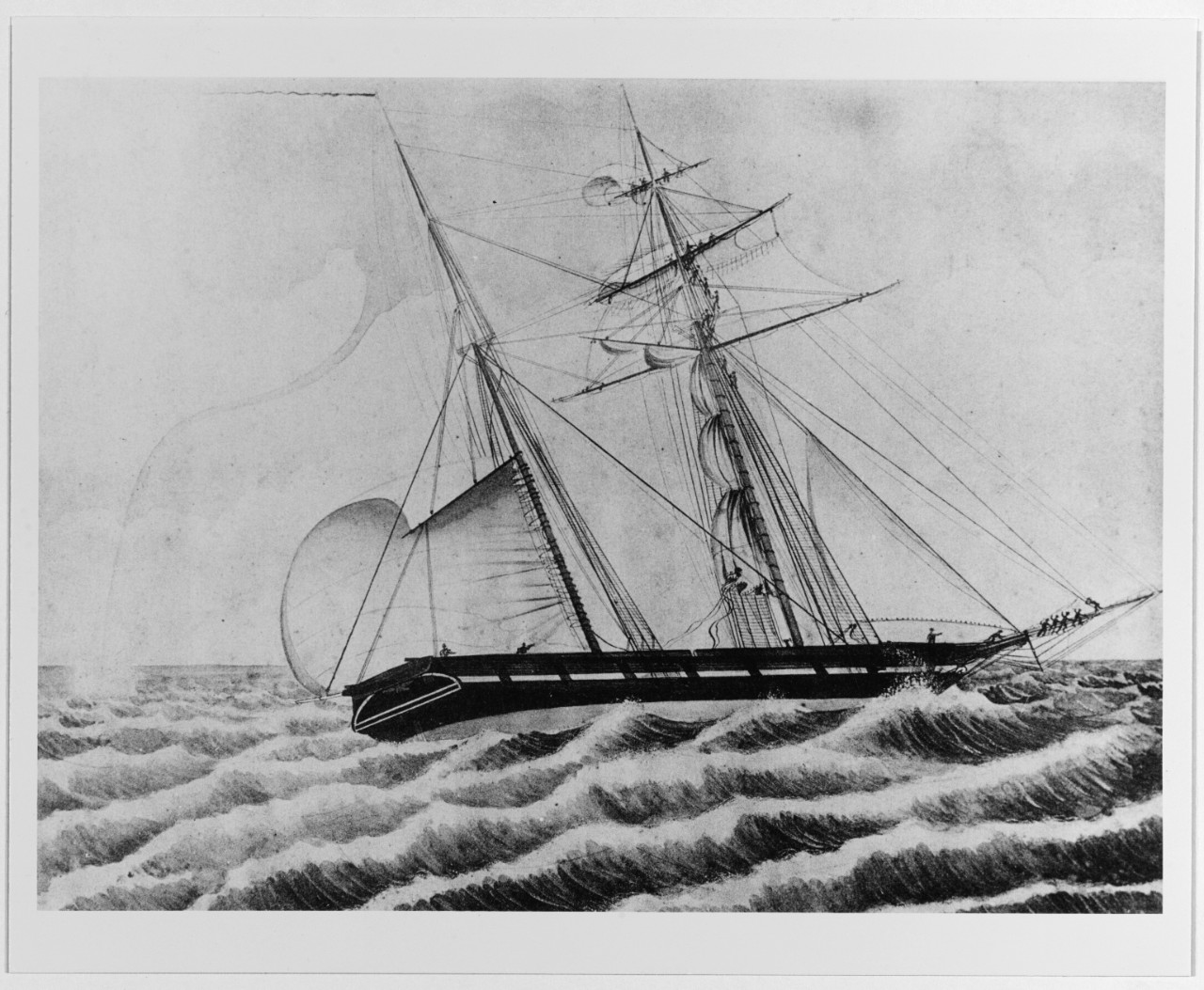
By Eric Baker
Cannons gave name to beach and town, and keep coming back. Hard aground.
That's how Lt. Neil Howison and his ship, the schooner USS Shark, found themselves after arriving at the mouth of the Columbia River on July 18, 1846.
Waves pounded the ship's hull violently against the sandbar as Howison pondered how to free his ship from peril.
Although he had successfully navigated the treacherous sands of the Columbia Bar guarding the river's mouth -- using only an outdated, hand-drawn chart for reference -- he now found his ship wedged on a sandbar, five years to the day after another Navy warship, the USS Peacock, had met its end in these waters.
The Shark was freed from the sand this time, but after months of exploration in Oregon, that September it would suffer the same fate as the Peacock.
Although the Shark is long gone, remnants of its journey live on. Earlier this year, two carronades -- short cannons -- thought to be from the shipwreck were discovered south of Cannon Beach, renewing interest in the Shark and its historical ties to Oregon.
Read more...