HOT NEWS !
Stay informed on the old and most recent significant or spectacular
nautical news and shipwreck discoveries

Kentuckian's shipwrecked artifacts to go on tour
By Byron Crawford
As a lifeguard at Las Vegas' Sahara hotel during his younger days, Rudy Lewis never imagined diving to the Atlantic Ocean's floor to recover historic artifacts aboard centuries-old ships.
The entrepreneur and developer who lives near Simpsonville, Ky., recounted his life's journey recently while putting several cannons from Spanish shipwrecks into a small stream on his farm.
There they would remain preserved from further exposure to the air until they could be properly treated, refurbished and used as educational exhibits.
In the years since Lewis learned about diving from Navy "frogmen" whom he met as a lifeguard in the late 1950s, he has honed his skills along treacherous coral reefs on which many ships broke apart during hurricanes and sank with sometimes valuable cargoes.
As owner of several sport-fishing charters south of Florida's Key Largo years ago, he was lured farther out to sea by stories told by wreck divers who passed through the Keys with treasures salvaged from 17th- and 18th-century wrecks on distant reefs.
Earliest confirmed TB case found

From BBC News
The 9,000-year-old remains of a mother and her baby discovered off the coast of Israel provide the earliest concrete evidence of human TB, say researchers.
The bones were excavated from Alit-Yam, an ancient Neolithic village near Haifa, which has been submerged in the Mediterranean for thousands of years.
The experts from University College London and Tel-Aviv University used DNA technology to confirm the bacterium.
Others have found remains that hint at TB dating from about 500,000 years ago.
Convention on the Protection of the Underwater Cultural Heritage

From UNESCO
Twenty States have now ratified the Convention on the Protection of the Underwater Cultural Heritage, which therefore will enter into force on 2 January 2009, three months after the deposit of the 20th instrument of acceptance.
“This is a very important step in the history of the safeguarding of cultural heritage,” declared Koïchiro Matsuura, Director-General of UNESCO.
“This represents an essential addition to UNESCO’s standard-setting apparatus.
From now on, it will be possible to offer legal protection to the historical memory that is in underwater cultural heritage, thus curtailing the growing illicit trade by looters.”
Read more...
Recuperan cientos de piezas de gran valor histórico y arqueológico
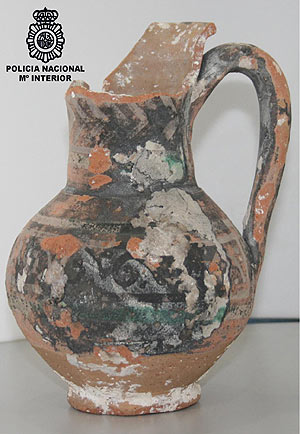
From Elmundo
La Policía Nacional ha recuperado cientos de piezas de incalculable valor histórico y arqueológico en diferentes operaciones en Almería, Jaén y Palma de Mallorca.
Agentes del Grupo Especial de Respuesta al Crimen Organizado (GRECO) de Palma de Mallorca y de la Brigada Provincial de la Polícia Judicial han sido los encargados de llevar a cabo una de estas operaciones en la que se han recuperado cerca de un centenar de piezas de importante valor arqueológico procedentes del expolio en yacimientos submarinos.
Esta actuación ha tenido lugar en el marco de una operación contra el tráfico de estupefacientes en la que han sido detenidas seis personas y se han intervenido 500 plantas de marihuana.
Por su parte, los agentes de la Brigada Provincial de la Policía Judicial de Almería, en colaboración con la UDEV de la Comisaría de Jaén, iniciaron una investigación conjunta tras el robo ocurrido en la Catedral de Jaén el pasado 18 de septiembre, en el que fueron sustraídas de una vitrina del museo varias joyas episcopales de alto valor histórico.
Read more...
By Tom Mooney
In May, as a handful of local archaeologists watched from the gunwales of four research ships, warfare scientists for the Navy and federal oceanographers lowered several high-tech robots into Narragansett Bay’s waters between Portsmouth and Jamestown.
Some of the robots resembled torpedoes. Others looked like mechanical crabs. The newest of their kind, the remote-controlled, sonar-imaging machines had been designed to find mines buried on the sea floor or attached to ship hulls.
But for two weeks, the Navy had offered them for another purpose as well: to test their capabilities in locating archaeological artifacts hidden, in some cases, under two centuries of silt.
For marine archaeologists Charlotte Taylor, D. K. “Kathy” Abbass and Rod Mather, those two spring weeks would be a cruel tease.
Full story...
Navy confirms sunken submarine is Grunion

From Science Daily
The submarine Grunion arrived at Pearl Harbor on June 20, 1942. The vessel completed pre-patrol training before departing on its first war patrol June 30. Grunion's commanding officer, Lt. Cmdr. Abele, was ordered to proceed to the Aleutian Islands and patrol westward from Attu on routes between the Aleutians and the Japanese Empire.
On July 10, Grunion was reassigned to the area north of Kiska. Over the next 20 days, the submarine reported firing on an enemy destroyer, sinking three destroyer-type vessels, and attacking unidentified enemy ships near Kiska.
Grunion's last transmission was received on July 30, 1942. The submarine reported heavy antisubmarine activity at the entrance to Kiska, and that it had 10 torpedoes remaining forward.
On the same day, Grunion was directed to return to Dutch Harbor Naval Operating Base. There was no contact or sighting of the submarine after July 30, and on August 16, Grunion was reported lost.
Read more...
High-tech explorers search Mon for elusive B-25
By Matthew Santoni
Divers and scientists are spending this weekend delving into a mystery that has lurked in the muddy waters of the Monongahela River for 52 years: What happened to the B-25 bomber that splashed into the river at the height of the Cold War ?
The official record says that on Jan. 31, 1956, the World War II-era bomber ran out of fuel en route to Harrisburg and ditched in the river -- just missing the Homestead High-level Bridge on its approach -- before floating downstream and sinking.
But local lore says the plane was raised by the Army and spirited away in the dead of night to hide a secret cargo, ranging from UFO parts to nuclear bomb components.
This weekend, the "B-25 Recovery Group" is trying for the third time in 14 years to find the remains of the plane, this time armed with the latest technologies for searching beneath the water and silt.
Read more...
By Scott Christiansen
One day in March of this year, Steve Lloyd’s 27-foot cabin cruiser Obtainium was headed on a course along the Kenai Peninsula’s southwestern tip from Seldovia to the elongated bay of Port Graham, which shelters the town of the same name.
Lloyd considers himself a pretty savvy scuba diver, if not Alaska’s premier shipwreck hunter and he and his dive partner Ursa Lively were headed for a nearby shipwreck site.
Their lure wasn’t treasure, but a 140-year-old military wreck known as the Torrent, which Lloyd had visited twice before.
His pioneering dives in July 2006 revealed only spikes; apparently part of the ship drifted and created it’s own debris field as wooden parts rotted away. Lloyd led an expedition the next year that found anchors, and cargo, including cannon balls and an intact bronze cannon barrel.
Slowly, the Torrent was giving up her secrets to an expanding, albeit small, circle of divers skilled enough to dodge Cook Inlet currents during brief periods of slack tide.
Read more...