HOT NEWS !
Stay informed on the old and most recent significant or spectacular
nautical news and shipwreck discoveries

Coins, jewelry stolen from home
From TCPalm
More than $68,000 in collectible coins and jewelry were stolen from a family's home sometime Thursday, police said.
A family member returned home at 2:15 p.m. Thursday and found the home in the 2600 block of 19th Street had been burglarized, according to a police report.
A fire safe containing many of the coins under the couple's bed had been opened, the report said.
The couple said the safe contained 14 rare silver coins from a shipwrecked Spanish boat.
In 1622, the Nuestra Señora de Atocha, a cargo ship from Spain, sunk off the coast of the Florida Keys. A hurricane tossed the ship in the coral reef, records show. The couple had obtained coins from the shipwreck, according to the report.
Read more...
Divers shed light on wreck of Portland
By Bina Venkataraman
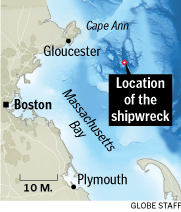
Captain Hollis Blanchard was at the helm of the steamship Portland when it went down off the coast of Massachusetts in November 1898. Nearly 200 perished.
In the cold, black waters 460 feet below the ocean's surface, the divers could not see their hands. They switched on their lamps, throwing light on one of the worst shipwrecks in New England history.
Clad head-to-toe in insulated dry suits, five Massachusetts men recently became the first divers to reach the Portland, a luxury passenger ship that was thrashed by hurricane-force winds and sank off the coast of Cape Ann in one of the 19th century's deadliest storms.
Although the upper decks had been ripped off, perhaps as waves pummeled the paddle wheel ship broadside, the divers found portholes with the glass intact, half-filled medicine bottles from an apothecary in Maine, and stacks of delicate china plates, many of which survived without a scratch.
"It's like somebody set the table, and just left it for 120 years," said Dave Faye, one of the divers and a lawyer at a Cambridge law firm. "It was very spooky.
Read more...
Cannon might be from 1846 wreck of USS Shark
By Tom Vogt
Two cannons with possible links to Fort Vancouver have had their 15 minutes of fame. Next comes the long, dirty slog of restoration.
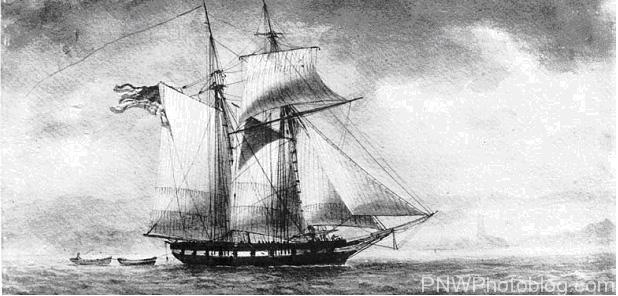
Research done on one of the cannons by the "History Detectives" TV series indicates it most likely came from the USS Shark. The U.S. Navy schooner was wrecked in 1846 near the mouth of the Columbia as it sailed from Fort Vancouver toward the Pacific.
Production of the PBS episode included a visit to the Fort Vancouver National Historic Site, where chief ranger and historian Greg Shine provided some background on the Shark, which was launched in 1821 at the Washington, D.C., Navy Yard.
The cannon investigation was one of three segments on the episode aired recently by Oregon Public Broadcasting.
Read more...
Treasure, interrupted for Odyssey Marine
By Mike Vogel
The country's largest publicly traded shipwreck exploration company has three promising finds but faces hurdles in opening the treasure chests.
In October 1804, four Spanish frigates approached the port of Cadiz in southwestern Spain, laden with South American treasure.
The loot was meant to bankroll Spain, nominally neutral but tacitly allied with Napoleon against Britain. Four British frigates met the treasure fleet.
In the ensuing Battle of Cape St. Mary, the British captured three of the Spanish ships. The fourth, the Mercedes, exploded.
Historical novelist Patrick O’Brian integrated the conflict into one of his novels, with fictional hero Capt. John “Lucky Jack” Aubrey awed as the Mercedes’ powder magazine destroyed the ship in “a blast so huge it wiped out thought and almost consciousness: the Mercedes blew up in a fountain of brilliant orange light that pierced the sky.”
Read more...
Namibia: Race against time to save ancient Portuguese shipwreck
From AFP
Archaeologists are racing against the little time left to salvage a fortune in coins and items from a 500-year-old Portuguese shipwreck found recently off Namibia's rough southern coast.
Despite its importance, the project, in a restricted diamond mining area, is itself costing a fortune in sea-walling that cannot be sustained after October 10.
"The vast amounts of gold coins would possibly make this discovery the largest one in Africa outside Egypt," said Francisco Alves, a Lisbon-based maritime archaeologist.
"This vessel is the best preserved of its time outside Portugal," he said.
"But the cultural uniqueness of this find is priceless."
Alves is part of a multi-national team combing the seabed where the wreck was discovered six months ago.
The 16th-century "Portuguese trade vessel was found by chance this April as mine workers created an artificial sand wall with bulldozers to push back the sea for diamond dredging," Namibian archaeologist Dieter Noli told reporters invited to view the site.
Sub Sea Research to recover WWII Freighter carrying tons of precious metals
From PR Web
Sea Hunters, L.P., a division of the Portland Maine based shipwreck research and recovery company Sub Sea Research, embark on their newest project: the recovery of one of the world's wealthiest wrecks.
The ship in question, the "Blue Baron", was attacked and sunk by a German U-Boat in June 1942. Through extensive and intensive research, Sub Sea navigated through the wreckage to discover large amounts of wealth, previously unknown to the world.
The ship is thought to have been carrying tons of precious metals, several thousand tons of tin and copper, all of which are presently hidden amongst the debris.
The total worth of the cargo equals out to more than four billion dollars, with the tin and copper alone valued at $165 million dollars.
The team is equipped with a number of unique tools that help make them the world's leader in shipwreck recovery technology. With the assistance of satellite imagery, a remote operated vehicle (ROV), side-scan sonar imaging, cesium magnetometers, and the help of their dedicated research team,
Sea Hunters, L.P., have been able to locate the exact position and location of the wreck and all of its secret cargo. The next mission is to apply this technology to exhume the contents.
The crew plans to head out to the site this fall on their new 220-foot salvage ship, M/V Sea Hunter equipped for deep water recovery. The ship is currently being prepared for the long journey ahead.
Read more...
Probe finds signs of doomed Franklin expedition
By David Ljunggren
Explorers trying to trace two ships from the doomed 1845 Franklin expedition in Canada's Arctic found fragments of copper sheeting likely to have come from the vessels, one of the explorers said on Friday.
Sir John Franklin, his 128 crew and the British ships HMS Erebus and HMS Terror were seeking the fabled Northwest Passage between the Atlantic and the Pacific oceans when they became stuck in ice. The men all died and the ships vanished.
"The archeological discoveries exceeded our expectations. We found copper fragments which could well have come from one of the ships we're looking for," said Robert Grenier, chief of underwater archeology at Parks Canada.
"They revealed the prior presence of considerable number of these sheets," he told reporters. "This was for us, I would say, a very significant find."
Copper did not exist naturally in the region and the sheets could not have been made by the local Inuit, he said.
The team found the fragments during a six-week trip in August and September to three islands near O'Reilly Island in the Queen Maud Gulf, close to where Franklin's ships are believed to have sunk.
Read more...
U.S. firm rebuts Spanish charges over $500 mn treasure haul
By Emilio J. Lopez
U.S. treasure-hunting firm Odyssey Marine Exploration denied Spanish government claims that it "secretly" scoured the ocean floor to find a wreck containing a $500 million haul of colonial-era coins.
"Odyssey in this case followed all the appropriate archaeological and legal protocols," Odyssey CEO Greg Stemm told Efe, calling allegations to the contrary false and "inflammatory."
Spain's Culture Ministry on Tuesday accused Odyssey of carrying out "this underwater excavation in secret after having received specific instructions that it was prohibited.
Madrid on Monday provided evidence to a U.S. federal court in Tampa, Florida, that the wreck in which Odyssey found hundreds of thousands of gold and silver coins is the Spanish frigate Nuestra Señora de Las Mercedes, sunk in October 1804 after a battle with British warships off the coast of Portugal in which more than 250 Spaniards died.
Read more...