HOT NEWS !
Stay informed on the old and most recent significant or spectacular
nautical news and shipwreck discoveries

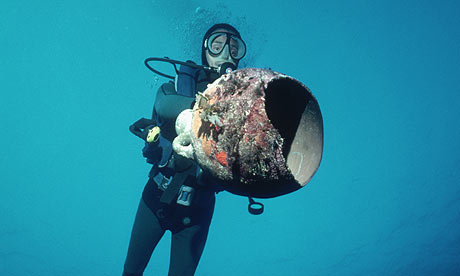
Divers plunder Greece's sunken treasure troves
By Helena Smith
For centuries they have lain forgotten and untouched in the murky depths of the Mediterranean. But the sunken glories of Greece are now threatened by modern treasure hunters, who are targeting their riches since the lifting of a ban on coastal scuba-diving.
At risk, say archaeologists, is an unseen part of the country's cultural patrimony, comprising thousands of shipwrecks dating from Classical, Hellenic, Roman, Byzantine and early modern times and their priceless cargoes of coins, ingots, weapons and gold.
"Greek waters are some of the richest in antiquities in the world," said the marine archaeologist Katerina Dellaporta.
"Thanks to very stringent controls over underwater exploration shipwrecks have been extremely well preserved."
Until recently divers were allowed access to just 620 miles of the country's 12,000 mile coastline, but in an attempt to boost tourism, the conservative government opened the country's entire coastal waters to underwater exploration in 2003.
Since then, looting has proliferated, say archaeologists.
Treasure hunters, encouraged by scuba-diving websites from America to Australia, are homing in on the "archaeological sea parks" armed with hi-tech scanners, cameras and nets.
Ancient wrecks being hunted in once forbidden sea off Albania
By Llazar Semini
Once Europe's most forbidding coast, this sparkling stretch of the Ionian Sea is slowly revealing lost treasures that date back 2,500 years and shipwrecks from ancient times.
Over the past two summers, a research ship carrying U. S. and Albanian experts has combed the waters off southern Albania, using scanning equipment and submersible robots to seek ancient wrecks.
In what organizers say is the first archeological survey of Albania's seabed, at least five sites were located, which could fill in blanks on ancient shipbuilding techniques.
The project would not have been even imaginable just 18 years ago, when the small Balkan country was still ruled by Communists who banned contact with the outside world.
The brutal regime pockmarked the countryside with more than 700,000 bunkers, against a foreign invasion that never came. Instead, the Communists were toppled after a student-led revolt in 1990, which opened Albania to the world.
"Albania is a tremendous untapped (archeological) resource," said U. S. archeologist Jeffrey G. Royal from the Key West, Fla.-based RPM Nautical Foundation, a non-profit group leading the underwater survey.
"With what we've discovered until now we may say that Albania is on a par with Italy and Greece."
The latest expedition has revealed traces of four sunken Greek ships dating from the sixth to the third centuries BC, while another three suspected sites have still to be verified.
In comparison, the 2007 season netted signs of just one ancient wreck.
"The discoveries are very important because of the lack of properly documented objects from that period," said Andrej Gaspari, a leading Slovenian underwater archeologist who was not involved in the project.
"The only ships found and documented from that time belong to the western Mediterranean and Israel . . . so our knowledge on the technology used for construction of ships is more or less limited."
Charles Darwin - Voyages and ideas that shook the world exhibit

From Sail World
We all know travel broadens our vision and stimulates our thinking… but what sort of voyage was it that inspired Charles Darwin to construct his theory of evolution that shook the 19th century world’s beliefs to their core ?
A major exhibition coming to the Australian National Maritime Museum takes you with him on HMS Beagle, introduces you to the people who sailed with him and shows you what they saw.
And it places the Beagle voyage in the context of other early 19th century exploratory expeditions, revealing the sense of wonder they experienced as the natural world opened up to them.
The Australian National Maritime Museum has assembled the exhibition Charles Darwin – Voyages and ideas that shook the world to commemorate the 200th anniversary of Darwin’s birth and the 150th anniversary of his most famous work On the Origin of Species.
And to coincide with the opening of the exhibition, the museum is combining with Sydney University to present a special two-day symposium (20-21 March) with eminent speakers from universities and other institutions in the UK and Australia.
The exhibition opens with an introduction to HMS Beagle, a small (27.5 metre) survey vessel and an account of its earlier (1826-30) survey expedition to Patagonia and Tierra del Fuego under the command of Phillip Parker King.
It then introduces the young Charles Robert Darwin, born12 February 1809, the son of Dr Robert Darwin, a successful Shropshire physician, and Susannah Darwin, daughter of the famous potter Josiah Wedgwood. Charles was the fifth of six children in this well-to-do family.
After unexceptional studies at Edinburgh and Cambridge Universities, Charles in 1831 – still aged only 22 – was invited almost by chance to join the Beagle on its circumnavigation of the globe which took five years to complete.
The voyage would expose him to a variety of environments and plant the genesis of ideas that would explain the evolution of life on earth.
Manitowoc County shipwreck listed in National Register of Historic Places
From Herald Times Reporter
The Wisconsin Historical Society has announced the listing of two Lake Michigan shipwrecks, the Lumberman (Milwaukee County) and the Continental (Manitowoc County) in the National Register of Historic Places.
The remains of the schooner Lumberman lie in 55 feet of water four miles east of Oak Creek. Built in 1862 in the remote, frontier shipyard of Allyne Litchfield in Blendon’s Landing, Mich., the Lumberman was built specifically for transportation of lumber products.
The three-masted, double centerboard schooner sank in a fast-moving storm on April 6, 1893.
The Lumberman is remarkably intact and provides the opportunity to study construction techniques on this unique vessel type.
Little documentation exists in the historic record regarding double centerboard schooners, and the Lumberman is one of only four examples known to exist in Wisconsin waters, making it an important archaeological resource, according to a press release from the Wisconsin Historical Society.
The remains of the bulk carrier Continental, located 1.5 miles north of Rawley Point Light in Point Beach State Forest near Two Rivers, rest broken in 15 feet of water.
Built in 1882 by well-known shipwright George Presley in Cleveland, Ohio, the Continental was one of a transitional class of Great Lakes bulk carriers that began to employ innovative hull-strengthening technologies to accommodate greater gross tonnage and longer hulls.
HMS Sussex: Spain cannot be allowed to get away with piracy says opposition
From Gibfocus
According to a recent company report, Odyssey Marine Exploration has been unable to continue its work on the site of the shipwreck believed to be that of HMS Sussex because of interference from the Spanish Government and its agencies.
Central to this is the continuing dispute of the sovereignty over the waters around Gibraltar which Spain continues to claim as her own.
The Opposition has said it takes a very serious view of this latest development which comes at a time when the territorial waters of Gibraltar have been placed under the microscope by Spanish politicians as a consequence of the eastside project.
In its latest report into the work done on the site believed to be that of HMS Sussex, the company says that at present access “remains denied to Odyssey by the Spanish government despite the wreck’s location in international waters, as recognized by the UK Government.”
The company highlights the abrupt deterioration of relations with Spain and the “aggressive nature of the confrontation” which “required immediate action to ensure the health, safety and security of all staff aboard the Odyssey Explorer.”
It will be recalled that Spain subsequently arrested an Odyssey vessel after it exited Gibraltar’s three mile limit even though the vessel was in international waters at the time.
Busy year for receiver of wreck
From Dive Magazine
The Receiver of Wreck said more than 1,500 items of wreck were reported in the UK during the last 12 months, ranging from water melons to 3m-long bronze cannons.
The Receiver of Wreck said more than 1,500 items of wreck were reported in the UK during the last 12 months, ranging from water melons to 3m-long bronze cannons. However, tonnes of recovered timber from the Ice Prince, a cargo ship that sank off the Devon coast in January 2008, had not been recorded separately according to the head of the government body.
In her annual report, Receiver of Wreck Alison Kentuck said a total of 299 reports of wreck were received in 2008, a small increase on the previous years figures - 290 in 2007. Incoming droit (wreck) figures, however, have declined since a peak between 2000 and 2002.
As long as all of the material reported has come from the same site, there is no limit to the quantity of recovered wreck material that can be reported.
'2008 has been a very busy year for the Receiver of Wreck with large scale incidents such as the timber cargo from the Ice Prince vessel in January in addition to many other interesting smaller scale recoveries,' Kentuck said. 'The wide range of items reported to the Receiver illustrates the huge variety of goods transported by sea both today and throughout history.'
Under the Merchant Shipping Act 1995, all recovered wreck material, regardless of age, size or value, must be reported to the Receiver of Wreck. T
his includes all wreck recovered from within UK territorial waters and any wreck material brought within UK territorial waters.
From Bega District News
The Mermaid sank 180 years ago (1829) off the coast of Cairns on Flora Reef.
In 2004 a search team went out to look for the ship and confirmed that Flora Reef was the most likely position of the shipwreck, then early this year a team set out to survey for the wreck.
The Australian National Maritime Museum and John Mullens from the Silent World Foundation sponsored us along with the help of our teacher Elaine Cozens to accompany the search party to find the Mermaid.
On New Year’s Day we boarded a plane in Merimbula to join the maritime archaeological expedition to find the wreck.
The group arrived in Cairns and boarded the Spoilsport, a well equipped professional diving vessel, to journey to the Great Barrier Reef.
The vessel has three levels: below deck, the cabins (one of which we shared and managed to fill to the brim with our stuff) the main deck with living room, kitchen, dining area which features two enormous flatscreen TVs.
When we first snorkelled on the reef we thought it was stunning; we were able to spot numerous bright blue starfish which looked like they were made of velveteen, sea cucumbers - big black knobbly ones and skinnier grey ones, and an eel hiding in a hole.
All the bright little polyps that suck in and out and the tessellating patterns of the hard corals are just amazing.
It was absolutely breathtaking to dive down into a world unknown by our eyes and discover all this beauty.
Murky treasure ship find raises doubts
From Shipping Times
Yesterday's Sunday Telegraph carries a report that a US salvage company has found a torpedoed cargo ship, which they claim contains the greatest ever maritime treasure from a wreck.
The photo that accompanies the article is a blurred fascimile that is supposed to be the wreck. They have, according to the Telegraph, codenamed the vessel 'BLUE BARON" as they do not want the identity of the vessel made known, not her exact whereabouts.
A member of staff at the Sunday Telegraph linked the photo to a vessel called the PORT NICHOLSON and Shipping Times has located a photo that is the original of this fascimile which clearly shows that the Telegraph was correct. The photo IS that of the PORT NICHOLSON.
She was lost off Cape Cod, sunk by U87 on 16 June, 1942.
This rather casts a doubt on the company's insistence that U87 sunk their wreck in June '42.
From available records it is quite clear U87 was never off Guyana in that year, never mind that month. In fact in all her (short) career she spent her time exclusively patroling either the Iberian coast or on the North Atlantic.
On 19th May 1942 she left St. Nazaire to start a 51 day patrol of the North Atlantic. From data obtained at Uboat.net it is evident each day was plotted faithfully until she retuned to St. Nazaire on the 8th July. At no time could she, or did she, deviate from this patrol.