HOT NEWS !
Stay informed on the old and most recent significant or spectacular
nautical news and shipwreck discoveries

-
WWII ship search may start this year
- On 21/03/2009
- In World War Wrecks
From the Sydney Morning herald
A search for the Australian hospital ship Centaur, torpedoed in World War II with the loss of more than 250 lives, could begin as early as November.
The AHS Centaur, well lit and clearly marked as a hospital ship, was torpedoed by a Japanese submarine southeast of Cape Moreton, off Queensland's southeast coast, in May 1943. She sank within minutes and only 64 of the 322 people on board survived.
International dive company Blue Water Recoveries was on Friday granted the tender to manage the search for the vessel. Blue Water Recoveries played a key role in last year's finding of HMAS Sydney II.
It is estimated that the AHS Centaur lies at depths of up to two to three kilometres. Once the search area has been defined, a tender process will be undertaken to contract an appropriate search vessel and equipment. -
Turkey's Aegean explored in underwater archaeology excavations
- On 20/03/2009
- In Underwater Archeology

From Balkan Travellers
Archaeologists announced today they have begun underwater excavations of the prehistoric site of Limantepe in western Turkey.
The underwater research, headed by Professor Hayat Erkanal of the Archaeology Department of the Ankara University, explores the prehistoric settlement located in the coastal town of Urla near İzmir in western Turkey.
The harbour settlement was inhabited as early as starting from 6,000 years ago and, as such, it is one of the oldest known artificial harbours in the Aegean Sea.A big part of it, including a fortification wall, was submerged in the sea due to a massive earthquake which occurred in 700 BC, according to Erkenal.
Layers from three different periods have been found at Limantepe. The lowest layer belongs to the Early Bronze Age and dates from the third millennium BC onwards. The second one dates to the Middle Bronze Age from the first half of the second millennium BC onwards.
According to experts, evidence from these two early periods indicate cultural ties with the nearby prehistoric sites of Tepekule, Bayraklı within the city of İzmir and the Panaztepe site at the mouth of the River Gediz. -
The mysterious marvel of the Mary Rose
- On 20/03/2009
- In Museum News
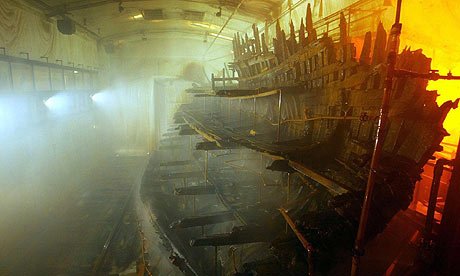
From the Guardian
Don't miss your chance to visit this astonishing shipwreck before the museum closes for a major overhaul.
This summer will be the last chance to see the Mary Rose, the early 16th-century wooden warship miraculously salvaged by underwater archaeologists in the Solent in the 1980s, before the ship's current display closes for several years for an ambitious redesign.When it opens, this will be – from the looks of the model – a museum truly worthy of one of the most amazing historic finds of the 20th century.
Here, you'll be able to look across from the ship in its sealed conservation chamber to facing displays of the unique objects that were preserved in it – from medical equipment to what looks like Lord Flashheart's boots.
The Mary Rose is a Renaissance Pompeii – a window on a lost way of life. But where Pompeii was a minor Roman city, this ship was one of the pearls of Henry VIII's navy, and one of the first purpose-built battleships in history.That's why, when it mysteriously capsized and sank, it was so crammed with gear. What makes it moving is what makes Pompeii moving – the astonishingly detailed survival of everyday artefacts.
You can see, in the current museum of finds near the boat shed in Portsmouth's historic dockyard, big cauldrons in which meals were cooked below decks, a brass syringe from the barber surgeon's cabin, strange wooden carvings that sailors made to pass the time.
-
Battle for the treasure that changed course of the Great War
- On 17/03/2009
- In Treasure Hunting / Recoveries
From The Independent
The wreck of a liner torpedoed in 1917 has been discovered. But who owns its £3m cargo, asks Cahal Milmo.Britain is locked in a court battle with an American treasure-hunting company over ownership of the wreck of a cruise liner with its valuable cargo of bullion, torpedoed in the First World War by a German U-boat in the Atlantic.
The 18,000-tonne Royal Mail Ship Laconia, which had been commandeered by the British government, was attacked with the loss of 13 passengers, including three Americans, en route from New York to Liverpool on 25 February 1917.
That changed the course of the war: a graphic account of the sinking by an American journalist aboard was credited with helping to push the United States into joining the conflict after it was read to both Houses of Congress.
But the discovery of the hull of the former Cunard liner 160 miles off Ireland by Odyssey Marine Exploration, a Florida-based company, has turned RMS Laconia into the source of a new transatlantic power struggle.The treasure-hunters have been appointed "custodian" of the wreck and its contents, including 852 bars of silver and 132 boxes of silver coins worth an estimated £3m.
Odyssey found the Laconia last November along with another First World War British merchant vessel, but kept secret the identity and precise location of the wrecks.The names of the ships were disclosed in a British government document obtained by The Independent.
-
Divers could accept plea deal
- On 17/03/2009
- In Illegal Recoveries
From The Packet
Deep sea divers from Truro, Falmouth and Helston, who face charges of plundering treasure from a Spanish shipwreck, are considering accepting a plea deal offered by the country’s authorities.
The deal would see the three men receive a 12 month suspended sentence, fined in excess of £5,000 and left with a criminal record for a crime they insist they did not commit.Professional diver and owner of Force 9 Salvage, Pete Devlin from Falmouth, electronics expert Steve Russ from Helston, and professional diver Malcolm Cubin from Truro are due to face trial in Spain on March 24.
The team has had the threat of six years in jail and huge fines hanging over their heads since 2002.
The Spanish government has now threatened to issue an international arrest warrant if they do not come to Spain to face charges, or plead guilty.The team has been warned they would not receive a fair trail because of slanted local press coverage.
Father of four, Malcolm Cubin aged 38 from Truro, who is considering fighting the extradition request said that having the threat of jail hanging over his head has been “mental torture” for him and his family. -
Dive charter group makes high bid for light tower
- On 16/03/2009
- In Miscellaneous
By Shelby Sebens
The dilapidated light tower 35 miles from the mouth of the Cape Fear River could become a home for a dive charter business and fishery research.Shipwrecks Inc. of South Carolina was the high bidder for Frying Pan Shoals light tower, which includes 5,000 square feet of living space and has its own helipad.
The company bid $515,000, said Lee Spence, one of the owners.
“We will be fixing it up very rapidly,” he said, noting he had not anticipated spending that much money.
Spence said not all of the details have been worked out yet, but the company plans to use the prime fishing spot for a sport fishing group, a dive charter business and probably do fisheries and oceanographic research with two or three universities. -
Anchor of Chinese make found off Gujarat Coast
- On 16/03/2009
- In Underwater Archeology
From The Hindu
Marine archaeologists have found a stone anchor in the Gulf of Khambhat with a design similar to the ones used by Chinese and Japanese ships in the 12th-14th century AD, giving the first offshore evidence indicating India's trade relations with the two Asian countries.
This stone anchor was found during an exploration headed by two marine archaeologists -- A S Gaur and B K Bhatt -- from the National Institute of Oceanography (NIO), Goa, in the later half of 2008.
"Though there are a lot of references and Chinese pottery (found from coastal sites) indicating trade relations between the two Asian nations (China and Japan) in the past, but this anchor from the offshore region is the first evidence from Indian waters.Similar type of anchors have been found from Chinese and Japanese waters," Mr.Gaur told PTI.
Both Gaur and Mr. Bhatt have described the findings of their exploration in a paper 'Marine Archaeological Exploration on the Western Coast, Gulf of Khambhat' posted on NIO's website.The exploration was conducted on the east coast of Saurashtra along the coastal areas of Bhavnagar district namely Gogha, Hatab, Gopnath and Vallabhipur.
"One of the anchors found at Hathab (in Bhavnagar) made of laterite has been discovered for the first time from Indian waters.It has a shallow and wide groove on all four faces of the block," the duo have stated in their paper.
-
Fishing trip leads to real treasure
- On 16/03/2009
- In Treasure Hunting / Recoveries
By Richard Charan
James Jagroop spent five hours casting his line into the waters off the Mosquito Creek, La Romaine, hoping to hook a big one for a fish broth to go with the rum lime.
He snared not one fish. But took home the catch of a lifetime-a sword, still in its wooden scabbard, encrusted in barnacles hiding the secret of its maker.
The Chaguaramas Military History and AeroSpace Museum investigated the the origin of the treasure. But just as mysterious is how the sword came to rest on the shallow seabed not 50 feet from the coastal road at the creek.
One suggestion is that the sword may have been part of a deep sea shipwreck, but was snared by a net dragged by a trawler and deposited closer to shore, where shrimping boats also trawling waters brought it to within reach of Jagroop's hook.
That the sword ended up being caught is also an apparent one-in-a-million chance event. But all Jagroop, a building contractor from Princes Town, wants to know, is how much his treasure is worth.