HOT NEWS !
Stay informed on the old and most recent significant or spectacular
nautical news and shipwreck discoveries

-
Civil War naval clashes uncovered at Bayport
- On 27/03/2009
- In Underwater Archeology

By Dan DeWitt
Dale Groth — minding his crab traps at Bayport Park and soaking in the gulfside atmosphere of sunshine, marsh grass, cabbage palms and wind-rippled water — was asked if he knew that this peaceful setting had hosted a series of naval clashes during the Civil War.Groth, 76, a Bayport regular since 1997, gave a surprised look and shook his head no. "I'll be darned,'' he said.
It's true. At least five times between 1863 and 1865, Union ships confronted blockade-runners in or near Bayport.Three of these cargo ships were burned, either by Union sailors who had captured them or Confederates who wanted to prevent their seizure.
In the most dramatic engagement, in April 1863, one Confederate soldier was killed and at least three were wounded.
That surpasses the single Confederate death and gunshot wound — probably inflicted by a band of fellow Southern sympathizers — during the much ballyhooed Brooksville Raid in 1864. -
Mud yields secrets of Newport's medieval ship
- On 26/03/2009
- In Underwater Archeology
By Mike Buckingham
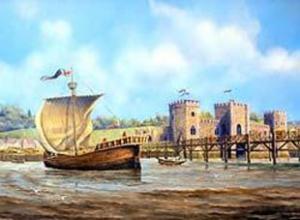
It looks like gloop from the River Usk. But as Mike Buckingham finds out, where there's muck there's an historical treasure trove. Mud, mud, apparently inglorious mud stored in 50 building waste bags may contain historical gold relating to Newport's mediaeval ship.
"And just as the old prospectors panned for gold we are going to have to sift through this lot to get it to reveal its treasure" Charles Ferris who has led the campaign to save the ship says.
Mr Ferris who is also a Newport councillor stands in front of unpromising rows of plastic bags ranged three deep on metal shelving in the industrial unit where remnants of the 550-year-old vessel are stored.
"And that's the easy part" he with a faint smile eloquently conveying under-estimation.
"After that the coins, scraps of clothing and bits of leather, fishbones, nails and items of lost cargo will have to be analysed, photographed and stored.
"The gold waiting to be discovered is the most detailed insight we can hope for of life in Newport and on board the ship at a crucial stage in the history of the development of sailing vessels." -
Sunken treasure stirs international booty battle
- On 25/03/2009
- In Illegal Recoveries

By Mike CelizicCourts will decide who owns $500 million haul found off coast of Portugal.
If he’s a pirate who’s made off with a half-billion-dollar booty haul, as Spain says he is, Greg Stemm didn’t look the part. Sporting a closely trimmed gray beard and wearing a sport coat with a black shirt and matching slacks, he never once said “Arrrr” or “matey.” He didn’t even have an eye patch or a parrot perched on his tweed-upholstered shoulder.
But what Stemm, the CEO of Odyssey Marine Exploration, does have in a warehouse somewhere in Florida is a haul of hundreds of thousands of coins — gold pieces of eight and silver coins — that the Spanish government says belongs to the people of Spain.
A U.S. District Court judge who has been hearing arguments in the case since last year is expected to rule soon on who is the rightful owner of what is reported to be the largest treasure ever recovered from the deep. -
Cornish divers forced to plead guilty to Spanish wreck plunder charges
- On 25/03/2009
- In Illegal Recoveries
From This Is Cornwal
Three deep-sea divers from Cornwall were today forced to plead guilty in Spain to crimes they did not commit to avoid potentially being jailed for six years, writes Jeff Reines.
Self-employed commercial divers Malcolm Cubin, from Truro, Peter Devlin, of Falmouth, and Steve Russ, of Helston, appeared at court in Santiago, Galicia, for about 20 minutes this morning, following last-minute negotiations with prosecutors.
They admitted damaging and stealing from a wreck and each received two six-month prison sentences, suspended for two years, and a £4,700 fine.
But they have always insisted they never touched the wreck of the Don Pedro, having been licensed by the Spanish government to recover tin from a sunken Dutch ship nearby, the Friesland.
During the salvage operation seven years ago, they were arrested and accused of plundering treasure from the Don Pedro.
The charges have hung over their heads ever since and they were due to face a full trial starting today, which could have resulted in prison sentences of up to six years and fines of £40,000. -
Fate of Titanic, its treasures in US judge's hands
- On 25/03/2009
- In Famous Wrecks
By Steve Szkotak
Nearly a century after the Titanic struck ice in the North Atlantic, a federal judge in Virginia is poised to preserve the largest collection of artifacts from the opulent oceanliner and protect the ship's resting place.
U.S. District Judge Rebecca Beach Smith, a maritime jurist who considers the wreck an "international treasure," is expected to rule within weeks that the salvaged items must remain together and accessible to the public. That would ensure the 5,900 pieces of china, ship fittings and personal belongings won't end up in a collector's hands or in a London auction house, where some Titanic artifacts have landed.
The judgment could also end the legal tussle that began when a team of deep-sea explorers found the world's most famous shipwreck in 1985.
The salvage company, RMS Titanic Inc., wants the court to grant it limited ownership of the artifacts.
At the same time, a cadre of government lawyers is helping Smith shape covenants to strictly monitor future activity at the Titanic wreck 2 1/2 miles beneath the surface of the Atlantic. Amid evidence of the ship's deterioration, experts and government lawyers say the sanctity of the Titanic must be properly protected as a memorial to the 1,522 people who died when it went down.
"For the most part, the value of Titanic is its history — and not from some pile of gold, silver and jewels," said Ole Varmer, an attorney in the international law office of the National Oceanic and Atmospheric Administration, whose office has developed guidelines for the Titanic. -
Odd paintings from shipwrecks
- On 24/03/2009
- In Eastern World Treasures
From Viet Nam Net Bridge
Some local newspapers recently wrote about a painting on a ceramic plate made in Vietnam in the 15th century. That painting clumsily shows a couple who are making love and one standing watching them. But there are more than that.
Archaeologists discovered this plate in a shipwreck off Cu Lao Cham Island in the central province of Quang Nam. Dr. Nguyen Dinh Chien, who oversaw the operation, said that since this object was incomplete, archaeologists didn’t pay attention to it.
It was discovered when they classified objects a long time after that. Dr. Chien affirmed that plate is a Vietnamese antique dating back to the 15th century and said it might have been made to order.
Experts say that the artistic value of this painting is not much because the woman has a badly-proportioned body and the posture of the couple is not romantic at all.
It was surely not made to serve playboys nor does it bear the hallmark of a religion or belief. It looks like a lively scene painted by a ceramic artisan when he was greatly elated. -
Greek fisherman nets 2,200-year-old bronze statue
- On 24/03/2009
- In Underwater Archeology
From The Associated Press
A Greek fisherman must have been expecting a monster of a catch when he brought up his nets in the Aegean Sea last week. Instead, Greek authorities say his haul was a section of a 2,200-year-old bronze statue of a horseman.
A Culture Ministry announcement said Monday the accidental find was made in waters between the eastern islands of Kos and Kalymnos.The fisherman handed over the corroded metal figure to authorities, who have started the cleaning process. Dating to the late 2nd century B.C., the statue represented a male rider wearing ornate breast armor over a short tunic and armed with a sheathed sword.
The trunk of the horseman and his raised right arm have survived.
-
Ship salvaged from Red River
- On 21/03/2009
- In Underwater Archeology
From VNS
Archaeologists believe that a sunken ship salvaged last week from under the Hong (Red) River between Hung Yen Province and Ha Noi belonged to 19th century Chinese merchants.
Among the objects recovered from the wreck was cu nau, a substance used centuries ago for colouring cloth.
"The cu nau had not yet dissolved but was fossilised," Pham Trung Hieu, curator of the Hung Yen Province Museum, said.
A wooden trunk, a porcelain statue of the Goddess of Mercy, three bowls, and some dishes, all made in China in the 18th century, were among the other objects found.
"The word Jiangnan, the name of a province in China, is painted on the trunk," Hieu said. From the shape of the 27m long wooden vessel and its equipment, archaeologists place it in the 19th century and believe it was powered by coal.