HOT NEWS !
Stay informed on the old and most recent significant or spectacular
nautical news and shipwreck discoveries

Search for sunken hospital ship Centaur to start in December
From News
The search for a torpedoed World War II hospital ship in Queensland waters will start next month.
Prime Minister Kevin Rudd and Premier Anna Bligh today said the hunt for the Centaur was expected to start in mid-December. A Japanese submarine torpedoed the hospital ship off south-east Queensland in May 1943, killing 268 people.
Premier Anna Bligh said a Defense Maritime Services vessel, the Seahorse Spirit, would play a critical role in the search.
She said deep-sea side-scan sonar equipment and a remotely operated submersible vessel capable of being operated at depths of up to 6000m were among the specialized equipment sourced from two US based firms.
"This is highly specialized equipment operated by only a handful of companies worldwide, with the majority based in the USA," Ms Bligh said.
"As the search is expected to be very challenging, with initial indications that the sub-sea terrain in the search area is steep and rugged, we need the best equipment and best people available to help us achieve success on this mission."
Divers taught to preserve secrets in old shipwrecks

From Bangkok Post
About 18 meters below the sea off Rayong province, 15 divers from seven countries are exploring a wooden shipwreck.
The exploration is part of Unesco's six-week training on underwater cultural heritage preservation.
The divers are from Cambodia, Indonesia, Laos, Malaysia, the Philippines, Sri Lanka and Thailand.
They have been picked for an underwater heritage protection programme organised by the United Nations Education, Scientific, and Cultural Organisation (Unesco) and the Fine Arts Department's Underwater Archaeology Division (UAD) which runs from Oct 26 to Dec 6.
Division head Erbprem Vatcharangkul said Thailand has 64 underwater archaeological sites. He said all of them, especially those in shallow water, were under threat from treasure hunters.
Protection of the sites required well-trained staff and cooperation from local people, including fishermen.
Other countries in the Asia-Pacific region face similar problems which prompted Unesco to set up the regional field training center to promote underwater heritage protection in the region and to exchange conservation information.
Treasure hunter: N.S. not protecting heritage
By Beverley Ware - The Chronicle Herald
A self-described treasure hunter said Nova Scotia is not living up to its obligations to protect its marine cultural heritage.
Robert MacKinnon of Sydney spoke in Halifax Saturday at a small gathering of diving enthusiasts concerned about revisions to the province’s Treasure Trove Act.
The act allows private treasure hunters to keep 90 per cent of the "financially significant" spoils of shipwrecks. The remaining 10 per cent of what is not deemed treasure goes to the province.
The act was implemented in 1954 to deal with prospectors seeking treasure on Oak Island. Some members of the archeological community say it should be thrown out, while its supporters say it provides for plenty of checks and balances and should be left alone. The province has commissioned a review that is not yet complete.
Mr. MacKinnon said he has been involved in about 15 treasure trove recoveries in Nova Scotia through wrecks such as the Auguste and Feversham off Cape Breton. He said he is responsible for 90 per cent of all marine treasure trove that has been handed over for conservation, but he said the province isn’t taking proper care of those artifacts.
Divers believe they've found Civil War-era steamer off Bayport

By Dan DeWitt - Tampa Bay
Considering the divers were looking for remains of an iron-hulled Civil War-era steamer, Tom Allyn's news was about as good as it could be.
"I found something — it's old and it's metallic,'' said Allyn, wearing a wet suit and standing in chest-deep water off Bayport Park on Thursday morning.
Then, moments later, marine archaeologist Billy Morris surfaced with an update that topped Allen's.
"It's a piece of steam pipe,'' Morris said.
That pipe, about 9 inches in diameter and 2 feet long — definitely iron and definitely consistent with the side-wheeler the divers were looking for — is some of the most solid evidence ever found of a dramatic and often overlooked chapter in Hernando history.
Andalucía apoya la intervención de la Armada en defensa del Patrimonio
Jesus Garcia Calero - ABC
Han bastado 48 horas. Ya nada impide que el convenio de los Ministerios de Cultura y Defensa se ponga en marcha y se permita a los buques cazaminas de la Armada colaborar con los arqueólogos para que no se vuelva a repetir un expolio como el que Odyssey pudo cometer en aguas del Estrecho de Gibraltar.
Como ya publicó ABC, Defensa y Cultura acordaron en julio realizar intervenciones arqueológicas en colaboración con las Comunidades Autónomas. Su voluntad era comenzar por Andalucía antes de acabar el verano, pero la Junta, tal vez mal asesorada, impugnó el acuerdo y amenazó con un conflicto de competencias, mientras catalogaba pecios que no podría proteger en solitario.
Ayer, en una rápida reacción, la Junta de Andalucía, por decisión de su presidente, José Antonio Griñán, ha enterrado esta beligerancia y ya ha comunicado que se muestra de acuerdo en la colaboración de la Armada en la defensa del patrimonio sumergido, con el simple añadido de una adenda al convenio interministerial que reconozca su papel en el proyecto.
Read more...
OME busy with deep-ocean gold and copper deposits
From Welt Online
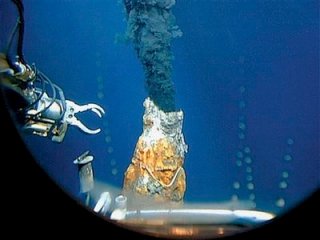
Odyssey Marine Exploration has acquired a minority interest in SMM Project LLC, a company funded by a group of investors to bring together the exclusive licenses and skills of world renowned deep-ocean geologist Dr. Timothy McConachy of Bluewater Metals, the deep-ocean survey and exploration expertise of Odyssey, and the offshore coring and mining expertise of Robert Goodden.
SMM Project LLC recently purchased a majority interest in Bluewater Metals Pty Ltd, an Australian company with licenses for mineral exploration of approximately 150,000 square kilometers of ocean floor in four different countries in the South Pacific.
The group will focus on the exploration and monetization of gold and copper-rich Seafloor Massive Sulfide (SMS) deposits through a new business entity which will acquire the remaining interest in Bluewater, in accordance with a memorandum of understanding concluded between the parties.
It is anticipated that Odyssey will dedicate certain marine assets, including a ship and related marine exploration technology to the endeavor, and will own approximately 40% of the new entity.
In addition, Odyssey is expected to provide proprietary expertise and personnel management to the entity under contract, and will supervise operations to explore for deep-ocean gold, copper and silver deposits in areas covered by exploration permits currently held by Bluewater Metals.
250,000 pieces of Blackbeard from shipwreck
From Island Gazette
Since the N.C. Department of Cultural Resources (NCDCR) began excavating the shipwreck believed to the Queen Anne’s Revenge, Blackbeard’s flagship, more than 250,000 objects have been recovered from the Atlantic Ocean, near Beaufort.
All recovered artifacts go through the conservation lab located at East Carolina University in Greenville. On Friday some of the latest artifacts readied for exhibit, and cannons and other works in progress, were reviewed for the news media at the lab.
“Some artifacts are in a stone like coating and are concreted together,” explained Chief Conservator Sarah Watkins-Kenney. “We may not know what’s in them when they come up.
Some objects, like ballast stones, don’t take long to conserve. Some, like cannons and hull timbers, can take four or five years.”
Among the showcase finished artifacts were a pair of copper alloy cuff links, neither as large as a dime, which were in good condition and intact. Another item was a pewter clyster syringe, indelicacy aside, which was used for enemas.
Both took about two years to conserve.
They are among items shown that will be transferred to the N.C. Maritime Museum in Beaufort in January, and will be exhibited by Valentine’s Day. A belt buckle, nesting weight, wine bottle and apothecary mortar also were displayed.
Australia announces $439,928 funding for Historic Shipwreck protection

From Sail the World
Federal Heritage Minister Peter Garrett today announced funding of $439,928 for projects that will protect the nation's underwater cultural heritage. A total of 25 projects across Australia will receive funding under the Historic Shipwrecks Program.
'The Historic Shipwrecks Program provides important financial assistance to state and territory agencies who manage, protect and raise awareness of historic shipwrecks on behalf of the Commonwealth,' Mr Garrett said.
'This annual funding helps protect shipwrecks and their relics and promotes activities which encourage people to visit shipwreck sites and gain a better understanding of conservation issues.
'It also promotes better understanding of the stories associated with the wrecks and gives us a fascinating insight into Australia's significant maritime past and the often treacherous journeys undertaken in the past.'
Projects to receive funding include:
* New South Wales — historic shipwreck survey, recording and monitoring of Commonwealth Historic Shipwrecks to expand the inventory and knowledge of known sites and newly detected or reported sites. This includes continuing investigations at the M24 Japanese midget submarine site and the convict transport shipwreck site of the Hive (1835) and its associated survivor’s camp near Jervis Bay.
* Victoria — funding will support Heritage Victoria staff to support the National Historic Shipwrecks Research Project which will focus on the preservation and reburial of historic shipwreck artefacts. The Victorian historic shipwreck Clarence (1850) has been selected because of its archaeological potential.