HOT NEWS !
Stay informed on the old and most recent significant or spectacular
nautical news and shipwreck discoveries

By John Christoper Fine - The Epoch Times
Ocean explorers in West Palm Beach found the treasure of Hernan Cortez. Long after the conqueror of Mexico’s death, his family was shipping some of his personal fortune back to Spain.
The cargo contained Aztec crystal skulls.
The ship was lost in a fire at sea. It burned to the water line then sank in deep water off Florida’s coast.
Diver, art expert, and undersea explorer Dr. Victor Benilous was contacted by a representative of the Cortez family and given information about the shipwreck. Benilous was well-known for his work on the oldest shipwreck in the Western hemisphere, found off Juno Beach.
The information he was given was sparse. It contained a log entry from another captain who had reported seeing a fire out in the Atlantic 250 years ago.
With the use of world-renowned psychics, Dr. Benilous and his team of divers located the wreck. One of the psychics was taken aboard the dive vessel. This same psychic is used by U.S. military and police authorities to locate missing planes and people.
“Dive here,” the psychic said. Deep below the spot where the psychic said dive, not 10 feet from the place where the anchor was dropped, an Aztec crystal skull was recovered.
Power ? Special properties ? Healing and spiritual abilities ? Margaret Ann Lembo thinks so. Margaret is the affable owner of The Crystal Garden on North Federal Highway in Boynton Beach, Florida.
The center conducts workshops and sells books, gifts, and jewelry. She invited Bill Homann from Indiana to speak at the Boynton Women’s Club and bring the famous Mitchell-Hedges crystal skull with him.
Bill Homann is a tall man with a moustache. His business card shows him in safari hat, in a tropical background, with the legend “A ‘Real Life’ Indiana Jones” printed beneath it.
He came to Boynton Beach with a PowerPoint presentation that showed F.A. Mitchell-Hedges and his daughter Anna during their exploration and digs in Central America.
The vintage photographs depict the jungle around the Mayan city of Lubaantun, in Belize, where the crystal skull was found.
Margaret Ann Lembo’s introduction of “Bill’s intention of goodness and love,” preceded the lecture. Photographs from the 1920s showed Mitchell-Hedges and his daughter Anna on various expeditions, including fishing, a sport the explorer was fond of.
The crystal skull was found in 1924 inside a pyramid. “It is a perfectly made quartz crystal, anatomically correct for a Meso-American female, aged 25 to 29.
The jaw and the top cranial part are the same crystal. It was one piece of crystal at one time. It is very hard to separate crystal. It’s brittle. The skull contains three prisms and two lenses built into the crystal skull. The only way you can do that is in zero gravity,” Homann explained.
Precious peacock: Heritage listing for $4m maritime showpiece

By Peter Collins - The Standard
It's sailed half-way around the world, survived a shipwreck 130 years ago and is valued at more than $4 million. Now the Loch Ard peacock has finally been included in Victoria's heritage register.
The life-size Minton porcelain artwork statue, which is the centrepiece of Warrnambool's Flagstaff Hill maritime history display, is insured for $4 million and kept in a padded glass case with electronic security.
Heritage Council of Victoria chairman Daryl Jackson described the peacock as a "very significant" object for Victoria.
"It is associated with a number of important events in the history of Victoria: the Loch Ard shipwreck, the exhibition of 1880-81 and the opening of the Royal Exhibition Building," he said.
The statue was shipped to Australia in the Loch Ard from England in 1878, destined for the official opening of the Melbourne exhibition building. But it only made it as far as the rugged coastline near Port Campbell when the ship was wrecked in one of Australia's worst maritime tragedies.
It sank in just 15 minutes with the loss of 52 lives.
Two days later a wooden packing crate containing the peacock was washed onto the beach at what is known as Loch Ard Gorge. It was found by local resident James Miller and remained in his family until 1943.
It came to Flagstaff Hill in 1975 after a local committee, the city council and Fletcher Jones organisation chipped in about $4500 to buy it through a Melbourne auction house.
The precious statue made the trip to Warrnambool in the back seat of a car.
Yesterday's heritage listing announcement was the culmination of months of work by retired teacher Ron Sproston a Flagstaff Hill Maritime Village volunteer who compiled an extensive document for Heritage Victoria on the peacock's history and significance.
By Eti Bonn-Muller - Archaeology
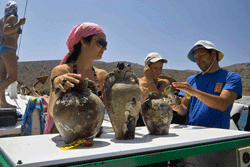
An unprecedented find off the coast of Crete.
Crete has seduced archaeologists for more than a century, luring them to its rocky shores with fantastic tales of legendary kings, cunning deities, and mythical creatures.
The largest of the Greek islands, Crete was the land of the Minoans (3100-1050 B.C.), a Bronze Age civilization named after its first ruler, King Minos, the "master of the seas" who is said to have rid the waters of pirates.
According to Thucydides, he also established the first thalassocracy, or maritime empire. The Minoans were renowned for their seafaring prowess, which opened trade routes with the powerful kingdoms of Egypt, Anatolia, and the Levant.
Depictions of ships abound on Minoan seals and frescoes. They are detailed enough to show that the vessels were impressive: generally, they had 15 oars on each side and square sails, and were probably about 50 feet long.
But little more was known about actual Minoan seafaring--until Greek archaeologist Elpida Hadjidaki became the first to discover a Minoan shipwreck.
Hadjidaki, a self-described "harbor girl," was born and grew up in the Cretan seaside town of Chania. An experienced and passionate diver trained in classical archaeology, she received funding from the Institute for Aegean Prehistory in 2003 to search for early ships near Crete.
"I always wanted to find a Minoan shipwreck," she says, "so I started looking for one."
For nearly a month, she and a team of three sponge and coral divers aboard a 20-foot-long wooden fishing boat trolled up and down the island's shores.
Together with George Athanasakis of Athens Polytechnic University, they used side-scanning sonar and detected some 20 "targets," or anomalies, that Hadjidaki sent her divers to investigate, often reaching depths of 400 feet.
One by one, they turned out to be a depressing array of natural geological formations and portions of the seafloor ripped up by the nets of deep-sea trawlers, as well as a World War II airplane, a 19th-century shipwreck, and several pairs of shoes.
Whydah group pulls out of Armory plan
By Ted Hayes - East Bay RI
A Provincetown, Mass. shipwreck hunter has pulled out of a plan to bring a pirate museum and conservation and research center to the Thames Street Armory.
Barry Clifford, who had been chosen by the Newport Redevelopment Agency as a partner in plans to renovate the landmark structure, officially withdrew his plan for the Armory Tuesday afternoon, saying the process had just become too political.
“It just got way too confusing,” he said Wednesday. “We’ve got other options, but it’s too bad. We definitely would have come to Newport if it hadn’t gotten out of hand like this.”
Mr. Clifford had been on the fence about quitting the project for nearly a month, and in fact submitted a withdrawal letter to the city on Thursday, Jan. 21. However, he was persuaded by some city officials to “put the letter in a drawer.” That changed Tuesday when one of his representatives had a meeting with city officials that did not go well, he said. That's when he decided to re-submit the letter.
“They knew where I stood, but in the end there was just too much going on. We don’t have time for this,” he said.
Specifically, Mr. Clifford was referring to several issues that have sprung up around the Armory over the past several weeks.
They include differences of opinion on what the best use of the building is, questions raised by some over Mr. Clifford’s financial plan, and other questions about whether the Ann Street Pier would be available for use by his research vessel, the Vast Explorer II.
He said the project needn’t have become so convoluted.
“All we were really looking to do was rent the space,” he said.
“We weren’t looking to really get into a major development. But then to find they want you to spend millions of dollars and then have to rent the building ? It was too much.”
Dentist leads Tongan police to sunken ship
From New Tang Dynasty Television
What does a shipwreck and dentistry have in common ?
It's a riddle that's just been unraveled by Tonga police. Suspicions were aroused when people began turning up to this dental practice with lumps of gold to be melted.
[Teisi Taimani, Dental Surgery Assistant]:
"From last year to this year many people were coming in with it. The end of each side, you see it's like it's gold there, because its shiny on the edge where they cut it."
The pieces being brought in were mostly too big to be melted. Police issued search warrants for five suspects.
[Chris Kelley, Tongan Police Commander]:
"The addresses yielded items and objects as well as the quantity of ammunition which we were also very interested in."
The recovered booty led authorities to a previously unknown shipwreck off the Tonga coast. Four people, including the older man seen here, have been charged with taking items from a sunken vessel.
[Chris Kelley, Tongan Police Commander]:
"Shipwrecks within the territorial waters are government property."
But all that glitters is not necessarily gold - tests are yet to determine whether the yellow metal is the real thing.
Shipwreck found in Tonga may have gold

From TVNZ
Police have found a shipwreck in Tonga after large numbers of people started turning up at dentists wanting to melt down gold items.
The ship is a mystery but four men have been charged with removing items from a wreck and not reporting it.
One of those four is navigator Tuakalau Loufau, who along with three others, has been charged with finding a shipwreck and taking items from it.
The police were tipped off about the mystery shipwreck off the main island of Tongatapu, when people started turning up to dental surgeries wanting to melt down what appeared to be gold.
"From last year to this year many people were coming in with it&the end of each side it's like gold there because it's shiny where they cut it," dental surgery assistant Teisi Taimani said.
The gold-like tubes measured up to 12 centimetres.
"When they came in we can't do anything with it. It's too big, we told them we cant do anything," says Taimani.
But when the police heard - they did do something, issuing five search warrants.
"Shipwrecks within the territorial waters are government property and so you're required when you find one to notify authorities and not to remove any items from that wreck," says Tongan Police Commander Chris Kelley.
New rules could limit the hunt of sunken treasure off Florida's coast
By Pamela V. Krol - Naples News
For years, sunken treasure off Florida’s coast has been a relative free-for-all for anyone with the time and ability to find it.
But proposed rules could make it harder for treasure hunters to collect the prized relics.
Some commercial salvers suggest the waters off of Florida contain more Colonial-era sunken treasure than any other place in the world, with a value estimated to be in the billions of dollars.
Salvage companies estimate at least a million dollars worth of treasure is in the Naples/Fort Myers area alone and artifacts worth hundreds of thousands of dollars are salvaged in and around Southwest Florida, by both commercial and recreational divers, each year.
Treasure hunting has been legal in Florida since the 1960’s. Recently, however, groups of marine archaeologists are fighting to have the practice outlawed.
Many in this camp consider treasure hunting to be little more than state-sanctioned looting of what they believe should be deemed historical sites. These groups are pushing for tougher laws and outright bans in many cases.
Over the past decade, marine archaeologists have successfully championed greater restrictions on Florida’s treasure hunting industry and have recently brought requests for modifications to the state’s rules governing the recovery of historical shipwrecks by private sector salvers.
Their requests would limit salvage permits to a period of one year and narrow search areas to one mile. They would also mandate that an archeologist be on board the search vessel.
The proposal would prohibit hunters from searching for treasure up to 500 yards offshore — the range that is considered the most treasure-rich because storms and hurricanes naturally wash shipwrecks toward the shore.
The rules could threaten the livelihoods of local treasure hunters, such as Captain Kym Ferrell, a Florida native who has been working aboard salvage vessels since he was 14.
He and a small crew of three to four people choose search sites based on historical research, instinct and knowledge of the local waters. Ferrell said he’s found treasure near Naples but would not say where.
By Matthew Aid with William Burr and Thomas Blanton - National Security Archives
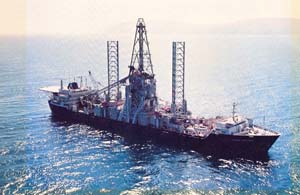
The CIA's Declassified History of the Glomar Explorer.
For the first time, the Central Intelligence Agency (CIA) has declassified substantive information on one of its most secret and sensitive schemes, "Project Azorian," the Agency codename for its ambitious plan to raise a sunken Soviet submarine from the floor of the Pacific Ocean in order to retrieve its secrets.
Today the National Security Archive publishes "Project Azorian: The Story of the Hughes Glomar Explorer," a 50-page article from the fall 1985 edition of the Agency's in-house journal Studies in Intelligence. Written by a participant in the operation whose identity remains classified, the article discusses the conception and planning of the retrieval effort and the creation of a special ship, the Glomar Explorer, which raised portions of the submarine in August 1974.
The National Security Archive had submitted a Freedom of Information Act (FOIA) request to the CIA for the document on December 12, 2007.
National Security Archive director Tom Blanton commented that "the Navy alternative to the Glomar Explorer--investigation by a deep sea submersible--sounds more convincing than the claim in the Studies in Intelligence article that Project Azorian advanced the cutting edge of deep sea exploration the way the CIA did on aerial and satellite reconnaissance. To me, Glomar resembles the Bay of Pigs more than U-2 or Corona.
On the latter, they brought in the best people, Ed Land and the Skunk Works, on the former, they only talked to themselves."
Also published today for the first time are recently declassified White House memoranda of conversations from 1975 which recount the reactions of President Ford and cabinet members to ongoing news of press leaks about the Glomar Explorer, including Seymour Hersh's exposé in The New York Times on March 19, 1975.