HOT NEWS !
Stay informed on the old and most recent significant or spectacular
nautical news and shipwreck discoveries

From the Fence Post
It is nothing short of incredible, the power of mud to preserve. In 1856 the Arabia steamed away from St. Louis bound for ports along the Missouri River where the 200 tons of cargo she carried would be distributed for use in frontier communities.
On Sept. 6, 1856, the Kansas City Enterprise reported, “The steamer Arabia bound for Council Bluffs struck a snag about a mile below Parkville and sunk to the boiler deck — Boat and cargo a total loss.”
The sinking occurred the previous day.
The muddy waters of the Missouri had obscured the snag that bored into the hull of the Arabia, causing the vessel to quickly flood and sink.
Although the crew and passengers — around 130 people in all — survived, the boat laden with merchandise quickly floundered and submerged.
There may have been minimal recovery of goods, but the vast majority of the cargo soon lay in the mud bottom of the Missouri.
The constant wash of water and mud completely covered the Arabia. Over the decades, the river shifted and moved, changing course as all active waterways tend to do.
Treasure hunters began searching for the Arabia. They looked where the river now flows, to the north, to the south, eventually to the west.
And in a farmer's field a half-mile from the present river's edge, in 1988, they found the Arabia, lying buried in mud and soil 45 feet below the surface. The discovery was not just an affirmation of where the steamboat lay, but became an intense archaeological and historical investigation.
The discovery of the Arabia came at the hands of five men: Jerry Mackey, Bob Hawley and his sons, Dave and Greg, and David Luttrell.
Their wives were not too interested in their quest for treasure ... at least not until they pulled the first outstanding piece of china from the hulk.
As the treasure hunters recovered the first plunder from the black, muddy soil they were astounded.
Fine English china had survived the snag and although mud-crusted was perfectly preserved. Beautiful pitchers and patters, cups, plates, saucers, bowls and more were lifted into the daylight for the first time in 132 years.
Controversial Southampton Sea City Museum
From Culture24
The futuristic maritime museum at the centre of divisive plans to sell off artwork by Southampton City Council has been given £4.6 million by the Heritage Lottery Fund.
Southampton Sea City Museum, a £15 million archaeological and naval showcase designed for a new Cultural Quarter in the city in 2012, will use a converted Grade II-listed magistrates' court to house permanent galleries on immigration and the 549 local voyagers who died when the Titanic sank in 1912.
It drew derision in September 2009 when the Council earmarked two works from Southampton City Art Gallery's revered municipal collection for disposal in a bid to raise up to £4 million towards the development.
Critics, campaigners and a Museums Association warning that the move could have breached its Code of Ethics forced planners to backtrack, but they remain under pressure to raise cash in matchfunding for the HLF award.
Speaking at the time, Council Leader Alec Samuels warned outraged residents that the authority could not afford the Museum without selling Alfred J Munning's After the Race and Auguste Rodin’s Eve.
"If we don't sell some paintings, we don't get a heritage centre,” he said.
"The Heritage Lottery Fund has offered £5 million, £5 million can be raised from business and sponsors, and the remaining £5 million falls to the City Council, which has no money for such a project.
“These decisions have not been taken lightly. The iconic Heritage Museum will bring many more people to the Cultural Quarter and the old and new art galleries.”
The Museum is the first beneficiary of an explosion in Lottery ticket sales which has allowed the Fund to announce a £25 million annual budget increase for heritage projects across the country, rising to £205 million from April.
The ravages of the recession appear to have left most people hoping for a pay-out from Lady Luck, and the official statistics are expected to show record flutter figures when they are published in May.
Marine science in Chile shaken

By Lisa Levin - NOAA
On Feb 27, I went down to my cabin to nap before a load of core samples arrived on deck.
It was after 3 am. and a long stretch of work remained. As I headed down all was well. When I came back up 45 min. later central Chile had just experienced an 8.8 magnitude earthquake, one of the largest ever recorded.
Over the next few days news slowly arrived over our frustratingly slow shipboard email system. My concern was for the people of Chile, but also for the many friends I had made in 1998 during my time on sabbatical spent at the University of Concepcion and the University marine lab in Dichato. The quake epicenter was only 70 miles from Concepcion.
As communications resumed, I heard directly from some friends and indirectly about others. Most of the marine scientists I knew seemed alive and unhurt.
The same was not true for marine science itself in Central Chile. Strangely enough the tsunamis resulting from the quakes and aftershocks did the most damage.
The wonderful marine laboratory at Dichato, where I had worked for one summer and returned to teach for part of another, was completely destroyed by a series of 3 tidal waves.
These arrived 30 minutes apart, the first 2 hours after the initial quake. The loss of instrumentation, lab equipment, computers, samples and countless hours spent generating data is catastrophic and heartbreaking.
Many of the top marine researchers at the University of Concepcion made this laboratory their base of operations. Only the side walls remain, most of the contents and parts of the roof are gone.
The Kay Kay, the University’s 18m research vessel was left high and dry nearly one kilometer inland.
Although this ship could have been salvaged, vandals have apparently removed all of its instruments.
Wrecked and buried, now stripped and sold
By Chris Kamalendran - The Sunday Times
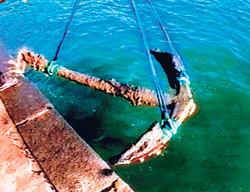
A racket involving the illegal salvaging of ship wrecks in the territorial waters of Sri Lanka and selling them off as scrap iron has surfaced, but officials appear to be lost at sea as loopholes in the law and political patronage have made things smooth sailing for the racketeers.
The Sunday Times learns that since the conclusion of the war, a group based in Colombo together with operatives in the north east and area politicians are behind the vandalising of sunk vessels.
More than 80 vessels, including foreign ones and those that once belonged to the defeated LTTE are known to have sunk off the northern and eastern seas in the past few years. Legally the state owns these wrecks.
However, well-organised racketeers, with powerful backing have begun salvaging these wrecks with the expertise of master divers and high-tech equipment. The iron is later sold off as scrap for millions of rupees in the open market.
The racket surfaced recently following the arrest of a group of people in Ampara along with a large stock of scrap iron. It was later revealed that these had been salvaged from a sunken ship off Ampara coast.
The group had carried out their operations armed with a document purportedly issued from the Coast Conservation Authority, endorsing the salvaging of the ships.
However, the CCA does not have the mandate to issue such a permit, the Sunday Times learns.
Sunken Treasure Ship of Playa de Oro Beach Manzanillo
From Manzanillo Blogger
146 years ago on the Sunday evening of July 27, 1862 this beautiful beach provided a much different scene. The surf was up that afternoon, viciously beating the shores.
Reflected in the violent waters was the inferno of flames pouring out of a nearby wrecked ship.
The very waves that surfers now carve were strewn with the battered bodies, wreckage, and gold that had fallen overboard.
The screams of the drowning burning men must have been terrible, covered over only by the roar of the unrelenting surf and explosions from the nearby shipwreck.
How did this happen ? It was the middle of the American Civil War. The boat was the S.S. Golden Gate, one of the fastest paddle steam ships on the West Coast.
338 passengers and crew, along with a reported $1.4 million in gold were sailing on a voyage from San Francisco to Panama. They never made it.
When the S.S. Golden Gate was just 15 miles off the shore of Manzanillo Mexico it was reported that there was a fire in the engine room. Since they were only a short distance away from the safety of shore the ship headed towards the beach.
The spot where they landed was at a rock called Pena Blanca.
The passengers were ordered off into lifeboats, but many never made it.
The fire spread rapidly, quickly engulfed the entire ship in an inferno of flames. The survivors were forced to jump overboard, putting themselves at the mercy of the currents and violent waves. Many died in the relentless surf, too weak and injured to make it to shore.
When help finally arrived 204 of the passengers and crew of the S.S. Golden Gate had already died. The ship itself was completely destroyed by the flames and pounding seas.
The massive iron boxes that had contained the golden treasure sunk down into the sand were quickly buried.
The strange mystery of the ship and the cursing stone

From the Derry Journal
The six survivors of the sinking of the HMS Wasp at Tory Island in 1884 were given a rousing welcome when they got to Derry afterwards.
Was the shipwreck the result of a catalogue of errors - or were dark otherworldly forces called up by the islanders ?
Ken McCormack investigates. Did the Cursing Stone of Tory sink the Wasp ?
It is one of the country's great unsolved mysteries. How could a sound ship, in familiar waters and in good weather conditions, be lost on rocks at Tory Island ?
Despite an Admiralty enquiry, no logical reason has ever been given. On Tory the story is still as alive as it was on that fateful night of September 1884. And you'll meet island folk who'll tell you outright that HMS Wasp perished because Tory's famous 'Cursing Stone' was turned against the vessel.
HMS Wasp was a 145 foot long gunboat powered by steam and sail. She was built in 1880 and based in Queenstown (Cobh, Co.Cork) with a complement of sixty crewmen. Her main functions were to convey parties for fishery and lighthouse inspections or other official duties.
And while she had delivered relief foodstuffs to the offshore islands, she also had the more distasteful task of ferrying bailiffs and constabulary for rent collections and evictions.
The talk on Derry Quay was that the sailors were not at all happy with these missions to the islands. Certainly such raids were the source of major discontent – landlords and the agents of officialdom were despised in equal measure and not welcome on Tory or anywhere else along the coast.
In the 1880s Derry was a thriving city and popular with the crew of the Wasp. She berthed at the port frequently throughout 1883 as did her sister ship HMS Valiant. And such were the high spirits on one visit that the sailors of both vessels opted to have their photographs taken at Hugh Kerr's new studio in Carlisle Road. How strange fate is – I'm sure both sets of crewmen never suspected they'd be in the throes of a major disaster within a year.
It happened that early on the morning of Sunday 21 September 1884 HMS Wasp left Westport in Mayo with instructions to sail up the coast to Moville on the Foyle to collect personnel for evictions on Innistrahull Island just off Malin Head.
The crew of the Wasp were familiar with the passage and the trip was going well as the small hours of the following morning approached.
Lost painting could hold key to Welsh shipwreck mystery
From Wales Online
It was a sturdy 500-tonne three- masted rigger that had made it through a treacherous Atlantic crossing only to founder in calm and shallow waters off the Welsh coast.
Now a diving team is hoping a long-forgotten painting holds the key to the whereabouts of the vessel, the Diamond, shipwrecked 185 years ago.
Diver Ian Cundy and his colleagues want to find the painting depicting the loss of the vessel at Sarn Badrig Reef between Barmouth and Harlech.
Mr Cundy and his team have already completed one unsuccessful search for the vessel, which went down with the loss of eight lives, and have now turned their attention to locating the painting.
The 62-year-old from Malvern, in Worcestershire, believes the painting showing the stricken boat upright in shallow water may lead him to the wreck.
Little is known about the painting aside from the fact that it once hung in a rectory near Dyffryn Ardudwy, in Gwynedd.
Mr Cundy, who used to run a boat-building company, said: “We’re hopeful it’s there somewhere because paintings are the sort of things that people generally don’t destroy.
If they don’t like them they’ll take them down and store them somewhere, which is probably where it is.”
In 2000, divers discovered the wreck of a ship initially thought to be the Diamond. But later investigations indicated the wreck was from a later period.
The resting place of the Diamond remains unknown.
DNA to solve origins of Anglesey shipwreck survivors
From BBC News
DNA analysis is being used to help solve the 18th Century mystery of the origins of an Anglesey medical family.
Two boys were sole survivors of a 1745 shipwreck and experts want to find out where in the world they were born.
One of the boys was a brilliant manipulator and healer of bones, and started a family of doctors who helped develop orthopaedic medicine.
Now DNA has been taken from a direct male descendant and scientists hope the mystery will finally be solved.
At the time of the shipwreck the boys were rescued off the Skerries by a smuggler called Dannie Lukie. The story goes that the boys were twins, and probably Spanish nobility, but there is no reliable evidence to support this.
Others say they were Manx, Scots or Dutch.
It is known however that after their rescue the boys were adopted and given the surname "Thomas", one was called Evan and the other Matthew. The one called Matthew seems to have died early-on but Evan went on to become a brilliant manipulator and healer of broken bones.
This spawned an entire family of qualified doctors who helped develop orthopaedic medicine.
One of his descendants, Hugh Owen Thomas, invented the "Thomas splint" which reduced the incidence of deaths from femoral leg fractures during the Great War.