HOT NEWS !
Stay informed on the old and most recent significant or spectacular
nautical news and shipwreck discoveries

Marine Art Museum (Van) Goghs all out
By Dustin Kass - Winona daily News
Minnesota Marine Art Museum officials unveiled a big addition Sunday - a painting by Vincent Van Gogh. "The Beach of Scheveningen," an oil painting the world-famous artist completed in 1882, was one of five new works revealed at an invitation-only event for museum supporters.
The paintings are on loan from the collection of Bob Kierlin and his wife, Mary Burrichter.
The Van Gogh further bolsters a collection already featuring works by Pierre-Auguste Renoir, Claude Monet and Camille Pissarro, and gives people another reason to visit and support the museum, officials said.
"A lot of people who don't know golf know Tiger Woods," said Jon Swanson, the museum's curator of collections and exhibits. "A lot of people who don't know basketball know Michael Jordan. We have something here that's going to draw people in. You can't get any better than Van Gogh."
Museum officials did not reveal many details about the new paintings before Sunday. They included the names of four of the artists in invitations but only said the fifth artist would rival Monet and Renoir. That curiosity spurred about 80 people to RSVP for the fundraising event, and drove most discussions as attendees waited for the black cloths covering the five works to be removed.
The suspense grew as the other four works were revealed. Frederic Edwin Church's "Autumn." Thomas Moran's "Near Southampton." Winslow Homer's "Winding Line." John Singer Sargent's "Landscape with Trees, near Calcot on River Thames."
Kierlin and Burrichter bought the four paintings in November, adding to their personal collection of about 340 works, in addition to about 120 the couple has donated to the museum.
Each unveiling Sunday prompted "ooh's" and applause.
Shipwreck treasure off Kawaroa
By Vicki Price - Taranaki Daily News
Divers sometimes surface clutching treasure found near steamers, ketches and other ships that have wrecked along our coast throughout the last century or two.
Some artefacts make their way on to Adam Rosser's Taranaki Dive Shop shelves for the enjoyment of those on land and to inspire other divers.
A green bottle spotted by divers over many years now rests on the Ocean View Parade shop's shelf, one side of it whitened from where it lay, undisturbed, stuck in the side of a reef that grew around it.
For years, its cork remained intact, until one day it looked as though a curious diver had poked it in. The contents are long gone, but part of the cork remains in the unbroken 142-year- old bottle.
The bottle, a pick- axe head, brass rudder pin and air cylinder are among artefacts from the Tasmanian Maid, a paddle steamer that sank off the Kawaroa Reef in 1868.
The air cylinder was used on steamers to power the paddle wheels until the steam pressure built up enough to keep them going.
The wreck is slowly disintegrating. Many of its portholes have all but disappeared. Mr Rosser says that like many ships and their artefacts which litter the ocean floor in our wild west coast conditions, it will eventually disappear.
During the wars over land ownership in Taranaki 150 years ago, the small steamship, affectionately known as the Maid, was sent from its home at the Port of Nelson to bring women and children back to Nelson if necessary.
It was used extensively by the European militia as a despatch vessel between the ports of New Plymouth and Waitara.
She would carry messages, soldiers (able, wounded and dead) and supplies. During the heat of the war, the Maid could be seen busily steaming between the two settlements nearly every day.
The 83-ton paddle-wheel steamer was built in 1856 and began her service in New Zealand the following year plying trade between Nelson, Motueka, Collingwood and Wairau.
She was the fastest the province had had, running 10 to 11 knots an hour in calm weather and still managing 7 or 8 in a strong headwind. The Maid pursued a valuable career transporting passengers and merchandise around various ports throughout the two islands, until the outbreak of war in Taranaki saw her come into military service.
One of the casualties of the war who was transported by the Tasmanian Maid was esteemed settler, businessman and military man Captain Richard Brown. Capt Brown had been the very first merchant in New Plymouth and for many years carried on extensive trade with European and Maori alike.
When the war broke out, he was already a member of the Taranaki Volunteer Rifles and joined the mounted escort, becoming a highly valued member because of his knowledge of the surrounding country and Maori inhabitants.
Capt Brown had been out for an hour's ride from Waitara to Bell Block to relieve the boredom of military camp life when he was ambushed and shot from close range.
The first bullet struck his leg and passed through, one hit his powder flask and dropped into his boot and the next took him while stooped on his horse, entering below the ribs. He survived for three months, being tended to at Waitara, before succumbing.
His body was taken aboard the Tasmanian Maid with full military honours and transported to New Plymouth.
The ship arrived with her flag at half mast and Capt Brown's body was removed from the ship amid a guard of honour of Bluejackets. He was buried at St Mary's churchyard.
Poole wreck gives up its treasures
By Diana Henderson - Daily Echo
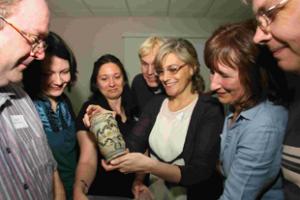
Precious artefacts dating from the 17th century, pulled from a wreck off Poole Harbour, will be displayed at a free lecture. The Swash Channel Wreck, believed to date from the 1620s, is still revealing its treasures to divers from Bournemouth University.
The lecture RMS Titanic: Protection, Preservation & Peril at the university focuses on the famous wreck of the Titanic and how best to preserve it for future generations.
It will be given by Ole Varmer, of the US based National Oceanic and Atmospheric Administration and will concentrate on whether the liner is in “marine peril” and if preserving it in situ is the best solution to protect it.
The lecture is organised by Paola Palma, lecturer programme leader for the university’s masters degree in Maritime Archaeology, who will speak about the Swash Channel Wreck.
Believed to be a high status ship, it lies in 7m of water, and was designated a Historic Wreck in December 2004.
Finds include at least six iron cannon, wooden barrels, rigging, copper, pewter, bones and apothecary jars and a rare wooden carving of a merman, which made headlines when it emerged from the deep in 2008.
Grounded submarine photographed with sonar

By João Medeiros - Wired.co.uk
This eerie wreck image is not computer generated. It's the sonar image of Russian nuclear submarine B-159 (called K-159 before decommissioning), which has been lying 248m down in the Barents Sea, between Norway and Russia, since 2003. The Russian Federation hired Adus, a Scottish company that specializes in high-resolution sonar surveying, to evaluate if it would be possible to recover the wreck.
"The operation was complicated as the submarine was very deep, so we had to use the sonar equipment mounted on a remotely operated vehicle, (below)" says Martin Dean, the managing director of Adus and a forensic-wreck archaeologist.
"We also had a problem with the surveying due to the density of north Atlantic cod attracted to the sound of the sonar and the light of the cameras. So at the beginning we had to turn off the equipment for 40 minutes and wait for the fish to go."
B-159, a November-class sub launched in 1963, was being towed to a shipyard in Snezhnogorsk, 1,000km north of St Petersburg, for scrapping when bad weather caused it to sink, killing nine crew.
"According to the sonar evidence, we can say that it sank stern first, headed down vertically and stuck 12m into the seabed, like a dart," says Dean.
"The hull then snapped at the aft end and crashed to the seabed, leaving about 8m of the outer casing, including the propellers, still buried vertically in the seabed. Surprisingly, the submarine is still in good condition for a salvage."
Shipwreck off Provincetown goes digital
By Mary Ann Bragg - Cape Cod Times
The mighty British man-of-war HMS Somerset III, wrecked off Truro in 1778 during the Revolutionary War, received a high-technology treatment yesterday.
Land surveyors hired by the Cape Cod National Seashore created the first digital archive of the remaining visible timbers of the wreck using a three-dimensional laser scanner.
The surveyors also identified the wreck’s exact longitude and latitude measurements using global positioning, according to the Cape Cod Times. The idea is to create the first permanent digital archive of the wreck of a ship that played a critical role along the East Coast during the War of American Independence.
The digital archive can be used by future researchers and historians. It provides precise, 3-D images of the wreck if it were to ever be destroyed — or disappear, never to return.
More than a dozen heavy, water-soaked ship timbers were sticking out of the sand at low tide yesterday, about two miles east of the Race Point Beach ranger station in Provincetown.
The timbers, most likely uncovered by the heavy winter storms, last poked up out of the sand about five years ago. They also appeared once in the 1970s and once in the 1870s, according to Seashore historian William Burke.
"We were never sure we’d see it again," Burke said.
Protection sought for historic shipwreck

From CBC News
The Yukon government is seeking protection for the Gold Rush-era boat sitting at the bottom of Lake Laberge.
An aquatic archeological team in the summer of 2009 found the A.J. Goddard shipwreck to be in pristine shape at the bottom of the lake, which is located north of Whitehorse.
The heritage department has begun the process of designating the area a historic site.
Doug Olynyk, manager of historic sites for the Yukon government, said the designation will allow the government to open the site to educational tours and keep track of what goes on there.
"We definitely want to keep trrack of who's down there and what their intentions are," said Olnyk. "We want to have it available just like any other Yukon historic site for educational purposes, but we do want to control what activities are there."
Olynyk said they are counting on the public to watch for any unusual activities in the area.
Yukoners have 30 days to make their feelings known on the historic site request.
Launched during the Klondike Gold Rush in 1898, the A.J. Goddard vanished in Lake Laberge during a winter storm on Oct. 22, 1901. Two members of the five-man crew survived but the other three drowned.
The international archeological team, which includes Doug Davidge of the Yukon Transportation Museum, found the steamboat with its hull completely intact and many of the crew members' belongings preserved.
Diver who salvaged £50m of gold from ship puts historical items up for sale

By Gillian Bell - The Press and Journal
Historical objects owned by a diving engineer who salvaged £50million of Russian gold from a wartime wreck will be sold at auction later this month.
Ric Wharton is selling a selection of the contents of Midmar Castle, near Echt, which was put on the market last year for offers over £3.5million.
Lots include a deep-sea diving helmet, a large collection of arms and a rare bronze cannon.
The cruiser HMS Edinburgh was sunk in 1942 after being torpedoed on the return leg of a voyage from the west coast of Scotland to Russia while carrying Soviet gold as payment to the US for military supplies.
Mr Wharton gambled Midmar to help fund the £3million operation to recover the ship’s treasure from the Barents Sea after rating his diving company’s chances at only 10% to 20%. When the expedition was successful in locating and recovering the haul in 1981, he used his share of the salvage reward to fund the restoration of the 16th-century castle and its collection.
Campbell Armour, of auction house Lyon and Turnbull, said: “Midmar is known as the first of the five great castles of Mar and contains many treasures collected by the gold bullion adventurer.”
Spanish treasure found in derelict home
By LynThomas - Business & Finance, Society
Finding wrecks of the Spanish treasure fleet has long been the dream of many explorers, archeologists and would-be treasure hunters.
The ships convoyed treasure between the New World and Spain and included everything from timber, to silver, gold, gems, pearls, spices, sugar, tobacco and silk.
Treasure thieves however, gave themselves up to the police, recently in Madrid, Spain, when their partnership turned nasty.
The gardener, of a derelict mansion in the Catalan interior, broke into the home of his partners in crime and stole Euro 4.5 million worth of jewels and antiques. When a fight erupted, the two young Romanian thieves gave themselves up for arrest.
The nosy part-time gardener had peered through the windows of the derelict mansion and discovered a glittering collection of antique treasure displayed in glass cases. He apparently came up with the idea of breaking in to take a closer look.
Tthe thieves had no idea of the value of their haul. “These were inexperienced, common crooks who thought they were breaking into an old uninhabited house in the countryside,” a police spokesman said.
The 12th century family treasure, worth around Euro 300 million, was kept in a run-down country home, by wealthy aristocrat, 65 year old Jaume Grau-Pla.
A home he only visited during the summer and at weekends. He believed no one would suspect the old house would contain a fortune.
“Only those who had been inside the house knew what was kept there. Many of the things are invaluable. No amount of money could replace them,” said Grau-Pla.