HOT NEWS !
Stay informed on the old and most recent significant or spectacular
nautical news and shipwreck discoveries

Korea to develop mobile underwater robots

By Kim Tae-gyu - Korea Times
Korea is striving to develop versatile aquatic robots, which can swim as well as crawl on the seabed at a depth of 6 kilometers by 2016.
The Ministry of Land, Transport and Maritime Affairs said Monday that the Seoul administration will channel 20 billion won over the next five years to create the underwater vehicles.
"It must be able to swim at a speed of 18 meters per minute and walk 30 meters per minute to explore the seabed to search for organisms or minerals," the ministry's director Joo Hyun-jong said.
"On the strength of its precision camera and acoustic facilities, the robot will also be able to find sunken ships that divers cannot easily access to."
The development of a six-paddle locomotive machine has drawn people's attention here since they could have helped following the sinking of the Navy frigate Cheonan in the West Sea late last month.
Dozens of sailors died in the tragedy and eight are still missing. Bereaved families of the dead crew members believe that some of them might have been rescued alive had there been a faster search.
Due to strong tidal currents and bad visibility in the West Sea, the search and rescue of the sunken vessel took several days. The ministry believes that such a six-legged drone would be ideal to work under such circumstances.
"The development of walking deep-sea robots was proposed a couple of years ago before the Cheonan disaster as demonstrated by the modest 1 billion won earmarked for the project earlier this year," Joo said.
Zwaanendael Shipwreck Archaeology features Millsboro artist
From Sussex Countian
The Roosevelt Inlet Shipwreck and HMB DeBraak, two of the more than 200 shipwrecks that have littered the floors of the Atlantic Ocean and Delaware Bay off Lewes, will be explored in the program “Zwaanendael Shipwreck Archaeology” which will take place on Saturday, May 29, between 10 a.m. and 4:30 p.m., at the Zwaanendael Museum, 102 Kings Hwy., Lewes.
In addition to historical information and a display of artifacts recovered from the two shipwrecks, “Zwaanendael Shipwreck Archaeology” will include a hands-on activity which will help children better understand the science of archaeology by finding, analyzing and researching, or drawing artifacts.
The program will also feature a demonstration of stipple drawing by Sharyn Murray, a Millsboro artist and Zwaanendael Museum historical interpreter.
Stippling creates an image through the use of small dots of a single color of pigment, applied with a pen or brush. Murray has recently completed a collection of stipple drawings of artifacts recovered from the Roosevelt Inlet Shipwreck.
HMB DeBraak was a British naval vessel that sank in the Atlantic Ocean off Cape Henlopen in 1798. The ship was raised, and badly damaged, during a commercial salvage operation in 1986. The Delaware Division of Historical and Cultural Affairs (HCA) has curated the remains of the ship’s hull and its contents since they were acquired by the State of Delaware in 1992.
The Roosevelt Inlet Shipwreck is thought to be the remains of a British commercial ship that ran aground near present day Roosevelt Inlet in the late 1700s.
The wreck was inadvertently discovered in 2004 during a beach replenishment project that mined sand from the floor of Delaware Bay.
An underwater archaeological investigation located the shipwreck site in 2005, while a second investigation in 2006 recovered a wide range of artifacts representing the ship's cargo. Recovered artifacts from the shipwreck are curated by HCA.
Canada's first warship to be preserved
As the federal government prepares to mark the 100th anniversary of the Canadian navy next month, the ship seen as the birthplace of the country's maritime fighting force is edging closer to formal recognition and protection as a national historic site - in the United States.
The CGS Canada, the armed vessel on which the nation's first naval recruits trained ahead of the official creation of Canada's navy in 1910, was later sold and renamed the Queen of Nassau before sinking off the Florida Keys in 1926.
Discovered by recreational divers in 2001, the ship has been probed extensively by U.S. Marine archeologists, who are now working toward designating the wreck a historic site because of its significance in the evolution of Canada's military.
"We're still in the process of writing the nomination," said Tane Casserley, national maritime heritage co-ordinator with NOAA, the U.S. National Oceanic and Atmospheric Administration.
Casserley, who completed his master's thesis on the history of CGS Canada/Queen of Nassau, has chronicled the story of the ship since it was built in 1904, describing the 61-metre cruiser as nothing less than "the nucleus of the Royal Canadian Navy."
In 2006, when artifacts recovered from the shipwreck were displayed at the Vancouver Maritime Museum under a special bi-national agreement, the warship was also hailed as "the cradle of Canada's naval forces."
Launched from a British shipyard, the CGS Canada was commissioned by the federal government to patrol our Atlantic fishing grounds. But amid international tensions in the first decade of the 20th century, the ship became the main training vessel for the officers of a Canadian navy that wouldn't be formally established until May 4, 1910.
The Canadian Forces website dedicated to this year's naval centennial notes that CGS Canada played a key role in the formation of a proto-navy.
"If not a navy," the site says, Canada's fisheries patrol vessels "did the job of a small one. Eight of the fisheries cruisers were armed, the most noteworthy of which was CGS Canada, and these latter vessels were operated in all respects as warships."
Sedwick Treasure Auction #7 Brings In $1.37 Million

By Daniel Frank Sedwick - Coin Link
“Our latest auction proves that world coins and treasure items are still strong,” said Daniel Sedwick, company principal and founder, “and that we achieve consistent results.
This is our second auction in a row that reached over $1 million with a 94% sell-through rate, which is remarkable and a testament to the hard work we put in, both to get great consignments and to do what it takes to sell them all.”
Sedwick also pointed out that many sections like shipwreck coins were complete sell outs and brought record prices, particularly the Karl Goodpaster estate of 1715 Fleet silver coins. Gold cobs, as always, fetched strong prices, with the two featured Peruvian specimens from the Frank Sedwick estate realizing $19,550 (8 escudos 1712) and $18,400 (4 escudos 1711, finest known).
Perhaps the most interesting coin in the sale was a Mexican cob 1 escudo from the 1715 Fleet that was flown to the moon aboard Apollo 14, and that coin brought $8,625. Most of the money, however, was in gold and silver ingots, including the highest priced lot in the whole auction, a naturally coral-encrusted “clump” of two complete gold bars from a mid-1500s Spanish wreck that brought $112,125. Many museum-quality artifacts sold for up to 5 times the high estimates.
Sedwick’s assistant Augi Garcia pointed to several unique factors for the success of their auction, including video lot viewing and illustration of all lots, but particularly the concept of live bidding via the Internet:
“People love bidding online, at their computer, in the comfort of their own home or office, even from their iPhone. At times we had more people actively bidding online than you see on the floor of a typical world-coins auction at a major coin show.”
A very strong online thrust via the Sedwick website as well as the bidding platform iCollector attracted over 25% new bidders from around the world. Also of benefit was lot viewing at the Baltimore show in March.
Read more...
Ecodivers scour Elizabeth River bottom for trash
By Scott Harper - The Virginian-Pilot
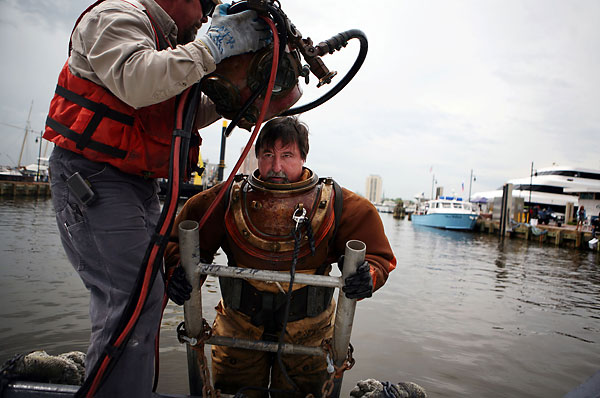
They found a wheelchair, three bikes, a baby stroller, a bag of laundry, a mop, tires, a garden cart, a sledge hammer, city of Norfolk banners, chairs, tables, a Ford hubcap, a ladder covered with oysters, hoses, cables, chains and a traffic cone – all covered with black mud and years of foul rot.
Commercial divers hauled up all this junk Saturday and loads more from the bottom of the Elizabeth River, in a small cove near Town Point Park and Waterside in downtown Norfolk, in just two hours.
The cleanup, called the Town Point Trash Dive, was the first of its kind in Virginia and only one of a handful in the United States, done to commemorate Earth Day, which officially arrives Thursday.
“We wanted to do something different for Earth Day, and this definitely was it,” said Karen Scherberger, executive director of Norfolk Festevents, the outdoor-party group that sponsored the daylong effort.
Dozens of curious people strolled by the piles of junk on display along the city docks, and marveled.
“Is this from a shipwreck ?” asked Charlene Goggins, visiting from Oklahoma.
“My God, this is unbelievable,” said her husband, David . “It makes you wonder how much else is dumped in our rivers. It’s disgusting.”
The running joke of the day among the divers and crews was who would find the first dead body.
Then, about mid-morning, a team from Precon Marine Inc. discovered what appeared to be a shoulder or hip bone. Police soon arrived and took the bone away in an evidence bag. They gave it to a member of the medical examiner’s office. The joke was definitely over.
The idea for the cleanup stemmed from a Festevents volunteer and photographer, Rosemarie O’Grady, who participated in a similar underwater cleanup last fall in a small town in Sweden.
Roman ingots to shield particle detector
By Nicola Nosengo - Nature News
Around four tonnes of ancient Roman lead was yesterday transferred from a museum on the Italian island of Sardinia to the country's national particle physics laboratory at Gran Sasso on the mainland.
Once destined to become water pipes, coins or ammunition for Roman soldiers' slingshots, the metal will instead form part of a cutting-edge experiment to nail down the mass of neutrinos.
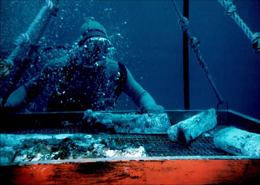
The 120 lead ingots, each weighing about 33 kilograms, come from a larger load recovered 20 years ago from a Roman shipwreck, the remains of a vessel that sank between 80 B.C. and 50 B.C. off the coast of Sardinia.
As a testimony to the extent of ancient Rome's manufacturing and trading capacities, the ingots are of great value to archaeologists, who have been preserving and studying them at the National Archaeological Museum in Cagliari, southern Sardinia.
What makes the ingots equally valuable to physicists is the fact that over the past 2,000 years their lead has almost completely lost its natural radioactivity. It is therefore the perfect material with which to shield the CUORE (Cryogenic Underground Observatory for Rare Events) detector, which Italy's National Institute of Nuclear Physics (INFN) is building at the Gran Sasso laboratory.
CUORE, which will begin operations next year, will investigate neutrinos: fundamental particles with no electronic charge and long thought to have no mass. Researchers have confirmed that neutrinos do have a mass, but have been unable to pin down a figure for it.
The aim is to use the detector to try to observe a theoretical atomic event called neutrinoless double-beta decay — a radioactive process whereby an atomic nucleus releases two electrons and no neutrinos. 'Standard' double-beta decay is accompanied by the release of two neutrinos.
By observing this predicted but so far unseen event, physicists hope to estimate the neutrino's mass and to establish whether neutrinos and their antimatter counterparts, antineutrinos, are different particles. Some believe the two to be one and the same.
CUORE scientists will wait for neutrinoless double-beta decay to happen in a 750-kilogram cube of tellurium dioxide placed under 1,400 metres of rock at the Gran Sasso laboratory.
But to successfully observe this rare event, they will need to shield their experiment from external radioactivity.
The search for a shipwreck near Four Mile Point
By Chick Huettel - The Destin Log
Many, many years ago while looking over a nautical chart of the Choctawhatchee Bay, I noted that the map revealed the identifying mark of hull bones just off Four Mile Point, which is located north of the Sandestin Resort area.
I think the map was dated in the area of 1950.
I had owned a small lot on the point and was fascinated. It lay almost due west of the property. Loving archeology, I was determined to find the wreck.
The U.S. Coast Guard and Geodetic Survey maps normally record large wrecks with the accompanying symbol. With snorkel, tied together lounging floats I went on the search.
The map depth lines showed it was in 5 to 9 feet. I was so sure I could find the remains. But after four days, I was tired, black fly bitten, and frustrated because the water was relatively clear. I gave up.
A few years later, while at an antique/junk store, I pulled a map out of the cardboard box. This one was dated 1943. As I unrolled it there before me was Four Mile Point again. The skeleton bone figure was not there and in its place was the word “boiler.”
This time the depth line was only four feet and in the same place. I called my brother and again we dragged floats and snorkels and began a search. I only wish we had used the grid system during the search, but it seemed so easy why go to the trouble?
Again we came up with nothing.
Today’s up-to-date Choctawhatchee map shows nothing. Neither the bones or the boiler. Where is this vessel ? It had to be of a good size because of its identification.
And of course a boiler is usually a large iron goliath not counting the steam engine components. Is it just under the surface sand ?
Steamboats traversed the bay in the 1800s and early 1900s. Local carriers and others came from Mobile, Pensacola, and Panama City. Steamboats were also built in Freeport.
Did it burn ? Was it a storm that caused the destruction ? Are there marine artifacts spread about the area ?
Survey efforts continue on British warship eluded by Paul Revere

By Stefanie Geisler - Boston
A survey crew returned with high-tech equipment this afternoon to the Cape Cod National Seashore, where the wreck has resurfaced of the British warship that was guarding Boston Harbor the night that Paul Revere made his famous journey to Lexington.
Federal park officials have hired Harry R. Feldman Inc. to record the remains of the HMS Somerset III with three-dimensional imaging technology.
Although crews performed several laser scans last week, wind affected the measurements made in one of them, said Michael Feldman, president of the company.
"One of the scans that we had done had skewed data," Feldman said. "We wanted to rectify what could have gone wrong."
The crew had planned to return to the site to make more measurements anyway, Feldman added.
The tide dropped this evening, giving the surveyors the best access to the wreck. The wreck was last sighted in the shifting sands 37 years ago, but recent storms uncovered it again.
The news over the weekend of the wreck's reappearance on the beach in Provincetown has inspired some people to make the 1 1/2-mile trek down the sands to see it, said William P. Burke, historian at the national seashore.
"The sand is starting to kind of creep in on it, but people are still walking out to the site," Burke said.
The Somerset, which featured 64 mounted guns and a crew of about 400, served in the French and Indian War and the American Revolution. In 1775, Paul Revere rowed across the harbor past the ship before beginning his ride to Lexington to warn the colonials that the British were on the move.
In his poem “Paul Revere’s Ride,’’ Henry Wadsworth Longfellow called it “a phantom ship, with each mast and spar/Across the moon like a prison bar/And a huge black hulk, that was magnified/By its own reflection in the tide."
A storm drove the Somerset onto the Peaked Hill Bars on Nov. 2, 1778. The US Park Service does not plan on excavating what remains of the ship, Burke said.
"We normally don't do that, unless it's something extraordinarily intact," he said. "With this wreck, there's no information to be gained from removing it. Probably only 10 percent or less of the original wreck is left."