HOT NEWS !
Stay informed on the old and most recent significant or spectacular
nautical news and shipwreck discoveries

Bronze cannon from 1715 shipwreck found

From South Florida Business Journal
Shipwreck salvage company Gold Hound LLC has found a bronze cannon with 63 gold and silver coins concealed inside, the company said Monday.
The cannon is part of the 1715 Treasure Fleet that sunk off Sebastian nearly 300 years ago. Inside were 25 colonial Spanish gold coins and 38 silver coins, but 22 more gold coins were found alongside, according to a news release.
The bronze swivel cannon was used to fend off pirate enemies on the treasure ships' ill-fated journey back to King Philip V in Spain.
The cannon was encrusted from lying hidden in the depths for centuries, and during its conservation, it suddenly let loose its of gold and silver, with an estimated value of more than $500,000, the company said.
"We found treasure within the treasure. This is right out of 'Pirates of the Caribbean,' except this is the real thing,” said Capt. Greg Bounds, of Sebastian-based Gold Hound, in the news release. “For centuries, there has been talk of treasure possibly hidden inside of cannons, but up ’til today, that was only pirate lore. Now, it’s the real deal.”
The cannon was discovered in less than 15 feet of water about 40 miles north of West Palm Beach.
Gold Hound is a subcontractor for 1715 Fleet-Queen’s Jewels LLC, which acquired salvage rights to the fleet from the heirs of treasure hunter Mel Fisher. Queens Jewels, also based in Sebastian, was founded by William Brisben, who previously led a national Cincinnati-based real estate development firm before serving seven years as the U.S. representative to UNICEF under President George W. Bush.
Among the gold coins was an extremely rare 1698 Cuzco mint coin from a Peruvian mine that operated for just four months, adding to the importance and value of the coin, the news release said. Historians have struggled for decades to unearth more information about the mine, of which little is known.
The remaining gold coins appear to be primarily from Bogotá, Colombia, referred to as “Bogie 2s” for their denominations, the news release said. The silver coins, subject to further identification, likely originate from mines in Mexico and Bolivia.
25th anniversary Of Atocha shipwreck discovery
From cbs4
Twenty-five years after Mel Fisher and his crew located the shipwrecked Spanish galleon Nuestra Señora de Atocha off Key West, treasures and artifacts are still being discovered under the leadership of Fisher's son Kim Fisher and grandson Sean Fisher.
Meanwhile, to commemorate the find's 25th anniversary on Tuesday, July 20, rare Atocha artifacts are being debuted at the Key West museum established by Mel Fisher, who died in 1998.
The Atocha, carrying gold, silver and other riches from the New World home to Spain, sank in a 1622 hurricane.
Mel Fisher and his crew, including his wife and their children, spent 16 grueling years searching for the wreck site. They discovered the $450 million "main pile" of treasure and artifacts July 20, 1985, in approximately 55 feet of water 35 miles southwest of Key West.
Underwater archaeologists and divers recovered gold and silver coins and bars, contraband emeralds, jewelry, cannons and other weapons, pottery and unique navigational instruments from the site.
But according to the Atocha's manifest, much remains undiscovered.
"Twenty-five years ago we found 47 tons of silver, but since then we've been looking for the rest of her," said Sean Fisher, who was then age 7 and is now vice-president of the family enterprise.
"There's still another 130,000 silver coins and over 400 silver bars that we haven't found."
The wreck also yielded significant information about the Spanish empire and 17th-century shipboard life.
Bristol marks 40th anniversary of SS Great Britain's return
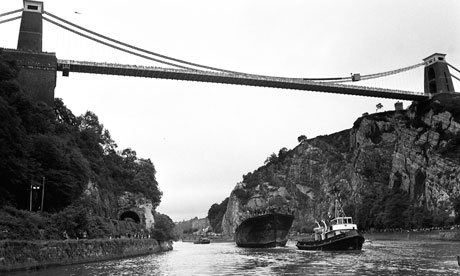
By Steven Morris - Guardian
Salvage diver Lyle Craigie-Halkett sips a glass of water (he's done a lot of talking to old chums and his throat is dry) in the splendidly restored first class dining room of the SS Great Britain and recalls the time a welly boot came smashing through the ceiling.
"That used to happen quite a lot - it went with the territory on this job," he says. Today was a time for old stories as dozens of people - divers, salvage experts and tugboat crew members - were reunited in Bristol to remember how they helped rescue the first great ocean-going liner and return her to her home city exactly 40 years ago.
Isambard Kingdom Brunel's magnificent vessel had been scuttled in shallow water in the Falkland Islands at the end of her working life.
She became a popular destination for picnickers and mussel-hunters but was rotting away until a scheme to refloat her and bring her back to the UK was hatched in 1969.
"People thought it was a crazy idea and perhaps it was," says Craigie-Halkett. "But we went for it anyway."
And thanks to the skill of the team, not to mention the cash of tycoon businessman Jack Hayward and dozens of mattresses donated by islanders to plug a worrying hole in the vessel, the rusting hulk was refloated on to an enormous pontoon and towed almost 8,000 miles across the Atlantic.
Thousands turned out on 19 July 1970, as she was guided up the Avon river and into Bristol where she has been lovingly restored and is now one of the south-west's most popular tourists attractions.
The memories came thick and fast today. Another of the divers, Stuart Whatley, described how the project came together thanks to "good planning, good logistics, fantastic improvisation."
He also remembered the mussels with huge pleasure.
"The ship was covered with them, eight or nine inches long, the biggest I've ever seen. The cook came along and collected bags full of them and we had them for tea. They were marvellous."
Ivor Boyce, the captain of the tug boat John King, that carefully guided the ship upriver after its ocean crossing, remembers the crowds. "It was just a mass of people.
The diesel noise was overpowered by the people cheering and honking. It was very, very moving."
Nova Scotia risks losing sunken wrecks
By Mark Iype - Montreal Gazette
For decades, treasure hunters from around the world have been lured by the romance of finding fortune among the skeletons of ships lost to Nova Scotia's temperamental waters and craggy coastline.
But one of Canada's most celebrated salvage divers says a decision last week by the Nova Scotia government to stop treasure hunting among the thousands of shipwrecks that litter its coastal waters will leave Canadian history to be literally washed away.
"Unless something changes in the next few months, shipwrecks that could piece history together will be lost forever," said Alex Storm, a pioneering treasure hunter who, in the 1960s, discovered two of Canada's most important 18th century shipwrecks: Le Chameau and HMS Faversham.
Last week, the Nova Scotia government announced its Treasure Trove Act would be repealed by the end of the year, putting a halt to all commercial treasure-hunting in provincial waters.
Under the current law, treasure hunters can keep 90 per cent of their booty, with the remainder being ceded to the province.
The proposed changes would prohibit anything discovered among the estimated 10,000 ships that have sunk along Nova Scotia's rocky coast over the past 500 years from being removed from the province.
The government says it wants to help preserve the artifacts and mementoes of Canadian maritime history that might otherwise be taken from the province.
"There is an opportunity here, from a heritage and tourism perspective, to experience whatever is found in the natural environment," said Michael Noonan, a spokesman with Nova Scotia's Ministry of Tourism, Culture and Heritage.
Nova Scotia's Treasure Trove Act became law in 1954 after treasure hunters flocked to the notorious Oak Island, on the province's South Shore, where, it is rumoured, everything from Black Beard's buried booty to the hidden gems of Marie Antoinette are hidden.
Over time, the original Treasure Trove Act had evolved to cover Nova Scotia shipwrecks.
Noonan said now a new law will be passed to cover Oak Island, leaving treasure hunters free to keep searching for pirate spoils. One famous wreck found off the coast of Nova Scotia was the controversial discovery by a U.S. salvage company of the British frigate HMS Fantome.
By Malaka Rodrigo - The Sunday Times
Abandoned shipwrecks rich in marine life have the potential to be steady magnets for dive tourism but they are being salvaged indiscriminately for scrap metal.
MV Cordiality, a large ship operated by a Chinese crew was anchored in the seas off Pulmoddai, loading valuable ilmenite, when LTTE Sea Tigers attacked it on September 1997. Six sailors were killed and the ship sank with its cargo close to the shore.
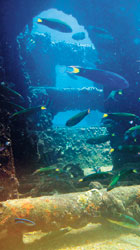
This war victim was forgotten within months, but nature claimed its ownership of the sunken vessel. Corals started growing on its large metal surface and thousands of fish and marine creatures have found the shipwreck a safe haven for the last 13 years.
Now however the ship is being salvaged for scrap metal.
“The MV Cordiality shipwreck at Pulmoddai has now become a huge artificial coral reef in the ocean, transforming itself into an oasis of marine life,” says Darshana Jayawardane, a marine naturalist who went diving near the wreck in May.
“One could spend hours just looking at the multitude of exquisite Lionfish, Scorpionfish, Butterflyfish, Juvenile Snappers, Nudibranchs and Fusiliers that swam around the massive hull. The huge towers, pillars and twisted pieces of metal lay around with ilmenite at the bottom, reminding one of a moon landscape,” Darshana said.
MV Cordiality could be easily developed as a key destination to attract tourists who travel around the world exploring marine and coastal environments.
Dive Tourism or wreck-diving is now becoming a huge business that forms a significant component of the growing global tourism industry. Sri Lanka has real potential to develop high-end Dive Tourism, based on these wrecks, point out marine specialists.
But shipwrecks, especially in the North and East, are being destroyed for their metal. Authorities sometimes claim salvaging is done to clean the shallow waters or because the wrecks are a problem for fishermen who cannot lay their fishing nets due to the underlying wrecks.
But what they do not know or consider is the long term value these wrecks can bring to our economy.
The revenue that can be gained by Dive Tourism based on these shipwrecks can be much more than the wreck’s scrap metal value.
If the average amount of metal that can be salvaged from this shipwreck is estimated as 15,000 metric tons and one kilogram of scrap metal is worth about 20 rupees – salvaging can bring Rs.300 million revenue from MV Cordiality.
But the long term gains from marine tourism are much greater and nothing special has to be done compared to the money that is spent on salvage operations.
The marine tourism potential of a ship wreck is in fact incremental because it is becomes richer with biodiversity and coral cover day by day.
At Woods Hole, conquering the deep ocean
By Daniel Terdiman - Cnet News
Although crews have managed to shut off--for now, at least--the flood of oil into the Gulf of Mexico, it is virtually certain that ongoing cleanup work will keep the concept of deep-sea science in the public's eye for some time.
That could be good news for the scientists and researchers at the Woods Hole Oceanographic Institution (WHOI) here, one of the world's leading repositories of across-the-board ocean expertise, and the developers of a stunning collection of hardware and software tools designed to probe the countless mysteries of the deep.
I've come here as part of Road Trip 2010, and have been promised a close-up view of Nereus, one of the most exciting developments in underwater research in years.
Nereus is a new style tool: a hybrid remotely-operated vehicle, meaning that it is the rare beast that can be used for pre-programmed, untethered research missions, or those in which it is controlled from the surface via a very thin, fiber cable that can reach 25 miles.
This is one of the only vessels on the planet capable of reaching the oceans' deepest locations, and it can do so while sending back high-fidelity data that could vastly broaden our understanding of what goes on below.
Yet, despite the promise of Nereus and the other vehicles in the WHOI fleet, as well as that of other institutions, there is little doubt that deep-ocean research has, until recently, barely registered on the national consciousness.
After all, just before the recent celebration of the 50th anniversary of the first--and only--manned mission to the bottom of the Mariana Trench, the deepest spot on Earth, at 35,800 feet, Don Walsh, one of the two men who had taken that trip, told CNET News, "We were happy to be the first, but we didn't expect to be the last."
To talk to me about Nereus, I've come to see Andy Bowen, the director of WHOI's national deep submergence facility.
Until now, Bowen said, most of the world's deep ocean exploration energies has gone into probing at 6,000 meters below the surface or above.
That's because, he said, 98 percent of the world's seafloor is above that level. The remaining 2 percent has largely been inaccessible. "We tend to look in the the easy places first and the hard places last," he said.
The history of deep-sea submersibles has been about two kinds of vessels: Autonomous underwater vehicles (AUVs), which are designed to explore wide areas of the deep, mapping as they go and providing scientists with broad looks at the ocean floor; and remotely-operated vehicles (ROVs), which are tethered to a surface ship and which transmit data--photos, video and more--back over some kind of cable.
But Bowen explained that as scientists probe deeper and deeper, the costs of the exploration has traditionally grown, given the need for more sophisticated, and rugged equipment.
Divers find 230-year-old champagne in Baltic shipwreck
From Focus-Fen
Divers have found bottles of champagne some 230 years old on the bottom of the Baltic which a wine expert described Saturday as tasting "fabulous," AFP reports.
Thought to be premium brand Veuve Clicquot, the 30 bottles discovered perfectly preserved at a depth of 55 metres (180 feet) could have been in a consignment sent by France's King Louis XVI to Russian Tsar Peter the Great.
If confirmed, it would be by far the oldest champagne still drinkable in the world, thanks to the ideal conditions of cold and darkness.
"We have contacted (makers) Moet & Chandon and they are 98 percent certain it is Veuve Clicquot," Christian Ekstroem, the head of the diving team, told AFP.
"There is an anchor on the cork and they told me they are the only ones to have used this sign," he added.
The group of seven Swedish divers made their find on July 6 off the Finnish Aaland island, mid-way between Sweden and Finland, near the remains of a sailing vessel.
"Visibility was very bad, hardly a metre," Ekstroem said. "We couldn't find the name of the ship, or the bell, so I brought a bottle up to try to date it."
The hand-made bottle bore no label, while the cork was marked Juclar, from its origin in Andorra. According to records, Veuve Clicquot was first produced in 1772, but the first bottles were laid down for ten years.

Blackbeard's secrets travel to Onslow libraries
By Jannette Pippin - EncToday
Whether it’s a little bit of gold dust or a massive 8-foot cannon, recovering artifacts from the shipwreck of the Queen Anne’s Revenge and conserving each piece in the lab is only part of the excitement for conservator Wendy Welsh.
Welsh loves sharing the story of each piece of history linked to the shipwreck presumed to be the flagship of pirate Blackbeard and explaining how the QAR team has worked to recover and preserve artifacts that have been resting nearly 300 years on the sea floor.
“I love talking to folks, and I like to get people as excited about (the project) as I am,” she said. “It’s such a North Carolina treasure.”
And for Welsh, who grew up in Onslow County and graduated from Swansboro High School, there’s extra excitement in being able to share her stories with a home crowd.
Welsh will be visiting each of the four libraries in Onslow County as part of the “Make Waves at the Library” Summer Reading Program, coordinated by the State Library of North Carolina, according a N.C. Department of Cultural Resources news release.
She will speak at the main library in Jacksonville Saturday at 2 p.m.; Sneads Ferry on Wednesday at 10 a.m.; Swansboro branch on Wednesday at 2:30 p.m.; and Richlands branch on Thursday at 1 p.m.
Welsh said the talks will be age-appropriate for youth audiences but also interesting to adults.
She’ll give a little history about Blackbeard and background on underwater archaeology and the recovery of artifacts from the shipwreck site.
She’ll also talk about the conservation process.
“A lot of people are surprised by what we have to do and how long it takes,” said Welsh of the conservation process that can take years to complete.