HOT NEWS !
Stay informed on the old and most recent significant or spectacular
nautical news and shipwreck discoveries

-
Soviet submarine wreck from WWII found In Baltic Sea
- On 19/12/2012
- In World War Wrecks
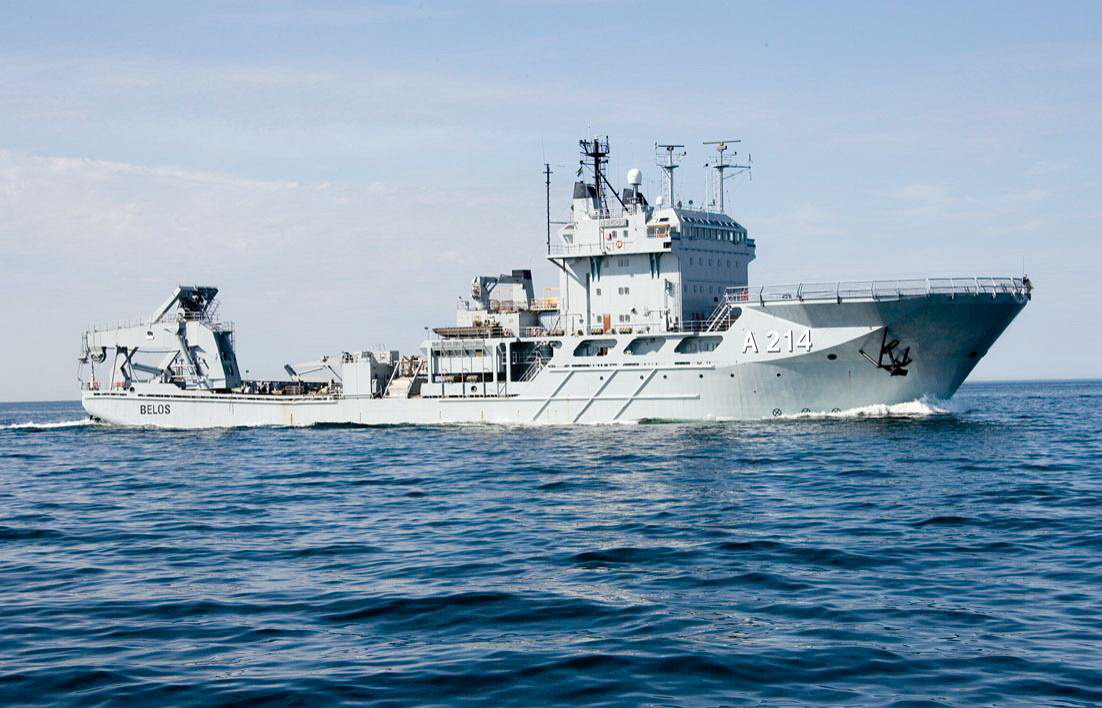
The wreck of a Soviet submarine lost during World War Two has been found in the Baltic Sea, 71 years after it sank, the Swedish Military said on Monday.
The Swedish Armed Forces said the submarine, believed to have been lost on patrol in late 1941, was found in the Swedish economic zone southeast of the Baltic island of Oland in an area which German forces had mined during the war.
"There is much to indicate that the submarine headed straight into the minefield while on the surface and was blown apart by a mine," the military said in a statement.
On its website the military posted a video and still images of the wreckage, which had broken into two large sections.
The wreck was first reported by civilian divers during the summer months in the middle of this year.Swedish submarine salvage ship HMS Belos in the following months confirmed the find and photographed it, the military said.
Swedish authorities had informed Russia of the find in order to give family members and the Russian navy the opportunity to conduct a memorial ceremony at the site, the military added.
Several Soviet submarines sunk during World War Two have been found in Swedish waters over the years, it added. -
Divers find second ship at same site off Plymouth
- On 16/12/2012
- In Treasure Hunting / Recoveries

From This Is PlymouthA group of amateur treasure-hunters who discovered the remains of an 18th century Dutch merchant vessel lost off the Devon coast during a violent storm in 1721, have uncovered a second wreck – on the same spot.
Sunk in similar circumstances, the two ships lie side by side in the shallow waters of Jennycliff Bay, Plymouth Sound, twin tragedies separated by decades but found by the same four-man team...
Scuba diver Howard Jones, whose recent book Blind Faith detailed his search for the wreck of the Aagtekerke, a 1000-ton Dutch East India Company vessel, now claims to have conclusive evidence of the final resting place of HMS Pallas, a Royal Navy frigate that met its end in treacherous conditions 77 years later.
Mr Jones, 50, a former Royal Marine and Falklands veteran, said: "We decided to widen our search for the Aagtekerke, and within a matter of only a few yards came across a very small iron swivel gun."
The 176lb, 38in swivel gun, lying on the seabed in two pieces, was a small bore cannon, designed for side-mounting on a ship's rails and was engaged during short-range combat or to cover the crew during boarding parties.
"We retrieved the gun in its entirety and carefully removed hundreds of years of encrustation expecting to find another relic from the Dutch wreck, but we were amazed.
"Not only did the two pieces match exactly, but to find a prominent British broad arrow marking on the barrel of the gun was a revelation."
Originally a heraldic crest, the broad arrow symbol was adopted by Henry VIII to mark goods purchased from the monarchy's own purse. By the 17th century it signified all government-owned armaments and is still used today to mark property belonging to the MoD.
-
Canadian underwater miner gets sinking feeling in Papua New Guinea
- On 16/12/2012
- In Miscellaneous

From ReutersA dispute between Papua New Guinea and Canada's Nautilus Minerals threatens to sink plans to mine gold and other metals for the first time from the ocean floor.
It could also work against efforts by the South Pacific country to restore faith in its vast resources potential and entice more foreign companies to follow the likes of Exxon Mobil , Newcrest Mining and Barrick Gold and invest billions of dollars in resource projects.
The groundbreaking undersea venture hopes to use robots operating 1 600 m deep to mine the sea floor near hydrothermal vents that deposit copper, gold and other minerals.
Hungry for foreign investment, Papua New Guinea (PNG), a nation of seven-million spread over an equatorial archipelago the size of California, had agreed in 2011 to pay 30% of the costs to build the Solwara 1 project in the Bismark Sea, which Nautilus said amounts to $80-million so far.
But in June, the government's investment arm, Petromin, said it was terminating the agreement. Without the funds, Nautilus says it cannot afford to proceed and the matter is now in arbitration in Australia under The United Nations Commission on International Trade Law (UNCitral).
Nautilus' shares have tumbled 60% since it said in mid-November it was laying off 60 workers and halting assembly work on the project to save cash. CE Michael Johnston said another round of job losses would follow on Friday unless a resolution can be reached.
"We don't know where we stand at the moment," Johnston told Reuters in an interview. "We're optimistic because we have to be, but we just don't know what Petromin is thinking."
Papua New Guinea has been described as an island of gold floating in a sea of oil, surrounded by gas, but consistently punches below its weight on the global resources stage.
The impoverished country has a long legacy of mining projects derailed by environmental disasters, landowner uprisings and corruption.
-
El patrimonio sumergido
- On 15/12/2012
- In Underwater Archeology

El Tiempo
Las palabras de la ministra de Cultura, Mariana Garcés, ante la plenaria de la Cámara esta semana resumen el interés del Gobierno en el proyecto de ley de patrimonio sumergido, ya aprobado por la Cámara de Representantes: "Que Colombia cuente prontamente con una legislación y no que estos temas se sigan resolviendo exclusivamente en los tribunales".
Detrás de ellas está el razonable motivo de contar pronto con reglas claras para rescatar los naufragios que existen en las aguas colombianas (se especula que son mil) y así evitar demandas millonarias, como la que el año pasado se falló en Estados Unidos a favor del país en el caso del galeón San José.
Dicho propósito ya acumula tres décadas.
En este lapso, cuatro intentos por tener una ley que regule el asunto han llegado al Legislativo y todos, como los propios tesoros, han terminado hundidos.
En algunos casos, ha sido el mismo Gobierno el que ha retirado las iniciativas, por falta de acuerdo sobre el 'criterio de repetición', concepto según el cual piezas (monedas y lingotes) de las que exista más de una unidad se pueden usar como parte de pago para las empresas buscadoras de tesoros. La iniciativa propone de nuevo ese criterio, razón por la que ha generado fuerte resistencia entre los académicos.
Estos argumentan que por el solo hecho de que existan varios objetos idénticos esto no los despoja de su valor patrimonial.
Y, según la Constitución, tal condición hace que sean de propiedad de todos los colombianos.
Este aspecto es crucial, pues con dicha parte de los tesoros que eventualmente se rescaten del fondo del mar se les pagaría a las empresas a las que se les encomiende la tarea.
Tal como se encuentra hoy el proyecto, a estas les correspondería el 50 por ciento de lo que no sea considerado patrimonio, lo cual pondría a Colombia al nivel de Gran Bretaña, República Dominicana y el estado de Florida (EE. UU.), únicos lugares que comercializan y pagan a los rescatistas con parte de lo hallado.
-
Hathcock History: Lost treasures and ghost ships
- On 14/12/2012
- In Miscellaneous

By Steve Hathcock - Valley Morning StarThe cargo steamer Baychimo, built in Sweden in 1914 for the Hudson Bay Company, spent its early days plying the frigid waters along the Victoria Island Coast of the Northwest Territory trading supplies for pelts with the people who lived in the cold northern wilderness.
The Baychimo was homeward bound in October 1931, when it became trapped in the ice. The ship was briefly abandoned, but the crew managed to break her free from its icy prison and the vessel resumed her journey.
A few days later the Baychimo again became stuck in the ice and this time most of the crew was airlifted to safety.
Fifteen men remained behind in the hopes that the vessel could be freed from the ice. A great blizzard sprang up and the crew took shelter in a cabin on a nearby shore.
When the storm lifted the ship had vanished and the crew assumed that the Baychimo must have sunk during the storm.
A few days later, the Baychimo was once again sighted some 45 miles away. The crew re-boarded her and a brief inspection revealed the craft to be unseaworthy.
After removing its cargo of furs and pelts and expecting the ship to sink at any time, the crew once again abandoned the old steamer.
Incredibly, the Baychimo continued to float on the sea on its own for another 38 years, and was seen many times.
Several times the ghost ship was boarded, but due to either bad weather or the lack of necessary equipment to salvage her, the Baychimo continued on her last voyage.
The Baychimo was last seen stuck in the ice of Beaufort Sea in 1969. According to legend, one of the most famous of the ghost ships, the Flying Dutchman, can never go home and must sail the sea forever.
If she is stopped by another ship at sea, her crew of the dead will try to send messages to people ashore (who are also long since dead).
In most versions of the story, the Dutch captain swore that he would not stop sailing in the face of a storm that threatened to sink his ship.
The crew and passengers begged him to change course, but the captain, who was either drunk or crazy, swore he would continue to round the Cape of Good Hope until Judgment Day.
Monstrous waves crashed against the ship and a howling wind shredded the sails and bent the mast but the captain stayed his course, alternately shouting curses at the heavens or drinking great draughts of beer and smoking his pipe.
-
Diving sickness rises after naval ship sinks
- On 13/12/2012
- In Miscellaneous

From ABC News
Medical experts expect the number of scuba divers suffering the bends to reach a record high in New South Wales this year, because of a new diving site on the state's central coast.The ex-naval frigate HMAS Adelaide was sunk off Terrigal and Avoca beaches last year to become an artificial reef and dive site.
Since then, doctors are reporting significant increases in the number of divers with decompression sickness.
The wreck lies about 32 metres below the surface, which is around the depth limit for many recreational divers.
Figures from the hyperbaric medicine unit at Sydney's Prince of Wales Hospital show 27 patients were treated for the bends up until August this year.
In comparison there were 19 cases in total in 2011 and 28 in 2010.
Glen Hawkins from the University of New South Wales, who is also the medical director of private firm Hyperbaric Health, says the dive season has only just begun.
"By August this year, we've already reached the annual normal number and haven't hit the main diving season yet," Dr Hawkins said.
-
Harbor Island shipwreck identified
- On 13/12/2012
- In Parks & Protected Sites

By Becky Vargo - Grand Haven TribuneLow lake levels this fall resulted in the exposure of at least five shipwreck hulks along the edges of Harbor Island. Michigan Shipwreck Research Associates was called in to survey and identify the vessels, in particular, the largest located just east of the public launch ramp on the island.
On Friday, MSRA director and historian Valerie Van Heest, teamed up with Kenneth Pott, a maritime archaeologist and director of the Tri-Cities historical Museum to survey the larger wreck.
Study of the hull construction, exposed propeller shaft cradle at the stern and exposed sides of the vessel led them to initially conclude that the vessel was a large steamer 40 feet wide and at least 165 feet in length, though an additional amount forward toward the bow end appeared buried.
Van Heest and Pott worked with historian William Lafferty, of Lafferty van Heest and Associates, who narrowed it down to two possibilities: the 185-foot L. L. Barth abandoned at Grand Haven in 1927 or a significantly larger vessel, the 290-foot Aurora, burned in 1932.
A survey east of the visible portions of the wreck conducted by Valerie and Jack Van Heest, Craig Rich and Larry Hatcher of MSRA on Sunday, revealed a structure well over 200 feet long, and led Van Heest to conclude that the vessel is the Aurora.
“The Aurora was a very significant ship when built in 1887,” Van Heest indicated, “and it’s thrilling to be able to study its remains now.”
When launched by the Murphy and Miller of Cleveland in late-July that year, the 290-foot, steam-driven propeller was the largest and most powerfully built wooden vessel on the Great Lakes.
The 3,000-ton vessel was initially owned by John Corrigan of the Aurora Mining Company of Milwaukee which paid $150,000 for its construction. It was used to ship iron ore from the Gogebic Range Ironwood, Michigan, to Cleveland and coal from Cleveland on the return trip.
“Not only did the length lead to our likely identification of the vessel, but the visible portions of the hull framing supported that notion as well.” Pott said.
According to records detailing its build, the Aurora was constructed with Kentucky oak. Frames were spaced on 21” centers 18 inches wide.
Iron straps 5” wide by ¼” thick were hot riveted into the hull and bent around the turn of the bilge. The firm Bassett & Presley, of Cleveland, supplied the iron.
At the time of the Aurora’s build, ironed-hull ships were still in their infancy. The technology of using iron straps allowed the builders to fabricate this immense ship with wood.
-
Introducing Sea Shepherd’s newest old ship, SSS Sam Simon
- On 12/12/2012
- In Miscellaneous

By Mike Schuler - gCaptain
The Sea Shepherd Conservation Society on Tuesday unveiled its newest addition to the fleet, the SSS (as in Sea Shepherd Ship) Sam Simon.
Named after the man who gave Sea Shepherd the money to purchase it – Sam Simon is co-creator of The "Simpsons" - the SSS Sam Simon was unveiled today in the port of Hobart, Tasmania where it is preparing to depart on Sea Shepherd’s newest campaign, “Operation Zero Tolerance.
The all white, 56- meter vessel is registered in Melbourne, Australia, and will carry a crew of 24 international volunteers who are ready to brave the Southern Ocean – and the infamous Sea Shepherd antics – in order to seek out and shut down the illegal Japanese whaling fleet.
The vessel itself was built in 1993 by IHI shipyard in Tokyo and was formerly used as a research ship by the Japanese Government – go figure !
The Sam Simon features an ice-strengthened hull and was operated by the Maizuru Meteorogical Observatory, a department of the Japan Meteorological Agency, up until 2010.