HOT NEWS !
Stay informed on the old and most recent significant or spectacular
nautical news and shipwreck discoveries

-
WikiLeaks cables: Art looted by nazis, Spanish gold and an embassy offer
- On 09/12/2010
- In Treasure Hunting / Recoveries
 Odyssey Marine Exploration/AP
Giles Tremlett - The Guardian
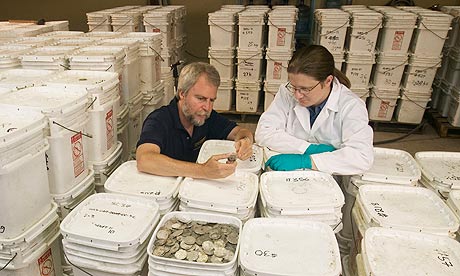
US officials offered to help Spain claim an undersea treasure haul of gold and silver coins discovered by a controversial American exploration company in return for Spanish assistance in the recovery of valuable art looted by nazi Germany, according to embassy cables released by WikiLeaks.
In a conversation with the Spanish culture minister, César Antonio Molina, the US ambassador in Madrid, Eduardo Aguirre, sought to tie the treasure found off the Iberian peninsula by Odyssey together with attempts by an American citizen, Claude Cassirer, to recover a painting by Camille Pisarro that hangs in a Madrid museum.
"The ambassador noted also that while the Odyssey and Cassirer claim were on separate legal tracks, it was in both governments' interest to avail themselves of whatever margin for manouevre they had, consistent with their legal obligations, to resolve both matters in a way that favoured the bilateral relationship," the embassy reported in a cable on 2 July 2008.
The offer was made after the Spanish government claimed ownership of half a million gold and silver coins found on the floor of the Atlantic Ocean by Odyssey's underwater robots.The company had provoked Spanish fury by landing the treasure at Gibraltar and flying it straight to the US.
The so-called Black Swan treasure, which Odyssey said came from an unidentified shipwreck, had been valued at about $500m.
Molina refused to tie the Odyssey case to the Pisarro painting, according to the embassy. "The minister listened carefully to the ambassador's message, but he put the accent on the separateness of the issues," the cable reported.
He promised, nevertheless, to meet Cassirer to discuss what could be done about the painting, Pisarro's Rue St Honoré. Après-midi. Effet de Pluie, which currently hangs in the Thyssen-Bornemisza museum in Madrid.
In another cable the embassy explained the background to Cassirer's claim. "The Nazis forced Mr Cassirer's grandmother to sell the painting in 1939. Baron Hans Heinrich Thyssen-Bornemisza acquired it in 1976.In the early 1990s, the Spanish government purchased the collection and built the current museum. In 1958, Mrs Cassirer received a DM120,000 restitution payment for the disappearance and provisional dispossession of the painting, but retained full right to the painting."
The museum has refused to hand over the artwork, claiming that it was bought in good faith. Baron Thyssen had not known the story of Lilly Cassirer, a wealthy German Jew who said she was forced to sell the picture for 900 marks (about $360).She said it was the only way she could obtain an exit visa from Germany as Nazi oppression of the Jews escalated.
The painting of a rain-soaked Paris boulevard had hung on the walls of the family's Berlin and Munich homes since the impressionist painted it in 1897.
-
Memorial ceremonies mark dedication of New Pearl Harbor Visitor Center
- On 08/12/2010
- In Miscellaneous

By Bob Janiskee - National Parks Traveler
The Congress, by Public Law 103-308, as amended, has designated December 7 of each year as "National Pearl Harbor Remembrance Day."
At Pearl Harbor (a component of World War II Valor in the Pacific National Monument) and other locations on Oahu, a multitude of events, special exhibits and activities were scheduled for December 4 – 8 in association with the commemoration of the Japanese attack that plunged America into World War II.Today, on the 69th Anniversary of that December 7, 1941, attack, the dedication of the new $56 million Pearl Harbor Visitor Center is a highlight event.
Scheduled for 7:30 a.m., the joint National Park Service/U.S. Navy commemoration and dedication is taking place on the back lawn of the visitor center (which faces the U.S.S Arizona Memorial) and is open to the public.There will be a stellar slate of guest speakers, including Secretary of the Interior Ken Salazar and National Park Service director Jon Jarvis as well as the Honorable Daniel K. Inouye (United States Senate), Admiral Patrick M. Walsh (Commander, U.S. Pacific Fleet), Admiral Thomas B. Fargo (retired former Commander of the U.S. Pacific Command), and keynote speaker Thomas Strickland, Assistant Secretary of Fish, Wildlife and the Parks.
Among the 2,500 in attendance will be more than 200 Pearl Harbor attack survivors. The theme of this year’s historic commemoration, “A Promise Fulfilled: 1941 – 2010,” is dedicated to these honored veterans.Members of the Pearl Harbor Survivors organization from all over America are attending their annual meeting in Honolulu during December 4th to December 8th so they (and more than 300 family members and friends) can participate in the anniversary commemoration and the dedication of the new visitor center.
The Pearl Harbor Survivors have played an integral role in volunteering and supporting the National Park Service administration of the USS Arizona Memorial since 1980. In 2007, the organization helped raise money for the new visitor center and museum, supporting the national fundraising efforts of the Pearl Harbor Memorial Fund and the Arizona Memorial Museum Association (now known as Pacific Historic Parks). -
Sunken sub saga from Cold War comes to light in new book
- On 08/12/2010
- In High Tech. Research/Salvage
By Bill Sizemore - The Virginian Pilot
It was audacious in the extreme, the most ambitious feat of ocean engineering ever attempted by man:
Raise a sunken Soviet submarine, armed with nuclear ballistic missiles, from its resting place three miles down on the Pacific Ocean floor.And do it in total secrecy, right under the nose of the Soviet navy.
Four decades later, the most complete account yet has emerged of this incredible Cold War saga.
Was it a historic achievement or a colossal boondoggle ?
The truth lies somewhere in between, says Norman Polmar, co-author of a new book about the CIA's super-secret mission to raise the Soviet sub K-129.It was a marvel of engineering ingenuity and high-stakes spycraft. But it was hugely expensive, and the intelligence payoff was meager.
Regardless, the story opens a revealing window on a little-known chapter of the Cold War and the lengths to which the two superpower rivals - the United States and the Soviet Union - went to get a leg up in the struggle.
It is a story full of head-turning details, such as the role played by the famously eccentric billionaire Howard Hughes in establishing the CIA's elaborate cover story for the operation.
Perhaps most remarkable, however, is the sheer enormity of the undertaking - and the tenacity with which the CIA fought to keep it under wraps for 40 years.
The story first began to emerge within a year after the operation ended, most prominently in a March 1975 expose by investigative reporter Seymour Hersh in The New York Times.There has been a smattering of other articles and books since, but none written with access to any classified records.
The CIA consistently refused to confirm or deny that the operation ever occurred until early this year, when it released a censored 50-page account in response to a Freedom of Information Act request from The National Security Archive, a Washington-based watchdog group. -
Cutting cost of hunting shipwrecks
- On 07/12/2010
- In Parks & Protected Sites

From Hydro International
Nearly 100 years after the three-masted schooner Hattie Wells sank in Lake Michigan, USA, during heavy weather, it has been filmed by a ROV. A key element of the mission undertaken by a team of marine archaeologists has been to prove the value of using an ROV to document shipwrecks in America's Great Lakes, says Dr Mark Gleason, chief marine scientist and director of education at Great Lakes Naval Memorial and Museum (GLNMM).By turning to specialist ROV operator, Seaview Systems, they were able to cut the cost usually associated with launching an ROV from a large support vessel by using the compact deep-rated Saab Seaeye Falcon DR ROV.
Matthew Cook of Seaview Systems explains that marine archaeology requires the collection of high quality video, still images and environmental and position data of a shipwreck in order to capture the full historical significance of the site. He sees an ROV as representing a very efficient means of collecting this information in a wide range of water depths.
‘One of the larger expenses in a research project,' says Matthew Cook, ‘is the support vessel from which ROV operations are conducted. ‘Since 2006 we have been leveraging the benefits of the compact fiber optic Falcon DR which can dive to 1000m from relatively inexpensive vessels of opportunity, in order to explore a range of historic shipwrecks, corals and other benthic habitats.
The Hattie Wells project that has included archival research, side-scan survey and ROV dive operations, has brought together representatives from government, private business and educational non-profits.
In addition to the GLNMM, these included the Michigan Shipwreck Research Associates (MSRA), National Marine and Underwater Agency (NUMA) sponsored by author Clive Cussler, National Oceanic and Atmospheric Authority (NOAA), and SeaView Systems, Inc.
Built in 1867, the Hattie Wells was originally a 135 ft three-masted schooner, later lengthened by 30 ft and the rigging removed. Over the years she courted disaster on a number of occasions including collision, grounding and a lightning strike. After grounding in 1892 she was given up for lost but was later salvaged as a wreck and towed back to Detroit for refit. -
New species of rust-eating bacteria destroying the Titanic
- On 07/12/2010
- In Famous Wrecks
From Our Amazing Planet
Rusticles, formations of rust similar to icicles, are speeding up the deterioration of the famous shipwreck.
Researchers at Dalhousie University in Halifax, Nova Scotia, in Canada have been examining the bacteria eating away at the remains of the famous ship as it sits on the ocean floor.
Using DNA technology, Dalhousie scientists Henrietta Mann and Bhavleen Kaur and researchers from the University of Sevilla in Spain were able to identify a new bacterial species collected from rusticles (a formation of rust similar to an icicle or stalactite) from the Titanic wreck. The iron-oxide-munching bacterium has fittingly been named Halomonas titanicae.
The bacteria have critical implications for the preservation of the ship's wreckage.
"In 1995, I was predicting that Titanic had another 30 years," Mann said. "But I think it's deteriorating much faster than that now. Perhaps if we get another 15 to 20 years out of it, we're doing good ... eventually there will be nothing left but a rust stain."
The wreck is covered with rusticles; the knob-like mounds have formed from at least 27 strains of bacteria, including Halomonas titanicae.
Rusticles are porous and allow water to pass through; they are rather delicate and will eventually disintegrate into fine powder. "It's a natural process, recycling the iron and returning it to nature," Mann said.
For decades following the ship's sinking in 1912, the Titanic's final resting spot remained a mystery. Discovered by a joint American-French expedition in 1985, the wreck is located a little more than 2 miles (3.8 kilometers) below the ocean surface and some 329 miles (530 km) southeast of Newfoundland, Canada.
In the 25 years since the discovery of the wreck, the Titanic has rapidly deteriorated. -
Recovering China's Past on Kenya's Coast
- On 04/12/2010
- In General Maritime History
From Online
A team of Chinese archeologists arrived in Kenya last week, headed for waters surrounding the Lamu archipelago on the country's northern coast. They hadn't made the trip to study local history. They came to recover a lost Chinese past.
In the early 1400s, nearly a century before Vasco da Gama reached eastern Africa, Chinese records say that the great admiral Zheng He took his vast fleet of treasure ships as far as Kenya's northern Swahili coast.Zheng visited the Sultan of Malindi, the most powerful local ruler, and brought back exotic gifts, including a giraffe. "Africa was China's El Dorado—the land of rare and precious things, mysterious and unfathomable," writes Louise Levathes in her 1994 history of Zheng's voyages, "When China Ruled the Seas."
Now the Chinese government is funding a three-year, $3 million project, in cooperation with the National Museums of Kenya, to find and analyze evidence of Zheng's visits.
The underwater search for shipwrecks follows a dig last summer in the village of Mambrui that unearthed a rare coin carried only by emissaries of the Chinese emperor, as well as a large fragment of a green-glazed porcelain bowl whose fine workmanship befits an imperial envoy.Although Ming-era porcelains are nothing new in Mambrui—Chinese porcelains fill the local museum and decorate a centuries-old tomb—the latest finds suggest that the wares came not through Arab merchants but directly from China.
For a resurgent China with often-controversial business ventures in Africa, Zheng's voyages epitomize what the 20th-century literary critic Van Wyck Brooks called a "usable past"—a historical tradition that serves present needs.Falling somewhere between history and myth, a usable past selects and emphasizes what is relevant and resonant for the present and omits the contradictory or distracting.
It both shapes and communicates identity, whether national, ethnic, artistic, religious, institutional or personal.
What you believe, or want to believe, about your past says a lot about who you are in the present. Americans celebrate the settlers at Plymouth Plantation as immigrants seeking religious freedom, thus allowing more-recent arrivals of very different faiths to identify with their story.
The Pilgrims "journeyed many a day and night / To worship God as they thought right," declares a children's Thanksgiving poem, glossing over the particulars of their separatist beliefs and their disenchantment with the tolerant Dutch society from which they had fled.Nuanced history isn't the point. A usable past may be anachronistic or imprecise, but it always contains an inspiring element of truth.
As a usable past, Zheng He's story says three important things about China: It was powerful and technologically advanced, more so than European nations. It was outward-looking and adventurous. And it came to trade, not to conquer or exploit.
As the long-insular country becomes a global power, this narrative maintains China's connection to its history while reassuring other countries of its benign intentions and, of course, presenting China as materially and morally superior to Europe—a bearer of "peace and friendship" rather than a colonial power. -
NOAA and Spain: Arrangement to preserve maritime underwater heritage
- On 04/12/2010
- In Miscellaneous

From NOAA News
NOAA’s Office of National Marine Sanctuaries and Spain’s Ministry of Culture announced today the signing of a memorandum of understanding outlining a framework to jointly identify, protect, manage and preserve underwater cultural resources of mutual interest within their respective areas of responsibility.
The arrangement calls for the exchange of information on actual or potential identification and location of underwater cultural resources, research and archeological examination of the resources, provision of information concerning potential or actual unauthorized disturbances of underwater cultural resources, cooperation with non-governmental organizations engaged in historical or archeological programs compatible with the objectives of the arrangement, and preparation and dissemination of educational and outreach materials.
“Today marks the beginning of a more formal and active interaction between NOAA and Spain as we learn from each other’s archives and share that information for a better understanding and appreciation of Spain’s important maritime cultural legacy in America,” said Daniel J. Basta, director of NOAA’s National Marine Sanctuary Program.
“The heritage spawned by Spain’s interactions with the sea and the exploration and settlement of our coasts by Spanish mariners dates back 500 years,” said James P. Delgado, Ph.D., NOAA National Marine Sanctuary Maritime Heritage Program director.“This arrangement will give us access to the incredible records in the archives and libraries of Spain.”
An example of the type of work that will benefit from the new arrangement is the discovery of a wreck that may be the Spanish ship San Agustin, which was lost in November 1595 in the California waters of the Gulf of Farallones National Marine Sanctuary and Point Reyes National Seashore. -
Rare French naval gun buried up to 180 years
- On 03/12/2010
- In Museum News
 Photo NZPA
From odt
An old French naval gun, which has lain buried under the sands of a beach on the west coast of the North Island for up to 180 years, is about to find a new home in the Dargaville Museum.
The 189-year-old carronade, a naval mortar which was used for lobbing explosive shells onto other ships, has been in a treatment tank for six years after shipwreck explorer Noel Hilliam and his wife Julie found it by chance on a beach west of Dargaville in 2004.
Mrs Hilliam stubbed her toe on a metal porthole, believed to have come from the New Zealand Shipping Company freighter Turakina, sunk by the German raider Orion in 1940.
Mr Hilliam, a Northland shipwreck explorer who never goes to the beach without his metal detector, began a search and found the carronade.
He said it was a chance find because about four metres of sand had been scoured off the beach by the wave action and returned within a few days.
"It dropped four metres over two tides. If we hadn't been out there I would never have known it was there. It was a real chance find.''
Mr Hilliam said a metre or so away his metal detector also uncovered an explosive charge used in the carronade.
The charge had a small, hollow wooden fuse which was filled with gunpowder. The length of the fuse would dictate when the charge exploded after the fuse had been ignited when the carronade was fired.
Mr Hilliam said he was astonished and delighted to find the carronade which was made at the Ruelle arms factory in France.
"I have read about these things but never expected to come across one. I was delighted.''
He said it was not recognisable because of the marine concretions which had formed over the cast iron carronade but he knew he had found something when it registered on his metal detector.
The carronade was placed in fresh water for six months so soak the salt out before he replaced the water with sodium hydroxide and put a small electric charge through it to protect it from deterioration .
That treatment lasted six years until the carronade was removed from the tank last week so a wooden frame would be built for its museum display.