HOT NEWS !
Stay informed on the old and most recent significant or spectacular
nautical news and shipwreck discoveries

-
Treasure hunter donates artifacts
- On 03/12/2010
- In Miscellaneous
By Wayne Ayers - Tampa Bay newspaper
Jim Leatherwood is convinced there is an as-yet-undiscovered shipwreck just off our shores. The treasure hunter from Largo backs his claim with dozens of ship-related artifacts, discovered while beach combing with a metal detector.
His finds include large keel pins, used in building wooden ships. They connect the wood and keep the ship together. He shows a heavy pin that is bent, evidence it has been under stress. “That tells you it has been in a wreck,” said Leatherwood.
Weighty spikes, bolts and wedges were all part of a ship’s outfitting, and further indications of a nearby shipwreck, according to Leatherwood. A brass nail would have tacked down the metal sheeting on a boat, while a pulley was connected to the rigging.
A piece of chain showed a string cheese pattern, indicating a long-ago blacksmith had worked it.
Dainty rings of ancient vintage, likely part of the ship’s cargo, carry distinct markings. A cat’s head, two “sea monster” dragons facing each other. One ring appears to have been made from a teaspoon.
A piece of shell/coral conglomerate contains the remnant of a dinner plate, with a design still discernible. Several nails in the cluster suggest that the plate was in a nailed box.Another conglomerate piece is embedded with a fragment of wood, nearly petrified from age, which was part of a ship. These are very rare finds, Leatherwood said, which his metal detector picked up because of the iron nails present.
Leatherwood held up a piece of coal. There is no natural coal in the ocean, he said, so its presence would mean a steamship had been nearby. “(The coal) would be the first thing that would turn me on to a site,” he said.
Numerous clues, such as the blacksmithing marks and nail head style, suggest that many of the items he has found date from the 1800s.
Leatherwood said he has probably walked a thousand miles along the local beaches, from Pass-A-Grille to Clearwater, in his treasure hunts. But his shipwreck discoveries have all been concentrated in one area – Indian Rocks Beach and Indian Shores. And they have mostly turned up during and after storms. -
Kozak boat discovered in Dnipro River
- On 03/12/2010
- In Underwater Archeology
By Tetyana Boychenko and Roman Feshchenko - Kyiv Post
Archaeologists retrieved a rare treasure in November from the bottom of Ukraine’s Dnipro River near the city of Zaporizhya.
After raging wars some 300 years ago, a Kozak (Cossack) boat rested, waiting to be discovered under water off Ukraine’s largest island and historical stronghold Khortytsya.
Historians regale in the new finding, claiming it to be the only well-preserved artifact of 18th century Ukrainian shipbuilding. Sediment apparently helped preserve much of the boat’s structure, making it much more than a retrieved pile of wood.The story of Ukraine’s first freedom fighters, which can be traced behind the water-soaked beams and masts, is what makes this find truly special.
The boat is like a time capsule representing an important part of Ukraine’s history. Historians think the boat participated in the 1735-1739 Russian war against the Turks and most likely was part of the Dnipro Flotilla.
It was discovered at Zaporizka Sich, a fort compound established by Ukrainian Kozak warriors in the 16th century on the Dnipro islands.It was a place where enslaved peasants could find shelter and join the free-spirited warriors. Fighting Turks, Poles and Russians in different times, this group of Ukrainian diehards eventually grew into a strong republic – a prototype of the independent Ukrainian state.
The reason for unleashing the war in which the boat allegedly took part were numerous attacks by Crimean Tatars, the Ottoman Empire vassals, against left-bank Ukraine, which was then controlled by the Russian Empire.The war was also a part of Russia’s campaign to gain access to the Black Sea.
Cossack vessels were the main force to resist Turkish galleys in the Black Sea.With a capacity to carry up to 40 people on board, it is 17 meters long and 3.4 meters wide.
-
A thousand shipwrecked stories from a Baltic seabed
- On 01/12/2010
- In General Maritime History
By Aira-Katariina Vehaskari - Times of Malta
Riikka Alvik rests her chin in her palm as she imagines the last terrifying moments of the life of a 13-year-old girl trapped in a cabin on the St Mikael as it mysteriously sank in the icy Baltic.
“We found her skeleton,” says Ms Alvik, a marine archaeologist and curator with Finland’s National Board of Antiquities.
“She never got out. Think of the panic she felt as the cabin filled with icy water – it was November, after all... November 1747, that is.It is Ms Alvik’s life’s work to piece together the histories of shipwrecks, stories she finds more meaningful and valuable than any sunken treasure.
Finland’s coastline is so treacherous that even modern-day sailors must strictly adhere to maps to navigate the labyrinth of islands, shallow water, skerries and rocks that have doomed countless boats over the centuries.
And yet the waters have low levels of corrosive salt, a unique absence of ship-eating worms and very little sunlight, all of which create ideal conditions for preserving sunken wrecks.
There are 1,500 confirmed wrecks in Finnish waters and nearly half of them are more than a century old, according to the Board of Antiquities, but most experts believe the actual number to be much higher.
Ms Alvik says new sightings are reported every year.
“Seeing an intact ship on the bottom of the sea is heart-stopping,” says Rami Kokko, a marine archaeologist who has made countless dives to the bottom of the ocean.
“But the wrecks from the Middle Ages are also intriguing, because even though they are in worse shape, they still hold the pottery and cargo from the era,” he says.
Painstaking research into the ships, their cargo and sometimes the remains of those still trapped inside reveal not only moving personal stories but clues to the life of that era.
For example the St Nikolai, a Russian war frigate which sank in the battle of Svenskung in 1790, shows that around 400 men were packed into a ship that was only around 40 metres (around 130 feet) long.
“Most people then didn’t know how to swim, and with all that gunpowder, some of them caught fire,” remarked Ms Alvik.
But it is the Vrow Maria, a Dutch vessel jammed on the seabed 41 metres below the surface, that captivated Ms Alvik from the first moment she dove to it. -
Hunley lab stabilizes artifacts
- On 01/12/2010
- In Conservation / Preservation
By Robert Behre - The Sun News
Sometimes, archaeologists don't want to find certain artifacts because they don't have the money to properly care for them.
That was partly the case last year, as archaeologists with the Charleston Museum, assisted by College of Charleston students, explored the wet muck at the bottom of one of the city's earliest walls.
"It was a worry," said archaeologist Martha Zierden. "Conservation is a long and expensive process."Their dig did unearth a few dozen soggy leather shoe remnants and other pieces of wood that had been well-preserved by the anaerobic environment of the wet clay.
If the water in the wood and leather wasn't replaced gradually, the items would fall apart.
So the Walled City Task Force turned to Clemson's Conservation Center for help.
It took a year, but the lab - created to analyze and conserve the Confederate submarine H.L. Hunley that was salvaged off the coast in August 2000 - was able to use its equipment to stabilize the leather, a few small wooden pieces and a metal tube believed to be either a tool or a gun.
Zierden and Katherine Saunders of the Historic Charleston Foundation recently retrieved the conserved items from Clemson's head conservator Paul Mardikian. The items included a leather sole held together with wooden pegs. Another sole that had metal nails is preserved in a sealed envelope with silica gel.
"This should be stable," Mardikian said of the artifacts. "You shouldn't have any problems with them for a number and number and number of years."
The lab conservation work took several steps over the course of a year.
Mardikian said while the Hunley is the lab's primary focus, he was happy it can provide an occasional gift to the wider community. He understood that the archaeology can carry risk if a dig unearths items that are costly to conserve.
"Any excavation is like a Pandora's box," Mardikian said. "You open it and you'll never know what you'll find."
Clemson handled all the waterlogged artifacts except for two large timbers sent to a special lab in Maryland.
The leather and wooden fragments represent just a tiny slice of the tens of thousands of artifacts unearthed during the 2008 and 2009 digs at South Adgers Wharf and East Bay Street.
Zierden said the cataloguing of those artifacts, taken from some 300 separate sections, is almost finished, and a full report could be done next year. -
Marine Geographic to salvage steamboat wrecked in lake
- On 01/12/2010
- In Miscellaneous
By Rebecca Ferrar - Knox News
Jim McNutt, owner of Marine Geographic, has filed a lawsuit in federal court seeking possession of any artifacts salvaged from a vessel - believed to be a steamboat paddle wheeler - submerged at the First Creek tailwaters in Fort Loudoun Lake.
The vessel is believed to date from the 1800s or early 1900s.
McNutt filed a complaint with the court, contending, "This is a maritime claim based on the law of find and salvage whereby plaintiffs seek declaratory relief and a determination of their legal right to retain possession of certain artifacts found and salvaged on these unknown vessel (vessels) and a determination of their legal right to continue their salvage of these vessels."
The lawsuit was filed in U.S. District Court on Nov. 19. The vessel was "used in everyday commerce on the Holston River," now Fort Loudoun Lake.
The lawsuit states that in February 1976, Marine Geographic began diving in the river and found various artifacts on the unknown vessel or vessels.
"Plaintiffs now request permission of this court to carry out salvage, archeology and the building of educational public displays and exhibits along Volunteer Landing Riverfront for the East Tennessee Historical Society with donations from the plaintiffs for public education," the lawsuit states.
"Plaintiffs shall abide by all local, state and federal laws in their archeological salvage of unknown vessels and receive due reward for their efforts as in laws of salvage."
The lawsuit asks that Marine Geographic "be appointed substitute custodians of all artifacts which have been found and salvaged and all artifacts which may be found and salvaged in the future and that title to all artifacts found and salvaged be vested in the plaintiffs." -
Shipwreck sees new interest as it turns 300
- On 30/11/2010
- In General Maritime History
Photo Jeremy D'Entremont
By Susan Morse - Nashua Telegraph
The shipwreck of the Nottingham Galley on Boon Island, a tale of winter survival and cannibalism, is a story that still fascinates 300 years later.
Richard Bowen, program specialist for The Museums of Old York in York, and lighthouse expert Jeremy D’Entremont, of Portsmouth, will commemorate the 300th anniversary of the Nottingham Galley shipwreck at 1 p.m. Saturday, Dec. 11, at Nubble Light, Sohier Park in York.
On a clear day, Boon Island can be seen from the York shoreline, six miles out to sea.
“I would place it in the top 10 New England shipwrecks,” said D’Entremont, author of “Great Shipwrecks of the Maine Coast.”
“How horrible it must have been out there, the misery of being shipwrecked and crawling up on rocks in a storm,” Bowen said. “If something like that happened today, people would be quickly rescued. Surviving hardship is a topic that fascinates.”
Stephen Erickson, of Portsmouth, recently published an article about the Nottingham Galley shipwreck in the New England Quarterly. “These sailors were particularly ill-equipped for the conditions they faced,” he said.“They had no fire, they didn’t get off (the ship) with a single overcoat, there was almost no food. They picked up cheese found floating in the water and soon suffered hypothermia ... it was a particularly miserable set of circumstances.”
The Nottingham Galley was on its way from England to Ireland and then to Boston when it crashed into Boon Island during a sleet storm Dec. 11, 1710. All 14 men aboard survived the wreck, crawling up the slippery rocks onto the 300- by 700-foot rock that is Boon Island.At only 14 feet above sea level, the men didn’t know that first night whether the entire island would soon be covered by water, according to D’Entremont.
As the first Boon Island lighthouse was built in the 1800s, there was no shelter.The men made a makeshift tent out of sailcloth, where they slept on bare rock. First Mate Christopher Langman managed to kill a seagull, which was eaten raw because there was no wood for a fire.
The cook died on the second night. “People say they ate the cook ... they were not desperate enough at that point,” D’Entremont said.
When the ship’s carpenter died about two weeks later, the men were desperate. Capt. John Deane cut the flesh into thin slices and wrapped the pieces in seaweed. The man’s head, hands, feet and bowels were buried at sea, according to stories written by D’Entremont.
Two other men drowned at sea in an attempt to get to the mainland aboard a raft made out of wood from the ship.Rescue for the remaining men came 24 days after the shipwreck, when people on the mainland discovered the raft and sent a search party looking for survivors. The men were taken to Portsmouth.
-
Freeze-drying history
- On 30/11/2010
- In Conservation / Preservation
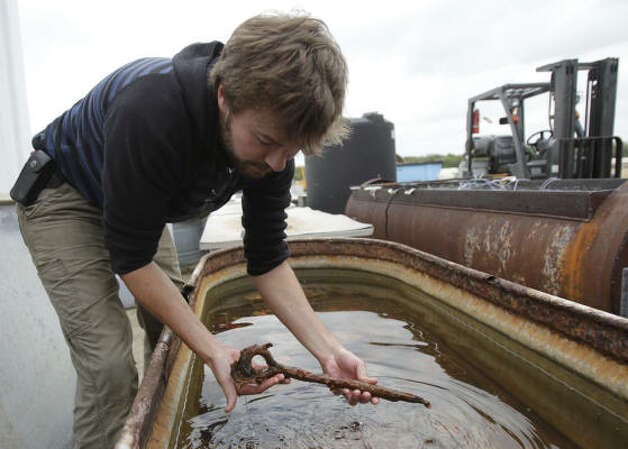 Photo Julio Cortez
By Allan Turner - Houston Chronicle
A&M archaeologists find a way to accelerate preservation of 17th-century shipwreck.
Since its discovery in Matagorda Bay 15 years ago, the French ship La Belle has yielded a treasure trove of artifacts that offer unprecedented insight into 17th-century exploration of the New World.
Weapons, trade goods, medical and navigational instruments — part of the approximately 1 million items plucked from the bay bottom — have found homes in Texas museums.
But the biggest, arguably most significant recovery — a massive section of the ship's oak hull — has remained out of sight, submerged in a tank of preservative at Texas A&M University's nautical archaeology conservation lab.
The process of replacing water in the sodden timbers with polyethylene glycol, begun in 2004, could have taken up to nine more years to complete. But now, with the purchase of what is thought to be the hemisphere's largest archaeological freeze-dryer, conservationists believe they have found a better, cheaper way to finish the work in far less time.
In coming months, segments of the ship's 54-foot-long, 14-foot-wide hull, will be transferred to the dryer for processing. In October 2013, the newly conserved hull will be unveiled at Austin's Bob Bullock State History Museum, where it will be reassembled - in view of museum visitors - over a 10-month period.
The hull will be the centerpiece of a 6,000-square-foot exhibit on the Belle and its role in French exploration of Texas.
The ship, one of four explorer Robert Cavelier, Sieur de La Salle, brought to America in search of the Mississippi River's mouth, sank in Matagorda Bay in 1686.
Texas Historical Commission nautical archaeologists discovered the Belle's remains in 1995, calling them one of the New World's most exciting shipwrecks.
"The exciting thing about the hull reaching completion, aside from the conservation of a major artifact, is that it's an icon of an event that transformed Texas history," said Jim Bruseth, historical commission archaeology director.The ship's sinking, he said, contributed to the failure of La Salle's Fort Saint Louis colony near present-day Inez and opened the door to Spanish domination of the region.
"We could very well have been a state with a French heritage," Bruseth said. -
Chinese archaeological experts due in Kenya for excavation
- On 27/11/2010
- In Underwater Archeology
Chinese archaeological experts will arrive Kenya on Saturday to commence the 2.5 million U.S. dollars terrestrial excavation aimed at retrieving treasures on board a ship which sank off Pate Island some 600 years ago.
The move is a solid gesture of the partnership that has existed between Kenya and China over the years and seeks to ravel the deep standing relationship between the two states, with the team expected to complete its work within six to eight weeks after the process commences.
The National Museums of Kenya (NMK) Director General, Farah Idle said the equipment to be used in the excavation exercise, are expected to be cleared at the port of Mombasa, before they are ferried to Lamu ahead of the exercise.
Speaking on the sidelines of the Lamu Cultural Festivals on Friday, Farah said the diving equipment including oxygen tanks, masks, suits among others, will arrive by Dec. 10-12 and the procedure commences."The team has already done initial pilot diving, and has established how deep the waters are, general locality of the wreckage near Shanga village and other few logistical issues," Farah said.
He told Xinhua that the findings and any treasure found within the wreckage will be used for analysis while others may have to be taken back to China for further tests.
The official also revealed that the exercise, which is a Sino- Kenya joint archaeological project in Lamu Archipelago, signed between Chinese and Kenyan governments on April 24, 2007, will involve three experts from China, and two sea experts from Kenya, including one analyst."The issue now at hand is if we shall be able to recover anything from the wreckage, but what remains a fact is that the Kenyan government will, at the end of it, have developed its capacity for Kenyans to carry out under water archaeology, which is the first ever," Farah said.
He added that Kenyans, will be able to be undertaking their own under water archaeology even when ships sink or when there is a maritime issue to be dealt with.
He however said the whole idea was to check the inside of the wreckage, float it if possible and conduct the research.
Already, the terrestrial excavation that was being undertaken at Mambrui in Malindi was complete, with the findings over the early settlers and some of the treasures expected to be handed over soon.
According to history, a Chinese merchant ship sunk six centuries ago and still lays in the deep sea, with some of the residents in the area, Shanga village, being nicknamed as the Chinese family as they bear distinctive Asian features such as yellowness of the skin and almond eyes.