HOT NEWS !
Stay informed on the old and most recent significant or spectacular
nautical news and shipwreck discoveries

-
Real pirates booty at the Denver museum of nature & science
- On 19/03/2011
- In Museum News
From PR Newswire
Pirate movie buffs will have to wait until May for the release of the latest swashbuckling Hollywood blockbuster, but pirate fans can load their treasure chests with booty right now, as they feast on Real Pirates: The Untold Story of the Whydah from Slave Ship to Pirate Ship.
The world's first exhibition of authenticated pirate artifacts, Real Pirates is on display at the Denver Museum of Nature & Science through August 21, 2011. Visitors can enhance their summer visit with exclusive pirate-themed hotel deals.Organized by National Geographic, Arts and Exhibitions International and AEG Exhibitions, Real Pirates tells the amazing story of the Whydah, a pirate ship that sank in 1717 and rested on the bottom of the ocean for nearly 300 years, only to be discovered by underwater explorer Barry Clifford in 1984.
The exhibition features more than 200 artifacts recovered from the ship wreck off the coast of Cape Cod, including treasure chests of coins, jewelry, cannons and weaponry.
The exhibition brings the real story of pirates to the public as it's never been told before – through real objects last touched by real pirates. Throughout the immersive 13,000-square-foot exhibition, visitors will experience the perils and privileges of life during the "Golden Age of Piracy."
Interactive activities include boarding a life-size replica of the ship's stern, hoisting the skull-and-crossbones, tying pirate knots, taking home a pirate hat, participating in a treasure hunt, and more. -
Shipwreck in Canada makes top 10 list of finds
- On 18/03/2011
- In Underwater Archeology
By Randy Boswell - The Gazette
This summer's discovery of the 19th-century wreck of the HMS Investigator, announced in July by a team of Parks Canada researchers scanning Arctic waters off Banks Island, has been named one of the 10 most important archeological finds of 2010 by the world's leading publication in the field.
Archaeology magazine unveiled a top 10 list this week that includes the discoveries of ancient tombs in Asia and Central America, the decoding of the Neanderthal genome by European scientists and the unearthing of the bones of a 3.6-million-year-old human ancestor in Ethiopia.
The discovery of the Investigator, a key vessel in the history of the Northwest Passage and the establishment of Canadian sovereignty in the Arctic, marks the first time a Canada-based archeological find has been recognized by the prestigious U.S.-based magazine since it began publishing its annual list of the world's best new historical treasures in 2006.
"Decades from now people may remember 2010 for the BP oil spill, the Tea Party, and the iPad. But for our money, it's a lock people will still be excited about the year's most remarkable archaeological discoveries," the magazine stated in unveiling its list.
"This was the year we learned that looters led archaeologists to spectacular and unparalleled royal tombs in both Turkey and Guatemala.
An unexpected find brought us closer to Pocahontas, and an underwater archaeological survey in the high Canadian Arctic located the ill-fated HMS Investigator, abandoned in 1853."
The listing by the magazine, which is published by the Boston-based Archaeological Institute of America, has capped a banner year for Parks Canada's underwater archeology division.
The unit is planning a followup study of the newly found wreck site next year, along with a third season of searching for the Sir John Franklin-commanded ships -Terror and Erebus -that the crew of the Investigator never found.
-
Wreck of Gold Rush steamship Winfield Scott unveiled at Maritime Museum
- On 18/03/2011
- In Museum News
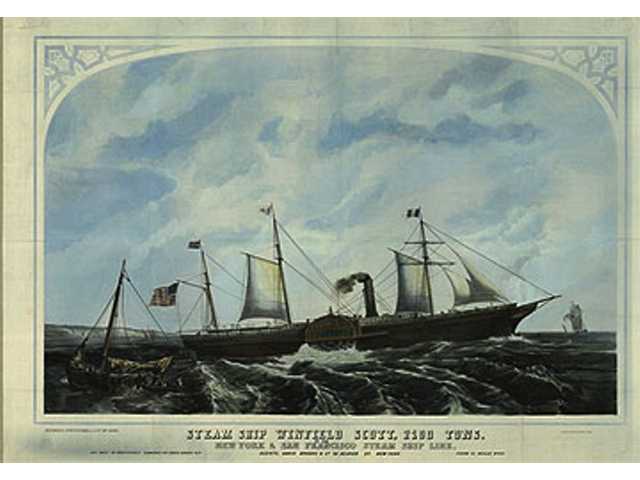
From the Signal
The Santa Barbara Maritime Museum is pleased to unveil its newest permanent exhibit, the shipwreck of the California Gold Rush steamship Winfield Scott.
During the California Gold Rush, ships propelled by steam regularly carried passengers and cargos between San Francisco and Panama. One such vessel was the Pacific Mail Steamship Company's side-wheel steamer, Winfield Scott.
In 1853, the steamer was en-route from San Francisco south bound to Panama with more than 500 passengers and a cargo of gold and mail when it ran aground on Anacapa Island, becoming permanently stranded.
"Several passenger steamships were lost in 1853. Winfield Scott was the final act that plagued the movement of passengers and cargo," said Robert Schwemmer, Maritime Heritage Coordinator for Channel Islands National Marine Sanctuary."Few shipwrecks have been lost while on their way to Panama, and the Winfield Scott furthers our understanding of what people were taking away from California."
Read more... -
Archaeologists analyze skeleton of Franklin expedition
- On 18/03/2011
- In Expeditions

From Unreported Heritage News
On May 19, 1845 Sir John Franklin, an experienced arctic explorer, set out on what would be his last voyage of discovery.
Leaving from Greenhithe, England, he commanded two ships, the Erebus and the Terror. His mission was to pass through and chart the Northwest Passage, the waterway which runs through arctic Canada, connecting the Atlantic Ocean with the Pacific.
The unforgiving environment of the passage, strewn with ice packs and small islands, would doom his expedition, killing Franklin and every single member of his crew.
A message found in a cairn near Victory Point on King William Island says that his ships were frozen in ice for nearly a year and a half.
Trapped in the arctic the crew began to die with Franklin himself passing away on June 11, 1847. At that point Captain Francis Crozier took over the expedition. He decided to try to save his remaining men by marching south across the ice and arctic tundra.
“Crozier must have been very desperate indeed to have made this decision,” writes William James Mills in his book Exploring Polar Frontiers.
Needless to say the plan failed with none of the crew surviving. Rescue expeditions and scientific surveys would find human remains on or near King William Island.
In the past, analysis of these remains has suggested that the crew members suffered from lead poisoning, a potentially deadly condition that may have caused them to engage in irrational behaviour. The crew could have gotten it through the tin cans that their food were stored in, they might also have gotten it from the water system on board.
It has also been suggested that the crew suffered from scurvy and tuberculosis, conditions that may have doomed many crew members who had been stuck in the ice for nearly 18 months. Cut marks on some of the bodies indicate that the men may have resorted to cannibalism.
-
Students help preserve history of Modern Greece warship
- On 15/03/2011
- In Conservation / Preservation
Photo Mike Spencer
By Amy Hotz - Star News Online
For a ship that’s been sunk 150 years, the Modern Greece has impeccable timing.On the morning of June 27, 1862, the 210-foot blockade runner slipped through a ring of Federal warships to enter the Cape Fear River.
Its hold was filled with goods from England for the industry-void Confederacy.
Before the Modern Greece could pass under the protection of Fort Fisher, which guarded the route to Wilmington, the USS Cambridge caught a glimpse of it and opened fire. Soon, the USS Stars And Stripes joined in.
The Modern Greece’s captain made a difficult decision. To prevent the goods from falling in to the hands of the North, he drove the ship aground. And the guns of Fort Fisher were able to finish it off, making sure nothing was left behind for the enemies.
Or so everyone thought for almost exactly 100 years.
Right around the 100th anniversary of the ship’s sinking, and while the nation was in the midst of commemorating the 100th anniversary of the Civil War, divers discovered that the Modern Greece had not, in fact, been completely destroyed.
It was still filled with its original cargo.
Thousands of artifacts were recovered by Navy divers and the N.C. Department of Archives and History. Much of their preservation techniques were the first of their kind and amounted to the beginning of underwater archaeology, not just in North Carolina, but in the United States, said deputy state archaeologist Mark Wilde-Ramsing.
Over the next four years, Civil War sites and museums across the nation will honor the 150th anniversary of the Civil War with elaborate commemorations. And here, the state will also honor the 150th anniversary of the sinking of the Modern Greece and the 50th anniversary of the beginning of underwater archaeology. -
Snowbird's find could be part of historic shipwreck
- On 15/03/2011
- In Miscellaneous
By Kimberly Blair - PNJ
Snowbird Agnes Hand has spent every winter for a decade hunting several miles of Navarre Beach for seashells she carts back by the box to Casper, Wyo.
She's always on the hunt for the rarest of shells, the spotted junonia, considered the queen of shells.
But last week she and her shell-hunting buddy, Debbie Thomas, found something even rarer: a 7-foot-long piece of timber that most likely came from an 1880s shipwreck.
Hand and Thomas were so focused on looking for sand dollars and olive shells they walked right past the piece of wood that had just floated up behind Hand's winter home, Regency Condominiums.
"This man was taking photographs, and he said to me, 'Did you notice the pegs in the wood?' " Hand, 75, said.
The ladies wheeled around and took a closer look and discovered the timber had what are called treenails, hallmarks of 1800s-era craftsmanship.
"When I saw those pegs, I could not believe it," Hand said. "The round pegs told me it was very old, and I figured it must be older than me. I was sure it must have some value historically."
She and Thomas snapped photos of the wood. And the Pensacola Historical Society directed them to Della Scott-Ireton, director of the northwest region of the Florida Public Archaeology Network. She confirmed it most likely was from a shipwreck.
"We often do get fragments of shipwrecks offshore, especially after storms," Ireton said.
-
Smithsonian shipwreck exhibit draws fire from archaeologists
- On 12/03/2011
- In Scams, Thefts

Photo Arthur M. Sackler Gallery
By Heather Pringle - Science Mag.
Archaeologists are criticizing the ethics of a planned Smithsonian Institution exhibit, Shipwrecked: Tang Treasures and Monsoon Winds, slated to open in the Arthur M. Sackler Gallery in 2012.The exhibit is based on artifacts hauled up from an Arab dhow that sank to the bottom of the Java Sea in the 9th century C.E.
The wreck was salvaged by a private German company, Seabed Explorations GbR, in the late 1990s, and critics say that its divers did not observe professional archaeological standards while recovering the artifacts, which include glazed ceramics, lead ingots, and intricately worked vessels of silver and gold from the Tang dynasty.
Then in 2005, most of the finds were sold to a second company in Singapore for a reported $32 million.
Such commercialization of ancient objects doesn't break the laws of Indonesia, in whose territorial waters the dhow was found, but many archaeologists say that it contravenes their field's standard ethical guidelines.
In recent weeks, three major American archaeological associations and three of the Smithsonian's own internal research organizations have written to Smithsonian Institution Secretary Wayne Clough strongly opposing the exhibition."We agree that there was unprofessional and unethical conduct associated with the recovery of this wreck, regardless of the 'letter of the law,' and that at the least, the perception of impropriety and the potential for the Smithsonian's engagement with this project could set a negative precedent and reflect ill on this institution," wrote Melissa Songer, chair of the Smithsonian Congress of Scholars, in her letter.
Underwater archaeologists have been fighting for decades to protect shipwreck sites from treasure-hunting operations that mine sunken ships for artifacts to sell.In 2009, the archaeological community scored a major victory when the UNESCO Convention on the Protection of the Underwater Cultural Heritage came into effect.
It stated that "underwater cultural heritage shall not be traded, sold, bought or bartered as commercial goods."
Read more... -
Local heritage shipwreck gets fresh marker
- On 11/03/2011
- In Parks & Protected Sites
From BC Local News
A century to the day after running aground and sinking just north of Thetis Island, one of B.C.’s most significant shipwrecks received a ‘re-plaquing’ March 4.
In 1911, the Robert Kerr, a 190-ft. barque first launched in 1866 by the Hudson’s Bay Co., was running coal for the Canadian Pacific Railway, which had converted the sailing vessel to a barge in 1888.
Heavily laden and running behind a towboat on March 4, 1911, the ship struck a reef and was abandoned once much of the coal was removed.
Last Friday’s underwater installation — replacing a plaque originally placed in the early 1980s, — will be conducted by the Underwater Archaeological Society of B.C.
Among the handful of divers taking part is David Hill-Turner, Nanaimo Museum curator and president of the UASBC, who said the Robert Kerr would have been a familiar sight in Departure Bay during its coal-hauling days, taking payloads from the Wellington mine and later bearing coal from the Extension mine out of Ladysmith Harbour.
“There was a fleet of these things travelling to and from Vancouver,” said Hill-Turner, adding that of the hundreds of wrecks in the waters around Vancouver Island, the Robert Kerr is one of just seven recognized under B.C.’s Heritage Conservation Act.
It is also one of the most spectacular and most intact, said Peter Luckham, a Thetis Island-based dive master and guide who regularly visits the site.