HOT NEWS !
Stay informed on the old and most recent significant or spectacular
nautical news and shipwreck discoveries

-
More sunken ships found in Bedwell Bay
- On 28/04/2011
- In Wreck Diving
By Jennifer McFee - Vancouver Sun
Deep under the waters of Bedwell Bay, history meets mystery in a graveyard of sunken ships, including two new wrecks documented earlier this month.
In mid-April, divers from the Shipwreck Exploration Team descended to murky depths in Bedwell Bay, located next to the Village of Belcarra near the start of Indian Arm.
They had been planning to shoot a video of the four known wrecks sunken in the area. But when they asked the Canadian Hydrographic Service for a sonar scan of Bedwell Bay, they discovered two more mystery targets.
Technical diver Dirk De keersmaecker was on the team that descended more than 100 feet to explore the underwater remains of a large wooden ship.
"We saw a really large object. It was close to 100 feet long, six to eight feet wide, but it didn't really look like a ship ... It's probably over 100 years old.That's the reason why there's so little left of it. Basically there's the beam left, some of the decking, some of the side beams, but the rest of the hull is actually gone and there's none of the super structures present anymore," said De keersmaecker, a New Westminster resident.
"It is quite thrilling if it is indeed 100 years old. We're very curious of what it can be. We'll have to do some future dives and do some more measurements and look at all the artifacts that are there to try to figure out the history."
De keersmaecker and the other divers hired a local charter service to bring them to the other submerged target, located on the other side of Bedwell Bay.
"It was a barge that was upside down. We do have the video. We do have the measurements. So the work is, of course, trying to figure out what it was used for. Normally a metal barge like this is a maximum [of] 40 years old," he said. "If it is a fresh sunken barge, then somebody might salvage it, repair it and use it again.Now if it's been down there for 20 or 30 years, which we think this one probably has, then it's too rusted to use again so they would probably just leave it there. Very likely, nobody wants to admit that they own the barge because then they have to bring it up."
Jacques Marc, explorations director for the Underwater Archeological Society of B.C., said Bedwell Bay has historically been a dumping ground for abandoned vessels. -
ORRV enters into joint venture agreement with the Mares Del Sur association
- On 28/04/2011
- In Treasure Hunting / Recoveries
From News Channel 5
Oceanic Research and Recovery Inc., a marine salvage and exploration company, today announced that it has entered into a joint venture agreement with the Mares Del Sur Association to pursue shipwreck projects in Peru.
This project will focus on working in partnership with Mar Del Sur Association, a Peruvian based organization dedicated to locating and recovering Colonial era Spanish galleons lost along the coast.
Named Southern Cross, the venture is due to begin in the late May to early June timeframe.
During the colonial years of 1550 to 1800 what was then the Viceroyalty of Peru was one of the richest of Spain's possessions in the New World.
Tons of silver and gold regularly shipped out of Peru on board ships of the South Seas Armada which transported the vast wealth to Panama where it was then shipped across the isthmus and put on board ships bound for Spain.
"Southern Cross has been in development for almost three years," said Scott Heimdal, CEO of ORRV. "This is only one of the exciting developments that will be announced in the coming weeks." -
Titanic's unknown child given new, final identity
- On 28/04/2011
- In Famous Wrecks

Photo Carol Goodwin
By Wynne Parry - Live Science
Five days after the passenger ship the Titanic sank, the crew of the rescue ship Mackay-Bennett pulled the body of a fair-haired, roughly 2-year-old boy out of the Atlantic Ocean on April 21, 1912.
Along with many other victims, his body went to a cemetery in Halifax, Nova Scotia, where the crew of the Mackay-Bennett had a headstone dedicated to the "unknown child" placed over his grave.
When it sank, the Titanic took the lives of 1,497 of the 2,209 people aboard with it. Some bodies were recovered, but names remained elusive, while others are still missing. But researchers believe that they have finally resolved the identity of the unknown child -- concluding that he was 19-month-old Sidney Leslie Goodwin from England.
Though the unknown child was incorrectly identified twice before, researchers believe they have now conclusively determined the child was Goodwin. After his recovery, he was initially believed to be a 2-year-old Swedish boy, Gösta Leonard Pålsson, who was seen being washed overboard as the ship sank.
This boy's mother, Alma Pålsson, was recovered with the tickets for all four of her children in her pocket, and buried in a grave behind the unknown child.The effort to verify the child's identity using genetics began a little over a decade ago, when Ryan Parr, an adjunct professor at Lakehead University in Ontario who has worked with DNA extracted from ancient human remains, watched some videos about the Titanic.
"I thought 'Wow, I wonder if anyone is interested or still cares about the unidentified victims of the Titanic,'" Parr said. -
The Black Swan Conspiracy
- On 27/04/2011
- In Treasure Hunting / Recoveries
By Lloyd Sowers - My Fox Tampa Bay
It's one of the richest overnight arrivals at any airport, anywhere, ever -- bucket after bucket, filled with 17 tons of silver and gold coins.
"It took an entire 757 to transport all of the coins back to the United States. Every square inch, including every seat of the plane, had a bucket of coins belted in," said Mark Gordon, Chief Operating Officer of Odyssey Marine Exploration.
Now, for the first time, they show what's inside one of the buckets: it's a clump of coins, fused together by two hundred years on the bottom of the sea.
One bucket contains about a hundred coins. Gordon shows it, saying it's one of the smaller ones.
"We actually picked up coins from the Black Swan site in clumps of a thousand and three thousand coins," Gordon explained.
"Black Swan" is Odyssey's code name for the treasure , found in deep international waters off Gibraltar. Spain believes it was their Spanish Galleon Mercedes that sunk in 1804, carrying a fortune.
The discovery set off a firestorm.. Spain seized odyssey's ship, and arrested the captain. But by that time, the treasure was in Tampa, leaving Spain to battle for the booty in U.S. federal court.
That's when Gordon became suspicious of the government.
"We've known for a long time something didn't seem right, that the U.S. government was intervening in the Black Swan case in a way that was very prejudicial," he said.
Then, the secrets were revealed by Wikileaks: there were transcripts of conversations between U.S. and Spanish officials, discussing the find off Gibralter, the Tampa Admiralty Court, and also a painting.
Gordon believes they were making a deal.
"That the U.S. government was actually working with the Spanish government to try to orchestrate a trade," he said.
A trade where U.S. officials would help Spain get the treasure if Spain would return a $20 million painting, long sought-after by a well-connected American family. It was stolen from their grandmother in Europe more than 60 years ago by Hitler's storm troopers.
"If people told me there was a movie coming out featuring sunken treasure, trading for Nazi art, government interference in a business, you would think it's beyond fiction, but it's reality here," Gordon said.
The coins themselves contain yet another twist: it's where they came from in the first place. -
More relics salvaged from ancient shipwreck
- On 26/04/2011
- In Underwater Archeology
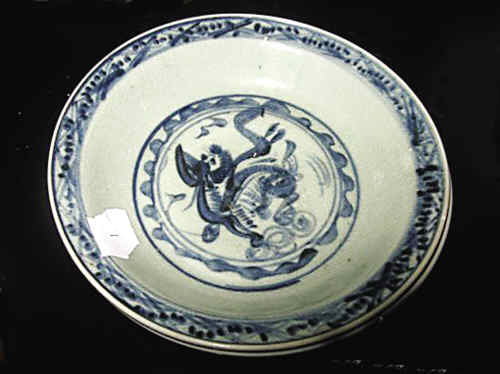
From China
An archaeological salvage team has restarted to retreat cultural relics from the wreckage of an ancient merchant ship that sank near the coast of today's Guangdong Province some hundreds of years ago.
The team plans to complete the salvage of all the relics from "Nan'ao No. 1" in 75 days. The retrieval of the shipwreck is not included in this year's task, officials in charge of the salvage said.
A large number of porcelain dishwares with exquisite graphic paintings have been found in previous archaeological surveys conducted in the shipwreck. Thousands of them were retrieved from the wreck last year.
The "Nan'ao No. 1" was believed to be en route to Southeast Asia from Zhangzhou City in the southeastern Fujian Province before it sank in today's Sandianjin waters off Nan'ao County of Shantou City during the late Ming Dynasty (1368-1644). -
Indians first to ride monsoon winds
- On 24/04/2011
- In Ancien Maritime History
By G.S. Mudur - Telegraph India
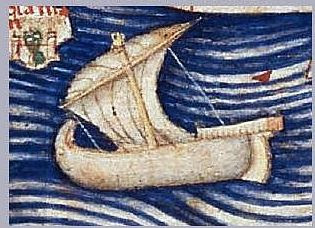
Mariners from India’s east coast exploited monsoon winds to sail to southeast Asia more than 2,000 years ago, an archaeologist has proposed, challenging a long-standing view that a Greek navigator had discovered monsoon winds much later.
Sila Tripati at the National Institute of Oceanography (NIO), Goa, has combined archaeological, meteorological, and literary data to suggest that Indian mariners were sailing to southeast Asia riding monsoon winds as far back as the 2nd century BC.
A 1st century AD Greek text, Periplus of the Erythreaean Sea, and a contemporary Roman geographer named Pliny have claimed that the Greek navigator, Hippalus, discovered the monsoon winds and the route across the Arabian Sea to India around 45 AD.
But Tripati has now used multiple lines of evidence — from inscriptions on ancient Indian coins to bronze pottery from an archaeological site in western Thailand — to question that claim and argue that mariners of India’s east coast knew about the monsoon winds perhaps about 200 years before Hippalus. Tripati’s research is published in the journal Current Science from the Indian Academy of Sciences.
“This work provides fresh insights into the maritime history of India,” said Ruby Maloni, professor of ancient Indian history at the University of Mumbai, who was not connected with the NIO research but is an expert on ancient trade contacts.
Tripati has analysed monsoon wind patterns in the Bay of Bengal to show how sailors could have used them to their advantage. The northeast monsoon winds between October and February help ships sail from the east coast of India to Sri Lanka and to southeast Asia. And between May-June and September, the southwest monsoon winds can drive ships from southeast Asia to the east coast of India.
“The strongest evidence to support this idea comes from ancient literary works and the timing of a festival observed in Orissa even today,” said Tripati, a scientist at the marine archaeology division at the NIO.
Both the Buddhist Jataka tales that date back to the 4th century BC as well as Tamil Sangam texts from around the 1st century BC mention ships moving through the force of winds or sails, Tripati said.
The monsoon winds have historically been linked to the Arabian sea and the western zone of the Indian ocean, Maloni said. This work throws light on how the winds were also used on the eastern side of India centuries earlier.
She cautioned that the new hypothesis is based on inferences and indirect deductions. “But the sources used to make this proposal such as the Tamil and Buddhist literary works and archaeological remains are indeed legitimate,” -
Whisky bottles still being washed up on the Llyn Peninsula
- On 24/04/2011
- In Parks & Protected Sites

By Eryl Crump - Daily Post
Whisky bottles are still being found where they were buried after a shipwreck 110 years ago, off the Llyn peninsula.
Sailing ship Stuart set sail from Liverpool on Good Friday 1901, bound for New Zealand carrying cargo that included pianos, cotton bales, porcelain and thousands of bottles of whisky.
The vessel came to grief near Porth Colmon on the north coast near Tudweiliog on a foggy and drizzly Easter Sunday morning. But Capt Robert Hichinson and his crew of 18 got ashore without injury or loss of life.
Locals made the most of the wreck taking away everything of value – especially the whisky – before Customs and Excise men arrived from Caernarfon. And by all accounts there was a huge party.
Historian Tony Jones, who has researched the shipwreck, said: “The incident mirrors the wreck of the SS Politician off Eriksay in the Hebrides. This was later made into the comedy film Whisky Galore. But this happened some 40 years beforehand. S4C should turn this story into a film.”
Mr Jones said the crew managed to re-board their ship only to discover it was hopelessly lodged. He added that, over the years, fact and fiction have become mixed up.
“The two became increasingly difficult to disentangle, but one thing is certain, when word got around about the wreck and especially her cargo it changed this part of Lln for a long time.
“To wake up and find an Aladdin’s cave full of goodies on your doorstep, especially with the poverty people endured back then, it would have taken a lot of willpower and faith to stay on the right side of the law.
“So hordes of people descended on the Stuart like a swarm of locusts, and within no time they were helping themselves to her cargo.
“This was before the 1904 Religious Revival that swept through Wales and alcohol was frowned upon for many years after that. The Customs & Excise arrived en masse from Caernarfon with Mason Cumberland in charge.
Read more... -
Boat found at Sea of Galilee dates back to time of Jesus
- On 23/04/2011
- In Parks & Protected Sites

By Jackie Shecker Finch - Herald times Online
After a severe four-year drought, two fishermen were walking alongside the Sea of Galilee when they made an amazing discovery.Buried in the sea was the barely visible remains of an ancient boat. At its lowest level in memory, the Sea of Galilee in 1986 was unveiling its tremendous treasure.
The brothers were shocked, however, to learn just how old the muddy boat turned out to be. Carbon dating and other techniques traced the large vessel to the time of Jesus.
“It seems impossible that the boat survived and that it was found,” said Orna Cohen, archaeologist and conservator of the vessel that has come to be called “The Jesus Boat.”
“If the drought hadn’t lowered the sea so much and if these two brothers hadn’t seen the nails of the boat and if they hadn’t contacted an archaeologist, the boat might never have been found,” Cohen said. “It was against all odds that these things happened.”
Buried in and protected by the seabed’s sediment, the boat was rescued in a painstaking and remarkable 11-day excavation. The delicate hull was then submerged in a chemical bath for seven years before being shared with the public.
The boat is 26.9 feet long, 7.5 feet wide and 3.9 feet tall. Adaptable to both sail and oars, the boat was used primarily for fishing but could also serve for transporting goods and passengers. “It would hold about 15 people,” Cohen said.
Although there is no evidence to scientifically tie the boat to Jesus, Cohen noted that Jesus lived along the Sea of Galilee at the time and that boats played a large role in his life and ministry.The Gospels record that Jesus’ first disciples were fishermen and that Jesus spoke to large crowds from aboard a boat. It is the Sea of Galilee that Jesus walked upon and where he calmed a storm.
“He was a fisher of men,” Cohen said. “There were very few boats here at the time and there are lots of reasons to believe that at least Jesus saw this boat and that he may have touched it or sailed on it.”
Fourteen years after its excavation, the boat was moved to its permanent home in a new wing of the Yigal Allon Centre.Located on the northwest shore of the Sea of Galilee near the city of Tiberias, the Ancient Galilee Boat museum recounts the discovery, excavation and preservation of the boat, called one of history’s greatest archaeological finds.