HOT NEWS !
Stay informed on the old and most recent significant or spectacular
nautical news and shipwreck discoveries

-
Bronze Age boats discovered at a quarry in Whittlesey
- On 10/12/2011
- In Underwater Archeology

From BBC News
Bronze Age boats, spears and clothing dating back 3,000 years and described as the "finds of a lifetime" have been discovered near Peterborough.
Archaeologists from the University of Cambridge have unearthed hundreds of items at a quarry in Whittlesey.
The objects, discovered at one of the most significant Bronze Age sites in Britain, have been perfectly preserved in peat and silt.
It is thought the settlement burned down in about 800 BC.
David Gibson, project manager for the excavation, said: "It is giving us a 3-D vision of this community that we only see very rarely in the world, let alone in this country."
Ropes, buckets and wooden spoons as well as swords and spears with their handles intact have been found at the site, which lies along the old course of the River Nene.
Six boats hollowed from the trunk of an oak tree, some with extensive carvings, have also been discovered on the site.
'Finds of a lifetime' The boats were discovered three metres below the modern-day surface. It is thought the community would have lived on the river, fishing for perch, pike and eels.
The remains of a nettle stew have been discovered in a wooden bowl.
-
Salvaging a 'multi million' industry
- On 10/12/2011
- In Miscellaneous
By Neil Hartnell
A leading Bahamian law firm yesterday told Tribune Business that an wreck salvaging industry worth potentially "hundreds of millions of dollars" might have been unleashed by law changes passed this week, disclosing that it had been contacted by "three-four major salvage groups" already.
The Bahamian law firm, well-known to Tribune Business but requesting anonymity because it wanted to protect clients still in the infancy of their exploration discussions, said amendments to the Antiquities, Monuments and Museums Bill passed by the House of Assembly had paved the way for a sector that could create numerous tourism and cultural spin-offs.
The firm was meeting with one party interested in salvage/excavation opportunities in Bahamian waters in Miami yesterday, and said it was "sure" the amendments - which lay out the statutory framework governing such operations in this nation's Exclusive Economic Zone (EEZ) - would "encourage a broad-based, viable and sustainable industry, centred in, and around, the northern Bahamas, Little Bahama Bank and the island of Grand Bahama, in particular".
Confirming it had suggested the 75/25 profit split between excavator and government, based on points, for each artifact discovered in Bahamian waters, a top partner at the law firm, speaking to Tribune Business on condition of anonymity, said: "We've had a number of calls from international treasure salvagers who are keenly interested in salvaging the Bahamas, and have been keen to do so for many years.
"This interest goes back for at least five years. We've heard of at least two wrecks. We'd say it could possibly be an industry in the hundreds of millions. It has terrific touristic and cultural potential.
"We've already had interest from three or four major groups, and we think more will come. There's said to be 200 wrecks around Grand Bahama alone."
Wreck exploration and salvaging, and the prospect of finding valuable artifacts, could be another potential economic sector for a Bahamian economy desperately in need of diversification and new revenue/employment sources.
A moratorium on such activities had been in place for several years, and that - coupled with uncertainty over the legal, regulatory and profit-sharing regime governing it - had deterred major international salvagers from dipping their toe into the Bahamian market.
Given this nation's position at the heart of the Caribbean, Atlantic and Florida waterways, and rich history (having been discovered by Christopher Columbus, and later used as a piracy bolt-hole), it would seem likely there are numerous wrecks in deep-lying Bahamian waters.
"It could have great touristic spin-offs and job spin-offs, not only on the boats," the law firm's leading partner told Tribune Business. "You set up a processing centre, where you clean and certify artifacts. That's an industry by itself."
The attorney said many Bahamians had made money by salvaging wrecks they knew about, referring to one now-deceased Abaconian who had known the whereabouts of a major wreck, and had been able to recover gold coins and other valuable artifacts.
That, though, had reached the stage where major heavy-duty equipment was required to complete any further salvage. -
Divers discover mid-1800s shipwreck near Cape Vincent
- On 09/12/2011
- In Parks & Protected Sites
By Jaegun Lee - Watertown Daily times
Two veteran divers discovered a rare mid-19th century shipwreck on the northeast end of Lake Ontario in the upper St. Lawrence River near Cape Vincent.
Dennis R. McCarthy, who discovered the wreck by pure coincidence with fellow diver Raymond I.
“Skip” Couch, said the ship appears to be a Great Lakes sloop used for short-distance cargo transportation in shallow waters that sank sometime between 1850 and 1870.
“We were getting new side scans of known shipwrecks for another book we are working on,” said Mr. McCarthy, Cape Vincent.
“We found this wreck by accident in a location you would never expect to find a sunken ship. Skip forgot to turn the equipment off and kept the side-scan sonar running.
We later identified the outlines of a shipwreck with the side scans from that day.”
After their discovery in August, the divers went back to the site in September and videotaped the 50-foot-long and 14-foot-wide wreck so that the state Historic Preservation Office in Albany could review and confirm that it was indeed a new find.The Historic Preservation Office confirmed in November that the wreck had not been registered with the state.
At this point, little is known about the ship and the circumstance of its sinking.
Based on the video images of the wreck, underwater archaeologists determined it is similar to Hudson River sloops but with a unique centerboard and triangular rudder design not seen before on the Great Lakes. -
Kaiser Willhelm's urinal found at bottom of Baltic
- On 09/12/2011
- In Treasure Hunting / Recoveries

By Matthew Day - The Telegraph
German maritime archaeologists claimed to have found a urinal used by Kaiser Wilhelm II lying on the bottom of the Baltic Sea.The piece of porcelain history was discovered in the wreck of the Udine, a light-cruiser which was sunk in the First World War by the Royal Navy, that now lies 28 nautical miles off the German island of Rugen.
"It was sunk by the British in 1915," said Reinhard Oser, the archaeologist leading the expedition. "We managed to take some great photographs, and made this unusual discovery."
At the time the significance of the urinal went unnoticed until later research revealed that the urinal was part of a special bathroom laid on for the emperor's convenience.
"Kaiser Wilhelm was on board the ship when it was launched in Kiel on December 11, 1902, and went on its maiden voyage," explained Mr Oser, who added the team had been surprised by the identity of the urinal's user.
The discovery of the regal lavatory has helped focus attention on the vast array of wrecks that litter the seabed of the Baltic. Archaeologists estimate that there as many as 3,000 ships, many of them victims of fighting in either the first or second world war, lie beneath the waves. -
Anniversary of Portland shipwreck
- On 08/12/2011
- In Museum News
From Wicked Local
Join maritime archaeologists from Stellwagen Bank National Marine Sanctuary for a visit to the steamship Portland shipwreck that lies hidden beneath the waves.The event will include a showing of the Science Channel’s award winning documentary, The Wreck of the Portland, and a presentation on current research.
The Commemoration of the Portland Gale and the Sinking of the Steamship Portland will take place from 1 to 2:15 p.m. and again from 2:30 to 4 p.m. Saturday, Dec. 3, at the Scituate Maritime and Irish Mossing Museum, 301 Driftway, Scituate.
The Scituate Historical Society and National Oceanic And Atmospheric Administration’s Stellwagen Bank National Marine Sanctuary sponsor this event.
Nov. 27, 2011 marks the 113th anniversary of the steamship Portland’s loss, one of New England’s greatest maritime tragedies. The ship sank during a tremendous storm that ravaged shipping and Massachusetts coastal communities on that fateful weekend after Thanksgiving. The storm became known as the “Portland Gale.”
Scituate bears a lasting mark from the storm – the opening of a new mouth for the North River, which splits the community of Humarock from the rest of the town.
Together, Stellwagen Bank National Marine Sanctuary and the Scituate Historical Society seek to commemorate the Portland Gale with an interpretive program highlighting the sanctuary’s archaeological and historical investigation of the steamship and the museum’s collection of Portland artifacts.
NOAA understands and predicts changes in the Earth’s environment, from the depths of the ocean to the surface of the sun, and conserves and manages our coastal and marine resources. -
Pearl Harbor attack remembered at 70th anniversary
- On 08/12/2011
- In Miscellaneous

From Fox News
About 120 survivors of the Dec. 7, 1941, bombing of Pearl Harbor observed a moment of silence to commemorate the Japanese attack and the thousands who lost their lives that day 70 years ago Wednesday.The moment of silence came just before 8 a.m. local time, when the first Japanese planes launched their attack. The survivors were joined by Navy Secretary Ray Mabus, military leaders and civilians at a ceremony in Pearl Harbor.
Altogether 3,000 people attended the event at a site overlooking the sunken USS Arizona and the white memorial that straddles the battleship.
President Obama hailed veterans of the bombing in a statement proclaiming Wednesday as "National Pearl Harbor Remembrance Day."
"Their tenacity helped define the Greatest Generation and their valor fortified all who served during World War II. As a nation, we look to December 7, 1941, to draw strength from the example set by these patriots and to honor all who have sacrificed for our freedoms," he said.
Also this week, five ash scattering and interment ceremonies are being held for five survivors whose cremated remains are returning to Pearl Harbor after their deaths.
On Tuesday, an urn containing the ashes of Lee Soucy was placed on his battleship, the USS Utah, which is lying on its side near the place where it sank. The ashes of Vernon Olsen, who was on the Arizona during the attack, will be placed on his ship late Wednesday.
The U.S. lost 12 vessels that day, but the Arizona and the Utah are the only ones still sitting in the harbor. The attack brought the United States into World War II.
The ashes of three other survivors will be scattered in the water in separate ceremonies this week.
-
New Orleans Auction to offer gold relics from shipwreck
- On 02/12/2011
- In Auction News
From Auction House PR
On September 4, 1622, two Spanish fleets set sail from Havana harbor under the command of Marquis de Caderieita, their holds laden with the richesse of the New World. The first fleet (or “flota”), the Tierra Firma, had picked up treasures at Columbia, Panama and other ports in South America.
The other, the New Spain flota, had collected its cargo along the coast of Mexico.
The two convoys gathered in Cuba to make the return trip together, accompanied by heavily armed warships to protect the fleet against pirates and privateers.
Bad weather and other problems delayed their planned July 1st departure until late in the season.
The 28 ships started on their usual route: through the Florida Straits, up the east coast of Florida to the latitude of Bermuda, then eastward home. Barely one day out, however, on September 6th in the Straits of Florida, disaster struck in the form of a massive hurricane.
The ferocious storm scattered the fleet, capsizing some ships, slamming others into the Keys.
Three galleons, five merchant naos and one patache were lost on the Keys, with two (or three) others lost in deeper waters.>
When news of the disaster reached Spain, authorities sent another five ships to Florida in attempt to salvage two of the galleons, the Atocha and the Santa Margarita. Over a period of about 10 years, Spain was able to recover about half the treasure of the Santa Margarita, which was in shallow enough water to allow some salvage by breath-holding divers.
Recovery from the Atocha, which had sunk in 55 feet, proved more difficult, and the rest - those private vessels lost in the deep waters of the Keys -were considered lost forever.
In the late 1960s, shrimpers working around the Dry Tortugas brought up in their nets a large ceramic amphora, later identified as a colonial-era Spanish olive jar.
The location of the site was noted, but once again the cost of recovery at such a depth – 1300 feet - made futher exploration impractical. Not soon after, treasure hunter Mel Fisher (1922-1998) began his 16-year search for the Atocha, which he discovered on July 20, 1985 on the coral reefs 35 miles from Key West.
The salvage produced a staggering amount of treasure: 40 tons of gold and silver bars, over 100,000 gold coins and precious Muzo emeralds. The discovery prompted a surge of interest in shipwreck salvage and advancements in the technology of deep-water recovery.
The olive jar dredged up in the '60s was remembered, and on June 6, 1989, about 50 miles southwest of the Atocha site, an 83-foot, 190-ton deep-sea diving research vessel, the R.V. Seahawk (a one-time shrimp boat seized by the Coast Guard and sold in 1987 for $50,000 to ad and P.R. man Greg Stemm), used its video- and sonar-equipped unmanned Phantom DHD2 remotely-operated recovery vehicle to retrieve a 4.1 kilogram bronze bell from the ocean floor.
It was labeled artifact number 89-1A-00001 and enabled Stemm and his partner John C. Morris to establish an admiralty claim for the site and allow their company, Seahawk Deep Ocean Technology Inc. (which went public in 1991), to begin salvaging the wreck, now called the 'Dry Tortugas.'
-
Desestiman el recurso de Odyssey contra la sentencia favorable a España
- On 02/12/2011
- In Illegal Recoveries
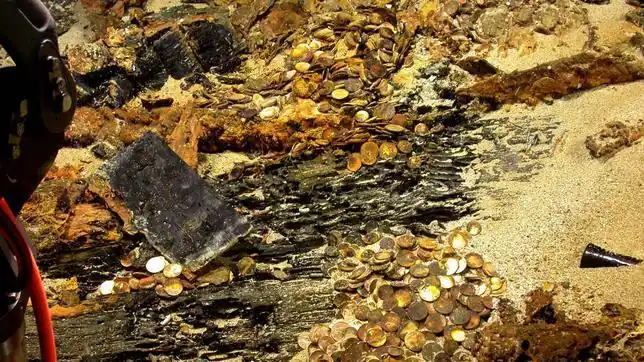
J.G.Galero - ABC
Fuentes consultadas por ABC aseguran que la intención de la empresa es recurrir ahora ante el Tribunal Supremo para no tener que devolver el tesoro de la "Mercedes".El Tribunal de Apelaciones de Atlanta ha desestimado el recurso presentado por la empresa Odyssey Marine Exploration contra la sentencia que le obliga a entregar a España el tesoro de la fragata española "Nuestra Señora de las Mercedes", según ha confirmado el abogado James Goold.
Fuentes diplomáticas consultadas por ABC aseguran que la intención de Odyssey es recurrir ahora ante el Tribunal Supremo. Se calcula en un 80% las probabilidades de que los cazatesoros traten de llevar el caso hasta el final.
Pero lo cierto es que el Supremio estadounidense no atiende todos los casos que se le presentan, sino aquellos en los que puede aclarar criterios con su jurisprudencia.
Siendo así, lo más probable es que decline aceptar el caso, dada la unanimidad de las sentencias en todas las instancias, que hasta ahora han dado la razón a España en la batalla legal por la carga de la fragata "Mercedes".
En caso de que Odyssey ni siquiera intente llevar el caso al Supremo, lo más seguro es que el Tribunal de Atlanta les dé un muy breve plazo de tiempo para devolver las monedas a España.
Nuestro país tiene el plan de retorno del material expoliado preparado desde hace meses.
La sentencia que Odyssey recurrió ante el Tribunal de Apelaciones de Atlanta reconoce los derechos del Estado español sobre la embarcación y su cargamento y ordena la devolución y entrega a España de todas las monedas y objetos extraídos del pecio.