HOT NEWS !
Stay informed on the old and most recent significant or spectacular
nautical news and shipwreck discoveries

-
Devil's Nose was a 'graveyard of ships'
- On 21/12/2011
- In Dangerous Places for Shipping
By Richard Palmer - Pall Times
More than two centuries ago, early in the development of commercial sailing, a particularly bad spot for shipwrecks was located a few miles west of Rochester at what today is Hamlin Beach State Park, then known as “Devil’s Nose.”
One of the first such mishaps occurred there more than two centuries ago. The location is approximately seven miles west of Braddock’s Bay, near Rochester.
The reason why so many wrecks occurred here is no mystery. Fortunately, no loss of life was been recorded.While the headland is easily spotted from the lake, there is — or was — a dangerous shoal extending outward from the shore, which was visible only during a heavy gale when the seas broke over it. Geologists say this shoal was the result of centuries of washing by waves and precipitation.
The Coast Pilot,” which was once the bible of navigators, warned sailors to keep half a mile off shore for good water as there was a “dirty spur” almost a mile east of Devil’s Nose, with only feet of draft on it, roughly three-eighths of a mile out.
Of the many vessels wrecked on Devil’s Nose, nearly all wound up there as a result of heavy weather, especially when the lake was fogged in. The ships would become hopelessly wedged in the boulders and break up like toothpicks.
This was the fate of the two-masted schooner Undine which was bound for Sodus on Nov. 1, 1890, and many others.
The first recorded shipwreck there was the Canadian schooner Duchess of York more than 213 years ago. About the only details existing of this wreck were reported in a newspaper published at Niagara-on-the-Lake, the Niagara Constellation, on Dec. 7, 1799:
“On Thursday last, Nov. 29th, a boat arrived here from Schenectady. She passed the York, sticking on a rock off the Devil’s Nose. No prospect of getting her off.A small deckboat also, she reports, lately sprung a leak 12 miles distant from Oswego. The people on board, many of whom were passengers, were taken off by a vessel passing, when she instantly sank. Cargo is lost.”
Later, on Dec. 21, 1799, another newspaper, the Upper Canada Gazette, reported:
“We hear from very good authority that the schooner York, Captain Murray, has foundered and is cast upon the American shore about 50 miles from Niagara, where the captain and men are encamped. Mr. Joseph Forsyth, one of the passengers, hired a boat to carry them to Kingston.”
Forsyth had been a merchant at Niagara since 1793 when he arrived aboard the lake’s earliest private merchant vessel, Dorchester. The vessel was 80 tons, and built near Kingston in 1787.
-
Mount Edgcumbe to display Cornish shipwreck cargo
- On 19/12/2011
- In Museum News

From BBC News
Artefacts from a ship that sank off the Cornish coast in the 18th century will be on show at a country park when £41,000 has been secured.
The Metta Catharina sank in 1786 off south east Cornwall. Its cargo, including calf hides and glassware will be on display at Mount Edgcumbe House.
For 32 years divers have retrieved the artefacts which will be on show alongside an exhibition in 2013.
A lottery grant has provided the money to help fund the project.
Items found on the Metta Catharina von Flensburg included Russian calf hides, wine carriers, clay tobacco pipes and shoe buckles, a spokesperson from Plymouth City Council said.Ian Skelton, chairman of the Metta Catharina Trust, said: "It is wonderful news that after 32 years of diving and research, the story of it can be told.
"Mount Edgcumbe is a fitting location for the artefacts to be displayed."
The total cost of the project will be £60,500 with additional funding coming from the Friends of Mount Edgcumbe, the Metta Catharina Trust and Mount Edgcumbe, the council spokesperson added.The Metta Catharina lay almost completely buried in deep silt off Mount Edgcumbe and was discovered by divers in 1973.
-
How to survive the Titanic
- On 17/12/2011
- In Famous Wrecks
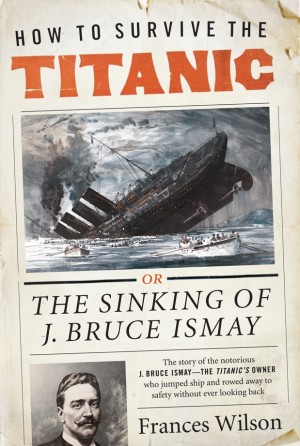
By John Konrad - gCaptainWhat fundamentally hasn’t changed in the 100 years since the Titanic ?
One hundred years ago today Harland & Wolff shipyard in Belfast Ireland was putting the final touches on a ship that would hold the title of the world’s largest passenger liner but her glory would be brief.
On 15 April of the following year, 1912, she would claim a more ominous title as the world’s most infamous ship. Her name was the RMS Titanic.
Scores of books have been written chronicling the disaster but few take the time to understand the men behind the tragedy.
In a new book titled HOW TO SURVIVE THE TITANIC, Award-winning historian Frances Wilson delivers a gripping account of the incident.
By investigating the ship’s collision and sinking through the prism of the demolished life and lost honor of the ship’s owner, J. Bruce Ismay, Wilson brings a bright new perspective to the event raising provocative moral questions about cowardice and heroism, memory and identity, survival and guilt—questions that revolve around Ismay’s loss of honor and identity as his monolithic venture —a ship “The Unsinkable” — was swallowed by the sea and subsumed in infamy forever.
The book is more than a gripping tale of survival, it’s also a window into the role ship managers and shipping tycoons play in the instigation of maritime tragedies.
The consolidation of major shipping and energy companies in recent years have created mega-conglomerates like Transocean and BP, companies in which CEO’s are responsible for the management of increasing risks and operational complexity.
While modern technology and regulations have made sweeping changes to the operation and safety of ships since the Titanic, as told by Wilson, the fundamental cause of disaster is the human element.
The character, motivations and personality of CEO’s play an important role in safety at sea. This, unfortunately, has not changed. The fundamental element of human nature and corporate decision-making on ship safety is just as relevant today as it was 100 years ago.
-
Feds nix export permit for polar explorer Roald Amundsen's ship
- On 16/12/2011
- In Expeditions
By Jane George - Vancouver Sun
A plan to tow the half-submerged wreck of a ship off the shore of Nunavut's Cambridge Bay back to Norway has hit a wall.
The federal government has turned down a request for an export permit for the Maud, once sailed by Norway's Roald Amundsen, the first European adventurer to travel the Northwest Passage in 1906 and the first person to reach the South Pole, a feat he achieved in December 1911.
Amundsen sailed the Maud on an unsuccessful attempt to sail through the Northeast Passage, then drifted in the ice toward the North Pole.
But bringing the Maud back to Norway is all about the enduring hoopla that surrounds the country's homegrown hero, Amundsen.
And that's why group of Norwegian investors wanted to raise the Maud with balloons, drag the hulk over to a barge and then tow it from Nunavut back to Norway — a 7,000-kilometre journey.
There, the Maud would be exhibited at a futuristic museum in Asker, a suburb of Oslo — where anything to do with Amundsen remains a huge draw.
The reason for the refusal of the permit: a full archeological study must be first be conducted on the wreck — a condition that came as unexpected news to the manager of the project "Maud Returns Home."
"The reason for the refusal is explained as lack of information concerning the extraction of the Baymaud. The Export Examiner states that the ship should not be recovered without adherence to accepted archaeological standards," Jan Wanggaard said Thursday — a day after Norway celebrated the 100th anniversary of Amundsen's arrival at the South Pole. -
Sackler Gallery cancels controversial exhibit of Tang dynasty treasures
- On 16/12/2011
- In Eastern World Treasures
By Jacqueline Trescott - The Washington Post
The Smithsonian Institution’s Arthur M. Sackler Gallery canceled the controversial exhibit “Shipwrecked: Tang Treasures and Monsoon Winds” after consulting with an international advisory committee.
In an unexpected move, the committee decided to seek permission from Indonesia to re-excavate the Belitung shipwreck, which has been submerged for more than 1,100 years, and eventually build an exhibition from those findings.
Before the cancellation, the show had been scheduled to open at the Sackler in the spring.The exhibition of materials from the shipwreck, considered one of the most important archeological discoveries of the late 20th century, sparked a heated debate among archaeologists and historians.
Critics contend that a commercial company’s recovery of the priceless finds from the Tang dynasty had not met with best practices and high scientific standards.
“I leapt at the idea of a re-excavation. This is an opportunity to gain the information that was ignored or lost in the first recovery,” said Julian Raby, director of Sackler and the Freer Gallery of Art.
In a meeting in Washington last week, the advisers agreed to try to organize a new excavation of the traditional Arab sailing vessel.
The ship was discovered off the coast of Indonesia with a cargo of 63,000 items. The discovery showed that there had been a maritime trade route between China and the Middle East in the ninth century.
The new plan, said Raby, would give any discoveries more scholarly context. -
AUV discovers Svalbard helicopter wreck
- On 14/12/2011
- In High Tech. Research/Salvage

The wreckage of a helicopter that crashed in Svalbard, Norway in 2003, has been discovered by an Hydroid REMUS100 AUV.The helicopter's crew escaped alive, but the wreck had not been seen since it sank into Adventfjorden bay.
Mark Moline, a professor from California Polytechnic University who is currently a Fulbright Arctic Chair at the University Centre in Svalbard, was doing research to climate-related changes to the Adventfjorden's ocean floor.
When he downloaded the images from an oceanographic survey September 2011, he discovered that the REMUS had photographed the missing helicopter wreckage.
The wreck is located in shallow waters close to the North shore of the Adventfjorden, where bigger boats are unable to travel, according to professor Moline.
He currently has no formal plans to investigate the helicopter wreck further, but he may attempt to explore it again next summer.
In addition to his ongoing oceanographic research, professor Moline also now hopes to use the REMUS to locate a German plane that crashed in the Adventfjorden during World War II.
-
Divers retrieve prehistoric wood from Lake Huron
- On 14/12/2011
- In Underwater Archeology

Photo John O'Shea
From Science Daily
Under the cold clear waters of Lake Huron, University of Michigan researchers have found a five-and-a-half foot-long, pole-shaped piece of wood that is 8,900 years old. The wood, which is tapered and beveled on one side in a way that looks deliberate, may provide important clues to a mysterious period in North American prehistory."This was the stage when humans gradually shifted from hunting large mammals like mastodon and caribou to fishing, gathering and agriculture," said anthropologist John O'Shea. "But because most of the places in this area that prehistoric people lived are now under water, we don't have good evidence of this important shift itself- just clues from before and after the change.
"One of the enduring questions is the way the land went under water. Many people think it must have been a violent event, but finding this large wood object just sitting on the bottom wedged between a few boulders suggests that the inundation happened quickly but rather gently.
And this in turn suggests that we'll find more intact evidence of human activity in the area."
With support from the National Science Foundation (NSF) and the National Oceanic and Atmospheric Administration (NOAA), O'Shea and U-M colleague Guy Meadows began exploring the area in the middle of modern Lake Huron several years ago. In 2009 they reported finding a series of stone features that they believe were "drive lanes" used by ancient PaleoIndian hunters to funnel caribou to slaughter, a technique still used today by the Inuit.
These drive lanes were located on the Alpena-Amberley Ridge, a land connection across the middle of modern Lake Huron that linked northern Michigan with central Ontario during the low-water periods of the Pleistocene and early Holocene ages.
-
A good and just law for shipwreck heritage
- On 11/12/2011
- In Parks & Protected Sites

By Dr Edward Harris - The Royal Gazette‘Only a small part of what once existed was buried in the ground; only a part of what was buried has escaped the destroying hand of time; of this part all has not yet come to light again; and we know only too well how little of what has come to light has been of service for our science.' - Oscar Montelius, The Civilization of Sweden in Heathen Times, 1888.
Standing as the only visible signpost in the west on the trans-Atlantic crossroads from the Caribbean to the Old World of Spain and the other countries of western Europe, Bermuda and its waters, being also an impediment of reefs in that eastward passage, became the burial place of many a hapless ship and intrepid mariner.
Over the course of the Age of Sail, in the case of Bermuda starting after its discovery in late 1505 by the eponymous Juan and ending with the advent of the Steam Age around the time of the American Civil War, the island become a sunken repository of shipwreck heritage, holding the remains of perhaps several hundred vessels.
Given that sea travel from the Age of Discovery onwards encircled the world, after Magellan if you will, the shipwreck heritage embedded in Bermuda's reefs is international heritage, ‘World Heritage' you might say, and thus it fell to the Island to preserve that heritage which belongs to all peoples.
For many years, we fulfilled that responsibility less than adequately, with much heritage being destroyed and not much being retained in the public domain, due to the inadequacies of a law promulgated in 1959, apparently composed with serious input from treasure hunters. The Act was slanted to their benefit and not that of the country or the world, and thus the possession of much of that shipwreck heritage passed into private hands.
That world changed with the enactment by the Progressive Labour Party government, under Premier (now Dame) Jennifer Smith, JP, MP, of the Historic Wrecks Act 2001.
That good and just law for shipwreck heritage mandates that all work carried out on the remaining sites be done by the scientific methods of archaeology and that artifacts and material found belong to the Government, which is also entitled to copies of all records made during the work. Those collections of artifacts and records are ultimately to form the ‘National Collection' of shipwreck heritage, to be preserved, studied and shared on behalf of the people of Bermuda and the wider world.
Since 1975, when shipwreck artifacts at the Bermuda Aquarium were transferred to Dockyard, the Maritime Museum (now the National Museum) became the de facto custodian of what then comprised “the national collection” and has spent several millions building an essential conservation laboratory and curating and exhibiting those collections, along with materials the Museum and associated groups, such as the Sea Venture Trust and university field schools, have excavated since 1982, when modern archaeology methods were introduced into the process of examining shipwrecks in Bermuda.