HOT NEWS !
Stay informed on the old and most recent significant or spectacular
nautical news and shipwreck discoveries

-
Old shipwrecks found in Greek waters
- On 19/02/2012
- In Underwater Archeology

Brendan Foley, a marine archaeologist at the Woods Hole Oceanographic Institution in Massachusetts, and his colleagues at Greece’s Ephorate of Underwater Antiquities in Athens, have conducted a four-week survey of the waters around Crete last October.
They wished to catalogue large numbers of ancient shipwrecks in the Aegean Sea.
And the grand prize would be a wreck from one of the most influential and enigmatic cultures of the ancient world — the Minoans, who ruled these seas more than 3,000 years ago.
The team took a two-pronged approach to exploring around Dia. The Gudgeon crew prowled Dia’s bays, where the ocean bottom is smooth and artifacts are more likely to show up in sonar images.
Near shore, where the bottom is too rocky for Gudgeon, Foley and his team of divers made a circuit of the bays at about 40 metres depth.
Almost immediately, the divers located five ancient wrecks, ranging from around the second century BC to the ninth century AD.
Foley is hoping to use the surveys to catalogue large numbers of wrecks of all ages across great swathes of the Mediterranean and the Black Sea.
Through a combination of sonar and high-resolution digital photography, he can compile detailed three-dimensional maps of a wreck site and answer questions about the date, origin and cargo of a ship without bringing up a single artefact.
Foley estimates that hundreds of thousands of ships must have sunk in ancient times — including thousands in the Bronze Age alone — and that a significant proportion of those are still sitting at the bottom of the deep sea.
-
Sunken British ships are focus of Newport archaeology project
- On 19/02/2012
- In Underwater Archeology
By Ken Shane - Jamestown Press
The Rhode Island Marine Archaeology Project (RIMAP) is currently engaged in a multi-year search to locate and identify 13 British transport ships that sunk in Newport Harbor in 1778.
The British navy scuttled the ships in an effort to blockade the French fleet that was threatening the city.
RIMAP is an organization that is interested in the state’s maritime history. Its goal is to locate, identify and study cultural resources in Rhode Island waters such as shipwrecks, debris fields, submerged man-made structures and inundated terrestrial sites.
Such discoveries can include Native American watercraft and Colonial and Revolutionary war wreckage. It also studies local slaving, steamship and naval histories.
Carolyn Frank is a Jamestown resident who teaches history at Brown University. At one time she participated in RIMAP wreck dives, including those in Newport Harbor, and she has followed the progress of the search since that time.
During the Revolutionary War, the French fleet came into Newport, Frank said. “There were British ships that had been anchored around Newport Harbor.
When the French fleet sailed in with bigger guns than the British had, they decided that the best plan would be to scuttle their vessels and try to create a blockade around Newport so that the French ships couldn’t sail in because they would get hung up on the sunken vessels. They took everything off of the ships and sunk them right before the Battle of Newport.”
RIMAP is particularly interested in explorer Capt. James Cook. Cook circumnavigated the globe three times, exploring more of the world than any person in history. Two of Cook’s four ships saw their last duty in Narragansett Bay.
Royal navy men who sailed with Cook served in Newport during the Revolution.
The current RIMAP search is particularly focused on a transport called the Lord Sandwich, which was one of the 13 scuttled ships. The reason for this focus is that the Lord Sandwich was formerly known as the Endeavour, the bark that Cook sailed on his first circumnavigation of the globe.
“One of the vessels, the Endeavour, had sailed in Capt. Cook’s fleet,” Frank said. “When the ship became derelict it went into private service and became a ship called the Lord Sandwich. During the Revolution it was sailed back to the United States.”
The transport had carried German troops to Newport in 1776 when the British occupied the city. For the next two years the Lord Sandwich was used as a prison ship to house American patriots.
“It was an old vessel,” Frank said. “The British tried to use these ships for as long as they could, to save money. It was a once illustrious vessel that was being repurposed.
It was scuttled along with the other vessels that the British scuttled in order to create the blockade.”
In July and August of 1778, the French fleet arrived in Narragansett Bay to provide support for American forces that were preparing to attack Newport. The British responded by burning or sinking 10 Royal navy ships to avoid having them captured. On Aug. 3 through Aug. 5, the 13 transports were scuttled.
-
Odyssey ha alterado y manipulado algunas monedas de la Mercedes
- On 19/02/2012
- In Illegal Recoveries
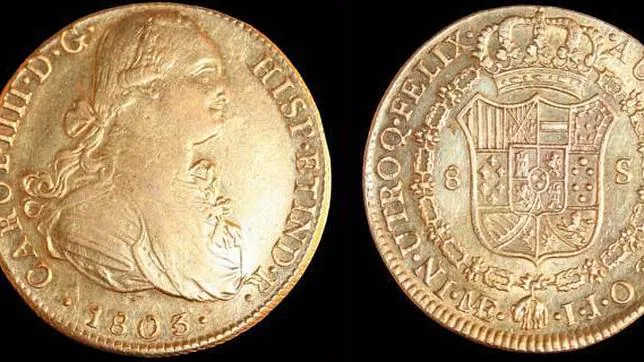
By Jesus Garcia Calero - ABC.esLa impactante victoria de España ante la Justicia de EE.UU. no ha reformado ni un ápice el comportamiento de la compañía cazatesoros Odyssey Marine Exploration, que parece buscar mil y una triquiñuelas con todos sus tentáculos para no entregar las 590.000 monedas de plata y oro, más otros restos, expoliados en 2007 y en secreto del pecio la fragata "Mercedes", hundido en 1804 frente a las costas del Cabo de Santa María.
El juez reunirá el viernes a las partes para tratar de la restitución.
De la documentación a la que ha tenido acceso ABC se desprende que la empresa que custodia las monedas desde su llegada a Tampa (llamada Numismatic Guaranty Corporation) ha podido manipular y alterar cientos de monedas y que ha decidido no entregar ni una sola hasta que España no le pague 185.159,02 dólares (a fecha de 3 de noviembre, y contando) por sus gastos de tratamiento y cuidados del material durante estos años.
Es decir, que la empresa contratada por Odyssey para desalinizar y conservar la carga expoliada ahora quiere cobrar a nuestro país por ese trabajo, que España no le pidió y que habría sido innecesario si los cazatesoros no hubieran reventado el pecio del buque de guerra español, en cuyo hundimiento perecieron 250 personas.
Numismatic Guaranty Corporation (NGC) no fue elegida por casualidad para ese cometido.
Tiene tratos con Odyssey y de hecho ha firmado algunos contratos de exclusividad para la certificación y posterior venta de las monedas de oro que los cazatesoros extrajeron en 2003, por ejemplo, del "USS Republic", un barco hundido en 1865 a 100 millas de la costa de Georgia.
Pero hay más. El 3 de noviembre pasado, un representante de NGC, Steven Eichenbaum, escribió al abogado de España en el caso, James Goold, para exigirle el pago de esos casi 200.000 dólares que «aumentarán necesariamente si el tiempo pasa».
La carta añade una amenaza taxativa: «La entrega de las monedas en nuestro poder no ocurrirá hasta que ese derecho de retención haya sido satisfecho por completo».
Mas... -
Deep sea archeologist, explorer recruiting in Chattanooga
- On 19/02/2012
- In Festivals, Conferences, Lectures

By Mary Barnett - Nooga
Deep sea explorer Dr. Robert Ballard may be best known for his underwater shipwreck discoveries including the Titanic in 1985, the German battleship Bismarck in 1989, the aircraft carrier U.S.S. Yorktown in 1998 and the wreck of John F. Kennedy's PT-109 in 2002.
But he told Chattanooga area high school students Thursday morning during a talk at UTC that he was most envious of the discoveries they would make in their lifetimes.
"Your generation is going to explore more of our planet than all previous generations combined," he told the students.
Ballard was in town for two speaking engagements as part of the Tennessee Aquarium's Our Blue Planet speaker series. Alexandra Cousteau, granddaughter of Jacques-Yves Cousteau, is the next scheduled speaker on Sept. 6.
The series is part of a grant the aquarium received from the National Oceanic and Atmospheric Administration (NOAA) three years ago.
"One of the components of that grant was to conduct a community lecture series that brings scientists from around the country and the world into Chattanooga to expose our community to an awful lot of environmental opportunities and information," Charles Arant, Tennessee Aquarium president and CEO, said in his opening remarks.
Ballard has spent much of his acclaimed career exploring vast underwater mountain ranges that no one knew existed when he was still in high school.
Ballard said his next greatest discovery is the one he is about to make.
"But I can't tell you what it is because I haven't a clue," he said.
His message throughout the hourlong talk underscored America's need for future scientists. He opened the discussion by openly stating he was there to recruit.
-
Le méga-yacht de Stéphane Courbit sombre en mer Egée
- On 19/02/2012
- In Maritime News

P.-Y.C. - Sud OuestLe Yogi, navire de croisière de luxe de l'homme d'affaires français a fait naufrage à la manière du Costa Concordia au large de la Grèce.
Décidément, il ne fait pas bon naviguer à bord de bateaux de luxe ces derniers temps.
Après le paquebot Costa Concordia en Méditerranée au large des côtes toscanes, c'est le Yogi qui a fait naufrage en mer Egée.
Le Yogi n'est autre que le plus grand yacht immatriculé en France. Un "méga-yacht" comme ont dit.Ce fier navire flambant neuf a été lancé en mars 2011 par un chantier naval turc.
Long de 60 mètres de long, il est la propriété de Stéphane Courbit, l'homme qui a fait fortune dans les années 2000 en revendant sa société de production télé qu'il avait contribué à créer avec l'animateur Arthur, au géant Endémol.
D'après Paris-match, le Yogi a chaviré et s'est couché sur le flanc, exactement comme le Costa Concordia.
Avant que le bateau ne coule, les huit hommes d’équipage ont pu être sauvés lors d'un hélitreuillage d'envergure réalisé par la marine grecque.
Alors que la Grèce doit se serrer la ceinture, cette coûteuse opération fait grincer bien des dents hellènes.
-
Henri Delauze, pionnier de la plongée profonde
- On 16/02/2012
- In People or Company of Interest
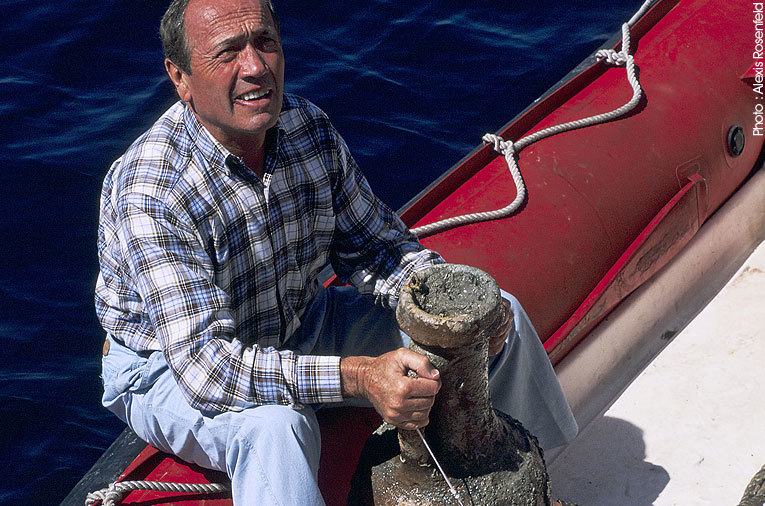
Par Jean-Luc Goudet - Futura-SciencesLe fondateur de la Comex, Henri-Germain Delauze, vient de décéder à Marseille.
Ce pionnier a défriché la plongée profonde et en est longtemps resté un des grands spécialistes mondiaux.
L’occasion de revenir sur la longue aventure de la conquête des profondeurs. Henri-Germain Delauze restera comme un des grands pionniers de la découverte des océans, aux côtés de Jacques Piccard ou de Jacques-Yves Cousteau.
Cet ingénieur des Arts et Métiers, d’abord spécialisé dans les travaux publics, est aussi un bâtisseur et crée en 1961 la Comex, pour Compagnie d’expertise maritime, installée à Marseille.
Car Henri Delauze est devenu un adepte de la plongée et un amoureux de la mer depuis ses séjours à Madagascar, pour son service militaire, et en Californie, pour ses études (où l’un de ses professeurs est Hans-Albert Einstein, fils de l’illustre physicien).La Comex est spécialisée dans les travaux sous-marins et prospèrera grâce aux chantiers pétroliers off-shore.
Tout est à inventer et l’entreprise multiplie les premières, avec le perfectionnement de la plongée profonde, dans un véritable laboratoire, le Centre expérimental hyperbare.
De nombreux mélanges gazeux sont testés car, au-delà d’une centaine de mètres, différents composants de l’air deviennent toxiques. La Comex mettra au point l’Héliox (hélium et oxygène), l’Hydrox (hydrogène et oxygène) et même l’Hydréliox (un cocktail des trois).
-
A graveyard for ships explored
- On 13/02/2012
- In Underwater Archeology
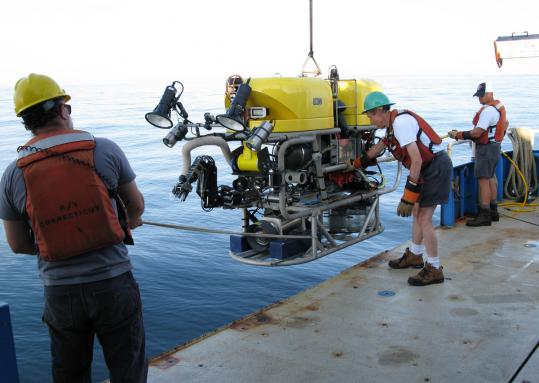
By James Sullivan - The Boston
About a million people a year head out on Massachusetts Bay for whale-watching cruises, according to Deborah Marx of the National Oceanic and Atmospheric Administration.
The stretch of ocean from Cape Ann to the tip of Cape Cod is especially rich with marine life due in large part to Stellwagen Bank, an underwater plateau formed during the Ice Age, now designated a National Marine Sanctuary.
While on the water, whale-watch guides often introduce passengers to another intriguing feature of Stellwagen Bank: It is a burial ground for dozens of ships that have sunk there over the years.
On Feb. 18, Marx and Matthew Lawrence, a fellow NOAA maritime archeologist, will present “The Shipwrecks of Stellwagen Bank’’ at Maritime Gloucester.
The presentation features “The Wreck of the Steamship Portland,’’ a 45-minute Science Channel documentary on the 1898 disaster, which Marx said is the sanctuary’s poster child for shipwrecks and the secrets they keep.
At last year’s Trails & Sails, the Essex National Heritage Commission’s annual fall event, the Stellwagen Bank presentation won a People’s Choice award.
It’s a popular event because of the close ties the North Shore communities, and particularly Gloucester, have to the ocean, Marx said.
Many of the wrecks on Stellwagen were fishing vessels; others were schooners or, like the Portland, passenger ships using the busy ports of Boston, Gloucester, and Provincetown.
Archeological research on shipwrecks like the Portland are truly historic, Marx said, revealing details about our shared heritage, the lives and livelihoods of our great-grandparents’ generations, and much more.
Marine sanctuaries like Stellwagen Bank, which the National Oceanic and Atmospheric Administration oversees - this year marks the 20th anniversary of the designation, are “the equivalent of an underwater park,’’ she said.
“They’re everyone’s resources, protected by Congress. They’re important to the nation as special places.’’
The Portland, a paddle-wheel steamship that ferried cargo and passengers between Boston and Portland, Maine, operated for almost a decade before it went down in a savage storm in November 1898. All 192 passengers and crew were lost; the storm became known as the Portland Gale. -
Odyssey Marine best seen on TV, not in your portfolio
- On 12/02/2012
- In People or Company of Interest
The Jaded Consumer
The Jaded Consumer recently submitted an article at Seeking Alpha with the above title, which the editors decided to rename " The Best Way To Play Odyssey Marine And Shipwreck Exploration".
When I started writing the article, I wasn't yet thinking about the long/short prospects of Odyssey Marine being shorted in favor of a major offshore oil and gas support services provider such as Oceaneering International or Subsea 7, which use some of the same (or better) equipment and skill sets but do so in a business model that has actually been proven to make a profit.
I was thinking that while it's cool to watch underwater exploration televised by the Discovery Channel, it really sucks to " stand under a cold shower tearing up £50 notes
Comments quickly arrived from those who watched OMEX – a crowd that surely has interest in Odyssey's yarn about the almost-in-hand treasure, or it wouldn't be watching OMEX news.
The thrust of the comments was that (a) Odyssey is about to pull up one (or more) of the wrecks, and (b) it's a ton of money on that wreck (or those wrecks) and it'll push shares to $____ (number varies with enthusiasm of advocate).
The comments thus assume that Odyssey is capable of salvaging a wreck at a net profit. Built into this assumption are a several important axioms, the doubt of which would considerably impair the the bull case:
(1) Odyssey is capable of recovering from the sea floor valuable cargoes, substantially intact, despite their being lost for many years,
(2) Odyssey will be able to prove some ownership interest in one or more of these valuable recoveries,
(3) Odyssey's timeline to proving its claim will be within a commercially reasonable time frame, and won't require multiple new share issuances to keep the enterprise's lights on (and attorneys paid) while litigation drags on for years as it did with Mel Fischer, and
(4) Odyssey's cost to recover property and defend a claim to title will not only cost so much less than the value of the recovered property, and be so quick that dilution can be ignored as a risk, but will provide so much upside that the risk of the shares going nowhere forever while OMEX burns investors' cash having fun hunting treasure around the world is really outweighed by the huge upside.
Of these axioms, (1) is probably the safest so long as OMEX is able to raise funds in the public markets to keep trying.
The others vary considerably by project.