HOT NEWS !
Stay informed on the old and most recent significant or spectacular
nautical news and shipwreck discoveries

-
Indonesian sunken treasure up for sale again
- On 07/03/2012
- In Auction News

From Jakarta Globe
Ancient treasure worth an estimated $80 million dollars (Rp 733.9 billion) which was found in a ship that sank off Indonesia 1,000 years ago is up for sale again, the head of the excavation team said Monday.
The “Cirebon treasure” was discovered in a wreck off the port of Cirebon on Indonesia’s Java island and contains about 250,000 precious objects, including crystal, pearls and gold.
“(The haul) is certainly the largest ever found in Southeast Asia in terms of both quality and quantity,” Luc Heymans, the Belgian director of Cosmix Underwater Research Ltd., the Dubai-based firm that excavated the find, told AFP in an email.
The treasure was recovered from the wreck of a merchant ship — nationality unknown — that dates back to about 960 A.D and was first spotted by Indonesian fishermen 187 feet under the sea.
It took some 22,000 dives between April 2004 and October 2005 to excavate the find, which was privately funded under an agreement with Indonesian authorities.
The treasure shows objects being traded between the Far and Middle East, including carved rock and crystal typical of the Fatimid dynasty in Egypt, Mesopotamian drinking glasses, pearls from the Gulf, bronze and gold from Malaysia and exquisite Chinese imperial porcelain. -
Taiwan, France sign 2nd undersea archaeological pact
- On 07/03/2012
- In Underwater Archeology
From Christie Chen - Focus Taiwan
Taiwan and France signed Tuesday their second pact since 2007 to continue bilateral cooperation on underwater archaeological research, saying that the cooperation will focus on research, training and site preservation.
Representatives from Taiwan's Council for Cultural Affairs (CCA) and the Department for Underwater and Undersea Archeological Research (DRASSM) under France's Ministry of Culture inked the four-year pact at a ceremony in Taipei.
Wang Shou-lai, an official of the CCA, said the pact will allow Taiwan to benefit from advanced French technology in underwater archeology and learn from its laws protecting underwater resources.
It will also allow Taiwan to send personnel to France to receive training and translate French undersea archeology publications to benefit local studies, he said.
Tsang Cheng-hwa, an archaeologist and researcher at Academia Sinica, said a team of more than 10 researchers is planning to explore the marine environment of Taiwan's Dongsha Atoll in the South China Sea from April through May.
He said historical documents show that at least 40 ships from countries such as Spain, Portugal, Japan and Sweden have sunk in the area and that his team could benefit from French resources in hunting for the wrecks.
"The French department (DRASSM) in Marseille has very advanced technology, underwater vehicles and diving equipment," said Tsang.
-
Greece, Antikythera shipwreck on display
- On 07/03/2012
- In Underwater Archeology
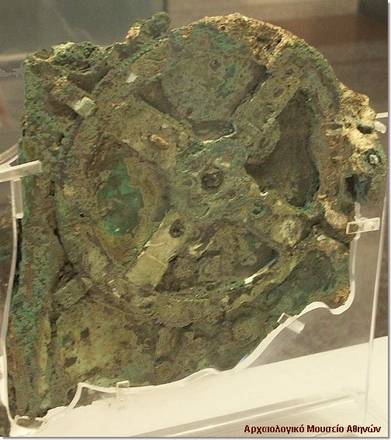
From Ansa Med
Over a century after the wreckage of Antikythera was found by chance (as often happens in the field of archaeology), the archaeological finds brought to light will be showcased together in the exhibition ''The Antikythera Shipwreck: the ship - the treasures - the Mechanism'' organised by Greece's National Archaeological Museum.
The show will be inaugurated on April 5 and will remain open until the end of April 2013. It boasts 378 finds, including sculptures, clay and bronze vases, coins, jewels, fragments of the ship, and, of course, the famous Antikythera Mechanism, considered the oldest computer ever made.
''The oldest example of technology surviving to the present day, which entirely changes our knowledge about ancient Greek technology,'' the British physicist and mathematician Derek De Solla Price said in speaking about this mysterious object, of which he is its first scholar.
Among the finds to be exhibited in the show are also dishes, jugs and amphorae with an acute base for the transporting of the water, oil, wine and dry food necessary for lengthy journeys.
Among the sculptures will be a life-size (1.93 metres high) statue of Hermes thought to be from the first century B.C., on which erosion from its lengthy stay under water is visible. The statue was likely to have been made by artists from the Polyclitus school, such as Cleon, Alypos and Polyclitus III. The bronze original has been dated at around 360-350 B.C.
The director of the National Archaeological Museum, Nikos Kaltsas, speaking to the weekly To Vima on the ship's load, said that the ship had been carrying ''decorations for the villa of a wealthy Roman or objects intended to be sold. This is shown by the refined taste of those who had ordered them, or by their potential buyers.
It would also mark the first known trade in art works, a phenomenon which was later to reach vast proportions in Western civilisation.''
The marble sculpture surfacing in the Antikythera wreckage can be divided into four categories on the basis of their style: the first includes copies of sculptures or variants on important works from classical antiquity.
The second are classical creations combining elements and compositions from different periods, enriched with the features of Hellenic art.
The third includes works intensely reminiscent of creations from the early and middle Hellenic period, and the fourth original creations from the late Hellenic one. -
Titanic sunk by "supermoon" and celestial alignment ?
- On 07/03/2012
- In Famous Wrecks

By Richard A. Lovett - National Geographic News
Just weeks before the Titanic shipwreck's hundredth anniversary, scientists have a brand-new theory as to what might have helped spur modern history's most famous maritime disaster.
An ultrarare alignment of the sun, the full moon, and Earth, they say, may have set the April 14, 1912, tragedy in motion, according to a new report.
R.M.S. Titanic went down on a moonless night, but the iceberg that sank the luxury liner may have been launched in part by a full moon that occurred three and a half months earlier, scientists say.
That full moon, on January 4, 1912, may have created unusually strong tides that sent a flotilla of icebergs southward—just in time for Titanic's maiden voyage, said astronomer Donald Olson of Texas State University-San Marcos.Even at the time, spring 1912 was considered an unusually bad season for icebergs. But figuring out why this happened has been a mystery.
Olson believes the iceberg boom was the result of a rare combination of celestial phenomena, including a "supermoon": when the moon is full during its closest monthly approach to the Earth. -
Treasure mysteriously appears in the Bermuda Triangle
- On 07/03/2012
- In Treasure Hunting / Recoveries

From Coast Explorer Magazine
The Bermuda Triangle is famous for mysterious disappearances but this time the triangle has given back a trove of silver coins lost in the 18th century, which are now at Cannon Beach Treasure Company.
As if right out of a Hollywood blockbuster, deep-sea submersible Mir 1 (of Titanic fame) slowly pushes through the pitch-black water, three miles below the surface of the Atlantic Ocean.
The lights soon reveal what appears to be the rigging of a sailing ship scattered on the bottom.
Then another shape emerges from the dark depths revealing itself to be the bow of an 18th century sailing ship thought to be lost forever in the Bermuda Triangle in 1810.
As Mir 1 approaches the stern of the wreck, the remains of a wooden chest come into view and it is filled with silver coins.
"There were only 1,315 coins recovered from this shipwreck, which makes them extremely rare," says historian and treasure hunter, Robert Lewis Knecht who owns Cannon Beach Treasure Company with his wife, April.
"They were recovered in 16,000 feet of water from the world's deepest, known treasure shipwreck." -
Arles: the excavations in Rhone
- On 04/03/2012
- In Underwater Archeology

From The Art Newspaper
Archaeologists have been working in Arles in the south of France for the past 25 years.
Important discoveries, which throw new light on the Roman settlement known as Arelate in antiquity, go on show at the Louvre this month.
Among the artefacts they have discovered from the city is an unusual bust of Julius Caesar, which could change our image of the Roman emperor.
Jean-Luc Martinez, the keeper of Greek, Etruscan and Roman antiquities at the Louvre, believes the Arles bust, lent by the Arles Museum of Antiquity, could be the only surviving lifelike sculpture of the emperor.
Until the discovery of this portrait of Caesar in Arles, says Martinez, experts considered a marble bust (about 40BC) of a thinner-faced Caesar discovered in Tusculum near Rome and now in the Museum of Antiquities, Turin, to be the best representation of him because it resembles his profile found on coins minted around 44BC. -
Faces of Civil War sailors from sunken USS Monitor reconstructed
- On 04/03/2012
- In Conservation / Preservation
From the Washington Post
When the turret of the USS Monitor was raised from the ocean bottom, two skeletons and the tattered remnants of their uniforms were discovered in the rusted hulk of the Union Civil War ironclad, mute and nameless witnesses to the cost of war.
A rubber comb was found by one of the remains, a ring was on a finger of the other.Now, thanks to forensic reconstruction, the two have faces.
In a longshot bid that combines science and educated guesswork, researchers hope those reconstructed faces will help someone identify the unknown Union sailors who went down with the Monitor 150 years ago.
The facial reconstructions were done by experts at Louisiana State University, using the skulls of the two full skeletal remains found in the turret, after other scientific detective work failed to identify them.
DNA testing, based on samples from their teeth and leg bones, did not find a match with any living descendants of the ship’s crew or their families.After 10 years, the faces are really the last opportunity we have, unless somebody pops up out of nowhere and says, ‘Hey, I am a descendant,’ ” James Delgado, director of the National Oceanic and Atmospheric Administration’s Maritime Heritage Program, said in an interview with The Associated Press.
The facial reconstructions are to be publicly released on Tuesday in Washington at the United States Navy Memorial where a plaque will be dedicated to the Monitor’s crew.
If the faces fail to yield results, Delgado and others want to have the remains buried at Arlington National Cemetery and a monument dedicated in memory of the men who died on the first ironclad warship commissioned by the Navy.
-
Odyssey Gib ‘treasure’ only of archaeological value
- On 04/03/2012
- In Illegal Recoveries
By Brian Reyes - Gibraltar Chronicle
As long ago as 2007, the Spanish Government was given a detailed breakdown of the archaeological artefacts that this week sparked a media frenzy in Spain on news they were still being stored in Gibraltar by Odyssey Marine Exploration.
The press reports coincided with the return to Spain of 17 tonnes of silver coins recovered by Odyssey in 2007 and believed to have come from the wreck of a Spanish galleon, the Nuestra Señora de las Mercedes.
The suggestion was that a portion of the treasure remained on the Rock, which was the operating base for Odyssey’s vessels.In fact, the only items that remain in Gibraltar are archaeological artefacts weighing a total of 93 kilos.
These were recovered in the Atlantic Ocean and are items of little monetary value but high archaeological importance, including pieces of a sextant, ceramics and a number of personal items.
They include just a small number of coins and were recovered not just from the Mercedes site but from three other locations in the Atlantic too.
All could potentially yield valuable information about the various wrecks they came from.
They are stored in a sealed crate in a commercially-operated bonded warehouse. The crate has remained unopened since 2007.
Back then, Odyssey provided a complete list as well as photos of these artefacts to Spain.
The recent reports in Spain suggested that Spain would take legal steps to recover the items but so far this has not happened.
This week the Gibraltar Government said the fate of any items that may remain on the Rock was a matter for the Spanish Government and the company.