HOT NEWS !
Stay informed on the old and most recent significant or spectacular
nautical news and shipwreck discoveries

-
Ancient items discovered underwater near Makronissos and Evia
- On 28/07/2012
- In Underwater Archeology

By Marianna Tsatsou - Greek ReporterArchaeologists have discovered ancient shipwrecks near the island of Makronissos in the Aegean Sea, dating back to the second century BC through the forth century AD.
More specifically, the Ephorate of Underwater Antiquities and the Hellenic Centre for Marine Research found, after diving expeditions that took place in the area for a whole month, six ancient shipwrecks and as a result, are having now a clearer image of trade in ancient times.
The ancient items found underwater were mostly amphoras from north Africa, Sicily and Rhodes island, according to Greek Ana news agency.
The antiquities were lying at a depth of 37 to 47 metres inside what remained of four ships.
In a more northern part of Greece, that is in the Gulf of Evia, archaeological teams found two more wrecks- the first one dates back to first or second century AD and contains building materials while the second one is estimated to be of the Hellenistic times.
In the broader area of Evia, 18 shipwrecks have been identified so far and thus, scientists assume that the Gulf of Evia was a route of significant commercial importance in ancient times.
-
Explorers find sunken German U-boat off Mass.
- On 28/07/2012
- In World War Wrecks
By Jay Lindsay - Associated Press
Divers have discovered a World War II-era German submarine nearly 70 years after it sank under withering U.S. attack in waters off Nantucket.
The U-550 was found Monday by a privately funded group organized by New Jersey lawyer Joe Mazraani.It was the second trip in two years to the site by the team, some of whom had been searching for the lost U-boat for two decades.
Using side-scan sonar, the seven-man team located the wreck listing to its side in deep water about 70 miles south of Nantucket.
Sonar operator Garry Kozak said he spotted the 252-foot submarine during the second of an exhausting two days of searching. Kozak said the team asked him if they'd found it, then erupted in joy without a word from him.
"They could see it with the grin (on my face) and the look in my eyes," Kozak said.
On April 16, 1944, the U-550 torpedoed the gasoline tanker SS Pan Pennsylvania, which had lagged behind its protective convoy as it set out with 140,000 barrels of gasoline for Great Britain, according to the U.S. Coast Guard website and research by Mazraani.
The U-boat slipped under the doomed tanker to hide. But one of the tanker's three escorts, the USS Joyce, saw it on sonar and severely damaged it by dropping depth charges.
The Germans, forced to surface, manned their deck guns while another escort vessel, the USS Gandy, returned fire and rammed the U-boat. The third escort, the USS Peterson, then hit the U-boat with two more depth charges.
The crew abandoned the submarine, but not before setting off explosions to scuttle it. The submarine hadn't been seen again until Monday.
The U-550 is one of several World War II-era German U-boats that have been discovered off the U.S. coast, but it's the only one that sank in that area, Mazraani said.
He said it's been tough to find largely because military positioning of the battle was imprecise, and searchers had only a general idea where the submarine was when it sank.
Kozak noted that the site is far offshore and has only limited windows of good weather. -
Archaeologists search for the real Captain Morgan
- On 27/07/2012
- In Underwater Archeology
From Fox News
To life, love and a legendary privateer’s lost fleet.
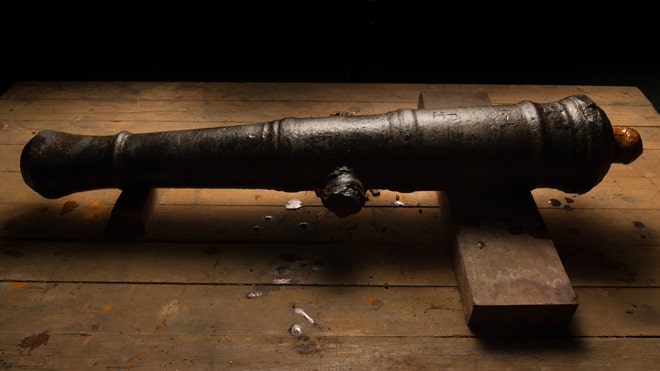
U.S. archaeologists are continuing their search for real-life buccaneer Captain Henry Morgan’s lost fleet after the discovery of six cannons, a 17th century wooden shipwreck and even a barrel that may very well contain rum.
Yo, ho ho indeed.
Aptly backed by the Captain Morgan rum brand, a team of leading archaeologists led by Frederick “Fritz” Hanselmann of Texas State University hope to unlock the myth and mysteries of one of history’s most iconic sea captains.
“We’re interested in telling the true story of Henry Morgan,” Hanselmann, who is a director of the Lost Ships of Henry Morgan Project, told FoxNews.com.
“He was a real historic figure who played a significant role in the history of Panama and 17th century politics. Morgan was a legendary figure, even in his time.
He pretty much ran amuck in the Spanish main, culminating in the sack of Panama City. He sacked a city no one thought could be sacked.”
En route to his most infamous plunder and what was then the richest city in the western hemisphere, Morgan lost five ships (including his flagship “Satisfaction”) at the mouth of the Chagres River, at the time the only waterway access to Panama City.
It’s here that Hanselmann and his team began their search in 2010.“One of the first things we noticed was a series of cannons on the reef where Morgan’s ships ran aground,” Hanselmann said, an indication that the team was on the right track.
They are now trying to narrow the search for where the ships might be using a magnetometer -- a large metal detector towed by boat -- to pick up irons or metals buried in the sand, which has led to them to their first shipwreck, which may have been one of Morgan’s.
-
Underwater metal detectors assist in recovery of shipwreck artifacts
- On 27/07/2012
- In Underwater Archeology
From The Maritime Executive
In October 1619 the naval warship Warwick sailed into the King’s Castle Harbour in Bermuda with an important cargo from England; the colony’s new governor, Captain Nathaniel Butler.
After taking on provisions the Warwick was to travel onto the struggling colony at Jamestown, Virginia, but it never made the voyage.
Before the ship could sail, Bermuda was hit by a fierce hurricane. Battered by strong winds the Warwick broke free from her anchors, was driven into the rocky shore, and torn apart by the pounding waves.
In 1969 Mendel Peterson of the Smithsonian Institution and now famous Bermuda shipwreck hunter EB “Teddy” Tucker located the remains of the Warwick and began an examination of the wreckage.
What they found was a good part of the hull remained preserved under a pile of ballast stone.
Fast forward another 50 years and a new group working under the supervision of the island’s National Museum began a more extensive examination of the site and recovery of some significant historic artifacts.
The museum enlisted some renowned experts in the field of marine archaeology to assist in the project.
One is Dr. Jon Adams, head of archaeology at the University of Southampton who says “the Warwick is one of the largest and most coherent pieces of early 17th century ship structures ever found.”
Dr. Kroum Batchvarov with the maritime archaeology program at the University of Connecticut adds “very few wrecks of the early seventeenth century have been excavated which has limited our knowledge of shipbuilding and seafaring in this period.
This makes the archaeological excavation and documentation of the Warwick an important contribution to that body of knowledge.”
Professor Kevin Crisman of the Nautical Archaeology Program at Texas A&M also thinks this wreck holds enormous potential for educating archaeologists, historians, and the public.
“It could illuminate the early years of England’s great century of overseas expansion, a time when the first English colonies were being planted in North America and around the world.”
-
Capturing history while updating charts
- On 26/07/2012
- In Marine Sciences
From Hydro International
USA Coast Survey’s Navigation Response Team 4 is conducting a year-long survey of the sea floor in the Port of Houston and Galveston Bay navigational areas, re-measuring ocean depths and searching for dangers to navigation.In collaboration with NOAA’s Flower Garden Banks National Marine Sanctuary and the Texas Historical Commission’s Marine Archeology Division, the navigation response team has re-mapped the location of two historically significant wrecks, one of them being the City of Waco steamship.
The steamship City of Waco is one of the historical wrecks that Forfinski’s crew was asked to survey.
The steamship burst into flames and sank on 8 November 1875, and 56 people died.
The sunken ship was ordered to be demolished in 1900, to protect navigation in the area, and the wreck was discovered seven years ago.
Nick Forfinkski, the navigation response team’s leader said that with the often-shifting sediment around that area, there are periods of covering and uncovering, so archeologists like to periodically map historically significant wrecks to see what’s changed.As the team was around surveying for maritime commerce, they were able to obtain up-to-date images of the wrecks.
Forfinkski’s team captured some fascinating images of the City of Waco, created from data they gathered during last week’s hydrographic survey as the multi-beam image with this article, obtained from NOAA.The echosounder used is a Kongsberg EM3002, grid resolution 0.25m and vertical exaggeration 2.5x.
-
Divers discover planes on ocean floor off St. Augstine's coast
- On 26/07/2012
- In Airplane Stories

By Jessica Clark - First Coast News
Joe Kistel, a diver on the First Coast, has stumbled onto a mystery. Kistel is the executive director of TISIRI, and his crews dive and map artificial reefs.
A couple weeks ago, about 20 miles off the coast of St. Augustine, they found some metal objects in a sandy area of the ocean floor.
One metal object led to another. The last one confirmed what they were thinking.
"We knew exactly what it was. We could see a bent propeller and an engine," Kistel recalled.
Low on oxygen in their tanks, he and his crew snapped some pictures and went back to the boat.
Since then, Kistel and his team have researched the name of the engine and the planes which have them. He prepared another dive for this past weekend, aiming to find a serial number.
"It will probably let us identify that plane," Kistel explained.
This weekend brought them another underwater surprise.
-
Iranian archeologists excavate underwater sites of Siraf
- On 26/07/2012
- In Underwater Archeology
By S.Isayev, T. Jafarov - Trend
A team of American and Iranian archaeologists has launched underwater excavations at the historical port of Siraf in the Persian Gulf, PRESS TV reported. Led by Iranian archaeologist Hossein Tofiqian and US-based Iranian expert Sorna Khakzad, the team started their work on July 16.
The American members of the team have brought the special equipment necessary for underwater excavations, ISNA reported.
"Previous studies had identified three or four archaeological strata at the site," said former director of Siraf Cultural Heritage Studies Center Behrouz Marbaghi.
"The most ancient layer dates back to the Parthian era, and the major archeological strata are related to the Sassanid and the early Islamic periods," he added saying that most of the archeological strata are now under the sea.
Located 220 kilometers south-east of Bushehr and approximately 380 kilometers west of Bandar Abbas, the city of Siraf is noted for its many historic sites dating back to the Sassanid, Parthian and Islamic eras.
Previous excavations had yielded east African ivory objects, Indian stone pieces, and Afghan lapis in Siraf which confirm the use of the historic port as the main marine trade route during the pre-Islamic era and the first four centuries following the advent of Islam.
One hundred 35-130 meter deep stone wells and graves at the foot of the mountains surrounding the city are among some of Siraf's unique archeological sites.
Islamic gravestones, the resting place of the Muslim scholar Ibn Sibeveyh, and a number of Towers of Silence and Zoroastrian temples portray the region's religious diversity throughout history.
Excavations had also yielded Sassanid and early-Islamic residential strata as well as a number of intact amphoras used in sea trade during the Parthian, Abbasid and early Islamic eras.
-
Feds seek to complete survey of shipwreck
- On 25/07/2012
- In Parks & Protected Sites
By Jane Gerster - Windsor Star
The federal government is looking to finish a survey of an underwater shipwreck littered with tonnes of munitions just outside of Halifax.
Defence Construction Canada, a Crown corporation that serves the Defence Department, has issued a tender for a contractor to complete the survey in an area south of the city that's popular with recreational divers.
The project, which is estimated to cost $310,050, is listed in a notice recently posted on a website that advertises government contracts.
The SS City of Vienna narrowly missed the entrance to the Halifax harbour on July 2, 1918, and was wrecked on rocky shoals near Sambro Island.
The ship's crew made it off safely with some of the cargo, but during a gale two months later the boat sank into deeper water.
The ship's log shows it was carrying an arsenal that includes 60-pounder shells, Howitzer empty projectiles and shrapnel.
Defence Construction Canada says 363 tons of shells were reportedly salvaged and removed from the site.
"Based on the above quantities, it is estimated that up to 10,000 individual munitions items may remain at the site, or a total of approximately 815 metric tonnes," Defence Construction Canada says in its notice.
"It is unknown whether all items are empty, or if some may be filled with explosive contents."
The ship's hull is no longer intact and the entire area is described as a "debris field."