HOT NEWS !
Stay informed on the old and most recent significant or spectacular
nautical news and shipwreck discoveries

-
Franklin expedition
- On 10/09/2014
- In Expeditions

By Kate Allen - The StarOn Aug. 5, 1997, a legal adviser for Canada’s Foreign Affairs Department signed a two-page document. Three days later, the British High Commissioner to Canada did the same.
The document specified what would happen if searchers ever discovered the HMS Terror and HMS Erebus, the lost Royal Navy ships commanded by Sir John Franklin when he set out in 1845 on his doomed search for the Northwest Passage.
For 166 years that event remained an abstraction. Successive missions to find the two vessels, their crew and their captain turned up nothing more than scattered debris and bones.
Then on Tuesday the Prime Minister’s Office announced that a Canada-led mission had discovered one of the ships. Suddenly a century and half of searching has been supplanted by a new routine: the delicate diplomatic and technical dance involved in recovering one of the world’s most important shipwrecks.
Because the wrecks of Erebus and Terror are both British property and Canadian national historic sites, the the 1997 memorandum of understanding carefully lays out each country’s claims and responsibilities.
Britain retains ownership of the wrecks but has assigned “custody and control” to the Government of Canada.
That means Canadian archeologists get to lead the recovery mission, and Canada can keep everything taken from the wreck — with a few important exceptions.
Any gold found aboard must be split between Canada, the U.K. and any third party with a legal claim to it. And Britain gets to keep any artifacts of special historic significance to its Royal Navy, though it is also responsible for costs associated with bringing those artifacts home.
-
Michigan's Lake Huron 'Shipwreck Alley'
- On 06/09/2014
- In Wreck Diving
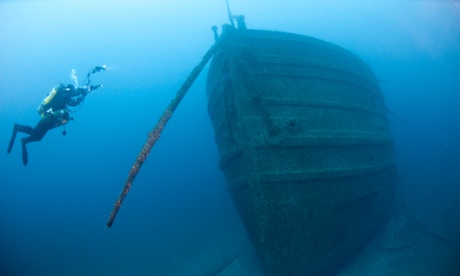
From The GuardianThe Thunder Bay National Marine Sanctuary in northern Michigan has received federal approval to expand its size nearly tenfold and boost the preservation of scores of sunken vessels in an area of Lake Huron once known as “Shipwreck Alley”.
Thunder Bay, the only freshwater national sanctuary, is announcing on Friday that the Obama administration has approved the years-in-the-making effort to grow from about 450 square miles to 4,300 square miles.
The expansion — which incorporates the waters from off Alcona, Alpena and Presque Isle in the north-eastern Lower Peninsula and to the maritime border with Canada — also doubles the number of estimated shipwrecks to roughly 200.
The effort to expand the sanctuary, originally created in 2000, started with three failed congressional bids and then the administrative review process through the Commerce Department.
The department oversees the National Oceanic and Atmospheric Administration, which manages the sanctuary along with the state of Michigan.
“It’s been a long, long effort,” the sanctuary superintendent, Jeff Gray, said.
“It’s a pretty monumental thing ... In a small way we raise the Great Lakes into this national dialogue.”
While many spots along the Great Lakes are hazardous,Thunder Bay became known as “Shipwreck Alley” in the 19th century, as it was part of a major shipping channel during an era when the region had few alternatives.
-
Arctic shipwreck will not leave Cambridge Bay this year
- On 06/09/2014
- In Underwater Archeology

From CBC NewsA ship that once belonged to Arctic explorer Roald Amundsen will not be moved from Cambridge Bay this year, despite a Norwegian group's plans to salvage the Maud this summer.
The Maud has been partially submerged in the waters near the community for more than 80 years.
The Norwegian group Maud Returns Home plans to move it back to the town where it was built a century ago.
But ice in the Northwest Passage has delayed a tug and a special submersible barge arriving from Norway. The vessels left Norway in the middle of June to make the 7,000-kilometre trip.
They should arrive in Cambridge Bay on the weekend but that may not leave enough time to raise the ship.
"Most likely we will not be able to lift Maud before the freeze up," said Jan Wanggaard.
"We will just do some preliminary testing of the principles and then we will wait until next year in the spring to do the lifting operation. That's how I think it will happen now."
Wanggaard has been in Cambridge Bay for several weeks. He and another diver are clearing away the loose material and debris around the Maud.
-
Shipwreck of S.S. Central America yields more gold
- On 31/08/2014
- In Treasure Hunting / Recoveries

By Karla Zabludovsky - NewsweekMore than 2,900 gold coins and 45 gold ingots have been recovered from the shipwrecked S.S. Central America since an archaeological excavation began in mid-April, Odyssey Marine Exploration, the company contracted to dive to the site, revealed on a report published Tuesday.
Other 19th century artifacts recovered include luggage pieces, a pistol, a pocket watch, and several daguerreotypes, an early type of photography.
Several samples of coral and sea anemones have also been collected through a science program which is studying deep sea biological diversity.
Pine and oak specimens placed on the seabed in 1990 and 1991, during the last known dives to the shipwreck site, are being retrieved so that scientists can study the “shipworms” consuming and destroying the ship’s timbers.
“The insights provided by this experiment have provided valuable new information about the degradation of shipwrecks in this environment, and it greatly aids our interpretation of the conditions we are observing on this site and can expect of other shipwrecks in similar circumstances,” says one of the reports previously released by Odyssey Marine Exploration.
The S.S. Central America sank off the Carolina coast in 1857, at the height of the California Gold Rush, when it sailed into a hurricane.
It had departed, days earlier, from Panama, with roughly 580 passengers who were carrying with them an unknown amount of gold.
Estimates for the total gold cargo range between three and 21 tons of gold.
-
Buddhists lead attempt to find Burma’s lost bell
- On 30/08/2014
- In Treasure Hunting / Recoveries

From The Scotsman
Divers stand on the edge of a small wooden fishing boat gazing at the murky, choppy waters below.After receiving blessings from Buddhist monks, they lower their masks and plunge one-by-one into the mighty Rangoon River, clinging to garden hoses that will act as primitive breathing devices during their dizzying descent into darkness.
From the shoreline, thousands of spectators look on, some peering through binoculars, praying the men will find what other salvage crews have not: the world’s largest copper bell, believed to have been lying deep beneath the riverbed for more than four centuries.
Weighing an estimated 270 tons, the mysterious bell is a symbol of pride for many in a nation of 60 million that only recently emerged from a half-century of military rule and self-imposed isolation.
And for the first time, search crews are largely relying on spirituality rather than science to try to find it.
Burma’s superstitious leaders have in years past been part of a colourful cast of characters who believe reclaiming the treasure is important if the nation is ever to regain its position of glory as the crown jewel of Asia.
It is a story of myth and mystery.
King Dhammazedi, after whom the bell was named, was said to have ordered it cast in the late 15th century, donating it soon after to the Shwedagon Pagoda, Burma’s most sacred temple which sits on a hilltop in the old capital, Rangoon.
The bell remained there for more than 130 years, when it was said to have been stolen by Portuguese mercenary Philip de Brito, who wanted to take it across the river so it could be melted down and turned into cannons for his ships.
With tremendous difficulty, his men rolled the massive bell down a hill and transferred it to a rickety vessel, which then sank under the weight.
Most people in Burma believe the bell is still lying deep beneath the riverbed, buried under layers of silt.
-
Lost French fleet of 1565 remains a mystery
- On 28/08/2014
- In Treasure Hunting / Recoveries

By Matt Soergel - The St Augustine RecordOn a sunny, breezy Saturday, this is an inviting place — the sea placid, the coastline green and still wild.
But from a diving boat a half-mile offshore, Chuck Meide can easily picture the desperate straits of the men of Jean Ribault’s doomed French fleet, fighting for their lives on perhaps this very spot, 449 years ago.
Their struggle as a hurricane drove their ships unmercifully toward the land. Their fear as the ships broke up, throwing the sailors into the stormy seas, clinging to any bit of wreckage they could find. Their relief at making it to the sand.
Their awful knowledge that they were stranded here, on the low coastline of a vast mysterious land, thousands of miles from home.
And their certainty that their enemy — men sworn to kill them — was still out there, still looking for them.
The French, who were trying to defend a colony in what is now Jacksonville, left signs of their presence at Canaveral: tools, jewelry and coins have been found at a survivors’ camp on the beach.
Where, though, are their four ships ?
After three weeks of searching the ocean floor, an expedition from the St. Augustine Lighthouse & Museum is no closer to finding out.
Meide, the principal investigator on the group, spent most of those weeks on the water, looking during the day and sleeping fitfully on the cramped vessel — “It’s no Carnival cruise,” he said — at night.
He was philosophical about it as the group wrapped up its search.
“It’s a big ocean,” he said.
Ribault’s fleet came to Florida in 1565 to support the struggling French colony at Fort Caroline. The Spanish, under Pedro Menendez de Aviles, arrived about the same time, with plans to wipe out the French.
-
Phoenician shipwreck found off the coast of Malta
- On 28/08/2014
- In Underwater Archeology

By Emily Sharpe - The Art NewspaperCargo from what may be the oldest shipwreck in the Mediterranean has been discovered off the coast the Maltese island of Gozo, reports theTimes of Malta.
Around 20 lava grinding stones and 50 amphorae of various types and sizes from the 50ft-long Phoenician wreck were found by a team of researchers from Malta, France and the US.
Experts date the artefacts to around 700BC, when Malta was among several areas in the Mediterranean colonised by the Phoenicians.
The exact location of the 2,700-year-old wreck, which lies 120m under the Mediterranean, is being kept secret until the team has had a chance finish their research, which includes the 3D-recording of objects using photogrammetry—a project funded by the French National Research Agency as part of the Groplan programme.
“This discovery is considered to be unique not only here but internationally as well because it is considered to be the oldest shipwreck in the central Mediterranean and it is in a fantastic state of preservation,” says Timmy Gambin, a senior lecturer in the classics and archaeology department at the University of Malta and the co-director of the project.He says that more than 8,000 photographs have been taken of the 14m x 5m site.
A culture ministry spokesman says: “It’s an important reference point for the entire central Mediterranean. It’s a point where we can understand interregional trade and exchange in antiquity.It’s a very unique site and first we would like to protect it and then research it as much as possible.” He also says the wreck will be added to the national inventory of 150 to 200 sites in Maltese territorial waters.
-
Horrific video posted of true murder at sea
- On 20/08/2014
- In Miscellaneous
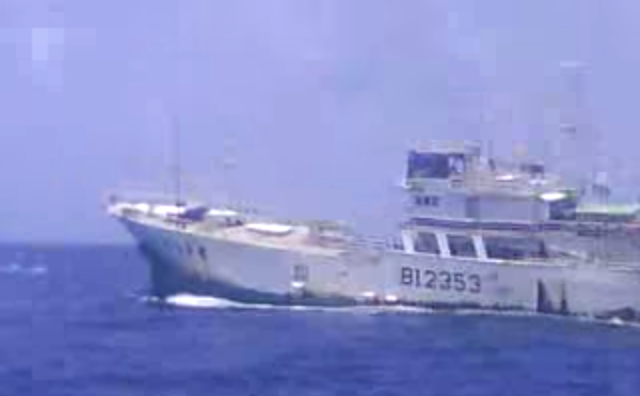
A video was just posted on YouTube allegedly shot offshore Fiji showing fishermen clinging on to wreckage from what appears to be their boat while attempting to hide from the crew of another fishing vessel that was shooting at them with rifles.
Update: It seems this incident likely did not happen off Fiji, but was rather the result of a failed piracy attempt off Somalia against Taiwanese fishing boats.
Needless to say, the men who were in the water were all killed in cold blood while their killers shot video and celebrated.
The video has been turned over to the Fiji Police for an investigation to find out exactly when and where the video was filmed.
Considering how graphic and utterly disturbing the video is, we’re not going to post it to gCaptain, but if you can watch it HERE