HOT NEWS !
Stay informed on the old and most recent significant or spectacular
nautical news and shipwreck discoveries

-
Underwater archaeologist still seeks Florida shipwreck
- On 03/12/2014
- In Treasure Hunting / Recoveries
From Examiner
The term underwater archaeology conjures up images of discovering artifacts long-hidden on the seafloor. The more romantic notions involve treasure-hunting amongst shipwrecks.
One notable underwater archaeologist is Robert Marx, who has written over 60 books on the subject. He was one of the founders of the Council on Underwater Archaeology as well as the Sea Research Society. Marx was also instrumental in creating the professional research degree of Doctor of Marine Histories.
For these and more, Marx has earned the description of being “The True Father of Underwater Archaeology,” according to noted diving pioneer and magazine publisher, Dr. E. Lee Spence.Marx’s main quest nowadays is a 1715 Spanish shipwreck that occurred off the Florida coast, near what is now Sebastian Inlet. It involved the flagship Capitana, which was then skippered by Don Juan Esteban de Ubilla.
“The 300th-year anniversary is coming up for the loss of that wreck and the whole fleet,” Marx informs. “I want to make sure people know about it.”
Centuries ago, during the Age of Exploration, fleets carrying treasure from the Americas would travel to Spain in galleons loaded with precious cargo. The return trip to Spain was often more hazardous because crews by then were fatigued – or even plagued by malnutrition and tropical diseases.
What’s more, the heavily laden fleet became vulnerable to pirate attacks. But bad weather was considered the greatest threat on account of its unpredictability.Spain was highly dependent on the influx of riches from the New World to fill its coffers. Unfortunately the expansion policies of France, Britain, the Dutch, and the Holy Roman Empire had practically dwindled the currency flow from the Americas to Spain.
The English were a particularly formidable foe, effective in sinking many of Spain’s ships. By 1715 the War of Succession had ended, and Spain was in even more dire need of New World gold and silver to relieve its financial strain.
-
Minnesota History: Most deadly shipwreck is least known
- On 01/12/2014
- In Famous Wrecks

By Curt Brown
It’s late November, so when talk turns to Minnesota shipwrecks, Lake Superior quickly comes to mind. The Edmund Fitzgerald vanishing in a 1975 gale with 29 aboard. The frozen bodies chipped from the icy deck of the Mataafa just off Duluth’s piers in 1905. And so on.
But Minnesota’s largest maritime disaster went down some 200 miles south of Duluth Harbor in Lake Pepin, that rodent-in-the-snake widening of the Mississippi River.On July 13, 1890, 215 people in Red Wing piled on to the Sea Wing, a wooden paddle-wheeler less than three years old, and its barge cohort, the Jim Grant.
The people, decked out in Victorian Sunday finery, were on an excursion to Lake City — where Gov. William Rush Merriam and other dignitaries gathered for a weekend exhibition at the Minnesota National Guard’s summertime encampment.
Cannons would be fired, bands would play, soldiers would march in formation and a grand time would be had by all.It was hot, humid and sticky. So many people wanted to take the pleasure cruise — perhaps hoping it would be cooler out on the water — that the barge was tied on to the Sea Wing to accommodate about 70 of the 215 passengers.
Scattered showers and some squalls foretold the trouble to come. At 5 p.m. in St. Paul, a tornado spun across Lake Gervais, killing six and injuring 11.
David Niles Wethern, the storekeeper skippering the Sea Wing, wouldn’t have known about the lethal twister in St. Paul, but he sensed conditions were growing ominous. He blasted the Sea Wing’s whistle at 7:30 p.m. and sailed north for Red Wing at 8 p.m.
Passengers were crammed shoulder to shoulder in the cabin on the skinny boat — 135 feet long but only 16 feet wide with a 22-foot-high pilot house. Straight-line winds began to whip Lake Pepin, with waves swelling from six to eight feet.
-
Shipwreck of SS Ventnor and its dead finally found
- On 19/11/2014
- In Wreck Diving

From StuffIt has been 112 years since the ill-fated SS Ventnor left New Zealand shores carrying the bodies of 499 Chinese miners who died here and couldn't afford the passage home.
The gold miners had been buried in New Zealand then disinterred and sent home so that, according to Chinese culture, their souls could be tended to by their families and they could finally be at peace. Chinese community members had pooled their money to send the remains home but tragically, the men never arrived.
Today, Maori and Chinese community leaders announced that the ship's wreckage has finally been recovered and efforts are being made to bring closure to the families of those lost at sea.
The SS Ventnor sank off the Hokianga Heads after striking a reef near the coast of Taranaki in October 1902.
Officially 13 crewmen died in the shipwreck and local iwi on the coast buried the bones which washed up.
This is the first time artefacts and footage from the wreck have been shown publicly.
Te Tai Tokerau MP Kelvin Davis and MP Jian Yang spoke at the conference as did the chairman of the Ventnor Project Group John Albert and vice president of the New Zealand Underwater Heritage Group Keith Gordon.
Yang said there was a saying in China that fallen leaves return to their roots. "So it is very important for these people to be returned to China."
The great great grand-daughter of one of the miners Angela Sew Hoy said it would be "just amazing" to be able to pay the respect to the dead men that they deserved. "For me it's about my
children's heritage as well and it would be nice to see him make the trip home."The ship was only built a year before it sank so it didn't last long, Gordon said. "The wreck is in a state of deterioration and in a few years there won't be much there."
In 2012, Albert and Gordon studied the wreck using an echo sounder. Last year, the group travelled to the site and deployed a remote operated vehicle onto the wreck.
-
‘A rare and historical find’ archaeologist discovers 17th-century shipwreck in Tobago
- On 17/11/2014
- In Underwater Archeology

From The GuardianA rare and historical find. That’s how Transport Minister Stephen Cadiz has described the recent discovery of the remains of a 17th-century Dutch ship, the Huis de Kreuningen, in Tobago.
The find, believed to be the ruins of the 1677 ship, was discovered during the July-August period in the Scarborough Harbour by University of Connecticut professor and maritime archaeologist Kroum Batchvarov. The Huis Kreuningen went to her watery grave on March 3, 1677.
Batchvarov, assistant professor of maritime archaeology in UConn’s Department of Anthropology, is an internationally known researcher specialising in 17th-century ship building and maritime archaeology. He is leading a multi-phased investigation to find and study the remains of 16 vessels that were sunk in a fierce battle that took place between the invading French and the Dutch in the harbour.
The sea battle, which was for control of the island, resulted in the loss of 2,000 people, including 250 Dutch women and children, and 300 African slaves. The story was published on October 21, this year, Batchvarov and his team began a remote sensing survey in the harbour and picked up some promising signals.
Batchvarov said although his team did not find the ship’s hull structure intact, they found cultural material that dates to the third quarter of the 17th century, including seven or eight canons, delft and bellarmine pottery jars, lead shot that was never fired, dozens of Dutch tobacco pipes, and bricks that perfectly match the standard dimensions for bricks made in the Dutch city of Leiden in 1647.
“To find what we believe to be the Huis de Kreuningen — almost by accident, as she was outside the boundaries where we expected to find her—undiscovered and untouched for over 300 years was an exciting moment,” Batchvarov said.The find is a significant source of information for the maritime history of the period. “Although we have some written records of the battle itself, we possess no detailed plans of 17th-century warships.
So our only sources of information about the ships of the day are the wrecks themselves. It isn’t an overstatement to say that what has been discovered is a treasure trove for archaeological researchers,” Batchvarov said.
The Huis de Kreuningen, though the largest in the Dutch fleet at 39.6 metres long and 9.62 metres in breadth, was only about three quarters of the size of her French foe, the much newer and better armed Glorieux.
In addition to the Huis de Kreuningen, which was the largest ship in the Dutch fleet, the Glorieux, the flagship of French Vice Admiral Comte D’Estrée, was also sunk and all but 80 of the 450 men aboard were lost. -
Shipwreck salvager recovers 15,500 gold, silver coins
- On 12/11/2014
- In Treasure Hunting / Recoveries
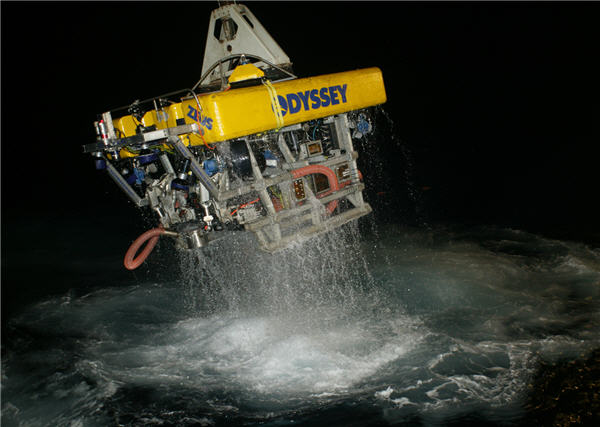
By Frik Els - MiningOdyssey Marine Exploration announced Tuesday that it recovered recovered more than 15,500 silver and gold coins including Double Eagles, 45 gold ingots, gold dust, nuggets jewelry and other artifacts
from the SS Central America shipwreck site since April."While the exact value of the recovered Central America cargo will not be known until it is monetized, we know it is valued in the tens of millions of dollars and well in excess of the project costs,” said Mark
Gordon, Odyssey's chief executive officer.The SS Central America wreck was discovered in 1988 at a depth of 7,200 feet and the Florida-based company said during the final month of the 2014 recovery season, the Odyssey Explorer performed a
161,000-square-meter, high-resolution video survey of the shipwreck and surrounding seabed.An additional survey with Odyssey's new dual-head SeaBat 7125 deep tow survey system is currently underway and Odyssey will evaluate information and data gathered from the 2014 operations,
including these new surveys, "to determine future plans".
With one of the largest documented cargoes of gold ever lost at sea, the SS Central America contributed to the Panic of 1857The Central America, carrying mainly mine workers and bosses returning east from the California gold rush was caught in a hurricane and sank on September 12, 1857 roughly 260 kilometres off the South
Carolina coast.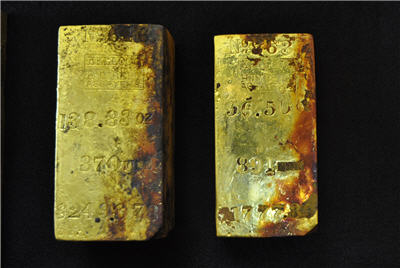
477 passengers, mostly miners and businessmen returning east from California with their personal possessions and fortunes in gold accumulated after years of prospecting during the Gold Rush were on board the steamship during her final voyage.
-
Bronze bell from long-lost Arctic shipwreck revealed
- On 12/11/2014
- In Underwater Archeology

By Megan Gannon - News DiscoveryDivers recovered a bronze bell from the wreck of the HMS Erebus, a British ship that was missing for nearly 170 years after an ill-fated expedition to the Canadian Arctic.
In 1845, British Royal Navy officer and explorer John Franklin led more than 100 men on a quest to find a Northwest Passage connecting the Atlantic and Pacific oceans. But they never completed their
mission; in 1846, their ships — the HMS Erebus and HMS Terror — became trapped in ice near King William Island in northern Canada.The weeks and months that followed were grim. Many of the crewmembers died of some combination of exposure, starvation, scurvy and lead poisoning. Some may have resorted to cannibalism. Search
parties looking for the missing crew turned up empty, though a few graves were later found. The fate of the ships, meanwhile, remained a mystery until this past September.Since 2008, Parks Canada led six searches for the sunken vessels. The agency finally succeeded this year, after capturing sonar images of a wreck in the eastern part of the Queen Maud Gulf.
-
Odyssey Marine Exploration's on Q3 2014 Results - Earnings
- On 11/11/2014
- In Treasure Hunting / Recoveries

From Seeking Alpha - Mark Gordon Call Transcript"Good afternoon and thank you for joining us today to discuss Odyssey Marine Exploration’s Third Quarter Results ended September 30, 2014. With us today are Mark Gordon, Odyssey’s Chief Executive Officer and President as well as Philip Devine, the company’s Chief Financial Officer.
Following their remarks, we will open up call for your question. Then before we conclude today’s call I’ll provide the necessary precautions regarding forward-looking statements made by management during this call as well as a special note to U.S. investors regarding disclosure of mineral deposits as referenced in the SEC’s Industry Guide 7.
We would like to remind everyone that this call is available for replay through December 10, 2014 starting later this evening. A webcast replay will also be available via the link provided in company’s earnings release as well as available on Odyssey’s website.
During this call, you can also send written questions by sending them via the webcast system. We may not have time to take everyone’s questions but if you submit questions via the webcast system we will answer all remaining questions via email after the call.
Now I’d like to turn the call over to CEO Mark Gordon. Please go ahead, sir.
Mark Gordon - Chairman & CEO
Well thank you, operator. Good afternoon, everyone, thank you for joining us. This is my first conference call since taking over as CEO and I want to thank all of you who have expressed their congratulations and support over the past month or so. I hit the ground running in my new position and we’ve already started implementing refinements to the business plan. We want Odyssey to be the company investors want to invest in, the place the best and the brightest want to work, and an organization our partners want to do business with.
We understand that our shareholders and the investment community want us to maintain a business model of leveraged returns but they also want us to focus of financial discipline in our business planning to generate more cash inflows from operations and from our investments.
To this end, we've recently implemented and improved investment analysis process which I believe will have a great impact on our business planning process. I believe that in our future filings and calls you’ll see a significant and positive transformation in our operating results.
In the few short months since our last call, we made significant progress on our shipwreck and mineral projects. We completed the 2014 season’s recovery operations at the SS Central America shipwreck site where we recovered more than 15,500 silver and gold coins, 45 gold ingots, gold dust, nuggets, jewelry and various other artifacts.
We installed and are currently testing a new state of the art deep ocean search systems acquired for use in our deep ocean 20th century shipwreck and mineral exploration programs"....
-
Shipwreck recovery off South Carolina coast is suspended
- On 18/09/2014
- In Treasure Hunting / Recoveries
By John McDermott - The Post and CourierA deep-sea salvage vessel that's been pulling up gold and other treasure from a shipwreck off South Carolina has returned to Charleston and likely won't resume work at the site until next year.
Florida-based Odyssey Marine Exploration Inc. said Tuesday that its Odyssey Explorer is back in port for a few weeks for repairs and to be upfitted with new equipment.
The company said it ended its first recovery phase after retrieving more than 15,500 gold and silver coins, 45 gold bars and hundreds of nuggets, jewelry and other artifacts from the SS Central America. The value of the items was not disclosed.
Odyssey Explorer left Charleston in April. The wreck of the SS Central America is in 7,200 feet of water about 200 miles off the coast, Odyssey Marine said.
Mark Gordon, the Tampa-based company's president and chief operating officer, said in a statement that it was "an appropriate time to suspend recovery operations to take a break for repairs and review the work we've recently completed."
Recovery efforts were hampered in recent weeks by Hurricane Cristobal and by the time required to complete a high-resolution video survey of the wreck and surrounding area, the company said.
Odyssey Marine said "an extensive amount of knowledge has been gained" about the site and the scope of the work required.
"Significant sections of the ship's structure, associated cultural heritage artifacts and coins were located some distance from the main shipwreck area, requiring excavation over a large area," the company said Tuesday.
"Sizable areas remain to be inspected and excavated outside the main shipwreck."
Gordon said the next step is to study the data collected over the past five months.