HOT NEWS !
Stay informed on the old and most recent significant or spectacular
nautical news and shipwreck discoveries

-
Centuries-old frigate discovered in Gulf of Finland
- On 20/03/2016
- In Underwater Archeology

The Finnish Maritime Administration confirmed the identity of 300 year-old frigate Huis te Warmelo on Monday. The vessel, which was found at a depth of 64 metres near Helsinki, was once part of the Dutch navy, more specifically a region known at the time as West Frisia.
The ship was identified on the basis of hull dimensions, location, structure and its canon fire power.
Divers reported that the vessel was extremely well-preserved and that the wooden structures were in surprisingly good condition, since all of the canons were still located on the gun deck.
The ship was a member of the West Frisian Admiralty or navy and had been built in Medemblik, a port town in the West Frisia region of modern-day Netherlands.
No other frigate from the latter part of the Dutch golden age has been found in such sound condition. The Huis te Warmelo apparently ran aground in the shallows off Helsinki before quickly sinking to the sea bottom.
The ship was first detected years ago when the maritime administration MKL conducted a seabed mapping exercise. However documentation of the wreck didn’t begin until 2014. At that time it was confirmed that the vessel was a 35-metre triple-mast frigate.
Research indicates that the ship sank in an upright position after running aground, explaining why all 17 canons on the upper gun deck are still in their original positions.
Researchers leaned on Russian and Swedish archive material to determine that the ship didn’t belong to either seafaring power. Officials then stated looking to other countries with naval forces.
Historian Peter Swart helped solve the mystery of the ship’s origins when he unearthed an old Dutch sea chart, which marked the spot where the war ship had gone down. The date of the sinking was recorded as 1715.
Researchers plan to continue their work during the summer. Weather conditions permitting, the Finnish research company SubZone will dive to probe the wreck and further document their findings.
One of their main goals will be to verify the name of the vessel.
-
Shipwreck discovered from explorer Vasco da Gama's Fleet
- On 15/03/2016
- In Underwater Archeology

By Kristin Romey - National Geographic
The oldest shipwreck from Europe's Golden Age of Exploration has been found off the coast of Oman, the country's Ministry of Heritage and Culture will announce on Tuesday.The wreck is believed to be that of the Esmeralda, which was part of a fleet led by legendary Portuguese explorer Vasco da Gama during his second voyage to India (1502-1503).
The wreck was initially located in 1998 and excavated between 2013 and 2015 by a partnership between the Oman Ministry of Heritage and Culture and the shipwreck recovery company Bluewater Recoveries Ltd., which is directed by David Mearns.
Support for the project was provided by the National Geographic Society Expeditions Council.
Analysis of the thousands of objects recovered from the wreck is ongoing, but researchers have concluded in an interim report that the vessel belonged to da Gama's fleet — and is in all probability the Esmeralda.
Their conclusion is based on extraordinary artifacts that include a Portuguese coin minted for trade with India (one of only two coins of this type known to exist) and stone cannonballs engraved with what appear to be the initials of Vincente Sodré, da Gama's maternal uncle and the commander of the Esmeralda.
If this is indeed a wreck from da Gama's 1502-1503 fleet, it will be the earliest ship from the Age of Exploration ever to be found and excavated.
-
Ex-treasure hunter kept in jail over gold found in shipwreck
- On 15/03/2016
- In Illegal Recoveries
By Kim Palmer - Reuters
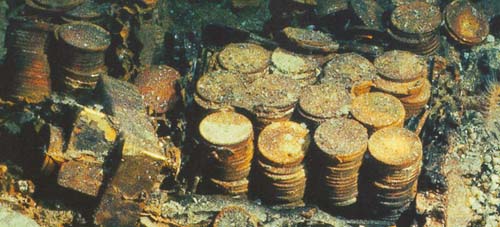
A U.S. judge is keeping a former treasure hunter in jail for again failing to answer questions about the location of 500 commemorative gold coins from the discovery of a 19th century shipwreck, prosecutors said on Monday.
Thomas "Tommy" G. Thompson, 63, of Columbus, Ohio, was arrested in 2015 and jailed because he failed to appear in court to disclose the whereabouts of the gold coins discovered in 1988 in the wreck of the SS Central America.
Last December, Thompson was sentenced to one year of supervised release, a $250,000 fine and 208 hours of community service, but the sentence was not to take effect until he revealed where the coins were.
On Monday, U.S. District Judge Algenon Marbley of Ohio found Thompson in contempt of a court order in a civil lawsuit over the treasure, said Jennifer Thornton, a spokeswoman for the U.S. Attorney's office in Columbus.
Marbley also continued a daily fine of $1,000 until Thompson reveals the location of the treasure, Thornton said. Thompson's lawyer could not immediately be reached to comment.
Thompson told the court last December that he had a stroke and suffered from chronic fatigue syndrome, short-term memory loss and other physical problems. He apologized then for not appearing in court previously to answer questions.
-
Up to 1300 shipwrecks lie undiscovered
- On 23/01/2016
- In Miscellaneous

From WA Today - Ray Sparvell
Two wrecks discovered over six months during the search for Malaysia flight MH370 are ghostly reminders of the shipping dangers posed by the Indian Ocean.While those long-fogotten vessels were found quite some way from land, some estimates suggest as many as 1600 vessels – large and small - may have found their final, watery resting places along the WA coast.
Up to 1300 of these, laden with treasure of both the literal and historical variety, lie undiscovered on the ocean floor, in a similar vein to those found in the MH370 search.
Maritime archaeologist Ross Anderson of the WA Museum said the key reasons why it has been such a notorious graveyard for ships was primarily storms, cyclones and shallow reefs along the coast.
"Some vessels were also purposely sunk or abandoned after they had passed their 'use by' date and were no longer seaworthy," he said.
Another key contributor to that extensive catalogue of wrecks was that navigational longitude couldn't be accurately measured until the mid-18th century. Many ships simply failed to turn north for the Dutch East Indies at the right time.
As a result they were wrecked on the WA coast. Mr Anderson said coastal trade vessels carrying passengers, cargo and mail had been important in linking WA settlements before road transport.
-
The heyday of treasure hunting might be at hand
- On 23/01/2016
- In Treasure Hunting / Recoveries

By Joseph Neighbor
Recent advances in deep-water technology have opened vast swaths of the ocean previously unavailable to humans.Up until the mid-20th century, underwater exploration was limited to a depth of about 200 feet, representing about 5% of the ocean. We now routinely go 20,000 feet and beyond. We’ve even visited the deepest point—the Challenger Deep, in the Mariana Trench, some 36,000 feet below the surface—multiple times now.
For the first time, we have access to ocean in its entirety.
And in these abysmal depths lay untold billions in sunken gold, silver, and emeralds, not to mention priceless caches of cultural history thought to be lost forever. How much is all this hidden treasure worth ?
UNESCO estimates there are three million shipwrecks underwater right now. No one has any idea exactly what each was carrying, so any guess as to value is speculation. And a gold coin fetched from a shipwreck and brought to market without context is worth the value of gold—no more, no less.
But a gold coin retrieved and documented with archeological diligence and sold as a historical artifact is worth much, much more.
Our new technological capabilities stem not from revolution—sonar has been around for over a hundred years; submersible vessels since the mid-18th century—but of refining, allowing for deeper dives on sounder information.
Take, for instance, the El Faro, a US cargo ship sank by a hurricane off the Florida Keys last October, taking all 33 sailors aboard with it. After weeks of intense search and rescue, the vessel was located at some 15,000 feet, or about three miles, below the surface—a depth utterly impossible to reach or explore a few decades ago.
-
The Mount Gambier teenager finding the south east's lost ships
- On 12/01/2016
- In Wreck Diving

By Kate Hill - ABC News
Diving down into the murky blue waters off Cape Douglas in South Australia's south east one morning last year, Carl von Stanke came across a ghost.Last seen in 1855, the Iron Age was a steel-hulled barque on its maiden voyage from England when the crew ran into trouble in heavy seas near the south-east coastline. The ship's crew managed to get to safety, but the brand new vessel sank below the surface.
After 160 years at the bottom of the ocean, all that is left is the rough outline of the ship's wooden hull, buried in the silt and the odd brick left over from its ballast. For the 18-year-old shipwreck hunter, witnessing it for the first time was a moment of delight and reward. With a knack for research and with nearly 10 years of diving experience under his belt, it is not the first wreck the Mount Gambier teenager has discovered — nor will it be his last.
During the last few years, Mr von Stanke has been working with the State Heritage Unit and Adelaide university researchers to rediscover and document the wreck of the Hawthorn, which sank in Bucks Bay in 1949.
He also believes he has found the 1892 wreck of the Lotus, lying near the coast of Port Macdonnell.
"That was accidental," he said, with a grin. According to Mr von Stanke, it is not only time and extensive research, but a combination of good weather and simple luck required to stumble across a ship's remains.
Rattling off names including the Adelaide, Witness, Galatea and the Prince of Wales, Mr von Stanke has a long list of the region's undiscovered shipwrecks firmly imprinted in his mind.
He smiles when asked if he would like to find those ships, many lost at sea in the 19th century. "I wouldn't mind it," he said. "I just enjoy finding things."
-
Half of artifacts from Confederate gunship returned to river
- On 02/01/2016
- In Conservation / Preservation

By Russ Bynum - Online AthensLeather boots, the hilts of swords — even a stray earring — were among the nearly 30,000 artifacts recovered this fall from the wreckage of the sunken ironclad Confederate gunship CSS Georgia.
More than half of the haul retrieved during the $14 million government project, however, was of a much more mundane nature: nuts, bolts, washers, bent iron rails and other material that did not shed any new light on the lives of sailors serving aboard the vessel.
Altogether, 16,697 artifacts weighing a total of 135 tons were returned to a watery grave at the bottom of the Savannah River, said Jim Jobling, project manager for the Conservation Research Laboratory at Texas A&M University, which is tasked with cataloging, cleaning and preserving artifacts from the Civil War shipwreck.
“Anything I considered to be unique, I would say, ‘I want this, I want this,’” Jobling said. “I picked through everything. No unique stuff went back in the river.”
The CSS Georgia was scuttled by its own crew to prevent Gen. William T. Sherman from capturing the massive gunship when his Union troops took Savannah in December 1864. Remains from the Confederate ironclad were salvaged during the summer and fall as part of a $703 million deepening of the Savannah harbor for cargo ships.
Based on sonar images of the murky riverbed, researchers knew they would fine big chunks of the ship’s armor, several cannons and large pieces of its engine.
What they hadn’t expected were the loads of small artifacts their cranes scooped up: Small buttons, hilts of knives and swords, an intact glass bottle, leather boots and an earring among them.
-
800-year-old shipwreck found off Salento coast
- On 29/12/2015
- In Underwater Archeology

From The Local
The sunken ship, made almost entirely of wood and measuring 18 metres by 4.5 metres, has lain for years untouched near the coastline of Salento, in the southern tip of the Puglia region, La Stampa reported.The wreck was found in the Porto Cesareo Marine Protected Area, where human activity is restricted in order to conserve the area's natural resources.
Pasquale De Braco, a fisherman and adviser to the protected area, notified local authorities of its presence, and divers were sent to investigate.
Because of the boat’s proximity to the medieval fishing village of Porto Cesareo, it could “explain significant aspects of the coastline in medieval times and contribute to the historical reconstruction of the area,” said Cristiano Alfonso, an underwater archaeologist from Salento University’s Department of Cultural Heritage, who carried out the initial assessment.