HOT NEWS !
Stay informed on the old and most recent significant or spectacular
nautical news and shipwreck discoveries

-
The SS Georgiana lost and found
- On 20/03/2010
- In Famous Wrecks

From Nashua Telegraph
Today (March 19th) in 1863, the SS Georgiana, reportedly the most powerful cruiser built for the Confederate Navy, failed to make it past the Federal Blockading Squadron and into Charleston, SC.The ship’s desperate crew was forced to beach the Georgiana and flee, after which the Union forces set the wreck on fire. As this was the ship’s maiden voyage, the Confederate forces were less than encouraged by this outcome.
By all accounts, the Georgiana was a beautiful ship, outfitted not only for war but for the raiding of enemy merchant vessels (a practice known as privateering).She was 226 feet long, with space for up to 14 guns, and powered by a steam engine that turned a propeller 12 feet in diameter. Her cargo holds were extra roomy, able to accommodate more than four hundred tons of cargo.
For her maiden voyage today in 1863, the Georgiana was loaded up with merchandise, munitions, medicines, and (supposedly) 350 pounds of gold. None of the cargo made it to its intended destination, with everything but the gunpowder sinking to the bottom of the sea along with the Georgiana.
The gunpowder, as you may imagine, was consumed when the ship was set on fire by the Union forces. There was so much gunpowder on board that the Georgiana burned for three days (punctuated by intermittent explosions) before it finally sank.
Exactly 102 years later in 1965, 18-year-old E. Lee Spence discovered the sunken Georgiana while diving. He didn’t have to go very deep – the ship’s boiler is a mere five feet under the surface.
Read more... -
Scots firm lands zinc treasure from Spanish shipwreck
- On 18/03/2010
- In Treasure Hunting / Recoveries
From BBC News
Treasure recovered from a ship which sank off the coast of Spain more than 30 years ago is bound for Scotland.
Lanarkshire-based metal coating company, Highland Galvanisers, has bought 75 tonnes of zinc recently salvaged from the wreck.
The Francois Vieljeux vessel was carrying a cargo of precious metals from Tanzania to ports in northern Europe when the it sunk in 1979.
The firm will melt down the zinc to use at its coating plant in Cumbernauld.
The ship and its cargo had lain at the bottom of the Atlantic Ocean until 2006 when a company called Subsea Resources started the process of recovering it using a special vessel fitted with a remotely operated grab.
Expert analysts estimated the lost cargo, which also included 5,500 tonnes of copper, would have a value of about £21m in today's market - the equivalent of 800kg of gold, or almost 400,000 barrels of oil.
Read more... -
Niña, Pinta sail to town
- On 18/03/2010
- In Maritime News
By Chris Segal - News Herald
Amidst the morning rain, replicas of Christopher Columbus’ Niña and Pinta vessels sailed into the Panama City Marina on Wednesday to set up a temporary floating museum.
With the help of a dinghy, the two vessels floated into the marina and will stay until Monday.
The ships are touring as a sailing museum. They offer guided tours and displays for school groups and the public. Each ship has a crew of four people who will be on hand to answer questions and talk about the vessels.
The two Columbus replicas were most recently docked in Alabama and, after a weekend in Panama City, they will make their way south to St. Petersburg and then up the East Coast.
This Niña was launched in 1992 and has been called by Archaeology magazine the “most historically correct Columbus replica ever built.”
Of the Niña, Pinta and Santa Maria, the smaller, faster Niña was Columbus’ favorite ship, and he made most of his journeys on it.The replica Niña has sailed a half-million miles, docked in 600 ports and traveled through the Panama Canal about a dozen times. This is the fourth time the Niña has docked in Panama City.
“Panama City has always been great,” said Niña Captain Morgan Sanger. “They really support the ship.” -
Nazi wreck puts Berlin at odds with salvager
- On 18/03/2010
- In Famous Wrecks
From The Local
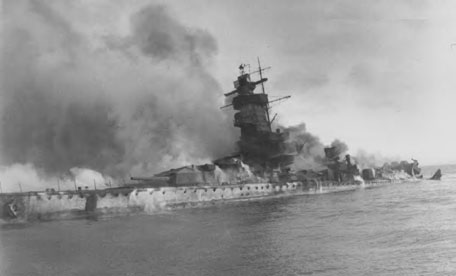
The Admiral Graf Spee, the German "pocket battleship" scuttled to Uruguay in 1939, is caught in the middle of a struggle between the businessman salvaging it and the German government, which wants to prevent its commercialization."We always proposed a serious historical and cultural destiny" for the remains of the Graf Spee while "contemplating fair compensation" for the work and investment made to recover its remains, Alfredo Etchegaray, the businessman, told AFP.
During a visit to Montevideo this week, German Foreign Minister Guido Westerwelle said his desire was "to prevent the remains of the symbols of the Nazi regime from becoming commercialized."
"What we want really is to reach a constructive deal," he said, adding that Germany was prepared to support the presentation of the remains "in a historical context, like a museum."
In 2006, divers hired by Etchegaray recovered an imposing Nazi bronze eagle measuring 2.8 meters (nine feet) wide by two meters high and weighing 350 kilogrammes (770 pounds) from the stern of the Graf Spee.
Two years earlier, they had come up with a 27-tonne rangefinder used to direct the ship's cannons. And in 1998, a 155 millimeter (six-inch) gun from the ship's secondary armament was salvaged.
The underwater salvage group planned to bring up more cannons and other pieces of the Graf Spee, but were barred from doing so by a Uruguayan government decree.
After the recovery of the Nazi eagle, with its outspread wings and swastika, Germany sent a note to the Uruguayan foreign ministry claiming ownership of the Graf Spee and opposing continuation of the salvage work. -
N.C. shipwreck may be oldest found
- On 18/03/2010
- In Underwater Archeology
From UPI
Winter storms on the Outer Banks have uncovered the remains of what may be the oldest shipwreck on the North Carolina coast, experts say.
Investigators from the North Carolina Underwater Archaeology Branch came to Corolla, N.C., to document the estimated 400-year-old wreck before it disappears, The (Norfolk) Virginian-Pilot reported Wednesday.The wreck has already drifted two miles since storms uncovered it in December.
"It wants to go south," Branch curator Nathan Henry said.
During its movement floorboards and the keel of the 70-foot ship have come loose and disappeared, and the wreck is in danger of completely falling apart, the Virginian-Pilot said. Some local residents, including the avid beachcomber who first discovered the wreck, want it raised from the sands and preserved.
"It's going to go to pieces," Ray Midgett said. "I would love to see them save it."
Experts estimate the wreck is even older than the famous remains of Blackbeard's ship the Queen Anne's Revenge, which sank in 1718 near Beaufort, S.C. -
Ukrainians uncover Crimean British Navy vessel
- On 18/03/2010
- In Underwater Archeology

From BBC news
Ukrainian archaeologists say they have identified the remains of HMS Prince, a British naval vessel that sank off Balaclava during the Crimean War.
The sinking, with all 150 men on board, caused outrage not only for the human toll, but because thousands of badly needed winter uniforms were also lost. The ship had not been found since it sank during a storm in November 1854. Other underwater expeditions have found parts of the ship, but it is the first positive identification.
According to Sergei Voronov, of the Ukrainian Academy of Sciences, and the leader of the expedition, explorers discovered a plate fragment from the captain's mess last summer.After months of meticulous cleaning, the fragment revealed the name of the company which owned the Prince before it was hired by the Royal Navy: the General Screw Steam Shipping Company.
-
Treasures from Capt. Kidd
- On 17/03/2010
- In Museum News
By Cathy Kightlinger - Indy Star
Visitors today at the Children's Museum of Indianapolis got their first glimpse of one of three "treasures" after a large crate was opened, unveiling remnants from Captain Kidd's 17th-century ship.
The ship's cannon and other artifacts will be on display during "Treasures of the Earth," a collaborative exhibition between the museum and National Geographic. It will open in 2011 at the museum.
In December 2007, an underwater archaeology team from Indiana University -- led by Charles Beeker, IU's director for Underwater Science, announced the discovery of remnants from Captain Kidd's ship, which was made 70 feet off the coast of Catalina Island in the Dominican Republic. The cannon has been submerged underwater at IU, where it will remain until it moves to the museum.
"I could have it squirreled away at my laboratory at IU," Beeker said about the cannon. "But by bringing it to the Children's Museum, we're going to have a very broad audience of people that can come see this."
The cannon will be submerged in a tank of water inside the exhibit, allowing visitors to watch the process used to slowly clean encrusted materials off of it, said Jennifer Pace Robinson, vice president of experience development and family learning at the museum.
"We really want families to come in and feel the thrill of discovery, but (also) that they are part of the archaeological process," said Pace Robinson, who is in the Dominican Republic this week getting ideas on how to replicate excavation activities for the exhibit, and learning how to care for the cannon.
"Kids will have some of the excitement of being at a pirate shipwreck site, and we'll be able to replicate that in the exhibit for people who aren't able to come down to the Dominican Republic and see it first hand," Pace Robinson said. -
Shipwrecks to get protection
- On 17/03/2010
- In Parks & Protected Sites
By Kirsty Johnston - Taranaki Daily News
The wrecks of two historic ships sunk in Taranaki waters during the 1860s could soon come under national protection.
The paddle steamer Tasmanian Maid and colonial steam transport SS Alexandra, both which lie in relatively shallow water off the North Taranaki coast, have been proposed for national recognition by the New Zealand Historic Places Trust.They are considered nationally rare examples of remains from the New Zealand Wars – rarer still because they have not been relocated, unlike many similar-aged wrecks
Heritage adviser Blyss Wagstaff said many vessels that saw active service in the wars ended up overseas, their location now unknown. That made the identification and recognition of these shipwreck sites that much more important given their rarity.
"They are a part of a series of major historical events in 19th-century New Zealand that have shaped our lives today," Ms Wagstaff said.
"They are reminders of the resistance of Maori to Crown alienation of their land and the Crown's response to those challenges. They are also representative of a commonly used form of coastal transport of the time."
The sites were rediscovered by divers from the New Plymouth Underwater Club in the 1970s. Tasmanian Maid, which lies off the Kawaroa reef in New Plymouth, originally operated as a coastal steamer in the Nelson/Marlborough area earning the distinction of being the first steamer to enter the Buller River in 1862.
It was then put to service as a supply and dispatch vessel in the Taranaki campaign of the New Zealand Wars, before being refitted to serve as the gunboat HMS Sandfly in the Hauraki Gulf and, later, Wanganui.
"While it was lost as a civilian vessel when it hit the Kawaroa reef in January 1868 it remains a significant link to the New Zealand Wars," Ms Wagstaff said. The Tasmanian Maid is being considered for Category I registration. Meanwhile, the SS Alexandra is being proposed for Category II registration.