HOT NEWS !
Stay informed on the old and most recent significant or spectacular
nautical news and shipwreck discoveries

-
Qing dynasty gold sycee sunken treasure valued at $40,000
- On 21/03/2013
- In Auction News

From Paul Fraser Collectibles
A gold sycee ingot from China's Qing dynasty will provide one of the star lots of Baldwin's 54th Hong Kong Coin Auction of Far Eastern and World Coins and Banknotes, to be held on April 4.The ingot is valued at $30,000-40,000, one of the highest estimates given in the sale.
It was discovered among the wreckage of the Geldermalsen, one of the largest Dutch East Indiamen, which sank in 1751 and was discovered in 1986.
The 10-Taels bar weighs 365g and is in a winged rectangular shape. It was originally part of the Christie's auction of the huge cache of porcelain and gold that was found in the wreck, which made more than $6.6m in the Netherlands shortly after its discovery.
In September 2012, Bonhams sold a gold ingot discovered among the wreckage of the SS Central America, better known as the Ship of Gold, for $146,000.
-
Vandals damage Sydney’s WW2 mini submarine wreck
- On 21/03/2013
- In Scams, Thefts

From the ScotsmanVandals have attacked the wreckage of a World War Two era Japanese mini submarine that attempted to attack Sydney Harbor during the conflict, and have stolen parts of the craft and protected relics.
Three vessels were involved in the attack in 1942, after a Japanese reconnaissance flight reported that Allied warships were anchored in the harbour.
The submarines attempted to attack the warships, but were detected by the Allied forces. One of the Japanese crafts tried to torpedo the cruiser USS Chicago, but missed, sinking the Australian ferry HMAS Kuttabul, with the loss of 21 lives.
The crews of two of the submarines scuttled their crafts and committed suicide, with the fate of the third unknown until scuba divers discovered it off the northern beaches of Sydney in 2006.
Authorities set up an exclusion zone around the submarine, which is believed to hold the remains of the crew along with good luck charms and personal items including Samurai swords.
Divers apparently entered the site, damaging the hull of the submarine before taking some of the relics and part of the propeller blades.
-
Titanic bandleader's violin confirmed as genuine, set for auction
- On 20/03/2013

From Paul Fraser Collectibles
The violin that bandleader Wallace Hartley played as the Titanic sank has been confirmed as genuine, following British auctioneer Henry Aldridge & Son announcing its discovery in February.The violin will not be auctioned straight away, but will be put on display for the first time, in Belfast at the end of March.
The auction house is said to be in negotiations with several museums.
When finally sold, it may well surpass the current auction record for Titanic memorabilia, which stands at £220,000 ($336,000) achieved by plans of the doomed ship, which sold in 2011.
It has been seven years since the music teacher who currently owns the violin first approached the auction house, and it has been undergoing meticulous testing since.
It was finally confirmed as authentic after the inscriptions on the plaque were discovered to be contemporary, and the corrosion was found to be compatible with immersion in seawater.
Wallace Hartley died as the Titanic sank, with his body only discovered 10 days afterwards.
The violin is thought to have been found in a leather bag strapped to his body and was later returned to his fiancee Maria Robinson, who had gifted it to Hartley to mark their engagement in 1910.
Maria Robinson died in 1939, and her sister donated the violin to her local Salvation Army band, where it eventually found its way to the current owner.
The story of "the band that played on" is one of the most memorable from the sinking, with the band continuing to play to calm the passengers, yet sacrificing themselves in the process. All eight members were killed, though only three bodies were found.
-
New protection for Drumbeg wreck
- On 20/03/2013
- In Parks & Protected Sites

From The Northern TimesThe need to “designate” the remains of an historic shipwreck off the north west Sutherland coast has resulted in Scotland’s first tranche of Historic Marine Protected Areas (MPAs) being announced today.
The well-preserved 17th, or early 18th, century merchant shipwreck was found close to the harbour of Drumbeg by a local scallop diver, who wishes to remain anonymous.
Historic Scotland’s marine archaeologists visited the site, with the diver, during summer last year to assess his discovery and concluded that the wreck is an historic asset of national importance, meriting statutory protection.
Fiona Hyslop, Cabinet Secretary for Culture and External Affairs, has also outlined a further six proposals for Historic MPAs around Scotland’s coast.
These sites (including one at Kinlochbervie) are currently safeguarded by the Protection of Wrecks Act 1973 and will have their protection transferred to the Marine (Scotland) Act 2010 – the first time the MPA powers of this Act have been used.
-
Ghosts in paradise
- On 16/03/2013
- In Parks & Protected Sites

Photo Edwina Pickles
From The AgeIn 1629, the Batavia sunk on the stunning coral isles west of Geraldton. Linda Jaivin visits the wreck’s site, and discovers a dark past.
Shipwreck, skulduggery, madness, murder and mayhem.
As we fly over the Abrolhos Islands, 122 wisps and droplets of land in the coral sea 80 kilometres west of Geraldton, WA, our pilot, Brendan, points out an execution site here, a mass grave there.
Then he dips the wing of the little seven-seater GA8 Airvan. As the horizon falls away on one side, the glittering turquoise of the Indian Ocean fills the windows on the other.
A patch of electric light blue shimmers up from the aquamarine, with a shape that suggests both boat and gravestone.
An instant later it disappears like a mirage in the slanting afternoon light. Flying at 500 feet, we make several passes around this eerie watermark on the gem-like sea: the site of the wreck of the Batavia in 1629, and the first chapter in one of the most chilling and riveting episodes in maritime history.
The Batavia, of the Dutch East India Company, was seven months out from Amsterdam on her maiden voyage.
In her hold, the tightly packed cargo included chests of silver, fine velvets and a sandstone portico for the Dutch fort at Batavia, today's Jakarta, where she was bound.
The 50-metre ship rounded the Cape of Good Hope and was tacking north on the final leg of the voyage. Her fresh-food supplies were exhausted and worms swam in the drinking water.
The ship stank of urine and unwashed bodies and there was a whiff of mutiny in the air.
At 3am on June 4, 1629, most of the Batavia's passengers and crew - 322 men, women, children, soldiers and sailors - were asleep.
A sailor on watch alerted Captain Ariaen Jacobsz to a patch of white water dead ahead.
The navigational science of the time was better at judging latitude than longitude; the captain hadn't realised how close to the Great Southern Land the strong westerlies known as the Roaring Forties had blown the ship.
Jacobsz dismissed the sailor's concerns; it was just moonlight. Minutes later, that moonlight - in reality a coral outcrop 4.6 metres beneath the surface - snagged the rudder and the Batavia slammed into the reef.
-
Rough seas uncover shipwreck in York
- On 13/03/2013
- In Parks & Protected Sites

By Gillian Graham - Portland Press Herald
Rough seas that washed sand away from the beaches of York last weekend left behind a surprising sight for local residents: the remnants of a shipwreck.Although the skeleton of the ship, believed to be at least 160 years old, has appeared from time to time on Short Sands Beach, little is known about the boat or how it ended up buried in the sand.
What's left of the wooden hull – catalogued by the state as the Short Sands Beach Wreck – made news in the 1950s after being exposed by a storm. It last appeared after the powerful Patriots Day storm in 2007.
"It always seems to stir the town up when it does arrive," said Tim Ellis, a lifelong resident whose mother brought a historian to York in 1958 to look at the wreck.
The sight of the timbers sticking out of the sand drew photographers and curious beachcombers to the wreck at low tide during the weekend and Monday. It remains to be seen how long it will take the waves to push sand back over the wreck, and when it will surface again.
The 51-foot-long hull is believed to be from a late colonial or early post-colonial sloop, which means it would date from 1750 to 1850, said Leith Smith, a historical archaeologist with the Maine Preservation Commission.
-
Honoring USS Monitor's fallen heroes
- On 12/03/2013
- In Famous Wrecks
By David Martin - CBS NewsAmerica is about to pay final respects to two of its fallen heroes more than a century after they lost their lives. But we can't tell you who they were and we may never know.
It is a solemn fact that the remains of Americans killed in conflicts dating back to World War II keep coming home from distant battlefields.
But Thursday was different, as flag draped caskets held unidentified sailors from the Civil War.
"Two human beings buried under there for 140 years or so," explained Joe Hoyt. He was one of the divers who discovered the remains in 240 feet of water off Cape Hatteras, North Carolina, where they had gone down with one of the Navy's most famous ships -- the USS Monitor.
"Arguably more significant than almost any shipwreck certainly in U.S. history," said Hoyt, "and to get down there and actually see it -- there's really nothing else like it."
The hull of the Monitor still lies where it sank, designated a marine sanctuary. But its gun turret -- with the remains still inside -- was raised from the bottom in 2002, and brought to the Mariner's Museum in Newport News, Virginia where Anna Holloway is head curator.
"This is the ship that you read about in 5th grade -- the Monitor and the Merrimack," she said.
The pride of the Union Navy earned its place in history on the day it fought the Confederate ship Merrimack to a draw.
"This was the first battle of iron-clad warships ever in history, and that's really what makes the Battle of Hampton Roads on March 9, 1862 so significant," said Holloway.
But ten months later the prototype for today's iron warships went down in a storm. "A very short life," said Holloway of the Monitor. "But a very monumental one if you think about her impact on modern warships."
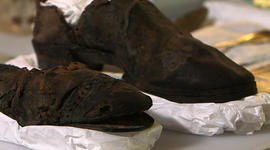
When the turret was brought up, pieces of the sailor's lives came with it. A mismatched pair of shoes gave silent testimony to curator David Krop about the ship's final moments.
"If you think about the chaos the night of the sinking," he said, "if there's water coming into the ship, it's dark, you might just grab what's closest to you, put those on in order to get out of the vessel.
-
'Viking sunstone' found in shipwreck
- On 08/03/2013
- In Underwater Archeology

From BBC NewsA crystal found in a shipwreck could be similar to a sunstone - a mythical navigational aid said to have been used by Viking mariners, scientists believe.
The team from France say the transparent crystal may have been used to locate the Sun even on cloudy days.
This could help to explain how the Vikings were able to navigate across large tracts of the sea - well before the invention of the magnetic compass.
However, a number of academics treat the sunstone theory with scepticism.
The team from the University of Rennes in France say they found the crystal while examining the wreck of a British ship sunk off the island of Alderney - in the English Channel - in 1592.
An oblong crystal the size of a cigarette packet was next to a pair of dividers - suggesting it was part of the navigational equipment.
It has now been shown that it is of Iceland spar - a form of calcite known for its property of diffracting light into two separate rays.
Testing a similar crystal, the scientists proved that by rotation it was possible to find the point where the two beams converge - indicating the direction of the Sun.