HOT NEWS !
Stay informed on the old and most recent significant or spectacular
nautical news and shipwreck discoveries

-
Shipwreck lost 100 years discovered in Lake Superior
- On 11/06/2013
- In Wreck Diving

From Associated PressAlmost 100 years after the Henry B. Smith freighter went down during a November storm in Lake Superior, a group of shipwreck hunters thinks it has found the ship - and much of it is largely intact.
The group found the wreck last month in about 535 feet of water off the shore of Marquette, Mich.
The group says it hasn't seen the name of the ship on the wreck yet, but all signs indicate it's the Smith, sitting amid a spilled load of iron ore.
"It's the most satisfying find of my shipwreck-hunting career," said Jerry Eliason of Cloquet, part of the group that has found many lost ships in recent years.
"It's a fantastic find," said maritime historian Frederick Stonehouse of Marquette, who has written about the Smith. "I'm excited at the opportunity to look at the video and see if we can learn the cause of the wreck, to write the final chapter of the ship."
The Henry B. Smith and its crew of 25 disappeared after sailing into the Great Lakes Storm of 1913.
The storm, one of the biggest on the lakes, wrecked more than a dozen ships and killed about 250 sailors. The Smith was safe in the Marquette harbor on Nov. 7 and 8, loading iron ore, but on the evening of Nov. 9, Capt. James Owen decided to leave port for Cleveland.
"The lake was still rolling, but there seemed to be a lull in the wind, the velocity having dropped to 32 mph," shipwreck expert and longtime University of Minnesota Duluth professor Julius Wolff wrote in "Lake Superior Shipwrecks."
"The gale ... should have blown itself out. But, this was no conventional storm. In taking his vessel out of the safety of Marquette Harbor, Captain James Owen sailed into eternity."
-
German WWII bomber raised from English Channel
- On 11/06/2013
- In Airplane Stories

From Huffington PostA British museum on Monday successfully recovered a German bomber that had been shot down over the English Channel during World War II.
The aircraft, nicknamed the Luftwaffe's "flying pencil" because of its narrow fuselage, came down off the coast of Kent county in southeastern England more than 70 years ago during the Battle of Britain.
The rusty and damaged plane was lifted from depths of the channel with cables and is believed to be the most intact example of the German Dornier Do 17 bomber that has ever been found.
"It has been lifted and is now safely on the barge and in one piece," said RAF Museum spokesman Ajay Srivastava.
The bomber will be towed into port Tuesday, he added.
A few fragments of the plane dropped off as it was being lifted, but officials said divers will retrieve them later.
-
Submarine grave discovery propels New York Explorers’ movie bid
- On 11/06/2013
- In World War Wrecks
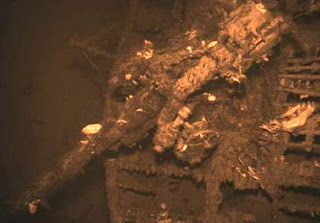
From gCaptainA team of New York-based explorers took Helen Cashell Baldwin out in their research vessel off the coast of Key West, Florida last summer.
More than 600 feet below lay the wreckage of a World War II submarine — the final resting place of her father and 41 fellow sailors.
Baldwin, 78, threw a rose into the water and whispered her father’s name.
She did the same for each of the men who died when the submarine R-12 sank during a training mission on June 12, 1943, one of 52 lost during the war.
Two years after Tim Taylor and Christine Dennison put up $750,000 of their own money to find and document the R-12, and 70 years after the vessel sank, the two explorers are tapping crowd-funding site Kickstarter to finish a documentary about the discovery.
“It gave me chills, absolutely,” said Baldwin. “The fact that Tim could show us the actual submarine on his sonar, it was so freeing. We were talking and we were grieving, which was something my mom had never done.”
The R-12 was the oldest submarine used in WWII, built in 1918 and recommissioned in 1940 as a training vessel. Bob England, 90, was on the Key West Naval base the day the R-12 didn’t return.
“I saw the ship off that morning, but I was fueling so I was the only person from the crew not aboard,” England said in a phone interview from Inverness, Florida.
“That afternoon we were notified by the operations officer that the R-12 was overdue.
Then they told us they were looking for survivors.”
-
19th-century steamer found could be filled with gold
- On 07/06/2013
- In Treasure Hunting / Recoveries

A shipwreck could possibly have gold concealed under the sea. On June 5, NBC News reported that U.S. explorers found the wreck of a smuggling ship off the coast of South Carolina over the weekend.Many believe that the ship carried gold and that the gold could be lying at the bottom of the ocean as you read.
"We have positively identified the vessel through the engine type, length, width, type of decking and other construction features, as well as its location, which matches perfectly with historical accounts," Dr. E. Lee Spence told Discovery News (via NBC News).
The shipwreck could turn up gold because the ship was known for "extensive gun and money smuggling to Haiti."
In the 1890's the ship sank after running into sandbars near Cape Romain.
The ship was soon forgotten and not discovered until the late 70's. Even then the vessel was not identified and no one thought much of it.
Now, however, researchers believe the identity of the boat is the SS Ozama and many are curious to see what is lying around the wreckage.
"Whatever is still there, we have good reason to believe at least some of it will be intact, as I have already brought up some unbroken china," Spence said.
If the shipwreck turns up any gold it may have to be turned in to the U.S. government. Even still this is an amazing find and Spence hopes to figure out the best way of diving in so to speak.
-
British deep water diver dies at Italy wreck
- On 26/05/2013
- In Wreck Diving
From CityTalk
A British man has died during a dive on a wreck in Italy, coastguard officials have confirmed.
The man was in a group of six divers taking part in a week-long programme involving several deep water explorations on ships that had been sunk during World War Two.
Coastguard officials said the man had been diving at a depth of around 300 feet when he got into difficulty and died shortly after reaching the surface of the water.
Paramedics were immediately called to the scene near Villasimius on the south-east coast of the Mediterranean island of Sardinia but the man could not be saved. The ship the man was diving on was a steamship called the Bengasi, which was torpedoed by the Royal Navy's HMS Truant in May 1941 and sank within 10 minutes of being struck.
It was primarily used as a troopship but at the time was empty and sailing between its home port of Naples and the Sardinian city of Cagliari.
Divers are drawn to the wreck because at the time it was sunk it was carrying a large cargo of glassware products. The wreck is about a mile from the uninhabited Isola dei Cavoli.
A coastguard spokesman in Cagliari said: ''We were called to an incident involving a group of divers who had been at the wreck of the Bengasi. "It appears that one of them, a British man, was in difficulty and when he got to the surface he was already unconscious.
"The paramedics tried to save him but he was declared dead at the scene. It looks like he suffered a heart attack."
-
87 shipwrecks, most from WWII, could leak oil near US
- On 21/05/2013
- In Dangerous Places for Shipping

By Seth Borenstein - Brandon SunA new government report details 87 shipwrecks — most sunk during World War II decades ago — that could pollute U.S. waters with tens of millions of gallons of oil.
Even so, the potential for pollution is less than scientists had expected. The report released Monday by the National Oceanic and Atmospheric Administration concludes "the scope of the problem is much more manageable than initially feared.... Our coastlines are not littered with 'ticking time bombs.'"
Agency officials estimate that far less oil will leak into the ocean than the BP oil spill of 2010, which spewed roughly 200 million gallons into the Gulf of Mexico alone.
"That's not a bad number in comparison to what we first thought it would be," said NOAA's Lisa Symons, who wrote the study.
There are 20,000 shipwrecked vessels that lie off the nation's coastlines. Most of those either finished leaking long ago, ran on coal instead of oil, are too small or aren't near vulnerable land.
"There are only six that really keep me up at night, but we don't know where they all really are," Symons said. Those six have the biggest potential to foul coastal areas because even if they spill only 10 per cent of their oil, they could cause a local-scale disaster, she said. They don't have to be a worst-case spill to be a disaster.
Of those six, Symons said NOAA doesn't know the exact location of three of them, just where they were last seen before they sank. Three of the six worst potential problems are off Florida, one near Georgia, one near South Carolina and one near New York. Some are as close as 15 miles from shore.
-
Work on salvaging the only remaining German WW II bomber begins
- On 10/05/2013
- In Airplane Stories
From India Today
Work to salvage the sole surviving German Dornier Do-17 bomber plane flown in the Battle of Britain in World War Two began on Friday, more than 70 years after it crashed into the English Channel.
Project managers said the plane, lying 16 metres (52 feet) deep, remains in surprisingly good condition and will be raised using a purpose-built cradle later this month in the biggest recovery of its kind in British waters.
It was first noticed when a fisherman caught his net in the aircraft almost 10 years ago and it was identified as a bomber by divers in 2008.
The plane will be packed in gel and plastic sheeting to shield it from the air before it can be transported to hydration tunnels where the crust created by 70 years underwater will be washed away over the next two years.
Eventually, the bomber will be exhibited in the Royal Air Force Museum in London, the city Adolf Hitler had hoped to bring to its knees, said Peter Dye, the director general of the museum, which is leading the project.
These aircraft were nicknamed the Luftwaffe's "flying pencil" bombers because of their narrow fuselage.
Research by the museum showed the plane was shot down on August 26, 1940 during a series of air attacks by the Germans known as the Battle of Britain, the first major campaign fought entirely by air forces.
"Britain remained a focus of defiance when all seemed lost," said Peter Devitt, historian and curator at the RAF museum.
"It won this extraordinary, very narrow victory at the Battle of Britain and from there could be used as a springboard to defeat the German forces and liberate Europe." -
Lost Egyptian city revealed after 1,200 years under sea
- On 07/05/2013
- In Underwater Archeology
From Huffington Post
It is a city shrouded in myth, swallowed by the Mediterranean Sea and buried in sand and mud for more than 1,200 years.But now archeologists are unearthing the mysteries of Heracleion, uncovering amazingly well-preserved artifacts that tell the story of a vibrant classical-era port.
Known as Heracleion to the ancient Greeks and Thonis to the ancient Eygptians, the city was rediscovered in 2000 by French underwater archaeologist Dr. Franck Goddio and a team from the European Institute for Underwater Acheology (IEASM) after a four-year geophysical survey.
The ruins of the lost city were found 30 feet under the surface of the Mediterranean Sea in Aboukir Bay, near Alexandria.
A new documentary highlights the major discoveries that have been unearthed at Thonis-Heracleion during a 13-year excavation. Exciting archeological finds help describe an ancient city that was not only a vital international trade hub but possibly an important religious center.
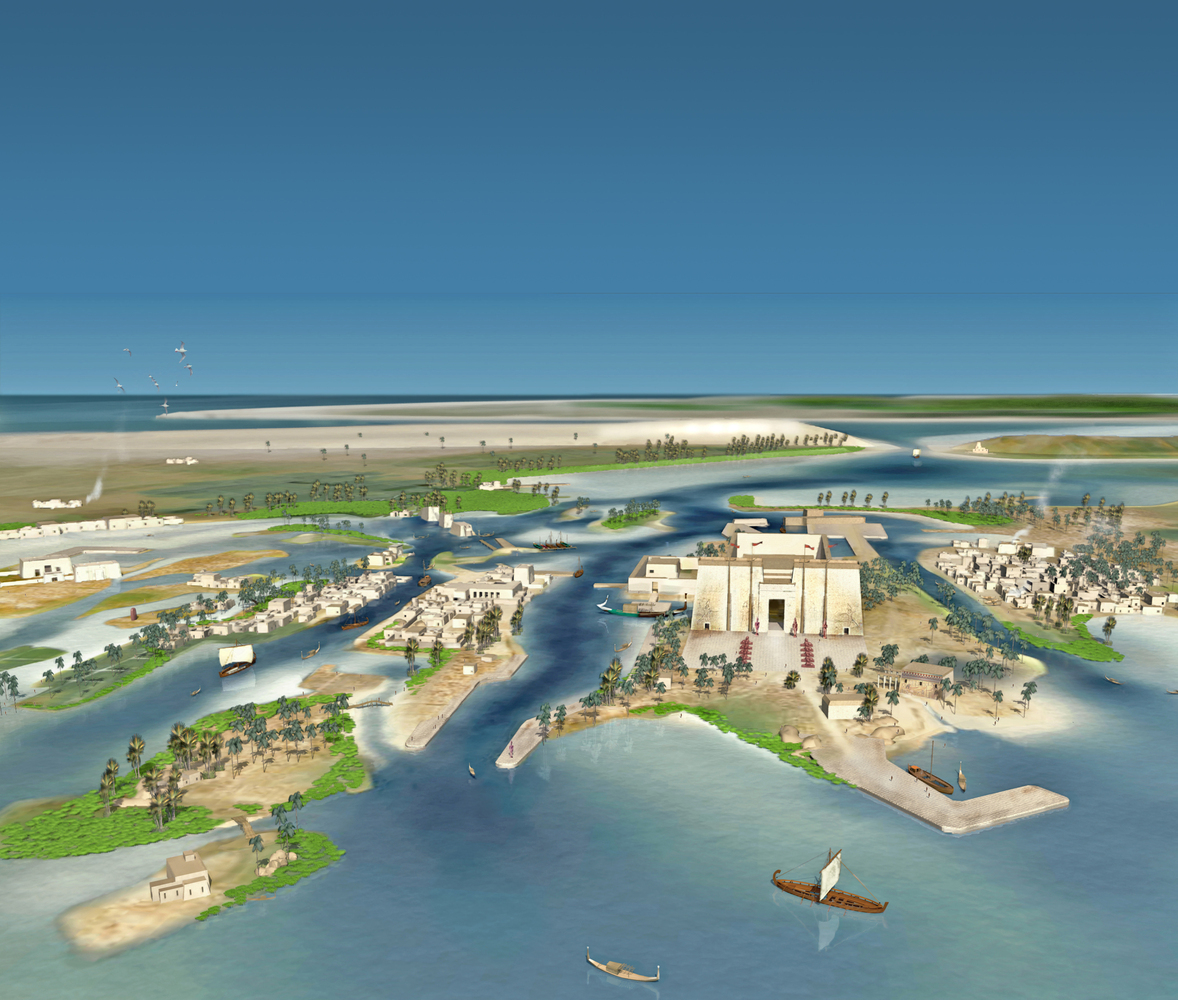
The television crew used archeological survey data to construct a computer model of the city.
According to the Telegraph, leading research now suggests that Thonis-Heracleion served as a mandatory port of entry for trade between the Mediterranean and the Nile. So far, 64 ancient shipwrecks and more than 700 anchors have been unearthed from the mud of the bay, the news outlet notes.
Other findings include gold coins, weights from Athens (which have never before been found at an Egyptian site) and giant tablets inscribed in ancient Greek and ancient Egyptian.
Researchers think that these artifacts point to the city's prominence as a bustling trade hub.
Researchers have also uncovered a variety of religious artifacts in the sunken city, including 16-foot stone sculptures thought to have adorned the city's central temple and limestone sarcophagi that are believed to have contained mummified animals.