HOT NEWS !
Stay informed on the old and most recent significant or spectacular
nautical news and shipwreck discoveries

-
Giant Crabster robot to explore shipwrecks and shallow seas
- On 05/07/2013
- In Maritime News

By Jason Falconer - Gizmag
The Japanese spider crab is about to lose its title as the world's largest crustacean thanks to a new robot, the Crabster, developed in South Korea.For the past 2 years, researchers at the Korean Institute of Ocean Science and Technology (KIOST) have been working on a giant robot crab that is about the size and weight of a Smart car.
This summer it will help scientists explore wrecks below the sea, weathering harsh tidal currents rushing over it at 1.5 m/s.
One of the key problems associated with traditional propeller-driven underwater remotely-operated vehicles (ROVs) and autonomous underwater vehicles (AUVs) is they don't perform well in strong currents. Another problem is their propellers tend to kick up a lot of detritus, lowering operator visibility.
To overcome these problems a team led by Principal Research Scientist Bong-huan Jun of KIOST designed a six-legged robot based on the characteristics of crabs and lobsters (hence the name).
The robot's six legs contain a total of 30 powerful joints. Like its biological cousins, the robot's two front legs are more articulated than the rest so they can be used as arms.
Objects can be picked up and stored inside a frontal compartment to be brought to the surface. Even in shallow seas it can get pretty dark down there, so the Crabster is equipped with 10 optical cameras and a long-range scanning sonar which scans up to 200 m (650 ft) away.
-
Deep water video confirms Lake Superior shipwreck
- On 02/07/2013
- In Wreck Diving
From Star Tribune
Video taken more than 500 feet down in Lake Superior has confirmed that a shipwreck is the long-lost freighter Henry B. Smith.
Shipwreck hunters located the wreck May 24 about 30 miles north of Marquette, Mich.
They had little doubt then that they had found the Smith, which vanished in a storm with a crew of 25 in 1913, but the group wasn't able to get video showing the ship's name until a return trip to the site last week, the Duluth News Tribune reported Monday.
"We were blessed with gorgeous weather," while out on the water last Sunday and Monday, said Jerry Eliason, of Cloquet. And the camera — despite getting caught on the wreck for a half-hour — captured video of lettering spelling out "Henry B. Smith" on the ship's stern.
The 525-foot Henry B. Smith sank in the massive Great Lakes Storm of November 1913, after it ventured out from Marquette during a lull. The storm kicked up again and the freighter sank, leaving scattered wreckage and just two bodies along the shores of Lake Superior.
-
Innocap Inc. set to begin shipwreck recovery efforts
- On 02/07/2013
- In Treasure Hunting / Recoveries

From Innocap
From The Street
Innocap, Inc. (or "Innocap") has received an agreement with a company based in the Republic of the Philippines under which Innocap agrees to organize, plan and supervise then will begin recovery efforts of a shipwreck located off the coast of the Philippines.
The ship, based on preliminary studies, appears to contain a cargo of Chinese porcelain made during the Ming Dynasty. Efforts will be made by Innocap to further identify and evaluate the best method of recovery, which includes conservation and archeological study of the pieces when made available.
Under the agreement, the Philippine company is responsible for obtaining all necessary Government and other approvals, permits and licenses.
The preliminary recovery efforts will begin when all required permits and licenses are obtained.
Under the terms of the agreement, Innocap will be entitled to 50% of any cargo that is recovered from the salvage.
Although many ships from the Ming Dynasty era contained cargoes worth millions of dollars by today's standards, there is no way at this time to estimate the value of the cargo on this sunken ship.
-
Wreck of two 17th century Spanish warships
- On 22/06/2013
- In Underwater Archeology
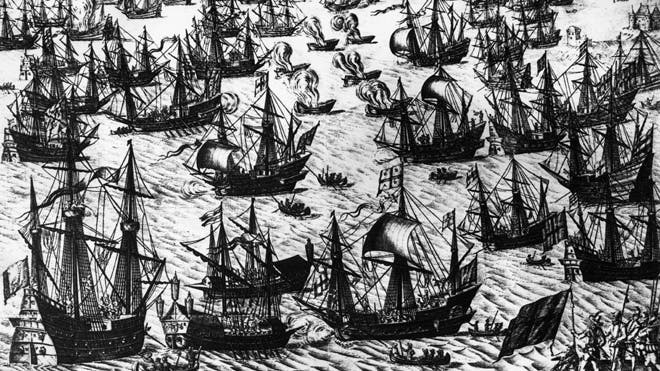
From Fox News LatinoLost at the bottom of the Pacific for over 400 years, two sunken Spanish warships could soon rise from the briny depths and see a port of call again.
No, this isn’t the plot line for a new “Pirates of the Caribbean” movie, but a mission by researchers in Peru to bring two Spanish war galleons - the Santa Ana and the San Francisco - back to the surface after being sunk in 1615 by marauding Dutch naval officer and pirate Joris Van Spilbergen.
Investigator and historian Jorge Ortiz said that thanks to the use of metal detectors, magnetometers and memoirs, the sunken ships – part of the fleet that defended the Spanish Crown when Peru was a colony in the European nation’s vast empire in the New World – are believed to be located some 93 miles south of the capital, Lima.
When they went down, the ships – carrying more than 300 men – were engaged in the Eighty Years' War between Spain and revolting Dutch subjects. After sinking the Santa Ana and the San Francisco, Van Spilbergen sailed north, making attacks in Mexico and later the Philippines.
The underwater excavation of these ships will give historians and researchers a glimpse into the maritime life in the Viceroyalty of Peru, which once covered much of South America.
Many similar boats from this period were destroyed in an earthquake and tsunami in 1746.
The National Geographic Society and Peru’s culture ministry are sponsoring the research, which is expected to uncover ship fragments, artillery, ammunition, glass and ceramics.
-
Remote Michigan village abuzz over shipwreck search
- On 18/06/2013
- In Treasure Hunting / Recoveries
Photo David J. Ruck
By John Flesher - Detroit Free Press
Commercial fisherman Larry Barbeau’s comings and goings usually don’t create much of a stir in this wind-swept Lake Michigan outpost, but in the past few days, his phone jangles the minute he arrives home.
Barbeau’s 46-foot boat is the offshore nerve center for an expedition seeking the underwater grave of the Griffin, the first ship of European design to traverse the upper Great Lakes.
Built on orders of legendary French explorer Rene Robert Cavelier de la Salle, it ventured from Niagara Falls to Lake Michigan’s Green Bay but disappeared during its return in 1679.
Divers this weekend opened a pit at the base of a wooden beam that juts nearly 11 feet from the lake bottom, believing it could be a section of the vessel, the rest presumably entombed in mud.
They picked up the pace Monday with more powerful equipment after a weekend of probing showed that whatever is buried is deeper than sonar readings indicated.
U.S. and French experts insist it is too early to say whether there’s a shipwreck — let alone the Griffin. But anticipation is building at the prospect of solving a maritime puzzle that’s more than three centuries old.
“After we get done for the day, everybody calls or comes to the house and they’re like, ‘What did you find ? What did you see ?
Can you tell me anything ?’ “ Barbeau said in a Sunday interview aboard his ship, the Viking, which holds crucial expedition equipment, including “umbilical” cables that supply oxygen to divers. “People are really interested and they’re excited to see what it is.”
-
Researchers find underwater monument in Sea of Galilee
- On 17/06/2013
- In Underwater Archeology

Photo Shmuel Marco
By Asher Zeiger - Times of IsraelA team of researchers from Tel Aviv University discovered an underwater monument in the Sea of Galilee that they believe may have been a Bronze Age burial site.
The cone-shaped structure is approximately 39 feet high and 230 feet across and weighs about 60,000 tons, according to a press release from the American Friends of Tel Aviv University.
The researchers published documentation of their find in the March 2013 edition of the International Journal of Nautical Archaeology.
Archaeologist Dr. Yitzhak Paz, of Ben-Gurion University and the Israel Antiquities Authority, believes that the structure is approximately 6,000 years old, dating it to the early Bronze Age (3300-2200 BCE).
According to Paz, the monument resembles ancient European burial sites and may have been connected to Beit Yerah, which was a major settlement during the early Bronze Age, approximately 1.2 kilometers (3/4 of a mile) south of where the monument was found.
The publication is the culmination of close to 10 years of research on the site.
The southwestern area of the Sea of Galilee was surveyed in 2003, when sonar technology revealed a large pile of stones in an otherwise smooth area.
-
La Salle's long-lost ship ?
- On 17/06/2013
- In Treasure Hunting / Recoveries

Photo David J. Ruck
By John Flesher - PhillyAs a teenager, Steve Libert was mesmerized by a teacher's stories of the brash 17th-century French explorer La Salle, who journeyed across the Great Lakes and down the Mississippi in a quest for a trade route to the Far East that he hoped would bring riches and renown.
Particularly intriguing was the tale of the Griffin, a vessel that La Salle built and sailed from Niagara Falls to the shores of present-day Wisconsin before sending it back for more supplies.
It departed with a crew of six and a cargo of furs in September 1679 - and was never seen again.
Although widely considered the first wreck of a European-type ship in the upper Great Lakes, its fate has never been documented nor its gravesite found.
After nearly three decades of research, dives, and tussles, Libert believes he's about to solve the mystery.
He was to lead a diving expedition over the weekend to an underwater site in northern Lake Michigan, where archaeologists and technicians were to try to determine whether a timber jutting from the bottom and other items beneath layers of sediment were what remained of the legendary Griffin.
"I'm numb from the excitement," said Libert, 59, a burly ex-football playe.
The just-retired intelligence analyst with the U.S. Department of Defense has a passion for maritime mysteries and has journeyed from Okinawa to the Florida Keys for diving expeditions.
A biography posted on his website says he's advised searches for the Titanic, five Navy torpedo bombers lost in the Bermuda Triangle during World War II, and John Paul Jones' warship Bon Homme Richard, among others.
-
Amelia Earhart plane discovery
- On 13/06/2013
- In Airplane Stories

By Ben Neary - Huffington PostA Delaware aircraft preservation group denies a Wyoming man's claim that it found pioneering aviator Amelia Earhart's missing plane in 2010 but sat on the news so it could solicit him to pay for a later search.
Mystery has surrounded Earhart's fate since her plane disappeared in 1937 in the South Pacific.
Earhart was the first woman to fly across the Atlantic Ocean in 1932, but many experts believe she crashed into the Pacific a few years later while trying to establish a record as the first woman to fly around the world.
Timothy Mellon, son of the late philanthropist Paul Mellon, filed a federal lawsuit in Wyoming last week against The International Group for Historic Aircraft Recovery and Richard E. Gillespie, the group's executive director.
Mellon, who lives in Riverside, Wyo., claims the group solicited $1 million from him last year without telling him it had found Earhart's plane in its underwater search two years earlier.
Mellon's lawsuit says the 2010 search in the waters around the Kiribati atoll of Nikumaroro, about 1,800 miles south of Hawaii, captured underwater images of the "wreckage of the Lockheed Electra flown by Amelia Earhart when she disappeared in 1937."
The suit claims the aircraft recovery group intentionally misrepresented the status of its exploration to Mellon last year, telling him a discovery of Earhart's plane was yet possible if he supported the search.
The lawsuit states Mellon contributed stock worth more than $1 million to the 2012 search and accuses the organization of engaging in a pattern of racketeering to defraud him.