HOT NEWS !
Stay informed on the old and most recent significant or spectacular
nautical news and shipwreck discoveries

-
Marine survey for ship wreck
- On 09/05/2012
- In Parks & Protected Sites
By Ali Ahmed al Riyami - The Oman Observer
As per the terms of the memorandum of understanding signed between Oman and China, the Ministry of Heritage and Culture has begun the second phase of a marine survey to search for the wreckage of the Chinese ship Zheng He along the coast of Oman, with the assistance of the Royal Navy of Oman, yesterday.
Through the signing of the agreement, the two countries seek to find the famous Zheng wreckage that is believed to be sunk off the coast of Oman in the 14th Century.As such, the search reflects the important historical significance of the shipwreck to both countries and the agreement is part of the desire of both countries to strengthen bilateral co-operation in a matter of common interest.
The great Chinese Admiral, Zheng He, and his fleet sailed through these waters on three famous voyages that were mainly diplomatic and commercial in nature.
Today, the research project for the Zheng shipwreck in Omani waters carries several implications, the most important of which are scientific and cultural co-operation between the respective institutions of the two friendly countries.
This will strengthen the historical bonds of friendship between Oman and China, allowing their top practitioners and experts in the field to participate in this research project.They have worked together continuously for two years in order to reach this phase, which will pave the way for further co-operation in the future, especially in areas of scientific and cultural value.
The Chinese delegation is being accompanied by concerned official representatives that include those from the Royal Oman Police (ROP), Sultan Qaboos University (SQU), Ministry of Agriculture and Fisheries and Ministry of Environment and Climate Affairs.
As noted by Hassan bin Mohammed al Lawati, Director General of Antiquities and Museums, Ministry of Heritage and Culture, “The Ministry of Heritage and Culture, which holds the second phase of this project in collaboration with all stakeholders in the Sultanate, sees this project as part of an ambitious program to take care of the historical effects found offshore in the territorial waters of Oman.
The ministry is considering several alternatives for the items of the program survey and marine survey research findings.
The results of the second phase, in co-operation with China, will help in the search for appropriate frameworks to complement the project, so as to achieve an understanding about the cargo and treasures of the shipwrecks.
The joint effort will strengthen distinguished, historical relations between the Sultanate and China. These kinds of joint bilateral projects may extend to some other countries that are thought to have ship-wreckages in Omani territorial waters. -
Protection granted for war shipwrecks
- On 09/05/2012
- In Parks & Protected Sites

By David Ellery - The Camberra Times
Cecil Wiswell was just 17 and had been in the United States Navy less than a year when his first ship, the USS Lexington, was sunk 70 years ago today.Mr Wiswell, who turns 88 in July, was in Canberra yesterday for the formal declaration of the USS Lexington, the USS Sims and the USS Neosho - all lost during the Battle of the Coral Sea - as "protected historic shipwrecks".
He was one of thousands of young sailors and airmen hailed as heroes by US ambassador Jeffrey Bleich for their service.
"We looked to these young men - and we asked them to put their lives on the line - to give the free world something to believe in," Mr Bleich said. "At that dark hour we desperately needed to stop Japan and the world needed hope."
Three other veterans of the battle, Australians Derek Holyoake and Gordon Johnson, and Harry Frey - who also served aboard USS Lexington - were at the ceremony at the Australian War Memorial.
The Lexington wreck is the last resting place for at least 111 of Mr Wiswell's shipmates.
Their sacrifice stopped a Japanese invasion force bound for Port Moresby and put paid to any plans the Japanese may have had to invade Australia. Another 419 men died aboard USS Sims, a destroyer, and USS Neosho, a replenishment vessel.
Mr Wiswell could not believe the behemoth he had only joined seven months before could sink.
-
Huge effort to bury St Leonards wreck in time
- On 09/05/2012
- In Underwater Archeology

Photo Andy Viduka
By Joanna Carson - Bellarine TimesA team of underwater archeologists are working against the clock to get a wreck they have just uncovered off St Leonards reburied. But there’s plenty of method to the seeming madness, according to project spokesman Dr Mark Staniford, of Monash University.
The team of around 60 is working from Queenscliff and St Leonards to reveal the secrets of 164-year-old coastal trader the Clarence, which sunk off the Swan Bay coast while transporting livestock from Hobart to Melbourne.
Luckily the crew and even the sheep were rescued, and there is no treasure in the traditional sense on board the Clarence, but for Mr Staniford and his team on the Australian Historic Shipwreck Protection Project, it is a precious piece of our history. The schooner is one of the earliest known examples of an Australian-built schooner.
“We can learn a lot about early building methods and we have already found things we didn’t expect, like a wooden bottomed leather bag, that would have belonged to a crew member. They add to our knowledge and to the story,” he said.
Instead of bringing the wreck to the surface and opening it up to further decay, ground breaking x-ray and modelling technology will be used to recreate the team’s findings electronically in 3D, before the ship is safely reburied where it could survive thousands of years more, Dr Staniford said.
“It’s one of the ethical dilemmas that we have, which shipwrecked material to bring up and which to x-ray and put back. Removing artefacts comes with its own burden,” he said.
The Clarence, which was rediscovered in the 1980s, had been well preserved for years, but changes to depth of sand on the seabed had resulted in it being more exposed in recent years, and it has suffered some damaged from boat anchors.
-
An ancient ship’s SOS
- On 07/05/2012
- In Conservation / Preservation

By Simon Bahceli - Cyprus MailOne day about 2,300 years ago, not long after the death of Alexander the Great, a small merchant ship stacked with wine and almond-filled amphoras sailed past the port of Kyrenia on Cyprus’ northern coast.
On board were four sailors about whom we know little, except that they had lowered their sail, possibly in anticipation of an approaching storm. We do not know whether the boat intended to arrive at Kyrenia, or if it was leaving.
Maybe it was simply passing by; but what we do know is that it sank 30 metres down to the bottom of the Mediterranean sea where it remained for 23 centuries until found by a modern-day Cypriot out diving for sponges.
Since its excavation from the seabed between 1968 and 69, the Kyrenia Shipwreck, as it came to be known, and its cargo of over 400 amphoras, has resided in Kyrenia Castle.
Despite its being one of the world’s finest and best-preserved examples of classical naval architecture and the cargo a unique source of information on trade in the classical era, the wreck and its associated relics today face permanent damage from neglect and decay.
“The problem we’re now encountering in this room [where the wreck is housed] is that this is not a museum,” says Dr Matthew Harpster, head of the Kyrenia Shipwreck Collection Restoration Programme, a body that seeks to “protect and revitalise” the collection.
“Originally this was a crusader castle,” says Harpster, pointing to damp patches on the walls and cracks in the 400-year-old roof above.
“The latest building work done was in the 16th and 17th centuries on top of Byzantine foundations,” he adds.
It is evident from the single air conditioner labouring away in a corner of room that the wreck needs better environmental controls. Harpster explains that the waterproof skin on the outside of the roof is eroding, and that the back wall is also slowly subsiding.
“As the wall moves, small fissure and cracks appear in the roof, and with its bad membrane, water seeps into the holes, soaks into the limestone, and all of that slowly falls on the ship.
And that dust and grit is falling on the hull and damaging it.
The archaeologist shows me the thick, grainy dust that has settled on the wooden upside of the hull, along with small thumbnail-sized pieces of the ship’s wooden body that have broken off.
-
SS Worcestershire: A forgotten shipwreck found
- On 06/05/2012
- In Wreck Diving
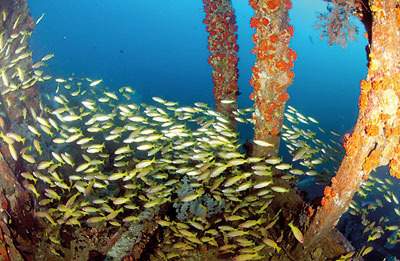
By Malaka Rodrigo - Sunday Times
Three young divers describe the excitement of discovering World War 1 treasures lying in the seabed of Sri Lanka.Recently the world commemorated the 100th anniversary of the sinking of the Titanic. Five years after the Titanic disaster in 1917, a British armed merchant ship met its end in the Indian Ocean near Sri Lanka.
The SS Worcestershire was en route from Rangoon to London when it was sunk by sea mines laid by German armed merchant raider SMS Wolf that was hunting British ships in the Indian Ocean at the height of World War 1. Two members of the crew died as the SS Worcestershire sank to its watery grave.
Nishan Perera, Naren Gunasekara, and Dharshana Jayawardena, three young divers have been on the trail of this lost ship for some years and recently were able to ascertain the identity of the wreck of SS Worcestershire. “We have located this ship about 12 km west of Mount Lavinia.
The ship is massive -137 metres in length and 16.6 metres in width,” the divers told the Sunday Times.
Though local fishermen and occasional divers hunting for reef fish knew about a shipwreck in this locality, they had no clue that it was an important wreck sunk during World War I.
“Finding the SS Worcestershire wasn’t easy. Maritime activities during World War 1 around Sri Lanka have not been well documented and we searched for two years,” said Dharshana.
“We knew the approximate locality, and kept checking with local fishermen who can give us vital clues as they are used to fishing on wreck sites that are rich with fish.” Finally, one fisherman had shown them the location of an old ship and the trio wasted no time in diving for the wreck last April.
“As always, a first glimpse of a shipwreck is bone chilling and thrilling. As drowsiness due to the deep dive envelops your senses what seems to be a large and hazy shadow slowly develops details.
Then, at 50 metres we are at the ship and in a strange, deep, lush paradise seen by a few,” Darshana said, recalling his first sight of the sunken ship.
The ship was at a depth of 57 metres and largely broken up inside. Since it was not identified, the trio initially named the wreck B2633 – the name denoting its depth as measured in local dialect.
-
Archaeologists accuse MoD of allowing US company to 'plunder' shipwreck
- On 06/05/2012
- In Treasure Hunting / Recoveries

From the Guardian
Experts take legal advice in effort to block lucrative deal on underwater excavation of HMS Victory.
The Ministry of Defence is facing a legal battle and parliamentary questions after letting a US company excavate a British 18th-century warship laden with a potentially lucrative cargo.
Lord Renfrew is among leading archaeologists condemning a deal struck over HMS Victory, considered the world's mightiest ship when she sank in the Channel in 1744.
In return for excavating the vessel's historic remains, which may include gold and silver worth many millions of pounds, Odyssey Marine Exploration is entitled to receive "a percentage of the recovered artefacts' fair value" or "artefacts in lieu of cash".
Lord Renfrew, a Cambridge academic, said: "That is against the Unesco convention, in particular against the annexe, which states that underwater cultural heritage may not be sold off or exploited for commercial gain. Odyssey is a commercial salvager.
It's not clear that payment could be obtained other than by the sale of the artefacts which are raised – which, of course, is how Odyssey has operated in the past. To raise artefacts simply for sale would be regarded by most responsible archaeologists as plundering."
Two bronze guns have already been recovered from the wreck and sold to the National Museum of the Royal Navy, funded out of the MoD's grant.
The archaeologists accuse the MoD of dereliction of duty in passing responsibility for the wreck to the Maritime Heritage Foundation (MHF), a charitable trust "which appears to have no financial, archaeological or management resources" while embarking on a project "that will cost millions".
Archaeologists are determined to halt the excavation and are taking advice from maritime lawyers. The issue was raised by the All-party Parliamentary Archaeology Group.
An Odyssey spokeswoman said that the MHF will work with an advisory group including representatives from the MoD and English Heritage, "to ensure that best archaeological practices are adopted in line with the annexe".
-
Confederate shipwreck in way of Savannah river dredging
- On 06/05/2012
- In Parks & Protected Sites

By Russ Bynum - The Post and CourierBefore government engineers can deepen one of the nation’s busiest seaports to accommodate future trade, they first need to remove a $14 million obstacle from the past – a Confederate warship rotting on the Savannah River bottom for nearly 150 years.
Confederate troops scuttled the ironclad CSS Georgia to prevent its capture by Gen. William T. Sherman when his Union troops took Savannah in December 1864. It’s been on the river bottom ever since.
Now, the Civil War shipwreck sits in the way of a government agency’s $653 million plan to deepen the waterway that links the nation’s fourth-busiest container port to the Atlantic Ocean. The ship’s remains are considered so historically significant that dredging the river is prohibited within 50 feet of the wreckage.
So the Army Corps of Engineers plans to raise and preserve what’s left of the CSS Georgia. The agency’s final report on the project last month estimated the cost to taxpayers at $14 million. The work could start next year on what’s sure to be a painstaking effort.
And leaving the shipwreck in place is not an option: Officials say the harbor must be deepened to accommodate supersize cargo ships coming through an expanded Panama Canal in 2014 – ships that will bring valuable revenue to the state and would otherwise go to other ports.
Underwater surveys show two large chunks of the ship’s iron-armored siding have survived, the largest being 68 feet long and 24 feet tall. Raising them intact will be a priority.
Researchers also spotted three cannons on the riverbed, an intact propeller and other pieces of the warship’s steam engines. And there’s smaller debris scattered across the site that could yield unexpected treasures, requiring careful sifting beneath 40 feet of water.
“We don’t really have an idea of what’s in the debris field,” said Julie Morgan, a government archaeologist with the Army Corps. “There could be some personal items. People left the ship in a big hurry. Who’s to say what was on board when the Georgia went down.”
Also likely to slow the job: finding and gently removing cannonballs and other explosive projectiles that, according to Army Corps experts, could still potentially detonate.
-
Scuba diver prays Costa Concordia will sink: 'manna from heaven'
- On 06/05/2012
- In Maritime News
Marcus Hondro - Digital Journal
There's an Italian scuba diver from the island of Giglio, where the partially submerged Costa Concordia lies, who is praying the cruise liner will sink.
Why ? Because Aldo Baffigi believes if it sinks it will attract scuba divers from the world over.
"Every night I light a candle and say a prayer for it to sink," Baffigi, from Giglio, says of the ship on which 32 people died.
"It would be the most popular shipwreck in the world. We wouldn't know what to do with all the divers.
It would be like manna from heaven."Baffigi has a vested interest beyond simply hoping to meet other divers, he owns and operates a company called Deep Blue Diving College and conducts tours of shipwrecks and points of interest in the area.
A sunken 290 meter ship with four swimming pools and 9 decks off shore will provide business.
Will it happen ? Despite the fact Titan Salvage of the U.S. is leading operations to remove the ship intact and sail from the area to a port where it will be salvaged - it will take up to a year - Baffigi believes there is a chance it will sink before that can happen.
Reuters reporter Steve Scherer points out in a story that quotes Baffigi, most of the rest of the 1,500 residents of Giglio do not want the ship, which has been there since Jan. 13th, to sink and stay in the area, they want it gone.
Full story...