HOT NEWS !
Stay informed on the old and most recent significant or spectacular
nautical news and shipwreck discoveries

Monster sea-plane dragged from the deep

By Mia De Graaf - DailyMail
It was the most treasured craft in Britain's possession when the Nazis declared war, but all of the Mk I Sunderland sea planes were thought to be long-lost after being gunned down in WWII.
The nation's only long-haul vessel, the 40 Sunderland flying boats were dispatched over the Atlantic Ocean and Germany to keep advancing submarines at bay.
But decades on, in 2000, one of the prized crafts has been found wrapped in coral 65ft below the coast of Wales in what historians are touting as one of the most important discoveries this century.
And though it is in bits, the thick coating of mud and barnacles have preserved the Sunderland's structure perfectly.
Now, 73 years since it sank in 1940, naval historians are on the cusp of finally piecing the unique vessel back together in a project worth half a million pounds.
A deep sea diver accidentally discovered the wreckage after seeing a lobster-pot had become snagged on something below the waves 13 years ago.
The diver followed the rope down to the seabed and came across the world’s only surviving Mark I Sunderland flying-boat.
Experts identified the craft as Sunderland T9044 of No 210 Squadron, RAF.
To confirm the identity, they tracked down the bomber's last pilot: 93-year-old Wing Commander Derek Martin OBE.
Martin was aged 20 in 1940, training young aircrews, when he flew the Sunderland out of Pembroke Dock, in West Wales, the day before it sank.
He said: 'I flew it on a routine flight around the dock and then moored it up.
'There was a gale during the night and it must have been holed by some floating debris and down it went.
'In the morning it wasn’t there. Well, it was at the bottom of the sea.'
Sunderland flying-boats flew out of Pembroke Dock during the Battle of the Atlantic - when they were used to attack German U-boats sinking vital supply ships.

By Doug Fraser - Bangor Daily News
Portland-based treasure hunter Greg Brooks has burned through at least $8 million of investor money in his hunt for a supposed fortune in platinum, gold and jewels on a sunken World War II freighter 50 miles northeast of Provincetown, Mass.
But now he is considering ending his hunt and selling off expedition assets, including the main salvage vessel.
According to his own records and status reports filed in court, Brooks spent fewer than 80 days at sea in his first five years attempting to salvage treasure from the S.S. Port Nicholson, which sank after being torpedoed by a German submarine.
He gained wide publicity but now appears to be quietly giving up, despite insisting there are billions on board the ship, according to documents filed in a court case contesting ownership of the freighter’s contents.
Brooks did not respond to phone messages requesting an interview but sent an email that pending litigation prohibited him from answering any questions and designating his chief engineer, Brian Ryder, as company spokesman.
In a phone interview Thursday from the company’s main salvage ship Sea Hunter, docked in East Boston, Ryder said Brooks has secured more funds and would be headed back out to the Port Nicholson when the weather improves.
In trip reports and interviews over the past two years, Brooks has said that his company, Sea Hunters, is literally one trip away from recovering a portion or all of the $3 billion in treasure from the freighter — although his estimates in media reports have soared as high as $6 billion.
Meanwhile, representatives of the British government, which insists it owns the vessel and whatever it contains, continue to say official documents show nothing on board beyond rusted automobile parts, military supplies and ballast.
Their dispute with Brooks is now in U.S. District Court in Portland. Another lawsuit against the company has been filed in a Maine court by a company that supplied one of the remotely operated vehicles, seeking payment for the equipment rental and technicians, Ryder said.
On Friday, Brooks’ company filed an inventory in U.S. District Court in Portland of items that have been retrieved from the Nicholson. The objects — including a waterlogged compass, a busted compass housing, a brass fire extinguisher and a brick — are so low in value they are not worth haggling over, attorneys for the British government said.
Exploring England’s shipwreck heritage
By Carly Hilts - Current Archaeology
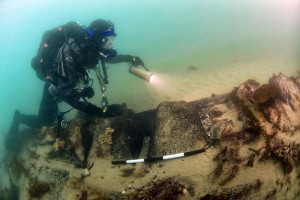
From sea shanties to the shipping forecast, boats and the sea are woven into the fabric of English life and culture, and yet we only began to take shipwrecks seriously as historical and archaeological monuments in the 1970s.
Chris Catling looks at what we have gained in the 40 years since the passing of the landmark Protection of Wrecks Act in 1973.
England’s rocky shores and sandy estuaries are littered with the remains of historic ships and boats.
Shipwrecks, in fact, constitute the largest category of recorded monument, with some 37,000 shipwreck ‘events’ on record, ranging in date from the Bronze Age to the more recent ship and submarine casualties of two World Wars (not to mention dirigibles and aeroplanes lost on the seabed).
To put that in perspective, there are 14,500 places of worship in England considered to be of sufficient architectural or historic interest to be included in the National Heritage Register.
And whereas the number of historic places of worship is relatively static, the number of known wreck sites is growing all the time; what we know now represents just a fraction of the actual number of historic shipwrecks on the seabed.
Two new sites of great importance were discovered as recently as 2006, when archaeologists found two adjacent wreck sites prior to dredging works in the River Thames – those of the London, built at Chatham in 1656 (soon to have its own CA feature), and the King, a vessel thought to have foundered during the First Anglo-Dutch War (1652-1654).
Systematic surveys funded by English Heritage are taking place around England’s coast to try to pin down exactly what has survived.
The Modern Wrecks Project, for instance, has so far added 500 new records to the wreck database of ships lost since 1945.
This has revealed new patterns in the type of vessel lost: for example, the large number of fishing trawlers that sank in the 1970s and 1980s, especially those from former Soviet Eastern Europe.
Another recording programme called the National Hulks Assemblage Project is looking not at ships wrecked as a result of storms like the one that lashed England and the near Continent on St Jude’s Day, 28 October 2013, but vessels deliberately abandoned.
Researchers discover long-lost WWII submarine off Oahu
From gCaptain
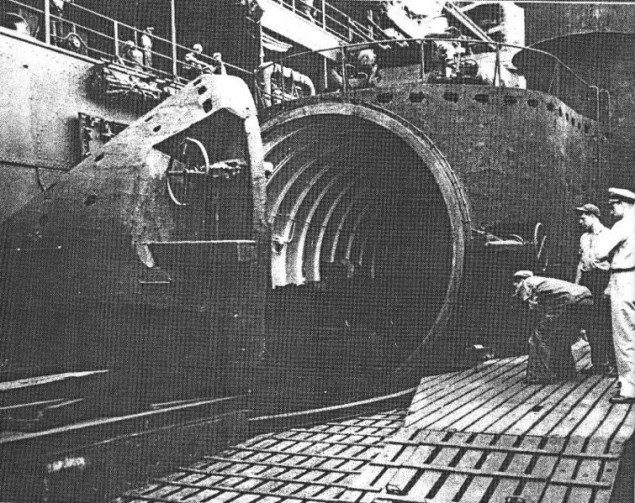
Researchers at the University of Hawaii this week have confirmed the discovery of a long-lost World War II-era Japanese mega-submarine, the I-400, lost since 1946 when it was intentionally scuttled by U.S. forces after its capture, ending a decades-old Cold War mystery of just where the lost submarine lay.
The Hawaii Undersea Research Laboratory (HURL) at the University of Hawaii say they discovered the 1-400 in August off the southwest coast of Oahu in waters about 2,300 deep and are releasing details of their findings now following a review by NOAA with the U.S. state department and Japanese government officials.
At 400 feet long, the I-400 was known as a “Sen-Toku” class aircraft-carrying submarine, the largest submarine ever built until the introduction of nuclear-powered subs in the 1960s.
With a range of 37,500 miles, the I-400 and its sister ship, the I-401, were able to travel one and a half times around the world without refueling, a capability that has still never been matched by any other diesel-electric submarine.
The subs discovery was led by veteran undersea explorer Terry Kerby, HURL operations director and chief submarine pilot, as part of a series of dives funded by a grant from NOAA’s Office of Exploration and Research and the University of Hawai‘i at Mānoa’s School of Ocean and Earth Science and Technology (SOEST).
China to recover ancient shipwreck’s treasures

From South China Morning Post
China is to start removing treasures from its greatest ever marine archaeological discovery, six years after the wreck was raised from the seabed in a giant metal box, reports said on Friday.
The wooden Nanhai 1 sank near Yangjiang in the southern province of Guangdong during the Southern Song dynasty of 1127-1279, with an estimated 60,000 to 80,000 items on board.
For centuries it was preserved under the sea by a thick covering of silt, and it was discovered accidentally by a British-Chinese expedition looking for a completely different vessel, the Rhynsburg from the Dutch East India Company (VOC).
The Nanhai 1 was salvaged in 2007, and its cargo of porcelain, lacquerware and gold objects is “more than enough to stuff a provincial-level museum”, said the Southern Metropolis Daily.
From LSJ
Five months after divers searched a remote section of Lake Michigan for a mysterious 17th century ship and retrieved a wooden slab the group leader believes is part of the vessel, it’s still uncertain whether they are on the right track.
The object of the weeklong mission in June was the Griffin, built by the legendary French explorer La Salle, which disappeared in 1679 with its six-member crew, becoming the oldest known shipwreck in the upper Great Lakes.
The dive team dug a deep hole at the base of the nearly 20-foot-long timber, which was wedged vertically into the lake floor, hoping other wreckage was beneath. To their disappointment, they found nothing.
Since then, the beam has undergone a CT scan at a Michigan hospital. A wooden sliver has been sent to a Florida lab for carbon-14 analysis. Three French experts who participated in the expedition have completed a report.
Others are in the works, as scientists who have examined the slab or data from the tests compile their findings. Thus far, most have declined to take a position on whether the Griffin has been found.
“Based on the totality of the scientific results thus far, as well as historical research, to this point there are still two valid theories” about the wooden beam, said Ken Vrana, who served as project manager for the expedition.
It could be part of a ship, or a “pound net stake” — an underwater fishing apparatus used in the Great Lakes in the 19th and early 20th centuries, he said.
Shipwreck wine draws buyers at auction

By Rupert Millar
The two six bottle lots of the salvaged Bordeaux (pictured) both doubled their high estimates and sold for £5,405 apiece.
The bottles were salvaged from the wreck of the Marie-Thérèse off the coast of the Philippines in 1991 and are believed to be from either the 1865 or 1869 vintage.
Once brought to the surface they were re-corked and labelled at the château.
Also performing well were a collection of 19thcentury Yquem, a bottle of the 1865 also doubled its estimate to £6,815, another bottle of the 1870 made £7,050 and a bottle of the 1894 made £4,230.
Elsewhere though the top lots, comprised, as usual, of Domaine de la Romanée-Conti, Haut-Brion, Pétrus, Henri Jayer and Le Pin, sold within their estimates – all save a 12 bottle case of 1994 Echézeaux Henri Jayer, Georges Jayer propriétaire, which made £22,325 with a high asking price of £18,500.
A collection of Ornellaia demi-magnums with designs by Michelangelo Pistoletto failed to even meet its low estimate of £7,500, the hammer coming down on £5,875.
Gold making people crazy in search for sunken treasure

By Vernon Silver - Bloomberg
Captain Robert Mayne stands at the wheel as he guides the steel-hulled Aqua Quest from the docks in the Florida Keys, pointing the vessel toward what he’s been assured is a gold-laden shipwreck that may be worth tens of millions of dollars.
Mayne, 60, says experience has taught him such gold hunts can be perilous: inspiring obsession, sending treasure hunters on endless journeys and blinding them to reason.
“Gold makes people crazy,” says Mayne, who in his youth smuggled marijuana, and now has neatly combed, greying hair. “They become lost in their dream.”
Even he finds the pull irresistible. Investors who hold rights to the site southwest of Key West say it may be the resting place of a galleon sunk by a 1622 hurricane.
Mayne has agreed to cover the cost of the excursion in exchange for half of any treasure.
Gold’s draw is a powerful one that drives both dreams and financial markets. It helped create a bubble in global gold prices, which gained more than sevenfold over a 12-year period. After peaking at $1,921.15 an ounce in September 2011, gold fell to as little as $1,180.50 in June.
It closed at $1,281.83 on Nov. 13.
The drop is battering fortunes, from individuals who bought coins through TV offers to billionaires who bet wrong. The gold fund of John Paulson, the New York hedge fund manager, declined 62 percent this year through September.
Yet for treasure hunters, the recent drop hardly makes a dent in their ambitions. Gold prices are still higher than when they began their quests, years or decades ago.