HOT NEWS !
Stay informed on the old and most recent significant or spectacular
nautical news and shipwreck discoveries

By Dominik Jůn
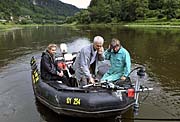
Public broadcaster Český Rozhlas or Czech Radio is financing an unusual project – the attempted recovery of a WWII tank rumoured to be lost somewhere at the bottom of the river Labe (or Elbe). Diving teams are trawling through the river hoping to find a lost artefact from the past.
May 1945, Nazi military units are in turmoil as Soviet troops move across Europe from the east, and American troops move in from the west. Keen to avoid leaving any easy targets for the Allies to destroy, the Nazis either hid or destroyed most of their abandoned hardware in occupied Czechoslovakia.
Earlier in February, the Allied bombing of Dresden had forced many nazis to flee into Czechoslovakia.
This is where the legend of the lost tank was born. Czech Radio along with the River Elbe Administration and the Military History Institute have been following up on a specific report found in the radio archives of a man, now sadly deceased, who claimed that there was indeed a tank at the bottom of the Elbe.
The man, one Václav Patka had helped to clear the Labe river bed of military hardware right after the end of WWII. He stated that there was indeed a tank at a place called Dolní Zleb. Now, a team of specialists is trying to find out if this is true.
Read more...
Shipwrecks and World War Two bombs threaten £6bn pipeline
By Roger Boyes
When Sweden scuttled 20 huge wooden warships more than 250 years ago, it was seen as a desperate measure to block the enemy Danish fleet.
Now those same wrecks could scuttle the key component of a European energy plan - the construction of a 1,200km (746-mile) gas pipeline along the cluttered floor of the Baltic Sea.
Russia and Germany are building the pipeline to avoid the political problems of transporting gas overland - Ukraine and Belarus, in the midst of price rows with the energy supplier Gazprom, have threatened to interrupt supplies to Western Europe.
The seabed route, known as Nord Stream, is turning into an obstacle course of a different kind.
Not only do 100,000 tonnes of unexploded Nord Stream ammunitions lie scattered along the route, but the German Navy is concerned that one of its live shells might hit the pipeline and set off an explosion during Baltic exercises.
Shipwrecks aplenty off Florida coast
By Mike Reilly
The bottom of the Gulf of Mexico and the Atlantic Ocean are home to more than 2,000 confirmed and documented shipwrecks. Experts believe there could be another 2,000 that are not documented.
That's the word from David Southall, curator of education at the Collier County Museum. He gave a talk on the subject Tuesday at the Marco Island branch of the Collier County Public Library.
The Friends of the Library sponsored his appearance.
But his first comments to the large gathering were aimed at letting them know it was not going to be a discussion of where to find the lost treasures buried in the sea.
NOAA goes diving for U-boats in North Carolina
By Catherine Kozak
Deep purple water with streaks of sparkling azure concealed a war grave 110 feet beneath the surface.
A vessel plying the waters off the Outer Banks on Saturday was hunting for what was once the hunter, a German submarine sunk 66 years ago by depth charges dropped by an American bomber.
Divers on the National Oceanic and Atmospheric Administration's new 41-foot catamaran were geared up and waiting to descend to survey the U-701, the most intact of discovered U-boats sunk off the North Carolina coast.
Boat captain Chad Smith, NOAA's East Coast vessel coordinator, slowed the catamaran's motor and circled the position above where the wreck lay mostly buried on the ocean floor about 22 miles off Avon.
Gulf treasure hunters went looking for gold, found lost military plane


From Naples News
They sound like treasure hunters. HammerHead. Fiberglass Bob. Caucasian Tim. And they talk like them, too. The grizzled salts and the young ones, too.
I believe the gold’s out there,” said Jake Wicburg, the 14-year-old son of Capt. Tim (not Caucasian Tim) Wicburg.
And is he going to be the one who finds it ? “Oh yeah,” he says.
The plane’s there and the gold’s there,” the elder Wicburg said. “I’ll be looking for it for the rest of my life.
When a young Timmie Wicburg snagged a piece of an airplane on a fish hook in 1990, he had heard the stories. So had his dad, the late Capt. Jim Wicburg.
Read more...
DNA survives two millennia underwater to shed light on amphorae
By Norman Hammond
Amphorae were the workaday containers of the ancient world, used to ship everything from aromatic wine to smelly fish sauce around the Mediterranean and beyond.
Thousands have been found, in shipwrecks and in fragments at their destinations.
Over the years, certain assumptions have grown up as to what was shipped in particular forms of amphorae and from specific source areas, and the remains of pottery containers have stood proxy for their presumed contents’ significance in ancient economies.
In most cases no direct evidence of those contents could be obtained: long burial in the ground or on the seabed had, it was thought, washed away any evidence.
A new study now shows that traces of ancient DNA can survive more than two millennia underwater.
These can be multiplied using the polymerase chain reaction (PCR) established in forensic analysis to yield evidence of what the amphorae contained: sometimes the results are surprising.
Read more...
150 feet undersea and snug as a bug
By Elliott Hester
Imagine you are diving beneath the surface of the Caribbean Sea.
A school of horse-eyed jacks suddenly changes direction, flashing what appears to be a silvery sheet. A shipwreck emerges in the deep blue distance. You head in that direction, cruising alongside a picturesque coral reef.
In this underwater adventure, you're neither a snorkeler nor a diver. You're a passenger in an submarine.
Since 1986, when Atlantis Submarines International Inc. launched the world's first public-passenger submarine off the coast of Grand Cayman Island in the British West Indies, more than 11 million customers have taken the plunge.
The voyages are now offered in 28-, 48- and 64-passenger subs at 12 island destinations in the Caribbean, Hawaii and Guam.
I went under in Atlantis III, a 48-passenger sub operating off the coast of Barbados.
The journey began at the dock in Bridgetown, the capital. I boarded the Ocean Quest transfer boat for the 10-minute trip to the dive site at Freshwater Bay Reef, a mile off Paradise Beach on the west coast of the island.
Full story...
Riddle of Lusitania sinking may finally be solved
By Eithne Shortall
American entrepreneur Gregg Bemis finally gets courts go-ahead to explore the wreck off Ireland.
It is the best known shipwreck lying on the Irish seabed, but it is only today that the owner of the Lusitania will finally begin the first extensive visual documentation of the luxury liner that sank 93 years ago.
Gregg Bemis, who bought the remains of the vessel for £1,000 from former partners in a diving business in 1968, has been granted an imaging license by the Department of the Environment.
This allows him to photograph and film the entire structure, and should allow him to produce the first high-resolution pictures of the historic vessel.
The RMS Lusitania sank off the coast of Cork in May 1915 when a German U-boat torpedoed it. An undetermined second explosion is believed to have speeded its sinking, with 1,198 passengers and crew losing their lives.