HOT NEWS !
Stay informed on the old and most recent significant or spectacular
nautical news and shipwreck discoveries

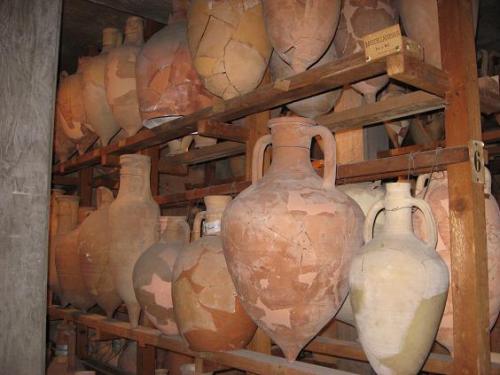
First century jars recovered by the Guardia Civil in Alicante
From TypicallySpanish.com
Two men have been arrested and the amphoras are thought to have come from a shipwreck off Villajoyosa.
Agents from the environment protection section of the Guardia Civil, Seprona, in Santa Pola, have arrested two people and recovered 19 amphoras dating from the first and second centuries, thought to have been plundered from a shipwreck.
The two men face charges of committing a crime against the historical heritage and one has been identified as 60 year old R.B.M.
The earthenware jars are thought to have been taken from the wreck of the ‘Bou Ferrer’ which was located off the coast of Villajoyosa in March 2001.
The arrests came as the men were transferring some the material which has now been taken to the Alicante provincial archaeology museum for study and cataloguing.
Other jars were found in searches of both men’s homes.
Supported mission discovers historic shipwreck off Turks and Caicos islands

From NOAA
Maritime archaeologists today announced they have recently identified the wreck of the historic slave ship Trouvadore off the coast of East Caicos in the Turks and Caicos Islands.
NOAA’s Office of Ocean Exploration and Research significantly funded several years of archaeological research leading to the discovery by Don Keith and Toni Carrell, from Ships of Discovery, an underwater archaeology research institute.
The Spanish vessel Trouvadore was participating in the slave trade, outlawed in the British Indies, including the Turks and Caicos Islands.
In 1841, after the vessel was grounded on a reef, Caicos authorities arrested the crew, and most of the 192 African survivors settled on Grand Turk Island.
Keith and Carrell believe the African survivors of the Trouvadore are the ancestors of a large portion of current residents in the Turks and Caicos Islands.
For example, traditions on the Islands have a recognizable African origin. The Turks and Caicos National Museum is recording these traditions through oral histories and is educating the community about their ancestral history.
British Museum say Treasure Act is having the right effect
From Antiques Trade Gazette
The British Museum have credited the Treasure Act – which ensures treasure hunters are compensated for finds – for the significant increase in reported objects.
This year’s Treasure Annual Report, published on November 19, lists a total of 749 precious metal objects reported last year, compared with 665 in 2006.
That amounts to a tenfold increase in the numbers of artefacts reported since the Act came into effect in 1996.
James Robinson, the curator of medieval collections at the British Museum, said: “The way the system works now is a massive incentive for people to go out and find things.
The number of items found seems to be getting bigger and bigger every year.”
Under the Act, any gold, silver and groups of coins more than 300 years old have to be reported to the local coroner.
“If the treasure is bought by the British Museum or a local museum, the proceeds are split, with half going to the finder and half to the landowner.”
This year’s major discovery was an Iron Age gold and silver torc c.50BC to 200AD found near Newark. It was purchased by Newark Sherwood museum services for £350,000.
New clues In Lusitania's sinking

By Anne Goodwin Sides
When the Lusitania went down, it left a mystery behind: What was the cause of the second blast ? After nearly a century of investigation, argument and intrigue, clues are starting to surface.
On May 7, 1915, the RMS Lusitania, jewel of the Cunard Line, was on a New York-to-Liverpool run when it was attacked by a German U-boat 12 miles off the coast of Ireland.
At 2:10 p.m., a torpedo plowed into the ship and exploded. Fifteen seconds later, a massive second explosion rocked the ship again.
Within a mere 18 minutes, the Lusitania plunged 300 feet to the bottom of the Celtic Sea. Of the 1,959 passengers and crew, 1,198 were lost, including 128 Americans. The tragedy sparked anti-German fervor that eventually drew the United States into World War I.
Shipwreck lover Valerie Van Heest
By John Hogan
Imagine standing on the deck of a boat in the middle of a choppy Lake Michigan, with wind-blown rain buffeting your face like rice at a wedding.
Not exactly the ideal way to spend your 48th birthday.
Yet Valerie van Heest prefers this sort of mid-September activity to strolling Chicago's Magnificent Mile with friends and a charge card.
The conversion came 20 years ago, when van Heest met a group of people who shared her long-dormant love of Great Lakes history.
"In 1988, my life changed," she said.
"All my friends were people from work, and my time was spent either shopping for clothes or working. I forgot how much I missed the water."
Big lake still holds mysteries of deep
By Tony Walter
It's agreed that the lake bottom holds the remains of dozens of vessels that challenged lake storms and lost. With each shipwreck, myth and lore add to the reputation of Lake Michigan as a recreational resource not to be trifled with.
Death's Door off the tip of Door County got its name for a reason.
Kevin Cullen, an archaeology associate for Discovery World at Pier Wisconsin in Milwaukee, recently speculated on what he called the "Lake Michigan Triangle," a 3,750-square-mile section of the lake that goes from Manitowoc to Benton Harbor, Mich., to Ludington, Mich., and back to Manitowoc.
Cullen cited the disappearance of a freighter, a Northwest Airlines plane, and one freighter captain within that triangle over the past century that he said could have natural or supernatural causes, depending on one's bent for mystery and mythology.
Plan to raise Asgard II from watery grave
By John Mooney
A plan to raise Asgard II, which is lying at the bottom of the sea off the French coast, will be presented to the cabinet before Christmas.
Willie O’Dea, the defence minister, hopes to commission a salvage company to raise the government’s training vessel so that it can be restored.
Officials are in negotiations with a specialist firm which submitted a “favourable” tender to raise the ship, which was designed in the 1980s by Jack Tyrrell from Wicklow.
If a deal is agreed, the company could raise the vessel from the seabed as early as next spring, weather and tidal conditions permitting. The operation could be paid for using money from the ship’s insurance policy.
Asgard II was covered by Allianz, an international firm, for €3.8m. The Department of Defence is confident a full insurance payout would cover the entire cost of the salvage operation and a refit of the vessel if it is successfully refloated.
A survey of the sunken ship by a Remotely Operated Vehicle in September showed that Asgard II is largely intact and could be saved, although it lies under 80 metres of water 31 km off the French coast in the Bay of Biscay.

By Robin Rowland
Pirate bands have existed since human beings first began ocean voyages. And it seems, despite their murder, robbery and slave trading, the public's romantic view of pirates existed long before Hollywood movies.
The pirates of the Caribbean were a money-maker for an author using the penname Captain Charles Johnson when his book, A General History of Robberies and Murders of the Most Notorious Pyrates, was published in London in 1724.
The account of famous pirates such as Henry Morgan and William Kidd became an 18th century bestseller. And 200 years before that, both Christian and Muslim chroniclers told the stories of pirates from both faiths, sometimes allies, sometimes enemies, who raided across the Mediterranean in the 16th century.