HOT NEWS !
Stay informed on the old and most recent significant or spectacular
nautical news and shipwreck discoveries

Treasure from 1715 fleet found; new stakeholder hopes to bring up more

By Tyler Treadway - TC Palm
A gold-rimmed portrait necklace, several gold and silver coins and numerous artifacts from a 1715 Spanish fleet were discovered in about 10 feet of water June 19 just off Indian River Shores in Indian River County.
The find was announced Monday by a firm based in Jupiter Island and Sebastian that also said it has acquired the salvage rights to the sunken ships from the heirs of world-famous treasure hunter Mel Fisher. The company plans to ramp up recovery efforts.
In 1715 an 11-ship fleet set sail from Cuba laden with gold bars, coins, diamonds, emeralds and pearls bound for King Philip V of Spain. The bounty included the dowry for Philip’s new bride, Elisabeth, who refused to consummate their marriage until she received it. The ships sank in a hurricane off the Treasure Coast.
“The ships were blown into the reefs and sank, so they’re relatively close to shore,” said Brent Brisben of Sebastian, who with his father, William Brisben of Jupiter Island, formed Queen’s Jewels.
The company then bought from Fisher’s heirs the U.S. admiralty custodianship of the 1715 fleet and the right to salvage the wrecked ships.
The sites of six of the sunken ships have been found, some in only 20 feet of water. But the bulk of the treasure — including the queen’s jewels, estimated to be worth close to $900 million — still hasn’t been recovered.
Capt. Greg Bounds, whose boat “Gold Hound” made the most recent discovery off the coast of Indian River Shores, is one of about 15 subcontractors who have worked with Mel Fisher Treasure and will continue to work with the Brisbens.
1857 - SS Central America Shipwreck Treasures at ANA World's Fair of Money
From American Numismatic Association
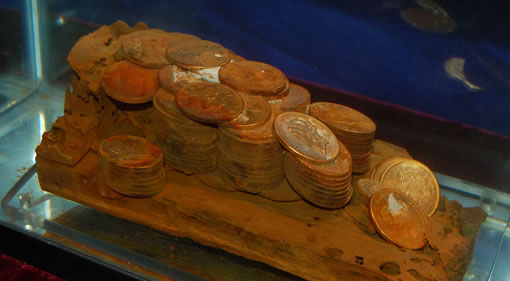
The incredible "Ship of Gold" exhibit, showcasing California Gold Rush-era sunken treasure recovered from the 1857 shipwreck of the SS Central America, will make port in Boston at the American Numismatic Association’s World’s Fair of Money, August 10-14 at the Hynes Convention Center. The exhibit is courtesy of Monaco Rare Coins of Newport Beach, Calif.
The SS Central America was recovered in 1988 from nearly 8,000 feet below the surface of the Atlantic Ocean. The ship sank in a hurricane in September 1857 while carrying California gold from Panama to New York City.
The exhibit also includes one of the 13 recovered octagonal $50 gold pieces produced by the United States Assay Office of San Francisco, and the remains of a wooden cargo box that still contains approximately 110 Double Eagles as they were found on the ocean floor. Many appear to be 1857-S $20 gold pieces, apparently freshly struck at the San Francisco Mint when they were placed in the container for shipping.
Visitors will see the front pages of three 1857 newspapers that published stories about the shipwreck, the ordeal of survivors and the devastating economic effects created by the loss of the gold. Robert Evans, the chief scientist on the 1980s mission by the Columbus-America Discovery Group that located and recovered the magnificent sunken treasure, will be in Boston to meet visitors and discuss the SS Central America, her cargo, crew and passengers.
Two N.J. divers find historic Andrea Doria bell at famous shipwreck site
By Grace Chung - The Star-Ledger
Two New Jersey divers sent waves throughout the wreck-diving community with the discovery of what is believed to the "bridge bell" from the historic shipwreck of the Andrea Doria, the luxury Italian ocean liner that sunk in 1953 off the coast of Nantucket, Massachusetts.
Ernest Rookey, of Jackson, and Carl Bayer, of Hillsborough, were part of an expedition team diving on the wreck when they made the find 240 feet below the ocean's surface.
Both men were diving the Andrea Doria for the first time as last minute fill-ins on the expedition after two other crew members dropped out.
“This is an incredibly significant find,” said expedition group leader, Joel Silverstein, of Arizona. “Think of it like finding a needle in a haystack.”
The bell, which weighs about 75lbs and stands two feet tall, is one of the few artifacts which has the ship’s name engraved on it.
The last major discovery was made when the stern bell was discovered by a group led by Gary Gentile in 1985, according to Silverstein.
The Andrea Doria, which was once considered Italy's flagship, has attracted thousands of divers since 1953, but most only go down one or two times "just to say that they went there,” said Silverstein.
Many consider it the Mount Everest of SCUBA diving because of the remote location and challenging conditions, Silverstein said.
Even among divers in the “core group” who have made multiple trips to the wreck, most only return with a few pieces of china, glassware, or portholes, said Silverstein, who has made 56 dives on the Andrea Doria wreck since 1992.
Zheng He's Tomb Found in Nanjing

From Cri English
A recently excavated tomb in Nanjing has been confirmed to be the grave of Zheng He, a eunuch from the early Ming Dynasty who led historic voyages to Southeast Asia and eastern Africa. The tomb was discovered accidentally on June 18th by workers at a construction site near Zutang Mountain that also holds the tombs of many other Ming Dynasty eunuchs, the Yangtse Evening News reported.
The tomb was 8.5 meters long and 4 meters wide and was built with blue bricks, which archaeologists said were only used in structures belonging to dignitaries during the time of Zheng He.
But experts believed his remains were not placed in the tomb because of the long distance between Nanjing and India, where he died during a visit in 1433.
Born in 1371, Zheng He was an excellent navigator and diplomat in the Ming Dynasty. He led the royal fleet to southwest Asia and east Africa on seven occasions from 1405 to 1433, nearly a century before Christopher Columbus discovered the American continent in 1492.
Amelia Earhart may have survived months as castaway

By Rossella Lorenzi - Discovey News
Amelia Earhart, the legendary pilot who disappeared 73 years ago while flying over the Pacific Ocean in a record attempt to fly around the world at the equator, may have survived several weeks, or even months as a castaway on a remote South Pacific island, according to preliminary results of a two-week expedition on the tiny coral atoll believed to be her final resting place.
"There is evidence on the island suggesting that a castaway was there for weeks and possibly months," Ric Gillespie, executive director of The International Group for Historic Aircraft Recovery (TIGHAR), told Discovery News.
Gillespie has just returned from an expedition on Nikumaroro, the uninhabited tropical island in the southwestern Pacific republic of Kiribati where Earhart and her navigator Fred Noonan are believed to have landed when running out of fuel.
"We noticed that the forest can be an excellent source of water for a castaway in an island where there is no fresh water. After heavy rain, you can easily collect water from the bowl-shaped hollows in the buka trees.
We also found a campsite and nine fire features containing thousands of fish, turtle and bird bones. This might suggest that many meals took place there," Gillespie said.
TIGHAR's expedition to Nikumaroro was the tenth since 1989. During the previous campaigns, the team uncovered a number of artifacts which, combined with archival research, provide strong circumstantial evidence for a castaway presence.
"On this expedition we have recovered nearly 100 objects," Gillespie said. Among the items, 10 are being tested by a Canadian lab for DNA.
"We are talking about 'touch DNA,' genetic material that can be retrieved from objects that have been touched," he explained.
The best candidate for contact DNA appears to be a small glass jar that was found broken in five pieces, most likely a cosmetic jar.
Other candidates for DNA extraction include two buttons, parts of a pocket knife that was beaten apart to detach the blades for some reason, a cloth that appears to have been shaped as a bow, and cosmetic fragments of rouge from a woman's compact.
The excavation took place on the island's remote southeast end, in an area called the Seven Site, where the campsite and fire features were found.
Feds assess threat from sunken Lake Champlain tug
From The Associated Press
For almost 50 years a tugboat that once hauled barges between Vermont and New York on Lake Champlain has sat upright 160 feet underwater, hardly changed since the November night in 1963 when it ran aground on a reef and went down.
The paint on the William H. McAllister appears barely faded in recent video footage, and fire hoses remain coiled on the deckhouse walls. There's also a chance that the tug's fuel tanks still could be holding as much as 14,000 gallons of diesel fuel.
That has federal officials, environmentalists and residents who know about it concerned.
The threat of what could happen if those tanks were to fail and belch fuel into the 120-mile-long lake that separates Vermont and upstate New York drew an expedition last week of federal environmental officials and engineers to the lake.
They sent a remotely operated vehicle onto the McAllister to try to determine if there's fuel that could leak out.
"It's in such good condition after all these years," said Don Dryden, a commercial diver who was there to provide technical expertise about the condition of the tugboat for McAllister Towing and Transportation of New York, the successor to the company that owned the tug in 1963.
The federal Environmental Protection Agency will analyze last week's findings and perhaps send divers into the tug later this summer to determine how much fuel is in the tanks.
If necessary, the remaining fuel would be pumped out, said Paul Kahn, a coordinator for the EPA working at the scene.
Legal battle brews over War of 1812 shipwreck
By Randy Boswell - Canwest News Service
A stunningly well-preserved Lake Erie shipwreck — purported to be the Canadian-built brig Caledonia from the War of 1812 — has prompted visions of a world-class tourist attraction on the Buffalo shore and sparked a legal battle between New York's state government and a U.S. salvage company that wants to raise the vessel.
But could a 76-year-old issue of The Beaver — the venerable Canadian history magazine — scuttle the controversial dream?
A Buffalo-based maritime heritage centre is pointing to an article published in the magazine's December 1934 edition to question the identity of the sunken ship.
The article, written by the renowned Great Lakes historian George Cuthbertson, traces the careers of several fur trade vessels — including the 26-metre, two-masted Caledonia — that were put to military use in the War of 1812 and later sold off to private owners.
Cuthbertson details the Caledonia's remarkable role in the war, beginning with its secondment from the Northwest Company in 1812 to ferry British, Canadian and First Nations troops to Michilimackinac Island at the western end of Lake Huron, a strategic prize close to the eastern entrance of Lake Michigan.
Without a shot being fired, an American force surrendered the island's fort — an important event that dashed U.S. expectations of an easy triumph in the war and largely solidified aboriginal support behind the British.
The Caledonia later fell into American hands, then saw action in September 1813 — as the renamed USS Caledonia — in the Battle of Lake Erie, a famous U.S. victory in which much of the Royal Navy fleet on the Great Lakes was destroyed.
Ship discovered 112 years after disappearing - Lake Michigan
By Meg Jones - Journal Sentinel
For almost 112 years, the steamship rested in ghostly silence at the bottom of Lake Michigan, unknown and unseen until a group of divers kicked their way down to the deck and solved a perplexing maritime mystery.
The deck houses were gone, the smokestack was tipped over and a wheelbarrow used to move cargo lay on the boat's surface.
Though the name couldn't be seen on the stern, the length of the vessel and unusual characteristics pointed to only one ship - the L.R. Doty.
Until last week, it was the largest wooden ship that had been unaccounted for in Lake Michigan.
The 291-foot-long L.R. Doty was carrying a cargo of corn when it sank during a ferocious storm on Oct. 25, 1898. All 17 people aboard and the ship's two cats, Dewey and Watson, were lost.
When a group of divers and maritime historians discovered the L.R. Doty's grave about 20 miles off Oak Creek in 320 feet of water, they found an intact ship sitting upright.
It was in remarkable condition considering it's been underwater for more than a century, courtesy of the frigid waters of the Great Lakes that act as a great preservative of wooden ships.
And the cargo, harvested from Illinois farms and destined for Ontario, Canada, is still in the hold, though it now has a layer of muck on top of it, said Brendon Baillod, a Great Lakes maritime historian who spearheaded the search.
"She vanished with no real explanation. She was a pretty new ship. We wanted to solve that mystery - why she disappeared in a Lake Michigan storm that she should have been able to handle," Baillod said Wednesday.
Built in 1893, the L.R. Doty was in the largest class of wooden vessels in existence on the Great Lakes at a time when the maritime highway was equivalent to today's interstate system. It was built with steel arches embedded in the hull, which provided extra stability, one reason its captain might have felt confident heading into bad weather.
Technical divers - breathing a special blend of mixed gas with equipment required to dive so far deep - shot video of the wreck site and snapped photos that give clues that could explain how and why the Doty sank in a storm so fierce it damaged part of the Milwaukee break wall and destroyed the boardwalk in Chicago.