HOT NEWS !
Stay informed on the old and most recent significant or spectacular
nautical news and shipwreck discoveries

Pistol used to steal coal for RMS Titanic appears for sale

From Paul Fraser Collectibles
In 1912, during a national coal strike, the Titanic's owners resorted to desperate measures. Sometimes it's the 'stories behind the stories' which provide the most interesting items of memorabilia.
Such is the case with the story of the RMS Titanic which, after striking an iceberg four days into its voyage on April 14, 1912, remains one of the deadliest peacetime maritime disasters in history.
Most people are familiar the story - famously retold in director James Cameron's 1997 blockbuster film starring Kate Winslet and Leonardo DiCaprio.
However, less people are perhaps aware of an amazing tale which precedes the Titanic's doomed maiden voyage from Southampton, England in 1912. Britain was then in the grip of a national coal strike, and the Titanic's owners White Star Liner feared that there wouldn't be enough fuel to power the mammoth ship.
To deal with the situation, George Frederick Bull, a bursar for the company, traveled with his colleague, R McPherson, to Wallasey in Merseyside. There, they stole coal from the striking miners at gun-point.
Today, almost a century later, the 104-year-old pistol which played such a crucial role in the launching the Titanic has appeared for sale on the collectors' markets.
The gun is being sold by Antiques Storehouse of Portsmouth, UK, priced £200,000.
It will be sold in an original flare box from the Titanic and has Bull's initials engraved on its handle.
New Titanic expedition will create 3D map of wreck

By Steve Szkotak - Associated Press/Breitbart
A team of scientists will launch an expedition to the Titanic next month to assess the deteriorating condition of the world's most famous shipwreck and create a detailed three-dimensional map that will "virtually raise the Titanic" for the public.
The expedition to the site 2 1/2 miles beneath the North Atlantic is billed as the most advanced scientific mission to the Titanic wreck since its discovery 25 years ago.
The 20-day expedition is to leave St. John's, Newfoundland, on Aug. 18 under a partnership between RMS Titanic Inc., which has exclusive salvage rights to the wreck, and the Woods Hole Oceanographic Institution in Massachusetts. The expedition will not collect artifacts but will probe a 2-by-3-mile debris field where hundreds of thousands of artifacts remain scattered.
Some of the world's most frequent visitors to the site will be part of the expedition along with a who's who of underwater scientists and organizations such as the National Oceanic and Atmospheric Administration.
Organizers say the new scientific data and images will ultimately will be accessible to the public.
"For the first time, we're really going to treat it as an archaeological site with two things in mind," David Gallo, an expedition leader and Woods Hole scientist, told The Associated Press on Monday. "One is to preserve the legacy of the ship by enhancing the story of the Titanic itself. The second part is to really understand what the state of the ship is."
The Titanic struck ice and sank on its maiden voyage in international waters on April 15, 1912, leaving 1,522 people dead.
Since oceanographer Robert Ballard and an international team discovered the Titanic in 1985, most of the expeditions have either been to photograph the wreck or gather thousands of artifacts, like fine china, shoes and ship fittings. "Titanic" director James Cameron has also led teams to the wreck to record the bow and the stern, which separated during the sinking and now lie one-third of a mile apart.
RMS Titanic made the last expedition to site in 2004. The company, a subsidiary of Premier Exhibitions Inc. of Atlanta, conducts traveling displays of the Titanic artifacts, which the company says have been viewed by tens of millions of people worldwide.
"We believe there's still a number of really exciting mysteries to be discovered at the wreck site," said Chris Davino, president of and CEO of Premier Exhibitions and RMS Titanic. "It's our contention that substantial portions of the wreck site have never really been properly studied."
RMS Titanic is bankrolling the expedition. Davino declined to state the cost of the exploration other than to say it will be millions of dollars.
The "dream team" of archaeologists, oceanographers and other scientists want to get the best assessment yet on the two main sections of the ship, which have been subjected to fierce deep-ocean currents, salt water and intense pressure.
Gallo said while the rate of Titanic's deterioration is not known, the expedition approaches the mission with a sense of urgency.
"We see places where it looks like the upper decks are getting thin, the walls are thin, the ceilings may be collapsing a bit," he said. "We hear all these anecdotal things about the ship is rusting away, it's collapsing on itself. No one really knows."
The expedition will use imaging technology and sonar devices that never have been used before on the Titanic wreck and to probe nearly a century of sediment in the debris field to seek a full inventory of the ship's artifacts.
Call for funds to house Guernsey's Roman wreck Asterix

From BBC News Guernsey
The director of Guernsey Museums has called on people outside the States to help preserve and exhibit the Gallo-Roman wreck Asterix in the island.
Dr Jason Monaghan said Asterix is the most historically valuable Roman artefact in northern Europe.
He said a public private partnership could be the way forward.
Dr Monaghan said: "It's a very exciting idea, but Guernsey is actually quite a small place and maritime archaeology projects are expensive."
He said: "What we're saying at the moment is the ship is ready we want people now who are interested in helping secure the future of the ship to step forward and to start the discussion of where it's going to go, how we're going to fund it coming here."
The wreck was found on Christmas Day 1982 in St Peter Port Harbour and raised by the Guernsey Maritime Trust during 1984-86.
Since then it has undergone restoration work at the Mary Rose Trust in Portsmouth, costing the States £5,000 a year.
Dr Monaghan said: "It will be finished in terms of conservation in the next couple of months, the Mary Rose Trust have agreed to keep it until the end of 2011 and we're discussing with them whether they can keep it for a couple more years while we establish what we're going to do with the ship long term.
It shows how important we were in the Roman world and it's also the biggest Roman object from Britain”
"It would be very nice if it could be brought back to Guernsey, the chief problem is its size, it's 18m (59ft) long. There's no building that the Museums service has which is long enough to put it in.
"So we have to find a building, we have to convert the building, we have to build a glass showcase to put the ship in with a bit of environmental controls to keep the humidity stable.
"Then we have to build effectively a museum gallery around it in order to make it interesting for the general public who don't know anything about Roman ships.
"So we display the artefact beautifully and then we interpret it for locals, for visitors, for school groups so that they can understand what they are seeing so they see how it fits into ships in the Roman world and how Guernsey fits into the Roman world as well."
Cape Breton a wreck-diver’s paradise
By Chris Shannon - Cape Breton Post
The coastal areas of Cape Breton Island have held secrets for hundreds of years as military powers looked to stabilize their colonies and migrants yearned to begin a new life in the New World only to chart a course that prematurely ended so many lives on the rocky Atlantic shore.
Shipwreck charts are dotted with spots up and down the coastline of Nova Scotia, particularly its northern most point of Saint Paul Island in Cape Breton.
Underwater explorers Michael Gerhartz, Ronald Newcombe, and Harvey Morash are part of the Si-Tech Explorer Team from Atlantic Canada. Si-Tech is a Swedish drysuit and scuba gear manufacturer.
The team has spent several months preoccupied with a 1834 shipwreck on Cape Breton’s eastern coastline, near the community of Little Lorraine.
The Irish immigrant ship Astraea ran aground at night May 8, 1834, and quickly broke up, killing 248 people. There were only three survivors — a surgeon, a carpenter and a seaman.
Researching background on the ship, the team came across a diary entry from Dr. Jerome O’Sullivan, one of the survivors of the shipwreck, and a letter written by the priest who oversaw the recovery of the bodies.
The documents are held in trust at the Beaton Institute at Cape Breton University.
Only tiny pieces of scattered timber, iron and brass remain of the wreckage after years of ocean currents and saltwater taking a toll on the debris.
In June, the explorer team dived 30 metres down to the site of the Astraea to lay a plaque on the ocean floor in memory of the people who died aboard the ship.
African quest for sunken ship of Ming admiral
By Xan Rice - The Guardian
It's another chapter in the now familiar story of China's economic embrace of Africa. Except that this one begins nearly 600 years ago.
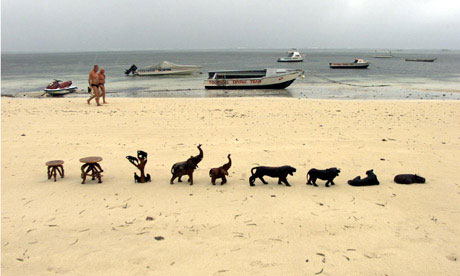
A team of 11 Chinese archaeologists will arrive in Kenya tomorrow to begin the search for an ancient shipwreck and other evidence of commerce with China dating back to the early 15th century.
The three-year, £2m joint project will centre around the tourist towns of Lamu and Malindi and should shed light on a largely unknown part of both countries' histories.
The sunken ship is believed to have been part of a mighty armada commanded by Ming dynasty admiral Zheng He, who reached Malindi in 1418. According to Kenyan lore, reportedly backed by recent DNA testing, a handful of survivors swum ashore.
After killing a python that had been plaguing a village, they were allowed to stay and marry local women, creating a community of African-Chinese whose descendants still live in the area.
A likely shipwreck site has been identified near Lamu island, according to Idle Farah, director general of the National Museums of Kenya, which is working on the archaeology project with its Chinese equivalent and Peking University.
"The voyages of the Portuguese and the Arabs to our coasts have long been documented," Farah told the Guardian. "Now, by examining this shipwreck, we hope to clarify with clear evidence the first contact between China and east Africa."
The project forms part of a recent effort by the Chinese government to celebrate the achievements of Zheng, a Muslim whose ships sailed the Indian and Pacific Oceans many decades before the exploits of more celebrated European explorers such as Christopher Columbus and Vasco da Gama.
Starting in 1405, Zheng made seven journeys, taking in south-east Asia, India, the Middle East and Africa, in fleets of up to 300 huge ships with nearly 30,000 sailors in total, according to Chinese records.
Sonar scanners find ancient wrecks off Italian coast
By Ella Ide - Washington Post
A team of marine archaeologists using sonar scanners have discovered four ancient shipwrecks off the tiny Italian island of Zannone, with intact cargoes of wine and oil.
The remains of the trading vessels, dating from the first century BC to the 5th-7th century AD, are up to 165 meters underwater, a depth that preserved them from being disturbed by fishermen over the centuries.
"The deeper you go, the more likely you are to find complete wrecks," said Annalisa Zarattini, an official from the archaeological services section of the Italian culture ministry.
The timber structures of the vessels have been eaten away by tiny marine organisms, leaving their outlines and the cargoes still lying in the position they were stowed on board.
"The ships sank, they came to rest at the bottom of the sea, the wood disappeared and you find the whole ship, with the entire cargo. Nothing has been taken away," she said.
The discoveries were made through cooperation between Italian authorities and the Aurora Trust, a U.S. foundation that promotes exploration of the Mediterranean seabed.
The vessels, up to 18 meters long, had been carrying amphorae, or large jars, containing wine from Italy, and cargo from North Africa and Spain including olive oil, fruit and garum, a pungent fish sauce that was a favorite ingredient in Roman cooking.
Another ship, as yet undated, appeared to have been carrying building bricks. It is unclear how the vessels sank and no human remains have been found.
Titanic exhibition a rare treasure
By Karen Rallo - South Bend Tribune
Want to get a personal glimpse into one of the most notorious maritime disasters ?
Then take a trip down U.S. 31 to visit “Titanic: The Artifact Exhibition” Sept. 25 through January at the Indiana State Museum in Indianapolis.
More than 5,400 artifacts have been recovered, following seven expeditions to the site of the Titanic’s final resting place, according to Cheryl Mure, vice president of education for Premier Exhibitions Inc.
RMS Titanic Inc., a wholly owned subsidiary of Premier Exhibitions Inc., is the only company permitted to recover objects from the wreckage.
The company was granted possession rights to the luxury liner, which is scattered in pieces some 12,000 feet beneath the sea, by a United States federal court in 1994.
The exhibition seeks to transport visitors back to the time of the voyage with room re-creations, says Mure.
“There’s even an iceberg to touch and feel just how cold the water was on that night. Over 240 artifacts really tell the story. They hold hundreds of memories of the passengers, crew and the ship. That’s what makes it so remarkable,” Mure explains.
Mure went on to say that the artifacts are exhibited in the very condition they were found in.
“We don’t restore, we conserve them to prevent any further decay or deterioration,” she explains.
Personal items like a gold wristwatch or a man’s bowler hat give visitors a sense of the various travelers, rich or poor.
“Who did they belong to? What was he like? Where was he going? These are real objects. This ship started out with such hope and expectation, especially for over 700 immigrants,” says Mure.
Upon entering the exhibition, visitors will be given a replica of an actual boarding pass with the real name of a passenger who boarded the Titanic. After completing the tour, visitors will go to the Memorial Gallery to learn if the passengers named on their boarding passes survived or perished when the Titanic sank, according to Mure.
Diving ban imposed on Champagne Wreck
From Yle
The provincial government of the Åland Islands has imposed a ban on diving in the area where a team of divers earlier this month found what could be the world's oldest drinkable champagne.
The Finnish Coast Guard is patrolling the area to keep prevent any unauthorized dives of the 18th century wreck. The ban in a 30 square kilometre zone is to be in effect until the end of December, according to an online report by the newspaper Ålandstidningen.
The paper added that the provincial government is considering if any other measures are needed.
The wreck, which is at a depth of 55 metres, is in good condition and contained a number of intact bottles.
Christian Ekström, who headed the team that discovered the cache, guessed they might contain champagne. He took one with him to help identify the age of the wreck. The shape of the bottle indicates that it is from the 1780s.
Opening the bottle, Ekström found that it tasted it like champagne. He offered tastes to several wine experts, who were highly impressed.
Not only the champagne may be valuable, the well-preserved wreck itself may be protected.
Under an earlier court decision, wrecks and their contents discovered in the waters of Åland, the semi-autonomous maritime province off Finland's south-west coast, are the property of the provincial government.