HOT NEWS !
Stay informed on the old and most recent significant or spectacular
nautical news and shipwreck discoveries

Shipwreck ! at the Maryland Science Center
By Chris Kaltenbach - Baltimore Sun
Pirates and their plunder, as well as some treasures recovered from the ocean depths, go on display.
It doesn't look much like coins, this misshapen hunk of stone-encrusted metal. But peer closer, and the coral-like formation turns out to be several dozen 19th-century half-dollars, clinging together like barnacles on a rock.
Sure, it's ugly. That's what spending more than a century at the bottom of the ocean can do to a coin.
This numismatic mutation is but one of the many wonders on display as part of "Shipwreck ! Pirates & Treasure," a traveling exhibition opening Friday at the Maryland Science Center.
Part pirate fantasy, part high-tech odyssey, the exhibit is devoted to treasure, highlighting both the scurvy scalawags who plundered it and the modern adventurers who spend years scouring the ocean floor trying to recover it.
The result is a happily schizophrenic exhibit that starts off talking about pirates, Jolly Rogers and unfortunate people walking the plank. The exhibit then gives way to a display of high-tech gadgetry used to find and recover the booty from shipwrecks that, for decades or even centuries, have rested quietly on the ocean floor.
At the center of "Shipwreck!" is a treasure-trove of artifacts salvaged from the wreck of the Republic, a ship that sank about 100 miles off the Georgia coast in 1865 as it was trying to deliver commercial goods to a New Orleans still reeling from the ravages of the Civil War.
"We really want to show the excitement, the thrill of deep-water- ocean shipwreck exploration," said Ellen Gerth, collections curator for Tampa, Fla.-based Odyssey Marine Explorations, the company that found the wreck of the Republic some 1,700 feet deep in the Atlantic Ocean. "So few people realize that the ocean is truly this vast, unexplored frontier."
"Shipwreck!" occupies about 8,000 square feet on the center's second floor, and it starts off with a pirate display clearly designed with kids and the "Pirates of the Caribbean"-obsessed in mind.
Visitors can fashion their own pirate on a computer screen (eye patch optional), practice tying nautical knots and shake boxes of mysterious booty (which could hold coffee beans, lead shot or gold coins).
Pirate flags are unfurled, including Calico Jack's famous Jolly Roger and Blackbeard's dancing skeleton. In a touch straight out of an amusement park house of horrors, the (fake) skeletal remains of one unfortunate pirate, his red cap still in place, hang from a ship's bow.
Displays showcase pirate artifacts, such as lead shot and clay pipes, and explain the differences between pirates, privateers (essentially pirates licensed by the government), buccaneers (originally restricted to the Caribbean, although now used to refer to any pirate) and Barbary corsairs (who operated out of North Africa).
"For whatever reason, people seem to gravitate to pirate legend and pirate lore," said Chris Cropper, the center's senior director of marketing. "There's just something fascinating about it."
The second half of "Shipwreck!" details the work of Odyssey, focusing primarily on the Republic, which was built in Baltimore in 1853. Launched as the Tennessee, it was used for commercial purposes and as a warship by both the Union and Confederate navies.
While on its way to New Orleans after the war, loaded with goods and some $400,000 in coins, it sank in a squall.
Treasures in storage while pirate museum is created

From First Coast News
Out the outside, it looks like a generic warehouse. Inside this as-yet-undisclosed location in St. Augustine, pirate museum props are overflowing the shelves and peeking out of boxes.
Pat Croce opened a squeaky door at the warehouse and said, "This is our secret bunker." He smiled a wry smile.
"I had to rent 6,000 feet to put all this paraphernalia and items we shipped up from Key West. Where was I going to put it ? The museum's not ready for it"
Shelves are lined with trunks, real and fake swords, and rusty lanterns. An unfinished mural of a pirate ship stretches across one wall of the warehouse.
The museum's creative director creates clouds and waves with every stroke of a paint brush. Another man cleaned a cannon on the floor.
Croce bounced around the warehouse showing off the items inside and explaining how they will be used in his museum.
He plopped himself down in an elaborately carved chair and said, "We're going to have a pirate sitting here holding a blunderbuss with all kinds of treasure and artifacts around him!"
Croce has collected pirate artifacts throughout the years. He's chosen to move his Pirate Soul museum in Key West to St. Augustine and call it St. Augustine's Pirate and Treasure Museum. It will be similar, but, as Croce said, "It will be what was in Key West... on steroids !"
There will be more interactive components for visitors as well as a new Hollywood Pirates exhibit.
With excitement in his voice, Croce said, "We'll have stuff from 'Captain Kidd,' 'The Goonies,' and 'Hook.' I got the hook from Peter Pan ! Oh yeah. It's great!"
It's not all props. There will be a large assortment of authentic artifacts on display as well. The museum will have a real pirate treasure chest with real pirate booty.
Also, Croce landed a deal with the Florida Department of State and the Historic Resources Department to display some of their items that have been under lock and key for years.
Vandalism of sunken U.S. warship off Okinawa
By Travis J. Tritten - Stars and Stripes
Sometime in the past three months, a group of unknown scuba divers drifted 135 feet down into the deep blue waters here.
Their destination was the ghostly wreck of the USS Emmons, a World War II destroyer battered by kamikaze planes and scuttled by the U.S. military in 1945.
The divers slipped inside the Emmons, pried loose an engraved metal plate, and disappeared again into the blue.
The looting of the Emmons builder’s plaque – a plate showing construction and commission dates – has drawn the attention of the Naval Criminal Investigative Service and riled former crew members.
NCIS was considering a criminal investigation of the alleged vandalism on Wednesday, NCIS spokesman Ed Buice said.
A law passed in 2004 asserts all such wrecks around the world remain sovereign U.S. territory, meaning looting and vandalism is a crime punishable under U.S. law. If NCIS picks up the case, it could be the first investigation launched under the new law, according to Buice.
“I think somebody stole it for a souvenir,” said Chuck DeCesari, an Okinawa dive company owner who discovered the missing plaque. “It is valuable to a collector as a piece of history.”
DeCesari said he made the discovery recently while shooting video of the wreck for the ship’s veterans group, the USS Emmons Association, and estimates the plaque was stolen within the past three months.
The sinking of H.M.S. Schooner The Speedy

By Tara Lember - oshawaexpress.ca
On the evening of October 7, 1804, the HMS Schooner The Speedy left the port at York en route to Presqu’ile.
The passengers aboard the ship were some of Toronto’s elite citizens and law makers. Combined with crew members, there were estimated to be more than 30 people aboard. The following day, a fierce storm swept across Lake Ontario disabling the schooner, and the vessel was never seen again.
It is assumed that the ship sank on October 8, 1804, after being hit with a large wave and possibly hitting a rock formation, just off shore from Presqu’ile Point.
The reason for the journey had a connection back to Oshawa. A man named John Sharp worked for the Farewell brothers from Oshawa at their trading post on Lake Scugog, and was murdered by a Chippewa tribe member on Washburn Island.
The trial was to take place at the town of Newcastle and those aboard the ship were all involved with the trial in some shape or form.
The Speedy’s only stop was at Port Oshawa because the Farewell brothers were to take part in the trial, but once they decided the vessel was over-crowded, they chose to find another means of transportation.
The Speedy never made it to its destination port.
There were 39 people that perished in the disaster, which also eradicated the court and government of Upper Canada, as many officials were on board.
Box found in Arctic has no Franklin, Amundsen items

From CBC News
A box unearthed in a Nunavut community along the Northwest Passage earlier this month contains nothing related to Arctic explorers Sir John Franklin or Roald Amundsen, government officials have announced.
The wooden box, which was believed to have been buried for decades in Gjoa Haven, Nunavut, was opened by the Canadian Conservation Institute in Ottawa on Friday.
The box was purported to contain either documents related to Franklin's ill-fated attempt to navigate the Northwest Passage in the 1840s or items from Amundsen's journey through the passage in the early 1900s.
"The remains of a cardboard box lined the bottom and sides of the interior of the wood box," the Nunavut government said in a news release issued late Tuesday. "Pieces of newspaper and what appeared to be tallow were discovered beneath the sand and rocks that filled the box
"No items related to either Amundsen or to Franklin were found."
Officials with the Nunavut government and the Institute will give more details in the coming days about the box's contents.
The box was believed to have been buried more than 80 years ago by George Washington Porter Jr., a resident of Gjoa Haven, below a large stone cairn.
It was said that he carefully placed some documents believed to be connected to the British Franklin Expedition — Sir John Franklin's attempt to navigate the Northwest Passage.
Stately Portuguese visitor sails calmly into Jakarta

By Ismira Lutfia - Jakarta Globe
The Portuguese training ship Sagres sailed into Jakarta with great fanfare from the Indonesian Navy on Saturday to begin its its five-day stopover here.
Arriving at the Tanjung Priok port after a week-long voyage from Dili, East Timor, Sagres will be open to the public until Thursday before it continues on its journey to Bangkok as part of its 11-month circumnavigation as “a floating embassy of Portugal,” said the ship’s captain, Comr. Luis Proenca Mendes.
“We will continue sailing to Thailand, Singapore, Malaysia, India and Egypt before reaching Lisbon by December,” said Second Lt. Flavio Eusobio, an officer on the ship.
This is the ship’s first journey to East Timor and Indonesia, Mendes said. The detour from its normal route from China to Singapore added six weeks to the ship’s itinerary.
“The ship’s main purpose is to train cadets from the Portuguese naval academy, who undergo three months’ training on board the ship at the end of their second year,” the captain said as he took journalists on a tour around the vessel, whose 23 white sails bear red crosses.
Sagres left its home port of Lisbon in January.
The last batch of cadets who trained on the Sagres joined the ship in California, bound for Shanghai, where the ship docked to participate at the Shanghai World Expo.
The 12 cadets worked daily on the ship’s bridge to familiarize them with the working life on board a ship. They also learn navigation, maneuvering and leadership skills as well as how to deal with unpredictable weather.
And for the younger generation, used to being constantly connected with the rest of the world through their gadgets, Mendes said the cadets’ time on the bridge gives them the unique experience of being offline and away from the phone.
“From time to time we also invite foreign cadets to join our training on Sagres,” said Mendes, who was made captain of Sagres in 2007.
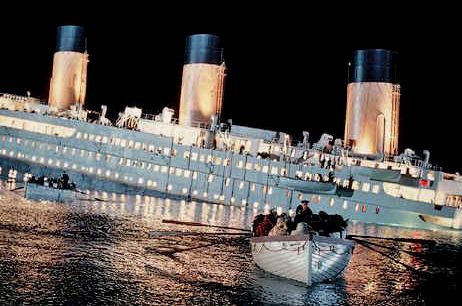
Author Claims Steering Error Sank the Titanic
By Robert Mackey - thelede.blogs.nytimes.com
The granddaughter of a senior member of the Titanic’s crew has revealed in a new book what she describes as a family secret kept for decades: that a simple steering error caused the ship to strike an iceberg and sink during its maiden voyage in 1912.
Louise Patten, a novelist whose new book, “Good as Gold,” mixes fact and fiction, told The Telegraph that her grandfather, Charles Lightoller, the senior surviving officer from the shipwreck that killed 1,517 people, told his wife that the man steering the ship when the iceberg was spotted had simply turned the wheel the wrong way.
“Instead of steering Titanic safely round to the left of the iceberg, once it had been spotted dead ahead, the steersman, Robert Hitchins, had panicked and turned it the wrong way,” Ms. Patten said.
She added that her grandfather, who went on to become a war hero, “was lying” when he told investigators looking into the cause of the wreck that he had no idea what had happened. Ms. Patten said that the ship’s captain and first officer told Mr. Lightoller, the second officer, about the steering error after the crash but he had concealed the truth to protect the reputation of his employer.
Ms. Patten also said that the steering error was caused by confusion about the difference between orders given for the steering of steamships and sailing ships. The novelist told Peter Stanford of The Telegraph:
Titanic was launched at a time when the world was moving from sailing ships to steam ships. My grandfather, like the other senior officers on Titanic, had started out on sailing ships. And on sailing ships, they steered by what is known as ’tiller orders’ which means that if you want to go one way, you push the tiller the other way.
It sounds counterintuitive now, but that is what tiller orders were. Whereas with ‘rudder orders,’ which is what steam ships used, it is like driving a car. You steer the way you want to go. It gets more confusing because, even though Titanic was a steam ship, at that time on the North Atlantic they were still using tiller orders.
Therefore [the first officer, William] Murdoch gave the command in tiller orders, but Hitchins, in a panic, reverted to the rudder orders he had been trained in. They only had four minutes to change course and by the time Murdoch spotted Hitchins’s mistake and then tried to rectify it, it was too late.
Asked to comment on the new theory by Britain’s Channel 4 News, Sally Neillson, a great-granddaughter of the steersman, Robert Hichins, said there “is no way on earth” it is correct. Ms. Neillson, who is working on a book about her great-grandfather, “Hard-a-Starboard,” due to be published in 2012 for the 100th anniversary of the disaster, claimed to have new theories of her own to be divulged later. She told Channel 4 News:
Hichins had 10 years experience, seven of those as a quartermaster. He sailed the Titanic for four days before the accident, during which he did shifts of four hours on, four hours off. He would have steered the vessel during these times, so been familiar with the systems. He knew ships. These were experienced men, a very experienced crew. I completely disagree with this theory.
Read more...
Mother Earth could have parted sea for Moses' escape
By Brett Israel - msnbc.msn.com
Mother Earth could have parted the Red Sea, hatching the great escape described in the biblical book of Exodus, a new study finds.
A strong east wind, blowing overnight, could have swept water off a bend where an ancient river is believed to have merged with a coastal lagoon along the Mediterranean Sea, said study team member Carl Drews of the National Center for Atmospheric Research. While archaeologists and Egyptologists have found little evidence that any events described in Exodus actually happened, the study outlines a perfect storm that could have led to the 3,000-year-old escape.
"People have always been fascinated by this Exodus story, wondering if it comes from historical facts," Drews said. "What this study shows is that the description of the waters parting indeed has a basis in physical laws."
Drew and his colleagues used models that showed that a wind of 63 mph, lasting for 12 hours, would have pushed back waters estimated to be 6 feet deep. This would have exposed mud flats for four hours, creating a dry passage about 2 to 2.5 miles long and 3 miles wide.
To match the account in the Bible, the water would have to be pushed back into both the lake and the channel of the river, creating barriers of water on both sides of newly exposed mud flats, which is exactly what the models show could have happened.
As soon as the winds stopped, the waters would come rushing back. Anyone still on the mud flats would be at risk of drowning.
As the Bible story goes, Moses and the fleeing Israelites were trapped between the Pharaoh's advancing chariots and a body of water that has been variously translated as the Red Sea or the Sea of Reeds.
In a divine miracle, a mighty east wind blew all night, splitting the waters and leaving a passage of dry land with walls of water on both sides.
The Israelites were able to flee to the other shore. But when the Pharaoh's army attempted to pursue them in the morning, the waters rushed back and drowned the soldiers.