HOT NEWS !
Stay informed on the old and most recent significant or spectacular
nautical news and shipwreck discoveries

-
3D sonar uncovers skeleton of Civil War battleship
- On 25/01/2013
- In Marine Sciences

By Flora Graham - New Scientist
Looking like the weathered skeleton of some ancient dinosaur, the rusting remains of an American Civil War battleship have been imaged in their underwater grave by 3D sonar.
The USS Hatteras sank during battle with the CSS Alabama in 1863, coming to rest in 17 metres of water in the Gulf of Mexico, 30 kilometres off the coast of Galveston, Texas.
One hundred and fifty years later, the bones of the iron-hulled paddle-wheel steamship have been mapped by the US National Oceanic and Atmospheric Administration (NOAA).
NOAA made the scans after local underwater photographer Jesse Cancelmo noticed that recent storms had shifted some of the sediment and sand that covered the wreck.
The main image above shows the curved tooth-like outline of the stern on the right.
The paddle-wheel shaft stretches from the top to the bottom of the picture, where the remains of the port paddle wheel lie crumpled like the bones of a skeletal hand.
More than half of the ship still lies beneath the seabed."
Most shipwreck survey maps are two-dimensional and based on observations made by sight, photographs or by feeling around in murky water while stretching a measuring tape," said James Delgado of NOAA's Office of National Marine Sanctuaries.
-
Remains of mid-1800s shipwreck
- On 25/01/2013
- In Parks & Protected Sites
From National Parks Traveler
High seas and pounding surf have revealed a piece of the past at Cumberland Island National Seashore in Georgia, where a shipwreck thought to date to the mid-1800s has surfaced.
Whether the remains are those of a freighter hauling corn, tobacco or cotton, or maybe a blockade runner with Civil War ties, is not yet known, and might never be. Seashore officials say the remains depict a craft roughly 80 feet long. Unfortunately, there are few clues as to the ship's provenance.
"This is only a section of the boat and is not the full craft.
Due to the broken nature of the wreck, archaeologists are unable to determine the function. However, based on the boat’s construction, it is believed that it was built in the mid-19th century," read a release from the Seashore.
"The two most prominent features uncovered are the 30+ ribs and approximately 10 pieces of the outer shell planking. The wooden timbers are fastened together by pegs or treenails."
So far archaeologists have been unable to identify the wood used in the construction, but hope they'll be able to both identify the wood and date it from samples they took.
That information could help them narrow down the date of the shipwreck.
-
The future of deep-sea exploration
- On 20/01/2013
- In Marine Sciences
By Andrew David Thaler - Southern Fried Science
Newsweek, in is new and impressive digital format, released a series of articles this week on deep-sea exploration, the challenges of human occupied and remotely-operated vehicles, and the decline in funding for ocean science, particularly in the deep sea.
The main article, The Last Dive ? Funding for Human Expeditions in the Ocean May Have Run Aground, is a deep, detailed look at the state of deep-sea science, seen through the eyes of Dr. Sylvia Earle and Dr. Robert Ballard, two giants in the ocean community.
The follow-up, James Cameron Responds to Robert Ballard on Deep-Sea Exploration, provides insight into the mind of James Cameron, who last year successfully dove the Challenger Deep in his own deep-sea submersible. Both the articles continue to perpetrate the canard that there is a deep chasm between the human-occupied submersible (HOV) and remotely-operated vehicle (ROV) communities.
The reality is that deep-sea scientists use a variety of tools, from mechanical samplers to autonomous robots, to study and understand the deep.
The choice comes down to which tool is most efficient, least expensive, and currently available. Absent a sea change, ROV’s will continue to be the workhorses of deep-sea research. And that is a good thing.
I sang the praise of my robot underlings the last time this debate breached the public consciousness.
I also discussed why basic deep-sea research and training highly skilled ROV pilots is a matter of national security. Ballard and Earle have been on opposite sides of this divide for a long time, with Earle pushing for a greater human presence in the ocean and Ballard supporting the continued expansion of telepresence technologies that allow scientist and the public to interact with deep-sea assets from the comfort of facilities like the Inner Space Center in Rhode Island.
Cameron, whose most successful movie to date is a essentially a meditation on how awesome it is to pilot a really sophisticated ROV, takes the stance that young minds cannot be inspired by remotely-operated exploration, that someone must be there to “experience it first hand and return to tell the story”, claiming “the quickest way to get even less interest and engagement is to take human explorers out of the vehicles.”
I categorically reject the implication that people cannot be inspired unless another person is physically there. The Mars Curiosity Rover is proof enough that our robotic brethren are nothing less than extensions of our own senses.
-
Scotland storm turns up lard 'barrels' from WWII shipwreck
- On 20/01/2013
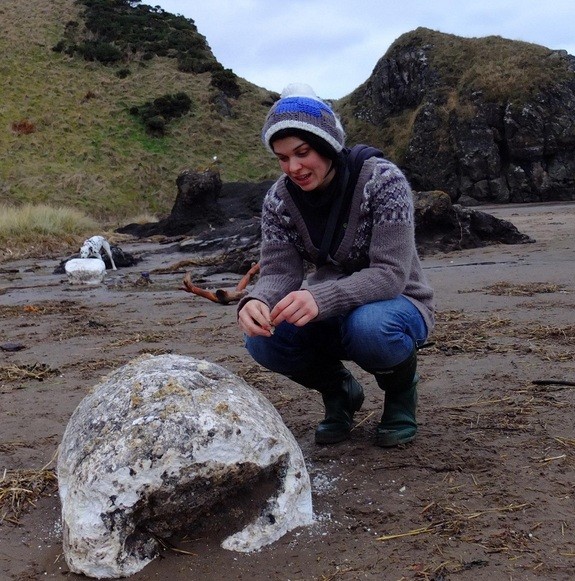
From Huffington Post
After storms lashed Scotland over the holidays, some strange World War II-era relics turned up on the country's chilly coast, including decades-old lard from a shipwreck and bunker blocks buried on a beach, local officials said.At St. Cyrus Natural Reserve, about 100 miles (160 kilometers) north of Edinburgh, four large chunks of lard washed up after the storms.
Though their wooden containers disintegrated long ago, the lard chunks retained their barrel shape, and they were still bright white under a thick crust of barnacles, local officials said.
"The depth of the swell during the storms we had over the holidays must have broke apart the shipwreck some more and caused the lard to escape," Therese Alampo, manager at the reserve, said in a statement from Scottish Natural Heritage (SNH).
"It's given us some interesting sights recently on the reserve: I'm sure there have been people wondering what on earth has washed up on the beach.
The lard was covered in the largest barnacles I've ever seen," Alampo added.
"Animals, including my dog, have certainly enjoyed the lard, and it still looks and smells good enough to have a fry-up with !" Vicki Mowat of SNH explained to LiveScience in an email that scientists haven't examined the lard yet, and the story of its origins comes from local history and knowledge.
"The lard was washed up for the first time after a merchant ship was bombed during World War II, and has continued to wash up every few decades after bad storms when we believe the wreck has been subject to deep swells," Mowat said. Local resident, Angus McHardy, told SNH that he first saw fat washing up on the beach in the early 1940s.
-
Volunteer dive into shipwrecks excavations
- On 19/01/2013
- In People or Company of Interest
By Cheryl Walker - UT San Diego
John Downing has always had a passion for archaeology. But instead of confining his explorations to ruins on land, he does his digging underwater — scuba diving to excavate shipwreck sites.
Downing, 61, of Valley Center, volunteers for the Anglo-Danish Maritime Archaeological Team, an international nonprofit, based in the United Kingdom.
Already an experienced scuba diver, joining the team was a natural fit for Downing.
“My wife and I love to go scuba diving, but after going so many times and seeing the fish enough times, I wanted to try something new,” he said.
“When I read about maritime archaeology, it was natural to put the two together.
It became diving with a purpose.” Downing’s interest in archaeology began well before the “Indiana Jones” movies popularized the subject.
In junior high school he read about exotic temples and artifacts, but he never thought about pursuing archaeology as a career.
After graduating from high school, he enlisted in the Navy with the idea of learning electronics. He was reading Archaeology Magazine when he learned about maritime archaeology volunteering.
He immediately wrote to the director, Dr. Simon Q. Spooner, about signing up for the next class. There wasn’t going to be another session soon, but Spooner, who was impressed with Downing’s enthusiasm, offered to teach him personally.
Spooner invited him to come to the Dominican Republic for training. “I couldn’t believe it,” Downing said. “I was getting private lessons from a person with a Ph.D. in maritime archaeology.
It was a wonderful opportunity — one I couldn’t say no to.”
-
Crew of USS Guardian removed as US Navy 7th fleet salvors get to work
- On 19/01/2013
- In Maritime News
From gCaptain
The US Navy reports this morning that all 79 crew members have been transferred from the stricken USS Guardian (MCM-5) while 7th Fleet salvors works to try and free the vessel which is solidly aground on Tubbataha Reef in the Philippines.
The sailors were safely transferred by small boat to the nearby support vessels USNS Bowditch (T-AGS 62) and MSV C-Champion.
“Seventh Fleet ships remain on scene and essential Guardian Sailors will continue conducting survey operations onboard the ship as needed until she is recovered,” said Vice Adm. Scott Swift, U.S. Seventh Fleet commander.
“Several support vessels have arrived and all steps are being taken to minimize environmental effects while ensuring the crew’s continued safety.”
The Avenger-class mine countermeasures ship had just completed a port call in Subic Bay, Olongapo City, and was en route to her next port of call when the grounding occurred.
The US Navy’s salvage operation continues today in close coordination with the Armed Forces of the Philippines while an investigation into the cause of the grounding continues.
-
Shipwrecks on Warrnambool sea shore
- On 19/01/2013
- In Wreck Diving

From News AU
There's a storm blowing in from the Southern Ocean and we're tucked up in Lighthouse Lodge listening to the squall outside.
An unruly wind is whistling around the historic Warrnambool cottage, the lingering rumble of distant thunder accompanies bolts of lightning, and the deluge is so heavy we can hardly hear each other talking over the thud of raindrops on the tin roof.
In any other part of Australia, the sounds of a storm would be an entertaining diversion, but on Victoria's Shipwreck Coast it's a reminder of the unforgiving conditions that claimed so many lives between 1834 and 1914, when dozens of ships were lost to the east and west of here, trying to find the narrow shipping route into Port Phillip Bay.
Safe and sound in Lighthouse Lodge - the old Warrnambool harbourmaster's house built in the shadows of the Lady Bay Lighthouse near the summit of Flagstaff Hill - we imagine the town's chief mariner heading out on stormy nights to check ships caught in the bad weather.
It was a foul night, just like this, almost 140 years ago, that the clipper Loch Ard became lost in a storm and sank at nearby Mutton Bird Island, taking 53 people to the bottom and making local legends out of Eva Carmichael and Tom Pearce who were its only survivors.
Tom, 19, and a member of the ship's crew, found land first by scrambling on to the hull of an overturned lifeboat but he waded back into the churning water when he heard the cries of a female passenger to find 18-year-old Eva clinging to a spar.
The pair washed into a protected ravine, the Great Ocean Rd landmark that became known as Loch Ard Gorge, where Tom hid Eva in a cave and went to search for more survivors before returning to the freezing Irishwoman and rubbing brandy on her legs to keep her warm.
Full article...
-
Deep-sea treasures of Vietnam
- On 19/01/2013
- In Auction News

From Vietnam Net
The information on antiques in the sea always attracts the attention of antiques collectors and traders, as well as fishermen.There were treasures worth of millions of USD found, making the hunt for antiques under the sea never end.
76,000 items including bottles, kettles, cups, plates, spoons, statues ... made of ceramic were brought from Vietnam to auction in Amsterdam, the Netherlands in 2007.
These are the artifacts that were excavated in 1998 and 1999 from an ancient sunken ship in Ca Mau waters. The antiques are defined to be produced in the Qing Dynasty, China, between 1662 - 1722.
Through the broker Unicom Corporation (USA), the auction of the huge number of antiques from the Ca Mau shipwreck was mandated to the Sotheby’s International Auction Company. After the 3-day auction, the entire antiques were sold.The number of antiques from Vietnam startled the world.
There were lots of antiques that were paid ten times more than expected: 69 plates and tea cups with the buffalo boy pattern were sold for 49,200 euros, 12 times higher than expected, or the set of 74 tea cups with the Chinese tent pattern was bought by a Russian for 31,200 euros, 10 times higher than the expected prize.However, in the end, the 76,000 antiques only grossed $3.9 million.
After deduction of income tax in the Netherlands, the sum was only $3.25 million. That amount continued to decrease by 20 percent of the remuneration for the company to stand up for the auction – the Sotheby’s and the cost of underwater archaeological excavations, preservation costs, etc.Finally, the real figure was just $1.3 million.