HOT NEWS !
Stay informed on the old and most recent significant or spectacular
nautical news and shipwreck discoveries

-
Underwater archaeology team helps preserve N.C. maritime history
- On 20/02/2011
- In Conservation / Preservation
Photo Paul Stephen
By Amy Hotz - Star News Online
On Good Friday of 1962, just as the nation’s collective thoughts reflected on the Civil War after 100 years of hindsight, a storm approached the Cape Fear.Sand shifted, as it always does along the Graveyard of the Atlantic. But this time grains scattered to reveal the wreck of a blockade runner, the Modern Greece.
The steam-powered ship had run aground near Fort Fisher on June 27, 1862, while trying to deliver supplies to the Confederacy. This was the first time any human being had seen it in decades. And it was nearly full of cargo.
Navy divers, representatives from the state of North Carolina and several U.S. government departments began a major salvage operation.
To house the objects, the Fort Fisher Preservation Laboratory, a makeshift facility, was somewhat hastily set up. By today’s standards, it was primitive, but the whole field of underwater archaeology was primitive at that time. Still, more than 20,000 individual artifacts were recovered from the wreck, including bowie knives, rifles, andirons and straight pins.
Much of the Modern Greece’s cargo today is scattered among museums across the Southeastern United States, including the museum at the Fort Fisher State Historic Site.But some artifacts will never be seen again. They were simply rinsed off and, unintentionally, left for corrosion to set in.
-
Historic shipwreck discovered amid contaminated harbor sediment
- On 19/02/2011
- In Underwater Archeology
By Dan McDonald - South Coast Today
Artifacts from a historic shipwreck unearthed in the upper harbor are likely more than two centuries old and may be remnants of a vessel that sailed West Indies or East Coast trade routes during colonial times, according to the EPA.
The timbers recovered during prep work for the dredging of the Superfund site included the keel of the vessel, frames or ribs of the ship and exterior hull planking fragments, according to the U.S. Environmental Protection Agency.
The artifacts are thought to be from the late 1700s or early 1800s and were found in about 5 feet of water directly across from the Aerovox mill, closer to the Acushnet side of the harbor.
Charring on the timbers likely means the ship was burned, according to the EPA.
It could also link the wreckage to a 1778 British attack on New Bedford and Acushnet when 30 to 70 ships were torched, according to an EPA slide show presentation.
Not everyone agrees with such a theory, however, and the EPA acknowledged Thursday there "was no conclusive connection made to this event."
Dr. Gregory J. Galer, the New Bedford Whaling Museum's vice president of collections and exhibitions, does not believe the timbers were related to the attack because of where they were found, upstream from where the attack took place.
Galer said the charring on the timber does not necessarily mean the remnants of the ship are connected to the attack. -
Journey of North Carolina's oldest shipwreck
- On 19/02/2011
- In Conservation / Preservation
From Our Amazing Planet
A nearly 400-year-old shipwreck was discovered in Corolla, N.C., in 2008 after storms and tides uncovered its timbers. Archeologists from the North Carolina Department of Cultural Resources believe the structure to be the remains of the oldest shipwreck discovered off the North Carolina coast.In the summer of 2010, archeologists decided that the wreckage couldn't remain on the beach any longer, where wind, sand and water could harm the timber remains.
North Carolina state officials surveyed and measured the wreckage in pieces so they could figure out the best way to move it.North Carolina's Outer Banks are no stranger to shipwrecks, with thousands scattered along the coast. But, it is rare to find the remains of older, wooden vessels still intact.
Since the shipwreck was exposed in 2008, many Corolla residents have used metal detectors to find artifacts at the site. The artifacts pictured above were recovered by resident Ray Midgett.Ray Midgett has collected many of the artifacts associated with the wreck. Above, a rare coin that he discovered.
"It is a silver, 1642 Charles I, British Crown ... issued during the English Civil War period," Midgett said. "The back of the coin bears the date and wording, "RELIG : PROT : LEG : ANG : LIBER : PAR," which means, 'To uphold the Protestant Religion, the Laws of England and the Liberty of Parliament.'" -
Shipwreck found at last
- On 18/02/2011
- In Parks & Protected Sites

By Michele Nugent - Weekend Courier
The WA Museum’s maritime archaeology department has pinpointed the location of a Tasmanian-built timber steamship that sunk southwest of Garden Island in March 1900.
The SS Cambria had left Fremantle on her way to southern ports when a southwest gale and heavy seas forced Captain Colstadt to seek shelter at Rockingham.
A heavy swell threw the 28.7m, two-masted vessel onto a reef, breaking its propeller and causing it to take on water, eventually sinking with its masts and funnel still showing in reasonably shallow water.
Luckily the crew of eight clung to the rigging overnight before launching a lifeboat the next morning and making it safely to an island beach – with the ship’s cat also saved from disaster.
They then found some old sails and rigged the lifeboat, sailing back to Fremantle that afternoon.
Captain Colstadt had his licence suspended for six months after a constable from Fremantle Water Police visited the wreck site and reported the vessel lying in 4m of water and cargo washing up on Garden Island.
Read more... -
Nautical archaeologist David Switzer
- On 18/02/2011
- In Festivals, Conferences, Lectures
From New Hampshire
The USS 0-9 submarine was undergoing a deep dive drill on June 20, 1941 off the Isle of Shoals when it sank, taking the lives of all 33 crewman.
The story of the American sub, and how it made it came to its end in New Hampshire, is the subject of a program at 7 p.m.
Tuesday, Feb. 22, at the Amherst Town Library. David Switzer, consulting nautical archaeologist for the State of New Hampshire, will present “The Discovery of the Remains of the Submarine USS 0-9.”The program is part of the February Marine Adventures series for adults.
During the latter years of World War I the U.S. Navy authorized a new class of submarine to augment the fleet of submarines already on duty in the Atlantic and the Mediterranean.
Smaller than the previous class of submarines, so-called “0-class” boats were designed for patrol in waters around Ireland.
The war ended before the new submarines reached Europe. In the aftermath of the war, the 0 class was dispatched to Panama as training boats, but after a few years the 0 class submarines were mothballed and nearly forgotten when the clouds of war once more gathered over Europe and Asia.
Too old to serve on active duty, the World War I era submarines were designated for training seamen to serve in the post war submarine fleet. The training was to take place at the New London Connecticut Sub Base.
Following the first training phase the 0 Class subs underwent deep submersion or “squeeze tests” in order to ensure the strength of the hulls. The 0-8 and 0-9 arrived at the Kittery Navy Base in June, 1941 to undergo the deep dive. The 08 was the first, and completed her test near the Isle of Shoals, where the depth was 200 feet, the limit for the 0 class. The 0-9 left the Navy Yard the next day for her test. She never surfaced.
An indication that the submarine had met with severe problems was evident when floating debris was seen. It was clear that 0-9 had exceeded the depth limit. Navy divers braving extreme depth found the hull at a depth of 400 feet. Following a memorial service at sea, with the Secretary of the Navy in attendance, the 0-9 tragedy was displaced by concerns about the depredations of Nazi Germany. -
30th Great Lakes Shipwreck Festival
- On 18/02/2011
- In Festivals, Conferences, Lectures

The 30th Great Lakes Shipwreck Festival presented by the Ford Seahorses Scuba Diving Club along with the Detroit historical Society's Dossin Maritime and the Dossin Great Lakes Museum will take place Saturday, March 5th at Washtenaw Community College.
The festival will run from 9:00 a.m. to 6:00 p.m. at Washtenaw Community College's Morris Lawrence Building. On display will be several new shipwreck discoveries that were found in the Great Lakes including the Lady Elgin and Marion Egan.
The Great Lakes Shipwreck Festival will also have stunning video and still images of colorful and unusual marine life from around the world. -
Gardiners Island: A nearly 400 year family history of pirates, treasure and triumph
- On 18/02/2011
- In General Maritime History

By Nicole A. Flotteron - Hamptons
Gardiner's Island - Approximately five square miles in size, Gardiner's Island, a part of the town of East Hampton, has a rich, tumultuous history that spans nearly 400 years of ownership by the same family.It is the only real estate intact in the United States that is part of an original royal grant from the English Crown.
The Island has survived Indian wars, pirates, invasion by British forces, war, and family issues.
It is home to more than 1,000 acres of old growth forest, the largest stand of white oak trees in the Northeast, 1,000 acres of meadows, rare, birds, Indian artifacts, and structures that date back to the 17th century.
Robert David Lion Gardiner, the last heir to bear the name Gardiner, said of his founding ancestors survey of the Island, "When he walked over it he found it had magnificent forests, saltwater ponds and fresh streams that he could dam and use for his lifestock."
The island was settled in 1639 by a man named Lion Gardiner after he retained a grant from King Charles I of England.
Gardiner purchased the island from the Montaukett Indians after his support of the tribe during the Pequot War, in exchange for a large black dog, a few Dutch blankets, and some powder and shot.Originally called the 'Isle of Wight' after the Isle of Wight in England, the royal patent issued to Gardiner gave him the "right to possess the land forever," as well as the title "Lord of the Manor."
In 1641, Gardiner's wife gave birth to a daughter named Elizabeth, who was the first English child born in New York, and would be responsible for initiating the first witch hunt and witch trial in the American colony.In February 1657, 15-year-old Elizabeth lay deliriously ill in East Hampton.
-
Well-preserved ship remnants found in Outer Banks
- On 17/02/2011
- In Parks & Protected Sites
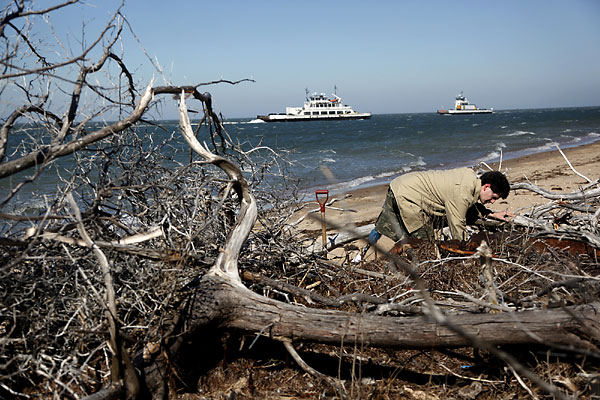
Photo Preston Gannaway
By Erin James - The Virginian-Pilot
The powerful winds of a blustery winter have uncovered the rusted metal and weathered wood of a previously unknown shipwreck on an isolated soundside beach of Hatteras Island.
The 20-foot mystery vessel has emerged from the side of an eroded dune, where recently uprooted trees attempt to shield the exposed wreck from curious eyes.Evil-looking spikes - presumably the bolts that once held the vessel together - reach upward from their former tomb of sand and seaweed.
Definitive answers about the vessel's age and origin will have to wait for historians and scientists to analyze the find. In the meantime, there's no shortage of excited speculation.
Could it be a Civil War transport ship that failed to navigate Hatteras Inlet on its way to attack Confederates on Roanoke Island in 1862 ?Or is this a World War II barge later converted into a ferry for transporting people between Hatteras and Ocracoke islands ?
Or is it something else entirely ?
"Someone's life may have been saved or someone may have died holding on to that wreck," said author and documentary filmmaker Kevin P. Duffus, who is considered an authority on Outer Banks maritime history."All of these shipwreck remains deserve a tremendous amount of respect."