HOT NEWS !
Stay informed on the old and most recent significant or spectacular
nautical news and shipwreck discoveries

-
Cannons retrieved from mystery ship off St. Augustine
- On 01/07/2011
- In Conservation / Preservation

By Dan Scanlan - The Florida Times
After more than two centuries 30 feet under the Atlantic Ocean, two cannons raised Tuesday from a shipwreck have a new home: conservation vats behind the St. Augustine Lighthouse and Museum.
As visitors watched, they were lowered into fresh water to begin cleaning off concretion from weapons carried by a ship archaeologists believe could date from 1776 to 1810.
When the job is done, markings on weapons that weigh 1,200 to 1,800 pounds each could tell archaeologists what ship they were on when it sank. Until then, having weapons of war becoming tools of learning was "public archaeology at its best" in the museum's backyard, said spokesman Beau Philips.
"It was like Christmas come early to see how interested people were in history, the artifacts and the stories they will be able to tell," Philips said. "There was genuine excitement as the crowd gathered. They were hushed, then asked a lot of questions."
Part of a wreck discovered two years ago about a mile off St. Augustine's shorelines by the Lighthouse Archaeological Maritime Program, the cannons were lifted up just before noon Tuesday. -
Magnetometer is a hit with archaeologists and divers
- On 01/07/2011
- In Maritime News
From Marine Executive
A diverse group of people from marine archaeologists to commercial divers are using a new compact, hand-held magnetometer designed to locate iron and steel objects underwater.
One company having great success with this instrument is Cosmos Agencia Maritima based in Peru. They provide a broad range of services to their clients including ship husbandry, cargo transportation and storage, machinery and equipment rental, supply of fuel and parts, and diving services.
A common request they receive is for underwater inspections of hulls, propellers, and bow thrusters. While performing repair work, a diver may drop a part or tool, which quickly disappears into the silty bottom. When this happens, an underwater metal locator is required to find the missing item.
Cosmos recently procured a JW Fishers PT-1 pipe tracking magnetometer for their search and recovery projects. Francisco Paolillo Tapia, manager of special operations, reports the PT-1 is excellent for finding anchors, chains and other objects buried in the seabed.
“This instrument helps us find the missing part quickly. Our divers used to spend a lot of time probing the muddy bottom searching for a lost tool or anchor. Now they find it fast using the mag, which saves us time and money.”North Carolina’s Department of Cultural Resources (NCDCR) was established in the early 1970s with a varied mission that includes preserving the state’s historical and cultural resources.
A high profile project being undertaken by NCDCR’s Underwater Archaeology Branch is the recovery of artifacts from the wreck site of Blackbeard’s flagship, Queen Anne’s Revenge. One of the instruments the team is employing is the PT-1.
A key advantage of this magnetometer is its ability to pinpoint artifacts in areas that may be strewn with many iron and steel targets. Other mags can have trouble differentiating between the multiple pieces of ferrous metal on a wreck, making it nearly impossible to pinpoint individual targets.
This hand-held magnetometer is the ideal tool to locate all of the ferrous objects at the site including anchors and chains, cannons, cannon balls, ship’s stoves, and the iron hardware used in construction of the vessel.
The first anchor from the Queen Anne’s Revenge was recently raised from the muddy bottom where it had by lying for the last 300 years.
-
Malacca probes sunken treasure thefts
- On 30/06/2011
- In Illegal Recoveries
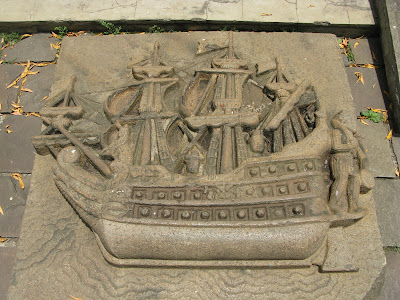
The state Museum Authority has been ordered to get more evidence on reports that hundreds of underwater artefacts from dozens of shipwrecks off the Tanjung Tuan coast here have been stolen by relic hunters.
Chief Minister Datuk Seri Mohd Ali Rustam said the evidence was crucial for the state government to file a police report on the alleged theft of these submerged treasures.
“I will ask the relevant authorities to conduct a probe in a bid to get more proof for the police and also to execute legal action against the culprits.
“There were reports that irresponsible individuals had gone underwater to take away the national treasures that are worth billions.
“But information on such thefts remains vague due to lack of eye-witnesses,” he said after flagging off participants of the Perodua Eco-Challenge 2011 at the Melaka International Motorsport Circuit in Ayer Keroh here yesterday.
A special night vision camera will be mounted at the top of the lighthouse in Tanjung Tuan to prevent more of these relics from being stolen, said Mohd Ali.
There were claims by maritime industry players that hundreds of these undersea artefacts had been looted since the late 1990s.
One mariner, who only wanted to be identified as Toh, said treasures such as Chinese blue and white porcelain, brassware and coins were stolen from the shipwrecks.
Last month, the state government announced a billion-ringgit offer to salvage companies to retrieve treasures from sunken ships along the Malacca coastline.
There were no takers and Toh believed the lukewarm response was due to the fact that not many priceless artefacts were left.
At least 13 merchant and war vessels are known to have sunk in the Malacca sea on the Spice Route more than 500 years ago.
-
NOAA and Navy to conduct archaeological survey
- On 29/06/2011
- In Expeditions

From NOAA
NOAA and the U.S. Navy embarked today on a two-day research expedition to survey the condition of two sunken Civil War vessels that have rested on the seafloor of the James River in Hampton Roads, Va., for nearly 150 years.
Using state-of-the-art sonar technology to acquire data, researchers will create three-dimensional maps of the two shipwrecks, USS Cumberland and CSS Florida, to analysis on their current conditions and better understand the technological innovations of the time.
“The remains of the USS Cumberland and CSS Florida, preserved in the waters of Hampton Roads, remind us of the sacrifices made during the Civil War and give us a unique and rare opportunity to explore a pivotal chapter in our nation’s history,” said David Alberg, superintendent of NOAA’s Monitor National Marine Sanctuary.“NOAA is pleased to be part of a project that increases understanding of America’s maritime heritage.”
USS Cumberland was lost on March 8, 1862, during the Battle of Hampton Roads, where she served in the U.S. Navy’s North Atlantic Blockading Squadron.She sank after being rammed by the Confederate ironclad CSS Virginia (formerly USS Merrimack) and went down with more than 121 men.
CSS Florida was a Confederate commerce raider which had been captured by the U.S. Navy in Brazil. Towed to United States as a prize despite Brazil's protests, it was lost on Nov. 19, 1864, following a collision with a U.S. Navy troop ferry.
Both vessels are protected by federal law under the Sunken Military Craft Act of 2005, the Abandoned Shipwreck Act of 1987, and the Territorial Clause of the U.S. Constitution, which gives the U.S. government exclusive rights to its own property.
“We are extremely excited about this project,” said Alexis Catsambis, underwater archaeologist and cultural resource manager of the U.S. Navy’s Naval History & Heritage Command (NHHC).“The information collected during this project will really increase our understanding of the condition of these wrecks.”
The last survey of the USS Cumberland took place in 2007. The expedition will be the first time the CSS Florida will be surveyed by the federal government.
-
Shipwreck cannon raised off St. Augustine
- On 29/06/2011
- In Underwater Archeology

Claire Simms - First Coast News
Archaeologists from the St. Augustine Lighthouse raised a cannon from a shipwreck off the coast today.
They hope the cannon will give them some clue to help identify the wreckage.The St. Augustine Lighthouse Archaeological Maritime Program (LAMP) brought a ship's bell to the surface earlier this year, but it did not have the name of the ship engraved on it as archaeologists had hoped.
The workers and onlookers cheered as the cannon cracked the surface for the first time in centuries.
"As you can imagine, everyone's pretty excited," explained Chuck Meide, LAMP director. "We've been building up to this for the past month. We weren't sure if we were going to be able to do this lift because the gun could've been stuck to the bottom."
Divers used a lift to pull the cannons to the surface and quickly wrapped them in wet towels to keep them moist. -
Discover the Sail, Power and Steam Museum in Rockland
- On 28/06/2011
- In Museum News
By Shari Closter - Bangor Daily News
Where can you find a working lime kiln, shipbuilding exhibits, nautical tools, a navigation room, shipwreck photographs, a knot exhibit, architectural half models, steam engines, antique machinery and more ?
On the grounds of the legendary old Snow Shipyard in the Sail, Power and Steam Museum, where visitors can delve into the history of the working, sailing schooners of the 19th century built at the old shipyard. Visitors to the museum also can learn about power and steam driven vessels.
The lime industry was a key aspect of Rockland’s history and tens of thousands of sailing vessels were here every year as part of the region’s early development.
The Snow Shipyard built more vessels than any other yard in Maine or in New England from 1862 until 1937, with hundreds of artisans crafting some of the finest vessels to sail the seas.The museum has on display the shipbuilder’s tools of his trade with an extensive display of hand tools of the 19th century.
You can be a rigger at the museum’s hands-on knot board and rope-working station. Learn the history behind the Matthew Walker knot, as he was the only man to have a knot named after him.
One exciting addition to the museum is the completion of the first working lime kiln since 1890, which burns limestone and is fashioned like kilns of the late 19th century, complete with two fire boxes and a draw pit to extract the cooked stone. Learn about Rockland’s history as “Lime City,” when more than 100 of these structures burned day and night.
The museum also has embarked on building Engine House 1, a 16-by-22-foot post and beam structure that was built by volunteers.
Once completed, it will house a collection of about 10 steam engines and “make ‘n break” gas machinery, so visitors can hear the engines’ unusual cacophony of rhythms all under one roof. Don’t know what a “make ‘n break” engine is ? Find out by stopping by to talk to Capt. Jim Sharp.
Full story... -
Documenting local ‘Shipwrecks’
- On 27/06/2011
- In General Maritime History
By Meg Hagerty - Post Star
Queensbury resident Bob Benway likes the thrill of the hunt.
He may not stalk big game animals in Africa, but he has pursued the hulking frames of vessels that lurk below the surface of Lake George.
The underwater photographer and videographer, along with Saratoga Springs underwater archeologist Joseph Zarzynski, discuss their most captivating findings in "Lake George Shipwrecks and Sunken History," published by The History Press.
"Below the surface of picturesque Lake George are cultural resources that help tell the full history of the colonial soldiers, boaters, visitors and others that have lived here. Journals, diaries and primary literature can only tell part of the story," Zarzynski said.
"When you combine the results of underwater archaeological investigation with the known archival record, you get a much better understanding of the lake's bountiful chronicles ... and I think this enriches us as a people today."
Within the book's 160 pages, readers can glean information on some of the discoveries made by Bateaux Below, a non-profit organization which has been preserving shipwreck sites in the lake for over 23 years.
The compilation of articles appeared in the Lake George Mirror from 2004 through last December.
Benway and Zarzynski first began investigating shipwrecks in Lake George after taking a three-day workshop on underwater archaeology in 1987.
A group of six from the class, including the two authors, was interested in finding out more about the underwater history of the lake and formed Bateaux Below.
They eventually uncovered the 260 year-old Land Tortoise radeau shipwreck, a 52 foot-long British vessel outfitted with seven cannons, a discovery which Benway said was "extremely significant."
"It was the only vessel of her kind ever found. She's listed on the National Register of Historic Places and also a National Historic Landmark, which is only one of six shipwrecks ever listed on that rating," he said.
Benway recalled being at the Adirondack Museum at Blue Mountain Lake in 1988 with Zarzynski while researching old newspaper clippings on bateaux, British transport vessels.
-
With some virtual help, Key West diver finds valuable coin in ship wreckage
- On 25/06/2011
- In Treasure Hunting / Recoveries
Soon after the 523-foot warship Hoyt S. Vandenberg was sunk as an artificial reef off Key West, documentary filmmaker Pat Clyne hid a $2,400 silver coin from the 17th-century aboard the Spanish galleon Nuestra Senora de Atocha.
Anyone finding the coin could keep it, and on Saturday, almost two years later, Key West diver Randy Pekarik found it in a corridor beneath the ship’s bridge at a depth of 97 feet.
To aid in the search, Clyne posted a series of clues on his YouTube site.
“I started following the clues, but it’s a huge ship,” said Pekarik, who made more than 30 dives looking for the coin.
“Even though the first clues eliminated three-quarters of the ship, that’s still a humongous amount of ship.
It was like finding a needle in a haystack.”