HOT NEWS !
Stay informed on the old and most recent significant or spectacular
nautical news and shipwreck discoveries

-
Union warship's profile rising after 146 years
- On 05/01/2012
- In Parks & Protected Sites
By Keith Morelli - The Tampa Tribune
One hundred forty-six years ago today, a violent storm lashed the Tampa Bay area, imperiling two U.S. Navy warships — tugboats with cannons — that had seen Civil War action in the Gulf of Mexico and were headed for peacetime duty after the war ended.One survived the storm. The other, the USS Narcissus, which had participated in the Battle of Mobile Bay, been sunk and refloated, did not. It ran aground on a shoal northwest of Egmont Key and sank in 15 feet of water after its boiler exploded. No one survived.
A plan to designate the wreck site an archaeological preserve is nearing the end of a six-year process. The preserve will be marked, and divers will be allowed to view the wreckage. Visible are the steam engine, propeller shaft and propeller, the scattered remnants of the wood-hulled tugboat and the exploded boiler.
The site is poised to become the 12th such underwater preserve in Florida and the first in the Tampa Bay area, which has two wrecks of Confederate blockade runners in the Hillsborough River.
The USS Narcissus was built in Albany, N.Y., during the Civil War. It was commissioned as a Navy fighting vessel, armed with a 20-pound Parrott gun and a single smoothbore 12-pounder.
During the Battle of Mobile Bay, the Narcissus was present when Union Adm. David G. Farragut uttered the famous words, "Damn the torpedoes, full speed ahead."
In 1866, the Narcissus was taken out of combat service and ordered to cruise out of the Gulf and up the East Coast to be decommissioned and sold.
She was destined to become a regular tugboat, ushering large vessels in and out of port, but the Narcissus never made it.
Taking part in the process to designate the preserve are the Florida Department of State, The Florida Aquarium and the Navy.It is the first time the Navy, which continues to claim ownership of the vessel, has granted permission to allow one of its ships to be recognized in this manner.
"Technically," said Mike Terrell, dive training coordinator at The Florida Aquarium, who along with two other archaeologists nominated the site for designation,
"it's still a war grave because all of the men were on it when it sank.
-
Another hazardous cargo, another 22 seafarers lost at sea
- On 05/01/2012
- In Maritime News
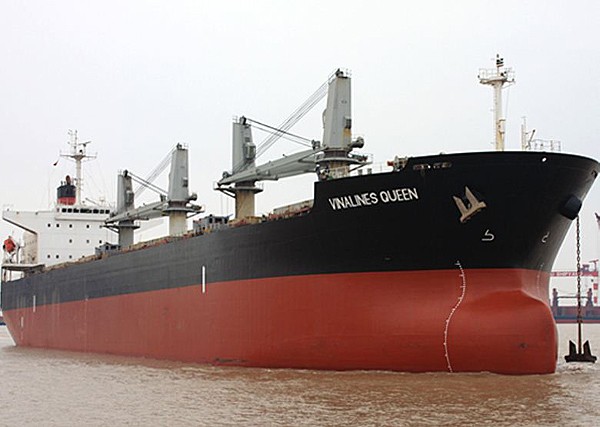
By Clay Maitland - gCaptainOn Christmas day, the bulk carrier VINALINES QUEEN, carrying a cargo of nickel ore from Morowali, Indonesia to China, went missing.
The ship and its crew of 22 must now be considered lost. Although it is certainly too soon to ascribe a known cause of sinking, it is probably fair to say, as an American judge did many years ago: Sometimes circumstantial evidence can be very convincing, just as when you find a trout floating in the milk
There continues to be a crying need for greater information, understanding and enforcement of regulations as well as testing of cargoes that may liquefy. Nickel ore is one such.
Intercargo, the International Association of Dry Cargo Shipowners, has commendably been a leader in fighting for international action to protect the lives of seafarers, at risk when bulk cargo vessels, like the Supramax VINALINES QUEEN, suddenly disappear.
Over the years, many such losses involved vessels carrying direct reduced iron (DRI), a cargo prone to heating when wet, sometimes resulting in a disastrous explosion. It took many years for international authorities to recognize the culpability of unscrupulous shippers and consignees one of our industry’s little secrets.
It will be recalled that in December of 2010, three bulk carriers and their crews were lost, all as a result of cargo liquefaction. The danger hasn’t gone away.
There is a need for stronger and clearer requirements particularly with respect to accurate information on the carriage of bulk cargoes. The IMO has held meetings, most recently last September, of its Sub-Committee on Dangerous Goods, Solid Cargoes and Containers (DSC), with many participants, including Intercargo, The International Group of P&I Clubs, The International Union of Marine Insurers, as well as other industry associations, to take further action strengthening the requirements of the existing IMSBC Code.
A prepared schedule for nickel ore will be further reviewed this coming March, before hopefully its inclusion in the IMSBC Code at the forthcoming Dangerous Goods Sub-Committee in September.
-
Titanic artifacts set to go up for auction
- On 04/01/2012
- In Auction News
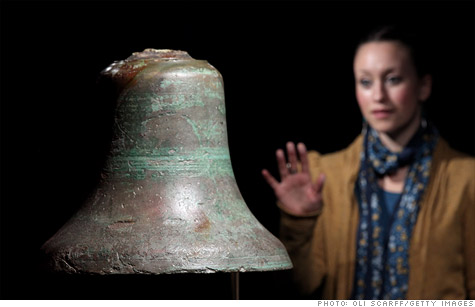
By Chris IsidoreThe owner of more than 5,000 artifacts recovered from the Titanic intends to auction them off in April on the 100th anniversary of the sinking of the famous ship.
But don't expect to be able to bid on any one item from the ship. The artifacts will only be sold as a single lot, according to a filing by Premier Exhibitions (PRXI), an Atlanta-based company that now exhibits the artifacts at various locations around the world.
Premier Exhibitions, the owner of the artifacts which disclosed the sale plans in a filing with the Securities and Exchange Commission, was not available for comment Thursday.
Its New York auction house, Guernsey's, did not have a comment.
The filing from Premier said that the collection had an appraised value in 2007 of $189 million. It said it has added to its collection since that time. -
Diver to present show on deadly shipwreck at Maritime Museum in Beach Haven NJ
- On 04/01/2012
- In Festivals, Conferences, Lectures
From AP
Mike Boring will give a presentation on the Wilhelm Gustloff at the NJ Maritime Museum at 7 p.m. on Friday, Jan. 13.
The Wilhelm Gustloff was a German liner loaded with refugees and military personnel that was sunk in January, 1945 by a Russian submarine in the Baltic. Between 7,500 and 9,000 perished, making it the deadliest shipwreck in history.
While Boring was living in Germany a number of years ago, he organized a trip to the Poland to dive the wreck. We ended up making three dives on the wreck and captured some good images.
“It's a tragic, fascinating story and most people have never heard of the wreck.” he said.
The NJ Maritime Museum is located at 528 Dock Road, Beach Haven. Reservations are required. Donation in lieu of admission fee requested.
Light refreshments will be provided. -
Shipwreck to reveal our history
- On 04/01/2012
- In Parks & Protected Sites

By Patrick Caruana From - The Courier Mail
The Royal Charlotte brought convicts to Australia, carried troops to India and, as a wreck, served as a warning beacon for other vessels.
Now scientists want her to help them understand early 19th century trade between fledging colonies.
The only problem is she's been under water for more than 180 years.
The Indian-built ship ran aground on Frederick Reef, northeast of Gladstone, on June 11, 1825, killing two people.
A party was sent to Moreton Bay, while the rest of the ship's 100 passengers soldiers and their families scraped their way to a sandy coral quay, where military discipline and ingenuity ensured their survival for six weeks before help came.
It's a remarkable story, which an expedition is trying to complete as they search for the The Royal Charlotte's remains.
The two-week expedition, led by Australian National Maritime Museum marine archaeologist Kieran Hosty, will depart Gladstone today.
Mr Hosty said the crew would search an area of shallow water 26km by 7km. -
13th century Mongol shipwreck
- On 01/01/2012
- In Underwater Archeology
From the Japan Times
The Agency for Cultural Affairs plans to have the seabed off Nagasaki Prefecture where the wreck of a ship believed to have been used by 13th century Mongol invaders has been found declared a national historical site, agency sources said.The declaration would make the area off Takashima Island in Matsuura, Nagasaki Prefecture, the first underwater ruins to be registered as such a site in Japan. The designation will in principle prohibit the area from being altered.
The agency sees the need to take immediate measures in the area, given that the relics there are expected to provide archeologists with crucial information on the 1274 and 1281 Mongol attacks that, until the discovery of the relatively intact shipwreck, has mostly been available only from documents and drawings.
The move came after the Matsuura's education board submitted a report to the agency in July calling for the designation of some 384,000 sq. meters in the area, including where the sunken ship was found, as a national historical site.
The board said academic research is still ongoing in the area and that no decision has been made on whether to raise the wreck.
The failure of the two attacks launched by Mongol leader Kublai Khan (1215-1294) against Japan, with battles fought in northern Kyushu, is often attributed here to "kamikaze," or divine winds that destroyed much of the Mongol fleets.
-
The Vasa: an elegant seventeenth-century warship in Stockholm
- On 01/01/2012
- In Museum News

By Sean McLachlan - Gadling
Sweden's capital Stockholm has a lot to offer-fine dining, good shopping, lovely parks, access to some interesting day trips (the old Viking capital of Uppsala being my favorite) and a unique museum.The Vasa Ship Museum is one of Sweden's most popular tourist attractions and it's easy to see why. It houses a beautifully preserved 17th century warship.
The Vasa was meant to be the pride of the Swedish fleet at a time when the nation was one of Europe's major powers. The galleon was 226 feet long, carried 145 sailors and 300 soldiers, and sported elegant woodwork over much of its exterior.Its 64 cannon could blast out 588 pounds of iron from port or starboard, giving it more firepower than any other ship then in existence. It must have been a major letdown when it sank barely a mile into its maiden voyage in 1628. It turns out the whole thing was top heavy.
While the Vasa was a bad ship, it's an awesome museum piece. The cold water, silt, and pollution of Stockholm harbor kept it safe from microorganisms that would have eaten it up.When archaeologists raised it from the sea they retrieved thousands of artifacts such as weapons, utensils, coins, clothing, tools, and hemp sails and rigging.
Some parts of the ship still had flakes of paint and gold leaf adhering to them, so its once-vivid colors could be reproduced in a scale model in the museum.
This year is the 50th anniversary of its raising from the bottom of the harbor. This was a tricky operation that required 1,300 dives and a great deal of delicate underwater work in low visibility.Divers had to dig six tunnels under the shipwreck in order to run steel cables through them and attach them to pontoons on the surface. After that, the pontoons lifted it to the surface without a hitch.
-
Feds update historic shipwreck protections
- On 01/01/2012
- In People or Company of Interest
By Cara Bayles - Houma Today
The federal government updated guidelines protecting historical sites on the bottom of the Gulf of Mexico, shipwrecks that date back as far as the 17th century.
The Bureau of Ocean Energy Management estimates there are more than 2,100 historic shipwrecks in the Gulf’s federal waters. A 1966 law requires that the bureau guide oil-and-gas companies drilling in the outer continental shelf to assure archeological sites are preserved.
Frank Cantelas, a marine archaeologist with the Office of Ocean Exploration and Research at the National Oceanic and Atmospheric Administration, likened the ships to “time capsules.
They’re a finite cultural resource,” he said. “Somehow, a ship tragically sank and captured that moment, and it offers a glimpse of how people were living at a particular time.
The update, issued Thursday, adds new portions of the ocean floor that are considered likely locations for shipwrecks. Those designated blocks of ocean floor require surveys and archaeological reports prior to drilling.
A statement released by Bureau of Ocean Energy Management Director Tommy Beaudreau says the update was prompted by “new information, recent discoveries and advances in hydrographic survey technology.
The government periodically updates its notice, but the changes signify a gradual shift in the way the bureau protects historic underwater sites, according to Robert Church, a marine archaeologist with C&C Technologies, a Lafayette-based survey company.
