HOT NEWS !
Stay informed on the old and most recent significant or spectacular
nautical news and shipwreck discoveries

-
Brothers’ catalogue of Titanic treasures
- On 27/01/2012
- In Famous Wrecks

By Gareth Crickmer - Jarrow and Hebburn Gazette
Memories of the Titanic are being brought to life by schoolboy brothers on the centenary of the famous liner’s sinking.
Leo, 14, and Ben Baxendale-Smith, 12, have compiled a catalogue of hundreds of artefacts relating to the vessel bequeathed to their father, Paul.Now the youngsters, of Harton, South Shields, are hoping it will inspire a collector to buy and treasure the collection.
They got to work after Mr Smith’s uncle, Michael Gallagher, 64, died, leaving original artwork, photos, postcards and other items signed by survivors.
Mr Smith, 46, who runs an engineering business, is delighted his sons have taken an interest.
He said: “They enjoyed compiling the catalogue and getting it all ship-shape. It took quite a lot of doing and some hard work – I think they spent a couple of weeks putting it all together.
“They have created a power point presentation of parts of it and have logged it all on a computer. It can be put on a disc for anyone interested.”
Mr Gallagher, who never married or had children, spent about 50 years compiling memorabilia.
He was inspired as a boy after watching a film about the ship’s tragic end at a cinema in Ocean Road, South Shields.
His collection contains nothing directly salvaged from the vessel but includes postcards signed by famous survivors including Eva Hart and Millvena Dean.
There is also a framed photo from a Titanic dive mission signed by Ken Marschall, a photographer well known for his portrayals of the ship, and others.
Dozens of books about the White Star Line-owned ship, which sunk after hitting an iceberg in April, 1912, with the loss of 1,517 lives, are also contained. -
Hunt for the ancient mariner
- On 26/01/2012
- In Underwater Archeology
J. Hios/akg-images
By Jo Marchant - Nature
Armed with high-tech methods, researchers are scouring the Aegean Sea for the world's oldest shipwrecks.Brendan Foley peels his wetsuit to the waist and perches on the side of an inflatable boat as it skims across the sea just north of the island of Crete.
At his feet are the dripping remains of a vase that moments earlier had been resting on the sea floor, its home for more than a millennium. “It's our best day so far,” he says of his dive that morning. “We've discovered two ancient shipwrecks.”
Foley, a marine archaeologist at the Woods Hole Oceanographic Institution in Massachusetts, and his colleagues at Greece's Ephorate of Underwater Antiquities in Athens have spent the day diving near the cliffs of the tiny island of Dia in the eastern Mediterranean.
They have identified two clusters of pottery dating from the first century BC and fifth century AD. Together with other remains that the team has discovered on the island's submerged slopes, the pots reveal that for centuries Greek, Roman and Byzantine traders used Dia as a refuge during storms, when they couldn't safely reach Crete.
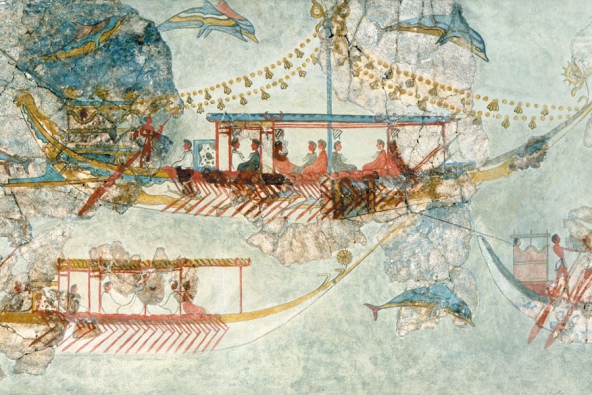
It is a nice archaeological discovery, but Foley was hoping for something much older. His four-week survey of the waters around Crete last October is part of a long-term effort to catalogue large numbers of ancient shipwrecks in the Aegean Sea. And the grand prize would be a wreck from one of the most influential and enigmatic cultures of the ancient world — the Minoans, who ruled these seas more than 3,000 years ago.Some researchers believe that quest to be close to impossible. But Foley and a few competitors are using high-tech approaches such as autonomous robots and new search strategies that they say have a good chance of locating the most ancient of shipwrecks. If they succeed, they could transform archaeologists' understanding of a crucial period in human history, when ancient mariners first ventured long distances across the sea.
Archaeologists have precious little information about the seagoing habits of the Minoan civilization, which erected the palace of Knossos on Crete — linked to the Greek myth of the Minotaur.
Minoans far exceeded their neighbours in weaponry, literacy and art, and formed “part of the roots of what went on to become European civilization”, says Don Evely, an archaeologist at the British School at Athens, and curator of Knossos.
Archaeologists are keen to understand what made the Minoans so successful and how they interacted with nearby cultures such as the Egyptians. -
Italy disaster shows Titanic lifeboat issues linger
- On 26/01/2012
- In Famous Wrecks

From The Malaysian Insider
The capsizing of the Costa Concordia will pressure the cruise industry to address a safety question that has lingered since the Titanic disaster almost 100 years ago — how to get thousands of people off a giant cruise ship into lifeboats quickly.
Carnival Corp, owner of the Concordia, conceded on Thursday that the accident, which has led to the deaths of at least 11 people with another 24 unaccounted for out of its 4,200 passengers and crew, “has called into question our company’s safety and emergency response procedures.” A Carnival spokesman could not immediately comment on whether the company’s safety review would include the lifeboats.
“The regulations rely on untrained and frightened passengers being able to deal with life rafts in the absence of trained crew members — including having to board them from the water,” said John Dalby, a former oil tanker captain who now runs maritime security firm Marine Risk Management.
“The whole point of the Titanic regulations was to avoid what happened with her, and it has now happened again with Costa — that is, the difficulty, if not impossibility, of launching lifeboats from the ‘high side,’“ Dalby said, referring to the side of the boat tipped into the air.
In the wake of the Titanic disaster, maritime regulations make it mandatory for all ships to have a minimum of 125 per cent lifeboat and life raft capacity, comprising 50 per cent on each side of the ship plus an additional 25 per cent available.
According to the International Chamber of Shipping, they are designed to be ready for use within five minutes and to be filled as quickly as needed.
But all of that is for naught if the lifeboats cannot get into the water, or if the ship finds itself in distress in adverse conditions — late at night, in a storm or far from land, for example.
That was the lesson the Titanic first taught in 1912, when — besides not having enough lifeboats on board — some lifeboats did not launch properly in the ship’s final, harried minutes. -
Treasure-laden wreck of first Victory may be raised by American company
- On 25/01/2012
- In Treasure Hunting / Recoveries

From Yorkshire Post
The remains of the first HMS Victory could be raised from the sea bed nearly 300 years after it sank.
The vessel, predecessor of Nelson’s famous flagship, went down in a storm off the Channel Islands in 1744, taking more than 1,000 soldiers to their deaths.
Along with a bronze cannon collection, some believe the ship was carrying a large quantity of gold coins from Lisbon to Britain, which would now be worth a reported £500m.
According to reports, the wreck is set to be handed over to the Maritime Heritage Foundation, which is expected to employ Odyssey Marine Exploration to carry out its recovery.
The American company found the ship four years ago.
A Ministry of Defence spokeswoman said: “Efforts to protect key parts of British Naval history such as the wreck of HMS Victory 1744 are very welcome and we hope to make an announcement shortly.”
The guns and other artefacts will be displayed in British museums, while Odyssey is likely to receive the bulk of any treasure under the laws of salvage.
Public interest in the Victory’s recovery, driven by the legend of its purported cargo, could match that seen for the raising of the Mary Rose in 1982 which involved a £4m operation to safeguard the 16th century remains.
The Maritime Heritage Foundation was set up by Lord Lingfield, the Tory peer formerly known as Sir Robert Balchin, who is a relative of Admiral Sir John Balchin who was on board the Victory when it sank, although he stressed he would not profit personally from the ship’s cargo.
Lord Lingfield told The Sunday Times: “The foundation seeks to prevent damage to this historically important site and maximise its archaeological, scientific and educational value. -
The Royal Navy's darkest day recalled
- On 25/01/2012
- In General Maritime History
By Chris Warne - Stroud News and Journal
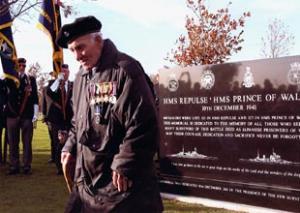
Seventy years ago last month, 840 British sailors perished in the lukewarm waters of the South China Sea when Japanese torpedo bombers descended from a cloudless sky to ambush two Royal Navy battleships making haste for Singapore.The devastating two-hour aerial assault, which left HMS Prince of Wales and HMS Repulse rooted to the seabed, was the greatest single defeat suffered by the Royal Navy during the Second World War and has been dubbed ‘Britain’s Pearl Harbour’ by historians.
With the passage of time the tragedy has faded from the national consciousness but for Stonehouse resident Charles Wright, 92, the events of that fateful day will never be forgotten.
Indeed, the memories of the chaotic scramble to help wounded comrades emerging from below deck, many of them severely scalded by steam from burst pipes, are never likely to be forgotten by him.
Ebley-born Charles Wright was in charge of the starboard aft 5.25-inch gun turrets mounted atop the HMS Prince of Wales on December 10, 1941.
"They estimate that 92 aircraft attacked us," he said.
"We never had a chance really. We kept putting barrages up but they just kept coming. -
HMS Victory 'set to be recovered' from seabed
- On 23/01/2012
- In Famous Wrecks

From BBC NewsThe remains of a 300-year-old warship are to be raised from the sea bed, according to reports.
The wreck of HMS Victory, a predecessor of Nelson's famous flagship, was found near the Channel Islands in 2008. The British warship, which went down in a storm in 1744 killing more than 1,000 sailors, could contain gold coins worth an estimated £500m.
The Sunday Times says the Maritime Heritage Foundation is set to manage the wreck's raising. It also reports that the charity will employ Odyssey Marine Exploration to carry out the recovery.
The American company found the ship four years ago, with the ship's identity confirmed by a bronze cannon.
The guns and other reclaimed artefacts will be displayed in British museums, however under the laws of salvage, Odyssey is likely to receive the bulk of any treasure found, according to the newspaper.
A Ministry of Defence spokeswoman said: "Efforts to protect key parts of British Naval history such as the wreck of HMS Victory 1744 are very welcome and we hope to make an announcement shortly."
The chairman of the foundation, Lord Lingfield, is a relative of Admiral Sir John Balchin, who was onboard the warship when it sank. The Tory peer, formerly known as Sir Robert Balchin, told the newspaper that he would not profit from the ship's cargo.
He added: "We will have the satisfaction of solving a great maritime mystery that has been part of my family history since the 18th Century."
The 300ft (90m) ship was discovered by the Florida-based firm in May 2008, nearly 65 miles (100km) from where it was historically believed to have sunk.
-
Thrilling discovery
- On 20/01/2012
- In Underwater Archeology

Photo Xanthe Rivett
The marine archaeology expedition to uncover the history of the Royal Charlotte is nearing an end but plenty of exciting discoveries have been made along the way.
A team of Australian National Maritime Museum archaeologists have been out on Frederick Reef since January 4 for the search and survey mission to find the ship, which was wrecked on the reef in 1825.
Australian National Maritime Museum senior curator and archaeologist Paul Hundley said in the expedition's blog that, during a scuba survey of the outside coral reef, divers located a copper fastening, keel staples and a large piece of lead, which may weigh more than 500kg.
The expedition team is expected to return to Gladstone Harbour on Sunday. -
Anthropology researcher searches for slave-era shipwreck
- On 20/01/2012
- In Ancien Maritime History

Photo Elise Apelian
By Liza Dee - GW Hatchet
Anthropology professor Stephen Lubkemann thinks his planned trek into the sea will soon help shape the understanding of one of the ugliest aspects of human history: the trans-Atlantic slave trade.
Lubkemann has spent two years pinpointing the site of a shipwreck near Cape Town, South Africa that killed more than 200 slaves being transported between East Africa and the Americas during the 1790s.If he reaches the sunken ship, he says the findings will add the first archaeological evidence to the 18th-Century slave trade.
The search of the South Atlantic Ocean is one of five research initiatives piloted by GW professors that now have the support of an 18-month-old joint fund between the University and the Smithsonian Institution.The time since the partnership’s establishment was spent vetting project ideas and selections were announced Jan. 12.
Alongside Smithsonian curator Paul Gardullo, Lubkemann will lead a team of nine researchers from the U.S. and South Africa to the ocean floor in hopes that getting an up-close view of the shipwreck will reveal historical details.
This is an area where archaeology could possibly make some contributions that would be unique,” Lubkemann said.
He added that although other teams of archaeologists have already studied shipwrecks from the trans-Atlantic slave trade, this effort would be the first to analyze a ship that was carrying slaves when it sunk.
Examining the ship’s size and technology will reveal goals and priorities for the slave traders – like concern about a British blockade or the importance of speedy transport, Lubkemann said.