HOT NEWS !
Stay informed on the old and most recent significant or spectacular
nautical news and shipwreck discoveries

-
Dockyard of the damned: Vancouver Island’s hidden shipwrecks
- On 16/04/2012
- In Parks & Protected Sites

Photo Jacques Marc
By Tom Hawthorn - The Globe and MailThe waters surrounding Vancouver Island do not easily surrender secrets. The remains of vessels that once plied these waters can be found all along the craggy shoreline, hidden beneath the waves.
It is said a wrecked ship rests on the seabed for every nautical mile along the western shores of Vancouver Island. They were lost to storms and misadventure, vicious sou’westers and unforgiving reefs.
Jacques Marc, 56, dons diving gear to explore what rightfully belongs on the surface.
As exploration director of the Underwater Archeological Society of B.C., he has admired the propeller of the Idaho, a passenger ship lost off Race Rocks in 1889; studied the boiler of Tuscan Prince, a freighter that sank in Barkley Sound in 1925; been awed by the wreckage of Valencia, a passenger steamer whose sinking claimed 136 souls in 1906.
He refers to the latter as “our local Titanic.”
The remnants of the worst disaster in the waters surrounding Vancouver Island can be visited only when diving conditions are ideal.
He has wandered among the remaining pieces of a ship whose terrible end horrified people in Victoria more than a century ago.
The experience is both “cool” and “eerie.”
He never forgets those whose last moments were spent aboard the doomed ship.
“The vessel is broken up,” he said, “and the West Coast surf has pounded it into the bottom.”
The largest remaining chunk belongs to the bow. It rests on the seabed, flanked on either side by anchors that failed to protect the ship from being dashed against the rocks. “Like it was cleaved in half,” he said, “and forced upside down.”
-
THA gives nod to university to salvage shipwrecks in Tobago
- On 16/04/2012
- In Underwater Archeology
The Executive Council of the Tobago House of Assembly (THA) has given approval to the University of Connecticut and the Institute of Nautical Archaeology of the United States to salvage shipwrecks on the seabed of the Scarborough Harbour that have been there for more than four centuries.
The project was agreed upon at the weekly meeting of the Council, chief secretary Orville London announced at a media briefing. He said an underwater search will be launched in the third quarter of this year for 12 Dutch ships sunk during fierce battles for the island.
London said the project will be undertaken at no cost to the Assembly and all artefacts retrieved from the seabed will remain in Tobago. The project is being funded by National Geographic as well as non governmental organisations in the United States.
London said the project will yield many benefits for the island by way of publicity via a variety of media outlets and an opportunity to educate the public on the values of conservation and the study of various cultural sources.
“Imagine a cruise ship docking and dive enthusiasts can actually have a dive just a couple metres away. It is the only site in the world where you have a dozen or more ships that have been down at the bottom of the ocean for over four centuries,” he said.
Earlier this month, London met the US Ambassador Beatrice Welters to discuss proposals submitted by the university. He said the Assembly is pleased to collaborate with the university, the institute and Texas ANM University since this particular activity benefit Tobago in research and dive tourism.
-
The top 5 most expensive items of Titanic memorabilia
- On 15/04/2012
- In Auction News

From Paul Fraser CollectiblesApril 15 marks the 100th anniversary of the sinking of the Titanic. The tragedy, in which 1,522 people lost their lives, has remained a powerful part of our cultural fabric through films, books and television shows ever since.
The market for historic Titanic memorabilia goes from strength to strength each year, and 2012 has recently seen numerous relics and artefacts sold at auction.
Here we present a list of the five most expensive items ever sold.
5) Master key for cabins E1-E42
Edmund Stone was a First Class Steward on the Titanic, responsible for cabins E1 - E42. He lost his life in the disaster, but his memory lived on through the artefacts recovered from his body which were sent to his widow in Southampton.
This collection of his personal affects was sold at auction in October 2008 through the U.K auction house Henry Aldridge and Son, specialists in Titanic memorabilia.
His set of master keys for cabins E1 - E42 was purchased by a U.S collector for a price of £84,000.
4) Last Titanic Lunch Menu
In April 2012, a First-Class menu from the last lunch ever served on the Titanic was sold by Henry Aldridge and Son.
The menu illustrated the luxury of the liner, offering 40 different options for the sitting. It survived in the handbag of Ruth Dodge, a First-Class passenger and wife of the prominent San Francisco banker Dr Washington Dodge, who survived the tragedy along with her son.
Menus from the Titanic have proven highly popular with collectors and this example was particularly prized, as it bore the fateful date 'April 14'.
It was sold for a record price of £76,000.
-
Shipwreck mystery lurks in the depths of Cadboro Bay
- On 14/04/2012
- In Parks & Protected Sites
By Natalie North - Peninsula News
In the afternoon of July 28, 1885, the Enterprise, a sidewheel paddle steamer carrying freight, livestock and passengers from New Westminster to Victoria, collided with another steamboat near Ten Mile Point.
Passengers and crew on the Enterprise panicked and jumped overboard to save themselves when the vessel’s lifeboats weren’t deployed. The two people who died were believed to have locked themselves in a cabin to save the large sums of money they held.
A third steamer towed the Enterprise into Cadboro Bay, where it was visible in shallow waters until the early 1900s.
Jacques Marc, explorations director of the Underwater Archaeological Society of British Columbia, began piecing together the tale of the Enterprise in 1987. Its existence is well-documented in historical records, but the wreck itself is yet to be found.
“The Enterprise is a mystery,” said Marc, noting the society’s ongoing efforts to locate the wreck over the years. “I’ve gone out and dug holes in Cadboro Bay. …We’ve searched for it numerous times and side scanned and found nothing – but it’s there. We’ve got pictures of it sitting about 100 yards off shore.”
In two searches, items were found but they were determined to be remnants of wharfs. Yet the existence of coal, the boat’s fuel source, scattered near the Royal Victoria Yacht Club, suggest the Enterprise isn’t far away.
“So far it’s eluded us and I don’t quite know why,” Marc said.
Disruption of the site by log booms and deterioration are two possible explanations for why the wreck has yet to be located. Adding to the difficulty, the engines were salvaged, so crews are no longer able to search for some of the bigger objects, including using modern methods, such as sonar, explained Marc.
-
Congress proposes protections for Titanic's 'hallowed ground'
- On 14/04/2012
- In Famous Wrecks
By Richard Simon - Sacbee
One hundred years after the sinking of the Titanic, lawmakers are moving to further protect the shipwreck site.
The R.M.S. Titanic Maritime Memorial Preservation Act would impose penalties of up to $250,000 a day and five years in prison on any U.S. vessel or American that disturbs the wreckage without permission or brings illegally recovered artifacts into the country.
"It's important to remember that this site on the floor of the Atlantic is a place where so many went to their deaths," Sen. John Kerry, D-Mass., the bill's sponsor, said in a statement.
It is, he added, "hallowed ground, not just some underwater area to be poked at or damaged for commercial reasons."
The Titanic, the wreck of which was found in 1985, sank off Newfoundland on its maiden voyage from Britain to New York in April 1912 after hitting an iceberg, killing more than 1,500 passengers and crew.
It lies in international waters, but the legislation seeks to thwart "looting and unscientific salvage" of Titanic artifacts - even by foreigners - by establishing penalties for bringing them into the United States and by subjecting them to seizure by the government.
Congress has addressed the Titanic disaster before, including holding hearings in 1912 and passing a bill in 1986, shortly after the Titanic was found.
That measure, signed by President Ronald Reagan, called for negotiating an international agreement that would designate the ship wreckage an "international maritime memorial" and the writing of rules for conducting research, exploration and salvage.
Marc-Andre Bernier, chairman of the Advisory Council on Underwater Archaeology, said in an email to the Los Angeles Times that the legislation is important "from the archaeological and historical perspective, and even more so from the solely global perspective aiming for the respect and protection of the resting place of more than a 1,000 souls."
-
Lake Minnetonka reveals a new trove of shipwrecks
- On 14/04/2012
- In Treasure Hunting / Recoveries

By Tom Meersman - Star Tribune
Archaeologists are scanning the bottom of one of Minnesota's largest lakes for unknown shipwrecks, and have already found some.A renewed effort to see what's lurking at the bottom of Lake Minnetonka has uncovered three historically significant shipwrecks from when the lake was a popular tourist attraction at the turn of the 20th century.
Tempted to don a diving suit and seek out a treasure chest ?
You'd come up empty-handed, because these wrecks and others, mostly steamboats, ferries or barges, were stripped clean of anything valuable and some were intentionally sunk when they became outdated.
"Artifacts for us are the fittings on the boats, the different cleats, the wheels if they're left on," said Ann Merriman of Maritime Heritage Minnesota, which found the remains during a sonar survey that also turned up several dozen smaller images that may be rowboats, cars or other long-lost items.
Seeing how the boats were crafted and used is historically important and their locations will be mapped so that they can be recognized as state archaeological sites. That would help keep them safe from disruption and allow divers to explore their wreckage.
"Our goal is to keep wrecks safe from looting, and safe from damage from anchors, but it's certainly not to limit scuba divers' enjoyment of them," Merriman said.
Merriman and her husband, Chris Olson, trolled the eastern, or lower half, of the large lake last fall and took hundreds of sonar images. The couple will survey the other half of Lake Minnetonka next month, looking for more.
-
Secrets lie on the bottom of the Bays de Noc
- On 14/04/2012
- In Treasure Hunting / Recoveries
By Karen Wils-Daily Press
A foghorn moans out on Little Bay de Noc.
From the waters of Green Bay to the head of our "little bay," a secret is out there.
Slip back in time. When the moonbeams touch the water, time knows no boundaries. The year 2012, blends and flows and stirs up voices from decades past.
The sad song of a Frenchman rolls with the waves. Feel the wind from a September gale ruffle the slightly tinged leaves along Washington Island, St. Martin's Island, the Stonington Peninsula and Sand Point (Escanaba). The secret is out there.
Suddenly the waves close in from three directions. There is the smell of wet furs, smoke and then silence.
Into a dark, murky, icy, tomb is cast The GRIFFON.
It was the first European ship, (not native birch bark or dug-out canoe) to ever sail the Upper Great Lakes. And it is out there only a hop and a skip away from Escanaba.
History books tells us that the Griffon was built above Niagara Falls and came to Lake Michigan in 1679. The ship belonged to King Louis XIV of France. It was the flagship for explorer, Robert LaSalle.
After stopping over on an island, LaSalle sent the Griffon on ahead towards home with 6,000 pound of fur and other trade items. But the storm called out instead stealing the sailors, the furs, and an iron cannon with the insignia of King Louis on it.
Looking southward from our sandy Escanaba shores, out over the water horizon, perhaps we can almost see where the Griffon was last seen.
U.S. Navy man and shipwreck hunter, Steve Libert, found what he believes is the Griffon in 2001. Is the mystery solved about the long-lost ship ? Maybe, but now there is a storm of legal battles to weather.
The ship is believed to be between Escanaba and St. Martin Island.
Is it in Wisconsin waters or Michigan's ? Does it belong to the United States or France ?
-
The quest to map Titanic
- On 13/04/2012
- In Famous Wrecks
From Oceanus
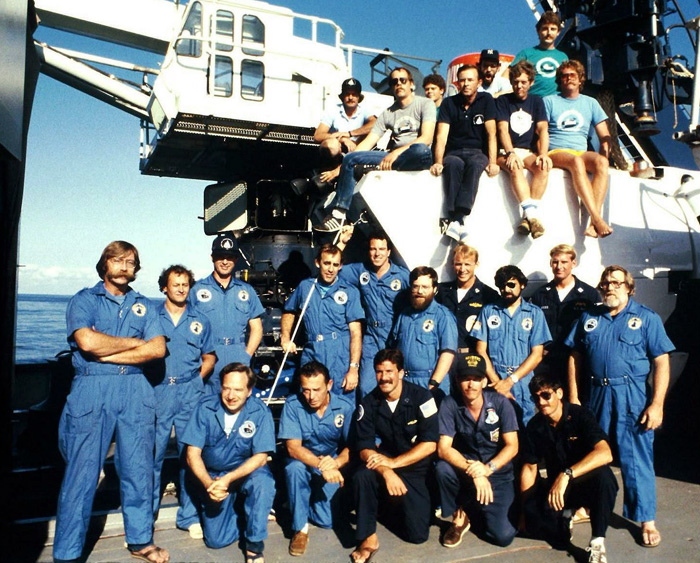
Bill Lange was aboard Knorr in 1985 when the Woods Hole Oceanographic Institution research vessel brought back the first grainy black-and-white images of Titanic resting on the seafloor.
Ever since, Lange has made it his quest to push the boundaries of imaging technology, engineering one-of-a-kind camera systems and operating them in the deepest and most extreme parts of the world’s oceans.
Lange, who directs the Advanced Imaging and Visualization Laboratory at WHOI, has returned to the Titanic site several times.
He played a major role in a 2010 expedition that yielded new, richly detailed views of the ship and wreck site that were published in 2012, the 100th anniversary of Titanic’s sinking.
The original Navy-funded expeditions in 1985 and 1986 used Titanic as a target to test pioneering deep-sea technology.Were camera systems on the list ?
Bob Ballard and a few of us had dreams of bringing color video back from the deep, but camera systems to do that didn’t exist at the time.
Designing a deep-sea camera system is a lot more than just taking a camera off the shelf and putting it in a pressure-resistant tube.
There’s a lot of engineering that goes into making these cameras work efficiently at depths of more than 13,000 feet, withstand pressures of 10,000 pounds per square inch and a range of temperatures from 100°F on deck to near freezing on the seafloor; operate on really low power; and produce high-optical-resolution images in very low light levels.
There really isn’t a big market for camera systems like that, so it’s not economical for a commercial vendor to build one.
As it turned out, Titanic has been a great driver for advancing our imaging, lighting, and other technologies in the deep sea. The constant desire of people to know more about Titanic has provided funding and resources to go back to Titanic over the years.
It helped drive our desire to keep bringing technology to the next level and improving the imaging capabilities for the scientists and the public.
What was the state-of-the-art technology in 1985 ?
The Argo towed camera sled system developed by Bob Ballard in 1985 was a paradigm shift.
In the past, scientists had towed underwater metal sleds with 35-millimeter cameras above the seafloor with no electrical connection to the surface.
You’d bring the camera back up to the surface, remove the film, and wonder what you had documented.
If you were fortunate enough, you had a way of developing the film out at sea and then knowing a day or so later what you had surveyed.
You didn’t see in real time what those cameras were seeing and thus loss valuable decision and ship time.