HOT NEWS !
Stay informed on the old and most recent significant or spectacular
nautical news and shipwreck discoveries

-
Odyssey Marine searches will be subject of TV specials
- On 05/05/2012
- In Treasure Hunting / Recoveries
By Ivan Penn - Tampa Bay Times
Although Odyssey Marine Exploration hasn't always been able to capitalize on treasures it pulled from the bottom of the sea, the Tampa outfit is hoping its adventures are more successful on air.
An Emmy Award-winning video production crew will travel aboard Odyssey's ships in June to film the company as it searches three shipwrecks for sunken treasure. The footage will air as three one-hour television shows.
Odyssey's adventures to date have proved good source material for a Hollywood drama: hundreds of millions in gold and silver pulled from the Atlantic Ocean; international political intrigue involving the Kingdom of Spain, the U.S. State Department and a multimillion-dollar painting stolen by the Nazis; and treasure troves with nicknames like "Black Swan."
The company announced the planned TV miniseries that it is filming with JWM Productions, which has produced shows for National Geographic and PBS, during its corporate earnings conference call Friday.
"After the recovery work … you'll have a front-row seat for all of the action, as camera crews are presently aboard and are filming for three one-hour television specials," said Mark Gordon, Odyssey's president and chief operating officer, during the conference call.
The company did not offer further details about the television program.
But Gordon said he expects this year to mark a substantial shift in the company's financial operations because of three salvage projects that will be the subject of the TV shows.
"One of Odyssey's goals is to share the excitement, stories and knowledge we gain from our shipwreck projects with the general public, and television programming is a great way to do that," said Liz Shows, an Odyssey spokeswoman.
-
Albert Falco, ship captain for Jacques Cousteau, dies at 84
- On 04/05/2012
- In People or Company of Interest

By Matt Schudel - The Washington PostAlbert Falco, who sailed alongside Jacques-Yves Cousteau for almost 40 years as the French underwater explorer’s principal diver and as captain of Cousteau’s ship, the Calypso, died April 21 at his home in Marseille, France. He was 84.
An entry on Mr. Falco’s French-language Facebook page said he had “a long illness” but did not specify the cause of death.
Mr. Falco, who learned to swim almost as soon as he could walk, was known as a master diver, mariner and ecologist long before he teamed with Cousteau in 1952. They joined forces that year when Cousteau was leading an underwater excavation of two ancient shipwrecks near Mr. Falco’s native Marseille.
“Cousteau needed me for my natural instinct,” Mr. Falco later said, according to London’s Telegraph newspaper. “There were things I knew about the sea that he did not.”
From then on, the two Frenchmen were constant companions on oceangoing voyages that took them around the world the equivalent of 12 times.
The angular, patrician-looking Cousteau became internationally celebrated as the public face of oceanography and marine conservation. But the stocky, unflappable Mr. Falco was the sunburned seafarer who efficiently kept Cousteau’s mission afloat.
“In many ways, he was an equal to Cousteau,” Paul Watson, founder and president of the Sea Shepherd Conservation Society, said Saturday in an interview.
“He was Cousteau’s chief diver and captain of the Calypso. He was really the cornerstone of the whole Cousteau enterprise.”
-
Exploring the Helen B
- On 03/05/2012
- In Wreck Diving

By Elizabeth Bush - Daniel Island News
You can only see it at low tide. And even then, the 200 year-old timbers poke ever so slightly above the pluff mud, a nurturing, oxygen-free blanket that protects in near perfect preservation what’s left of the vessel below the surface.
"You have to use a little imagination,” said certified sport diver Douglas Boehme, a Summerville resident who discovered the site some 15 years ago.
The football-shaped impression, a little more than 60 feet long, sits just off the Daniel Island shoreline north of I-526 near Governor’s Park, and has been the subject of much curiosity among those who have spotted it.Is this mysterious structure, which consists only of the lower third of a boat, the shipwreck of a Jeffersonian-era gunboat ?
That is one possibility, according to Boehme, who named the site “The Helen B” after his daughter. Boehme discussed the wreck while serving as guest speaker at the March meeting of the Daniel Island Historical Society.
When coming over I-526 at a time when you know it’s going to be a really low tide, if it’s visible it should be readily apparent,” he said, while showing his audience photos he and his diving partner, George Pledger, took of the site.You’ll see that football shape. It’s hard to miss. It’s a really cool wreck.
The day after discovering the site, Boehme notified the South Carolina Institute of Archaeology and Anthropology (SCIAA) to officially register his find. Working with the SCIAA and another archaeologist, Boehme and Pledger would later begin their own volunteer investigative project to help uncover more information about the vessel.A small dredging effort conducted at the site revealed pieces of ceramics, “200 year-old corncobs,” broken glassware, and evidence the heavy-timbered boat may have been burned, said Boehme.
Whether it was a vessel that burned, or whether it was a vessel that was abandoned and they burned it to clear for navigation, we don’t know, and probably will never know,” he added.
The best guess Boehme has at this point as to the origin of the boat is that it may have been built at the former Fairbanks Plantation on Daniel Island.The 18th century plantation was owned by Paul Pritchard, an acclaimed boat builder who is credited with crafting Jeffersonian Gunboat No. 9 on Daniel Island in 1805. He also operated a larger shipyard on nearby Hobcaw Creek, where he constructed other vessels for the U.S. Navy.
-
Shipwreck explorers funded for excavations of historic ships
- On 02/05/2012
- In Treasure Hunting / Recoveries
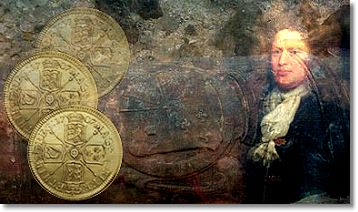
From Marine LinkOdyssey Marine Exploration soon to begin three high-value marine recovery projects, receives US$ 8 million investment.
Odyssey Marine Exploration, Inc. deep-ocean shipwreck explorers, announce it has delivered an additional closing notice for the Second Tranche of the financing that was previously announced in November 2011.
The Company and the investor have agreed to a Second Tranche amount of $8 million.
Odyssey is planning to conduct the archaeological excavation of HMS Victory (1744) under contract with the Maritime Heritage Foundation and cargo recovery operations on SS Gairsoppa and SS Mantola under contract with the UK Department for Transport in 2012.
The Company has several other projects and government agreements in various stages of development throughout the world.
Under the terms of the agreement, the indebtedness under the note for the Second Tranche is not convertible into equity for six months, during which time the Company has the right to redeem the note for 110% of the amount outstanding at the time of redemption.
The note will bear interest at the rate of 9% per year.
-
Heinkel HE-219 found in Denmark
- On 01/05/2012
- In Airplane Stories

Photo Danmarks Flyvehistoriske Selskab
From PolitikenDanish divers and the Aviation History Society (DFS) of Denmark have recovered a rare World War II German night-fighter off the northern Jutland peninsula and are to restore the aircraft.
The only known other full example of the aircraft is said to be in the United States, where it was taken following the war after it and two other of the aircraft were confiscated by US Army Intelligence Service from the Grove Air Force Base in Jutland, Denmark.
One of the more advanced aircraft to be built during WWII, it was the first military aircraft in the world to be equipped with ejection seats and was equipped with an effective VHF intercept radar designed to seek out and attack allied bombers.
It is also said to be one of the first operational aircraft with cockpit pressurisation.
Found in the Tannis Bay between Hirtshals and Skagen in Denmark, the plane’s tricycle landing gear gave it away.
“Landing gear is just like a fingerprint on humans, but I found it difficult to believe that we had such a rare aircraft in Denmark,” says DFS Chairman and aircraft archaeologist Ib Lødsen adding the recovery was like waiting for a Christmas present.
“It was so exciting. You never know whether you’re going to get what you want. I was a little disappointed,” he adds, saying that wires to the aircraft’s instruments had been cut, suggesting that someone had tampered with the aircraft previously.
The only parts of the aircraft that remain to be found are one of its two engines and part of the tail, which probably included the aircraft number, which in turn would help determine why the aircraft ended up in Tannis Bay.
The aircraft is now to be transported to the Garrison Museum in Aalborg where it is to be restored and exhibited.
-
Cerberus protection group gets sinking feeling
- On 30/04/2012
- In Parks & Protected Sites

Photo John Woudstra
By Kylie Northover - The AgeHopes of raising the wreck of colonial naval ship HMVS Cerberus have been scuttled with the government deeming a plan to build a stabilising platform too dangerous.
The historic wreck, once Australia's most powerful ship, was sunk as a breakwater at Half Moon Bay off Black Rock in 1926.
Protected under the Victorian Heritage Act, the Cerberus has been sinking since its hull collapsed in 1993.
In 2008, then heritage minister Peter Garrett pledged $500,000 to the National Trust to advance a project to stabilise the wreck.
Friends of the Cerberus, a volunteer group working to preserve the wreck, had then tried to raise $6.5 million, but were unsuccessful.
Instead, plans were made to spend the $500,000 on bracing the ship's gun turrets, which, says group president John Rogers, are in imminent danger of collapsing.
''The plan was to raise it up and put it on a platform before it collapses,'' Mr Rogers said. Failing to stabilise it, he said, would be ''destruction by neglect''.
Engineering company BMT Design and Technology had designed a bracing system and was ready to begin the work.
But last week the Victorian branch of the National Trust received a letter from the Department of Sustainability and Environment, advising that the department had changed its mind on spending the money on structural support work, saying ''the proposals would be excessively invasive in terms of heritage values … and potentially dangerous for the people''.
The department proposes using the funds to ''continue and enhance the existing corrosion management processes and to establish a high-quality interpretative device on the shore … adjacent to the vessel''.
The interpretation could include mounting guns which were removed in 2005, (at present on the sea bed), in nearby parkland.
-
Firing cannons at model shipwrecks — for science !
- On 30/04/2012
- In Underwater Archeology

Why fire a cannon at a model of an Israeli shipwreck ? For science, naturally !
The vessel in question was found in the walled port city of Akko — known in English as Acre the historically strategic coastal link to the Levant.
The shipwreck apparently dates to the 1840 campaign the British, Austrians and Ottomans waged against the Egyptians who held Akko at the time.
A direct hit by a shell on the main powder magazine in November of that year caused a giant explosion, and Akko was taken the following day.
The wreck was discovered in Akko harbor at a depth of about 12 feet and its roughly 75-foot-long hull was excavated over a span from 2006 to 2008.
Researchers think it was a small armed Egyptian vessel with 16 guns in total — 11 cannonballs, several lead bullets, and six muskets were found inside, among other finds.
The sides of the ship were made of solid oak about 6.7 inches thick, raising the question of what protection they offered against cannon fire.
To find out, researchers created a scale model to shoot at, assuming that a roughly 12-pound cannonball found in the shipwreck site was a typical projectile.
They found that a 12-pounder cannonball would have easily penetrated the side of the original ship, causing much internal damage.
Their experiments also showed in gunners truly wanted to be nasty, they made sure cannonballs traveled slower — that increased the number and size of splinters generated, potentially inflicting more casualties.
-
Heroes sunk and unsung
- On 30/04/2012
- In World War Wrecks
By Robert Kennard - Northern District TimesDr Michael Bendon is trying to identify two sunken British naval vessels used to evacuate 30,000 Commonwealth troops - mostly Australian and New Zealanders - from Greece in World War II.
Known only as the A6 and A20 landing craft tanks (LCT), the vessels used pioneering technology of the time, enabling 900 men to be taken off the beach and on to a vessel without the need for smaller ferries.
They began evacuating soldiers on April 24, 1941: Anzac eve.
“The connection of these vessels to Anzac history is astounding,” Dr Bendon said. “Thousands of Australian and New Zealand lives were saved because of the sheer load of men these vessels could carry.”
Twenty LCTs were commissioned by British prime minister Winston Churchill in 1940, and were hastily delivered to the North African and Mediterranean theatres of war in 1941.
Witnesses reported the vessels identified by Dr Bendon were dive-bombed by German aircraft at the end of May 1941.
Although local villagers have always known the vessels were there, Dr Bendon said the British and the Australian War Memorial had yet to identify them.
“British reports still say the vessels were lost in action somewhere in the Middle East,” he said.
“It seems no one has bothered to investigate these shipwrecks until now.”
Dr Bendon hopes to secure funding to investigate other LCT wrecks in Tobruk and off the coast of mainland Greece.