HOT NEWS !
Stay informed on the old and most recent significant or spectacular
nautical news and shipwreck discoveries

-
Underwater archaeologists searching for lost village
- On 19/05/2012
- In Expeditions
By Lauren Amstutz - Up North LiveA group of underwater archaeologists are preparing for a project off the shores of Empire.
The goal is to discover clues about the village's booming history, a history that currently lies several feet below Lake Michigan.
The action will begin on June 8th, when a team of divers will employ the latest electronic and underwater sonar technology to find evidence of a once thriving lumber town.
More than 100 years ago, the small village of Empire boasted one of the largest hardwood millis in the state of Michigan.
Dave Taghon, with the Empire Museum built a scale model of the Empire Lumber Company. Dave Taghon says, "There were two 50 feet wide by 500 feet long docks used in shipping between 1887-1917."
It's those huge piers that has history buffs intrigued. While the lumber company burnt down in 1917, the piers are still out there and a group of underwater archeologists are setting out to rediscover them.
Troy Wilson, who is a part of Northwestern Michigan College's Nautical and Underwater Archaeology Department says, "Instead of taking hand measurements by tape, we will have lasers to do different spots.
They will do the math for us."
-
Costa Concordia salvage plan revealed
- On 19/05/2012
- In Maritime News
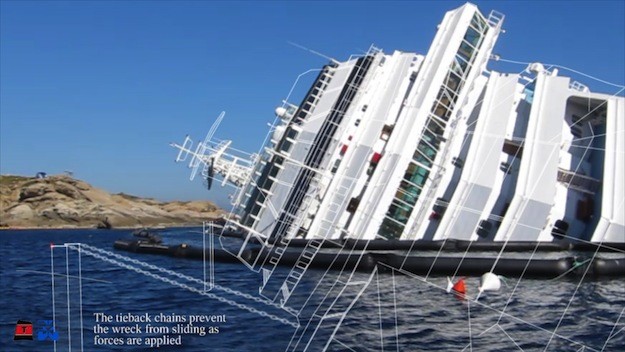
From gCaptain
Representatives from Costa Crociere and the Italo-American consortium Titan-Micoperi today presented the details of their much anticipated plan to remove the wreck of Costa Concordia from the Island of Giglio using cranes and caissons to float the vessel.
As we learned weeks ago, Titan Salvage and Micoperi were selected to remove the stricken Costa Concordia from Giglio Island after beating out several leading salvage companies vying for the historic contract.
Titan Salvage, part of the Crowley Group, is an American-owned specialist marine salvage and wreck removal company and is a world leader in its field. Micoperi is a wellknown Italian marine contractor with a long history as a specialist in underwater construction and engineering.
The requirements laid out for the job included refloating the hull in one piece while giving top priority to minimize the environmental impact, protecting Giglio’s economy and tourism industry, and maximizing safety.
To do this, Titan-Micoperi will set up shop on the mainland near Piombino, where equipment and materials will be stored and crews will be housed, therefor avoiding impact on the island’s port activities and as not to clogg up the island’s limited hotel accomodations.
The consortium says the work will begin in a few days and is expected to last about 12 months.
-
Bunbury wrecks remain buried in the sands
- On 18/05/2012
- In Parks & Protected Sites
By Sharon Kennedy - ABC
Why it's not feasible to raise Bunbury's whaling wrecks ?Digging up a wreck is the easy part, says Ross Anderson from the WA Museum. A marine archaeologist, Ross was part of the successful dig late last year which uncovered wrecks near Koombana Bay.
"It's the physical raising and the conservation of the material, for the long term, that's really difficult and expensive.
"We're still learning lessons here with the Batavia."
The archaeologists work closely with department of materials at the Museum to conserve shipwreck artefacts, says Ross.
"There is a whole field of study called waterlogged organics. Skin and bone and wood survives well but as soon as you take it out of that environment, they dry out and they can disintegrate really quickly.
"So it's a specialised area. What has been done with the Batavia and the Mary Rose is that they are treated with polyethylene glycol, a water soluble wax. As the wood dries out and all of those cellular spaces in the wood dry, it's replaced.
"You can see it on your hair conditioner."
Treating a ship would need a few tonnes of PEG, says Ross and a specially constructed framework in which to immerse it. "It would take at least ten years...and then you'd have to dry it out under controlled conditions.
"The cost of something like that is estimated to be something like $5-6m. Then you've got the long term storage and curation of it."
-
Old shipwrecks reveal their chemical secrets
- On 17/05/2012
- In Conservation / Preservation

Photo Javier Kohen
From SCI News
A team of scientists from the University of Gothenburg and Stockholm University has found large quantities of sulphur and iron compounds in marine archaeological wood from shipwrecks both in the Baltic Sea area and off the west coast of Sweden.A few years ago scientists reported large quantities of sulphur and iron compounds in the salvaged 17th century warship Vasa, resulting in the development of sulphuric acid and acidic salt precipitates on the surface of the hull and loose wooden objects.
Similar sulphur compounds have now been discovered also in other shipwrecks both from the Baltic and off the west coast of Sweden, including fellow 17th century warships Kronan, Riksnyckeln and Stora Sofia, the 17th century merchant vessel in Gothenburg known as the Göta wreck, and the Viking ships excavated at Skuldelev in Denmark.
“This is a result of natural biological and chemical processes that occur in low-oxygen water and sediments,” said Dr. Yvonne Fors of the University of Gothenburg in Sweden, a co-author of the study published in the Journal of Archaeological Science.
Besides the Vasa, similar problems have previously been reported for Henry VIII’s flagship Mary Rose in the UK, which sank off Portsmouth in 1545, and the Dutch vessel Batavia in Australia, which was lost in 1629, the year after the Vasa.
-
Energy industry uncovers old shipwreck site in Gulf of Mexico
- On 17/05/2012
- In High Tech. Research/Salvage

By Richard Thompson - Nola
A team of scientists and technicians have uncovered the remnants of a shipwreck thought to be hundreds of years old about 200 miles off the coast of Louisiana, a scene complete with artifacts like navigational equipment, glass bottles, ceramic plates, and boxes of muskets.The discovery was made by researchers at the National Oceanic and Atmospheric Administration, acting at the request of the Interior Department's Bureau of Ocean Energy Management, which regulates offshore drilling. NOAA paid for the 56-day expedition, which wrapped up last month and was used to map and provide images of little-known features and habitats of the Gulf of Mexico.
Without knowing what it was, Shell Oil Company identified the wreckage -- more than 4,000 feet below sea level -- using sound waves during a routine oil and gas survey late last year, a process that is required by federal regulators as part of the process for issuing permits for deepwater drilling.
Officials were reluctant to give full details of the position of the wreckage, in part to avoid attracting too much attention to the area.
Using underwater robots equipped with lights and high-definition cameras, NOAA investigators were used to provide a glimpse at the ship's remnants. As a new twist, the agency, which focuses on the conditions of the oceans and the atmosphere, streamed the expedition live on the Internet.
More than 80,000 people tuned in, with some pointing out what they saw and lending advice to maritime archeologists, scientists and resource managers involved in the project, said Fred Gorell, public affairs officer for NOAA's Office of Ocean Exploration and Research.
Jack Irion, a maritime archeologist with BOEM, described the find as "pretty unusual, just on the fact that it's in pretty pristine condition."
-
Captain Paul Watson Arrested in Germany
- On 16/05/2012
- In Maritime News
By Mike Schuler - gCaptain
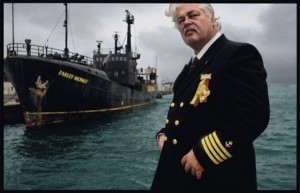
Notorious Sea Shepherd captain Paul Watson was arrested Saturday in Germany and is likely facing extradition to Costa Rica where he could be charged with attempted murder.
The charges, Sea Shepherd admits, stem from an alleged incident took place in Guatemalan waters in 2002 while filming Sharkwater, a documentary film meant to expose the shark-hunting industry and stars Watson as he confronts shark poachers in Guatemala and Costa Rica.
According to a release by the marine wildlife conservation society, Sea Shepherd encountered an illegal shark finning operation run by a Costa Rican ship called the Varadero and order them, under authorization by the “order of the Guatemalan authorities”, to cease activities and head back to port to be prosecuted.
While escorting the vessel back to port, the crew of the Varadero contacted the Guatemalan authorities and said that that the crew of Sea Shepherd actually tried to kill them.
Staying true to their roots, the Guatemalan authorities quickly switched sides and dispatched a gunboat to intercept the Sea Shepherd crew.
The Sea Shepherd retreated, fleeing into Costa Rican waters where they continued their assault on illegal shark finning groups.
But that’s not the end of the story.
-
Explorers lose fight for treasure
- On 15/05/2012
- In Illegal Recoveries
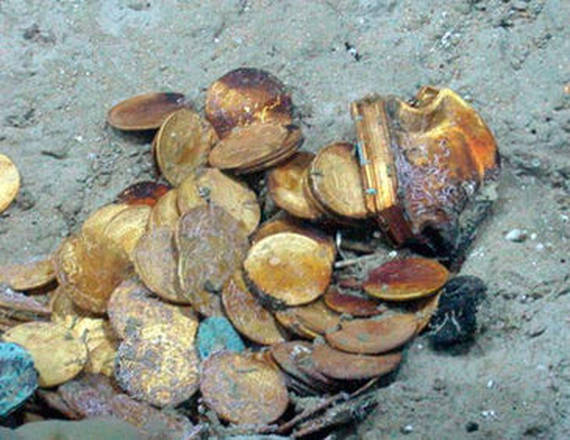
The US Supreme Court has again avoided an international dispute over the treasure salvaged from a 19th-century shipwreck.
The justices rejected appeals from deep-sea explorers, who found the wreck of a Spanish galleon, and Peru, both of which objected to rulings awarding the treasure to Spain.
In February, Spain took possession of 17 tons of silver coins and other artefacts worth around $500m.
Odyssey Marine Exploration has lost every round in federal court in its bid to keep the treasure it discovered after finding the wreck, believed to be the Nuestra Senora de las Mercedes, in the Atlantic off Portugal.
The ship sank in 1804.
-
Kenya: Chinese experts arrive for a ship excavation project
- On 15/05/2012
- In Underwater Archeology
By Maureen Mudi - All Africa
The second phase of the historical underwater ship excavation in a Sh300 million partnership project in the Coastal region is set to commence this November with the arrival of Chinese archeologists in the country.A 13-member delegation has been in the country since two weeks ago to conduct surveillance over the expected archeological sites in Mombasa and Malindi-Mambrui/Ngomeni area, according to the National Museums of Kenya assistant director, Coastal region, Athman Hussein.
The excavation will, however, this time be unique since for the first time in the history of African archeology, it will be beamed live all over the world, with a team of 25 archeologists in Mombasa and Mambrui, simultaneously conducting the exercise.
"A team of 80 Chinese experts including those from CCTV will be around to ensure the historical event is filmed and transmitted to the whole world as a way to help market Kenya as an underwater cultural heritage hub," Athman said.
The Mambrui wreck, according to Athman, is a local ship believed to be between 150-200 years old, while the Mombasa channel has two wreckages, both assumed to have been ships from the Portuguese which sunk in the 17th century and are near Fort Jesus.
"The ship had begun being excavated in the 1980s but due to shortage of funds, the process was stopped, but now its back, with the assistance of the Chinese," Athman said.