HOT NEWS !
Stay informed on the old and most recent significant or spectacular
nautical news and shipwreck discoveries

-
Merchant and pirate ships provide modern day fairy tales
- On 26/05/2012
- In Underwater Archeology
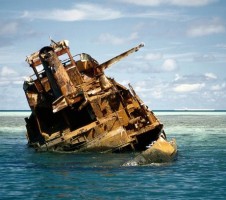
By Bev Lawhead Shafer - Costa Rica StarMarine archeology is quickly emerging as the next, big investment opportunity.
With professional exploration companies developing more sensitive and detailed underwater search equipment, the odds are increasing of a huge payday for some and reclamation of precious artifacts for many countries and their museums.
Sonar detectors and sophisticated radar have replaced the swashbuckling eye patches and bottles of rum from days gone by. But the adventurers on the high seas today are after much larger conquests.
The largest shipwreck salvage companies are now using the same type of tools used by big oil firms to locate deep sea drilling potential. The most expensive projects, usually in very deep waters, can cost upwards of $30 million dollars to complete.
“There are multi-hundreds of billions of dollars of potential in this industry,” says Sean Tucker, founder and managing member of Galleon Ventures, a U.S. shipwreck and salvage exploration company. “
Treasure bearing ships that have historical artifacts, coins, and emeralds dating back hundreds of years, lying at the bottom of the sea just waiting to be brought to the surface“, he adds.
UNESCO estimates there to be as many as three million shipwrecks scattered across the bottom of the world’s oceans. Although Tucker points out that only 3,000 of these are likely to bear treasure of any value, recent discoveries such as the $3 billion of platinum located on a World War II merchant vessel by Sub Sea Research, confirm the industry’s potential.
Dr. Lucy Blue from the Centre for Maritime Archaeology at the UK’s University of Southampton, voices concern about the methods of some smaller operators in the industry.
She says that some companies plunder sunken wrecks without concern for their archaeological and academic value, leading to the destruction of important sites.
-
The Curious case of Lloyd’s Register, The Times, and the Titanic
- On 26/05/2012
- In Famous Wrecks
By Christopher Browne - Lloyd’s Register
The message was brief and cryptic: “Struck an iceberg and sank in latitude 41.16 N, longitude 50.14 W”.
It might have been just another daily entry in Lloyd’s Register’s Casualty Returns. But it hid perhaps the most infamous event in shipping history – the sinking of the Titanic.
That was 100 years ago – on 14 April 1912 to be precise.
Since then a flurry of historians, scientists, investigators, conspiracy theorists and media pundits have pondered and puzzled over just why this great and ‘unsinkable’ vessel should founder on a lone iceberg.
A spectacular array of events are being held this year in the seven European and North American cities involved in the mighty ship’s last voyage.
However behind the ritual and razzamatazz are some curious post-disaster stories including one about the role of Lloyd’s Register.
A few days after the incident, the national press wrote a series of reports suggesting the Titanic had been built ‘considerably in excess of the requirements’ of Lloyd’s Register.
Although we had not classed the vessel, and the information was patently wrong, you could argue it was a form of faint praise by association.
Although our Secretary at the time, Sir Andrew Scott, didn’t quite see it like that. “I am directed to say that these statements are inaccurate.
On the contrary, in important parts of her structure the vessel as built did not come up to the requirements of Lloyd’s Register for a vessel of her dimensions,” he wrote in a letter to The Times of London.
“I do not for a moment suggest that this circumstance had any bearing whatever upon the loss of the vessel and therefore, for obvious reasons, this letter has been delayed until after the close of the Inquiry (the Mersey Committee set up in the UK to investigate the loss).
-
Senate poised to give UN control of everything re the oceans by ratifying LOST
- On 25/05/2012
- In Maritime News
By Larry Greenley - JBSThe United Nations Convention on the Law of the Sea ... is perhaps one of the most significant but less recognized 20th century accomplishments in the arena of international law....
Its scope is vast: it covers all ocean space, with all its uses, including navigation and overflight; all uses of all its resources, living and non-living, on the high seas, on the ocean floor and beneath, on the continental shelf and in the territorial seas; the protection of the marine environment; and basic law and order....
The Convention is widely recognised by the international community as the legal framework within which all activities in the oceans and the seas must be carried out.
("25th Anniversary of the United Nations Convention on the Law of the Sea," Oct. 17, 2007; emphasis added.)
If you wonder why some of us have been so vigorously opposing ratification of the Law of the Sea Treaty (LOST) since it was negotiated at a series of UN conferences between 1973 and 1982, read the above quote very slowly and with comprehension.
This statement from the 25th anniversary celebration of the completion of the United Nations Convention on the Law of the Sea (UNCLOS), also known more simply as the Law of the Sea Treaty (LOST), says LOST's "scope is vast: it covers all ocean space, with all its uses, including navigation and overflight; all uses of its resources, living and non-living, on the high seas, on the ocean floor and beneath, on the continental shelf and in the territorial seas....
The Convention is widely recognized by the international community as the legal framework within which all activities in the oceans and the seas must be carried out."
If you read the quote carefully, you'll see that the UN Division for Ocean Affairs and the Law of the Sea which administers LOST would have authority over everything, everything, over, on, and under the oceans and seas of the world. Ratification of LOST would be a very large step toward world government.
And, remember under the UN division that administers LOST, our nation wouldn't have veto power like we do in the UN Security Council. We'd have just one vote among 150 or more votes. Just as the League of Nations ultimately fell apart without the United States, let's stay out of the UN's LOST regime, thus denying its legitimacy...
If you're still not convinced that the implementation and administration of the LOST Convention is part of the United Nations, consider this statement from the Sixty-second United Nations General Assembly Plenary meeting, December 21, 2007:
The Assembly had before it a 22-part resolution on oceans and the Convention on the Law of the Sea ... by which it would call on States to harmonize, as a matter of priority, national legislation with the provisions of the Convention and, where applicable, relevant agreements and provisions....
The Assembly then adopted the resolution by a recorded vote of 146 in favour to 2 against....
-
Explorers find a wreck and a lot of life in deep seas
- On 25/05/2012
- In High Tech. Research/Salvage
By William E. Gibson - Sun Sentinel
While scientists watched intently on computer screens in Florida and across the world, the crew of a federal exploratory ship cruising in the Gulf of Mexico last month grew increasingly excited as they maneuvered a robotic undersea vessel toward a major find nestled on the seafloor 4,000 feet below.
First an anchor appeared. Then a hull, remarkably intact, revealing the remains of a wooden ship from the early 1800s.
As the robotic vessel's high-definition cameras swept across the wreck, the crew on the surface and those watching on shore could see a stunning array of artifacts: ceramic plates, bottles, cannon and a box that appeared to contain muskets.
"There was a burst of pride from the whole crew," recalled Mashkoor Malik, expedition coordinator for the National Oceanic and Atmospheric Administration.
The shipwreck was just one of several remarkable discoveries during the latest voyage of the Okeanos Explorer. Perhaps most important were many unexpected signs of marine life, notably forests of deep-sea coral in the Gulf and off the shores of northeast Florida.
The ship keeps exploring wherever it goes. So after completing a 56-day expedition across the central Gulf — from the Texas coast to near the site of the Deepwater Horizon oil spill south of Louisiana — the crew sailed through the Florida Straits and up the state's east coast, stopping near Jacksonville to map the sea floor, confirm the presence of deep-sea corals and briefly escape a storm at sea.
After leaving Florida waters this week on their way back to home port in Rhode Island, the crew talked with the Sun Sentinel via NOAA's command center in Silver Spring, Md.
"We wanted to stay forever, because it was new and we were finding big concentrations of fish," said Elaine Stuart, a NOAA senior survey technician.
"I think even the scientists were surprised to see all the life down there because they weren't sure what those populations were.
When we actually went down with the ROV [remotely controlled vehicle] and saw all the clam beds and the mussel beds, it was a major find for them to know that these existed."
These signs were especially heartening after the massive Deepwater Horizon spill spewed millions of gallons of oil into the Gulf in 2010, fouling waters already burdened with stormwater runoff, fertilizers and many other sources of pollution.
-
The Egan Maritime Institute announces
- On 25/05/2012
- In Museum News
From Market Watch
The Egan Maritime Institute announces "Guiding Lights: Nantucket's Lighthouses, Keepers & their Families," an exhibition celebrating the island's historic monuments, at the Nantucket Shipwreck & Lifesaving Museum from May 24 - October 8, 2012.
This warming exhibit celebrates the beacons of light and the families that guided mariners through the treacherous shoals for centuries that surround Nantucket.
Before modern technology, captains and sailors could only rely on the light from the lighthouses to guide their vessels to safety.
And for centuries, the families that manned these lighthouses were just as important in guiding sailors to safety as were the lighthouses.
This year's exhibition celebrates not just the Island's historic monuments but also these early heroes.
The Nantucket Shipwreck & Lifesaving Museum is excited to honor and pay tribute to the men, women, and children by sharing their stories and photographs of their daily life as well as true tales of shipwreck sights and salvage at sea.
In addition, a small replica of Sankaty Light, for children to climb into, as well as other kid oriented activities will be included.
The Nantucket Shipwreck & Lifesaving Museum shares the fascinating stories of yesterday's maritime heroes through permanent and changing interpretive exhibits and special events.
-
Project to hunt for ancient shipwreck
- On 24/05/2012
- In Parks & Protected Sites
By Nicole Asher - Busselton Mail
A local archeological project is giving you a chance to become part of history.The project, called Search for the Deadwater Wreck is aiming to locate the remains of what could be a 17th century Dutch wreck.
The legend of the wreck dates back to the 19th century when credible sources, including the famous explorers Frank and Augustus Gregory and the receiver of wrecks Worsley Clifton noted the location of a wreck in the Deadwater, a section of the Vasse-Wonnerup estuaries.
Locals removed material from the wreck during the 1860s and in 1902 when salvage rights were granted.
The remains of the Deadwater wreck are estimated to be up to 30 metres long and are now likely to be buried in silt.
A public information session about the wreck and the upcoming archeological project which will try to detect the remains will be held at the St Mary’s Family Centre this Saturday from 7-9pm.
Search for the Deadwater Wreck project leader Rupert Gerritsen will be at the information night. “I strongly urge anyone interested in the wreck, with information to offer, with view on the wreck, to come to the public meeting.
“They may in fact make history,” he said.
-
Public comment on Lake Huron shipwreck sanctuary expansion ends Friday
- On 24/05/2012
- In Parks & Protected Sites

By Carolyn Sundquist - Great Lakes EchoThe only federally-protected underwater sanctuary on the Great Lakes could increase 10-fold to more than 4,000 square miles.
Thunder Bay National Marine Sanctuary in Lake Huron could expand from its current 448 square miles after an environmental study by the National Oceanic and Atmospheric Administration’s Office of National Marine Sanctuaries.
The expansion includes waters adjacent to Alcona and Presque Isle counties in the northeast of Michigan’s Lower Peninsula.
The sanctuary receives about 70,000 visitors a year. It was established in 2000 and is managed by federal and state officials.
In 2007, sanctuary advisers adopted a resolution supporting the expanded boundaries, but recent tries at getting Congressional approval came up short.
Now the 30-person council will decide, after public comment, if it will continue to recommend it.
“We can get this thing done our way and hopefully it can get through,” said Steve Kroll, a member of the advisory board and an Alpena dive shop owner.
The sanctuary preserves nationally significant shipwrecks and other maritime heritage resources through protection, education and research. It is one of 14 U.S. marine sanctuaries that offer educational programs and scuba diving opportunities. Vessels can pass through it without restriction.
The proposed expansion includes an estimated 200 shipwrecks and would connect the underwater sanctuary from Michigan to the shores of Canada. No public funds are allotted as part of the approval.
-
Sea archaeologist critical of Odyssey project
- On 23/05/2012
- In Miscellaneous
Chairman of the UK’s Joint Nautical Archaeology Policy Committee, Robert Yorke has replied to an article in the Sunday Times, which the paper ran on May 17, called “Guns and Glory”.
He is critical of Odyssey Marine, the team that was forced away from a joint project with MoD to recover treasure from HMS Sussex off Gibraltar, because of Spanish pressure..
The article had stated that “Odyssey Marine scours the ocean more efficiently and stands to profit more handsomely”, by selling coins and artefacts from the wreck of HMS Victory which sank in 1744. It also posed the question, “Is that really so unfair?”
In his reply Mr Yorke said, “Of course it is unfair. It deprives ours and future generations from seeing the full grandeur of the ship’s 100 bronze cannons and its full collection of artefacts (including any coins that may be found) properly conserved and displayed in one place, such as the Mary Rose Museum.”
His letter explains that this is because the collection will be spread all around the world as Odyssey Marine sells off artefacts to reimburse its costs.He then questions the fact that that sort of practice is not allowed on land excavations so why should it be allowed underwater ?
He wrote, “Long-term visitor income from a future Victory museum should not be sacrificed for short-term greed and one-off financial gain.”
He also writes that in his opinion, “Just as importantly, the Maritime Heritage Foundation, to which the Ministry of Defence has given the wreck and to which Odyssey Marine is a sub-contractor, is under a duty to work in accordance with the rules of the Annex of the Unesco Convention on the Protection of the Underwater Cultural Heritage 2001.”
The Annex, which the UK Government has accepted as its policy for historic wrecks, states that wrecks should not be exploited for commercial gain and artefacts should not be sold off.
Concluding his letter, Mr Yorke wrote, “If the MoD were to allow the Maritime Heritage Foundation and Odyssey Marine to sell off Victory’s artefacts, not only would it be in breach of UK government policy, it would also set a precedent for treasure hunters worldwide to finance the excavation of historic wrecks by selling off their contents.And we do not want that.”